Page 236 of 375
Downloaded from www.Manualslib.com manuals search engine Before closing the hood, be sure all the filler caps are on
properly. Then lift the hood to relieve pressure on the
hood prop.
Remove the hood prop from the slot in the hood and
return the prop to its retainer.
Then pull the hood down firmly to close. It will latch
when dropped from
10 to 12 inches (25 to 30 cm)
without pressing on the hood.
Engine Oil
It’s a good idea to check your engine oil every time you
get fuel. In order
to get an accurate reading, the oil must
be warm and the vehicle must
be on level ground.
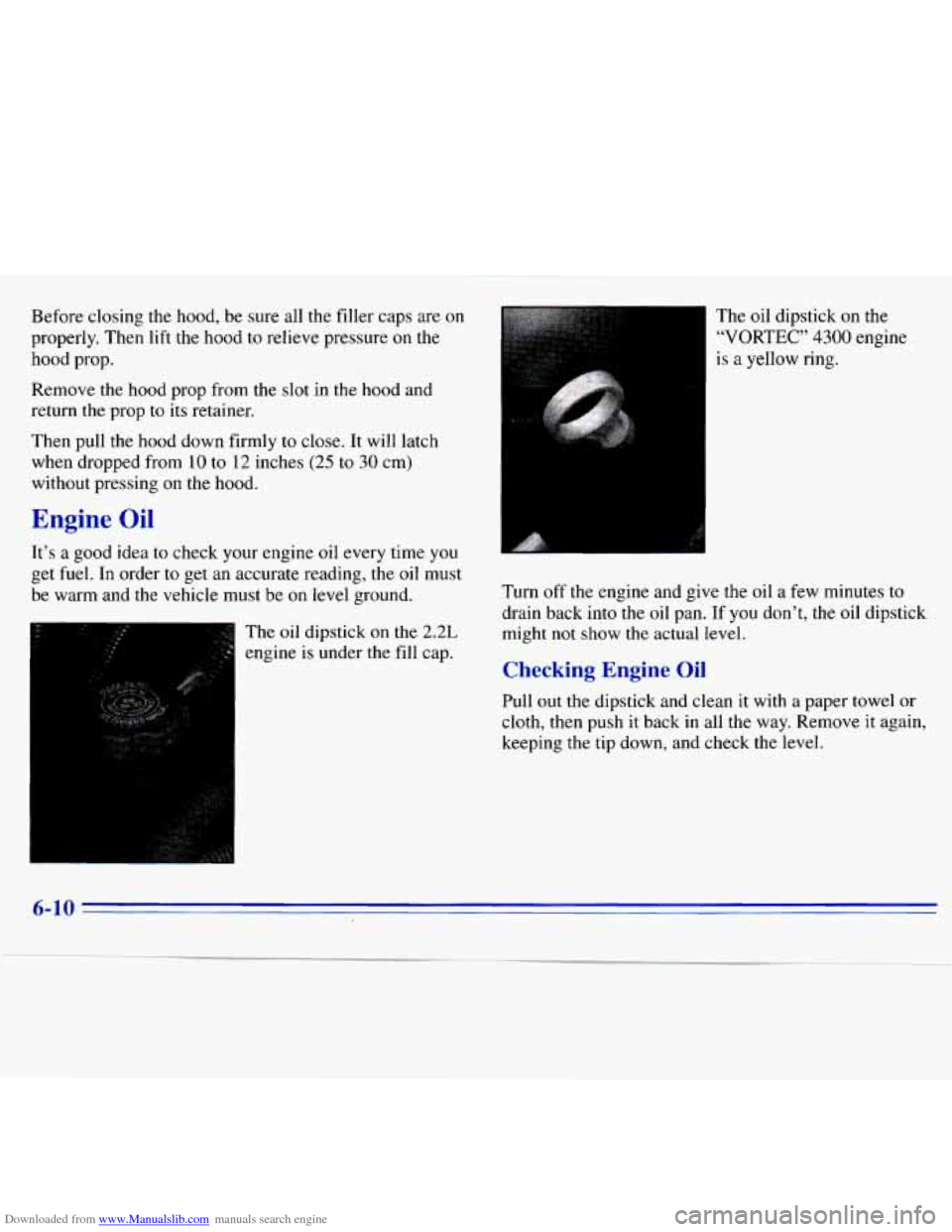
The oil dipstick on the 2.2L
engine is under the fill cap.
’* .d. L
The oil dipstick on the
“VORTEC” 4300 engine
is a yellow ring.
Turn
off the engine and give the oil a few minutes to
drain back into
the oil pan. If you don’t, the oil dipstick
might
not show the actual level.
Checking Engine Oil
Pull out the dipstick and clean it with a paper towel or
cloth,
then push it back in all the way. Remove it again,
keeping
the tip down, and check the level.
6-10
Page 242 of 375
Downloaded from www.Manualslib.com manuals search engine Automatic Transmission Fluid
When to Check and Change
A good time to check your automatic transmission fluid
level is
when the engine oil is changed.
Change both the fluid and filter every
50,000 miles
(83
000 km) if the vehicle is mainly driven under one or
more
of these conditions:
In heavy city traffic where the outside temperature
regularly reaches 90°F (32°C) or higher.
0 In hilly or mountainous terrain.
0 When doing frequent trailer towing.
0 Uses such as found in taxi, police or delivery service.
If you do not use your vehicle under any of these
conditions, the fluid and filter do not require changing.
See “Scheduled Maintenance Services” in the Index.
How to Check
Because this operation can be a little difficult, you may
choose to have this done at your
GM dealer’s Service
Department. If you do it yourself, be sure to follow all the instructions\
here, or
you could get a false reading on the dipstick.
NOTICE:
Too much or too little fluid can damage your
transmission.
Too much can mean that some of
the fluid could come out and fall on hot engine
parts or exhaust system parts, starting a fire. Be
sure to get an accurate reading if you check your
transmission fluid.
Wait at least 30 minutes before checking the
transmission fluid level if
you have been driving:
When outside temperatures are above 90°F (32°C).
0 At high speed for quite a while.
0 In heavy traffic -- especially in hot weather.
0 While pulling a trailer.
To get the right reading, the fluid should be at normal
operating temperature, which is 180°F to
200°F
(82°C to 93°C).
6-16
Page 245 of 375
Downloaded from www.Manualslib.com manuals search engine How to Add Fluid
Refer to the Maintenance Schedule to determine what
kind
of transmission fluid to use. See “Recommended
Fluids and Lubricants” in the Index.
Add fluid only after checking the transmission fluid
HOT. (A COLD check is used only as a reference.) If
the fluid level is low, add only enough of the proper
fluid to bring
the level up to the HOT area for a hot
check. It doesn’t take much fluid, generally less than a
pint.
Don’t over-ZZ. We recommend you use only fluid
labeled DEXRON@-111, because fluid with that label
is
made especially for your automatic transmission.
Damage caused by fluid other than DEXRON@-I11 is
not covered by your new vehicle warranty.
After adding fluid, recheck the fluid level as
described under “How to Check.”
When the correct fluid level is obtained, push the
dipstick back
in all the way; then flip the handle
down to
lock the dipstick in place.
Manual Transmission Fluid
When to Check
A good time to have it checked is when the engine oil is
changed. However, the fluid in your manual
transmission doesn’t require changing.
How to Check
Because this operation can be a little difficult, you
may choose to
have this done at your GM dealer’s
Service Department.
If you do it yourself, be sure to follow all the
instructions here, or you could get a false reading.
I NOTICE:
Too much or too little fluid can damage your
transmission.
Too much can mean that some of
the fluid could come out and fall on hot engine
parts or exhaust system parts, starting a fire. Be
sure to get an accurate reading if you check your
transmission fluid.
Page 302 of 375
Downloaded from www.Manualslib.com manuals search engine I Short Trip/City Maintenance Schedule I
The services shown in this schedule up to 100,000 miles
( 166 000 km) should be performed after 100,000 miles
(166
000 km) at the same intervals.
Footnotes
-f- The U.S. Environmental Protection Agency or the
California Air Resources Board has determined that the
failure to perform this maintenance item will not nullify
the emission warranty or limit recall liability prior
to the
completion
of the vehicle’s useful life. We, however,
urge that all recommended maintenance services be
performed at the indicated intervals and the maintenance
be recorded.
** Drive axle service:
0
0
0
Locking Differential -- Drain fluid and refill at first
engine
oil change. At subsequent oil changes, check
fluid level and add fluid as needed. If driving in
dusty areas or towing a trailer, drain fluid and refill
every 15,000 miles
(25 000 km).
Standard Differential
-- Check fluid level and add
fluid as needed at every oil change. If driving in
dusty areas or towing
a trailer, drain fluid and refill
every
15,000 miles (25 000 km).
More frequent lubrication may be required for
heavy-duty or off-road use.
Page 303 of 375
Downloaded from www.Manualslib.com manuals search engine I Short TripKity Maintenance Schedule I
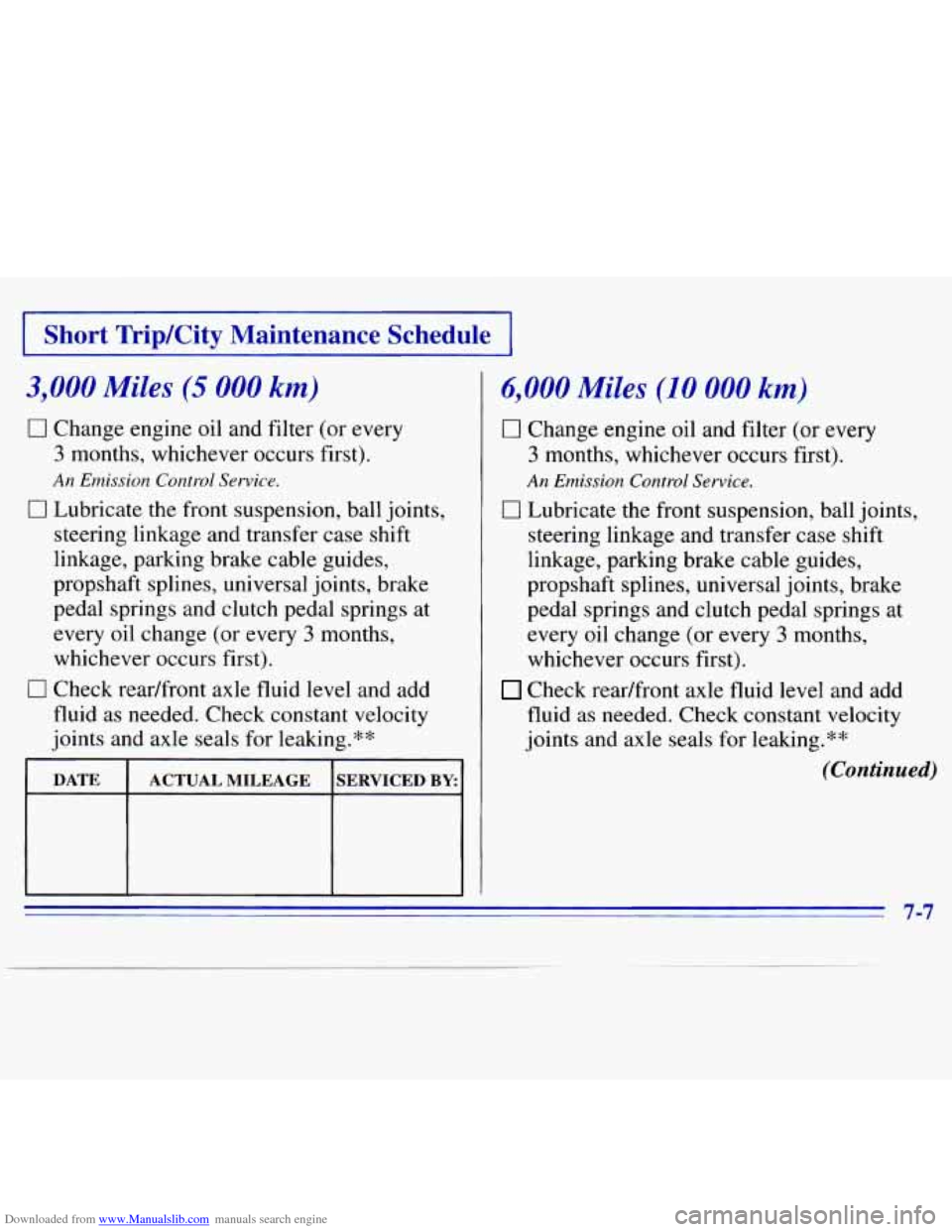
3,000 Miles (5 000 km)
0 Change engine oil and filter (or every
3 months, whichever occurs first).
An Emission Control Service.
0 Lubricate the front suspension, ball joints,
steering linkage and transfer case shift
linkage, parking brake cable guides,
propshaft splines, universal joints, brake
pedal springs and clutch pedal springs at
every oil change (or every
3 months,
whichever occurs first).
0 Check readfront axle fluid level and add
fluid as needed. Check constant velocity
joints and axle seals for leaking.**
6,000 Miles (10 000 km)
0 Change engine oil and filter (or every
3 months, whichever occurs first).
An Emission Control Service.
0 Lubricate the front suspension, ball joints,
steering linkage and transfer case shift
linkage, parking brake cable guides,
propshaft splines, universal joints, brake
pedal springs and clutch pedal springs at
every oil change (or every
3 months,
whichever occurs first).
Check readfront axle fluid level and add
fluid
as needed. Check constant velocity
joints and axle seals for lealung.
**
(Continued)
7-7
Page 304 of 375
Downloaded from www.Manualslib.com manuals search engine I Short TripKity Maintenance Schedule I
6,000 Miles (10 000 km) (Continued)
0 Rotate tires. See “Tire Inspection
and Rotation” in the Index for proper
rotation pattern and additional information.
During tire rotation, check brake calipers
for freedom of movement. Refer to the
appropriate
GM service manual for proper
caliper service procedures.
L
9,000 Miles (15 000 km)
0 Change engine oil and filter (or every
3 months, whichever occurs first).
An Emission Control Service.
Lubricate the front suspension, ball joints,
steering linkage and transfer case shift
linkage, parking brake cable guides,
propshaft splines, universal joints, brake
pedal springs and clutch pedal springs at
every
oil change (or every 3 months,
whichever occurs first).
0 Check readfront axle fluid level and add
fluid as needed. Check constant velocity
joints and axle seals for leaking.**
DATE
SERVICED BY: ACTUAL MILEAGE
7-8
Page 305 of 375
Downloaded from www.Manualslib.com manuals search engine I Short TripKity Maintenance Schedule I
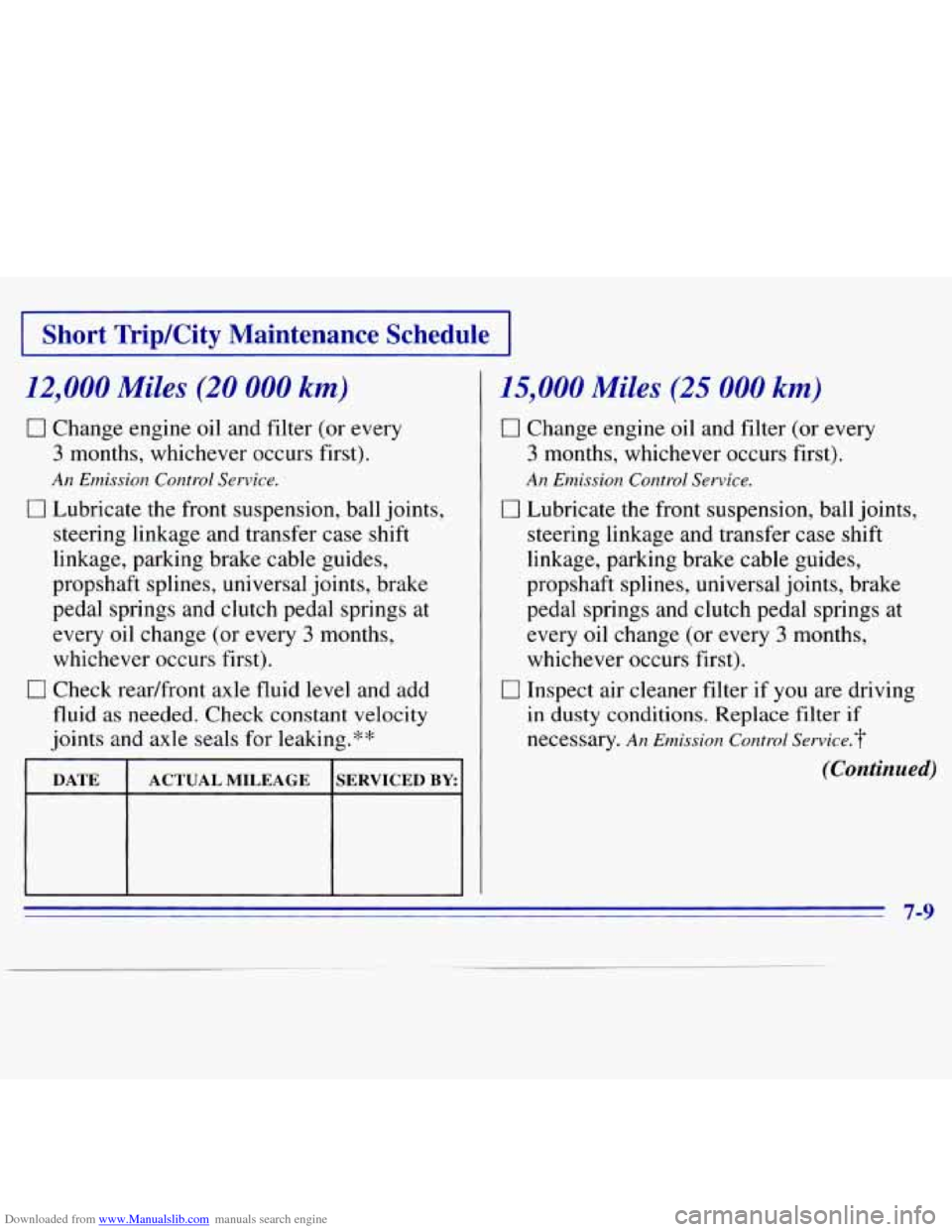
12,000 Miles (20 000 km)
0 Change engine oil and filter (or every
3 months, whichever occurs first).
An Emission Control Service.
0 Lubricate the front suspension, ball joints,
steering linkage and transfer case shift
linkage, parking brake cable guides,
propshaft splines, universal joints, brake
pedal springs and clutch pedal springs
at
every oil change (or every 3 months,
whichever occurs first).
0 Check readfront axle fluid level and add
fluid as needed. Check constant velocity
joints and axle seals for leaking?
15,000 Miles (25 000 km)
El Change engine oil and filter (or every
3 months, whichever occurs first).
An Emission Control Service.
0 Lubricate the front suspension, ball joints,
steering linkage and transfer case shift
linkage, parking brake cable guides,
propshaft splines, universal joints, brake
pedal springs and clutch pedal springs
at
every oil change (or every 3 months,
whichever occurs first).
in dusty conditions. Replace filter
if
necessary. An Emission Control Service.?
CI Inspect air cleaner filter if you are driving
(Continued)
7-9
Page 306 of 375
Downloaded from www.Manualslib.com manuals search engine I Short Trip/City Maintenance Schedule I
15,000 Miles (25 000 km) (Continued) 18,000 Miles (30 000 km)
0 Check rear/rronr: axle fluid level and add
fluid as needed. Check constant velocity
joints and axle seals for leaking.**
I
0 For Two-Wheel-Drive vehicles only: Clean
and repack the front wheel bearings (or at
each brake relining, whichever occurs first).
DATE ACTUAL MILEAGE SERVICED BY:
L J
0 Change engine 011 and filter (or every
3 months, whichever occurs first).
An Emission Control Service.
0 Lubricate the front suspension, ball joints,
steering linkage and transfer case shift
linkage, parking brake cable guides,
propshaft splines, universal joints, brake
pedal springs and clutch pedal springs at every oil change
(or every 3 months,
whichever occurs first).
0 Check readfront axle fluid level and add
fluid as needed. Check constant velocity
joints and axle seals
for leaking.**