1996 CHEVROLET MONTE CARLO key
[x] Cancel search: keyPage 110 of 340
Downloaded from www.Manualslib.com manuals search engine Security Light
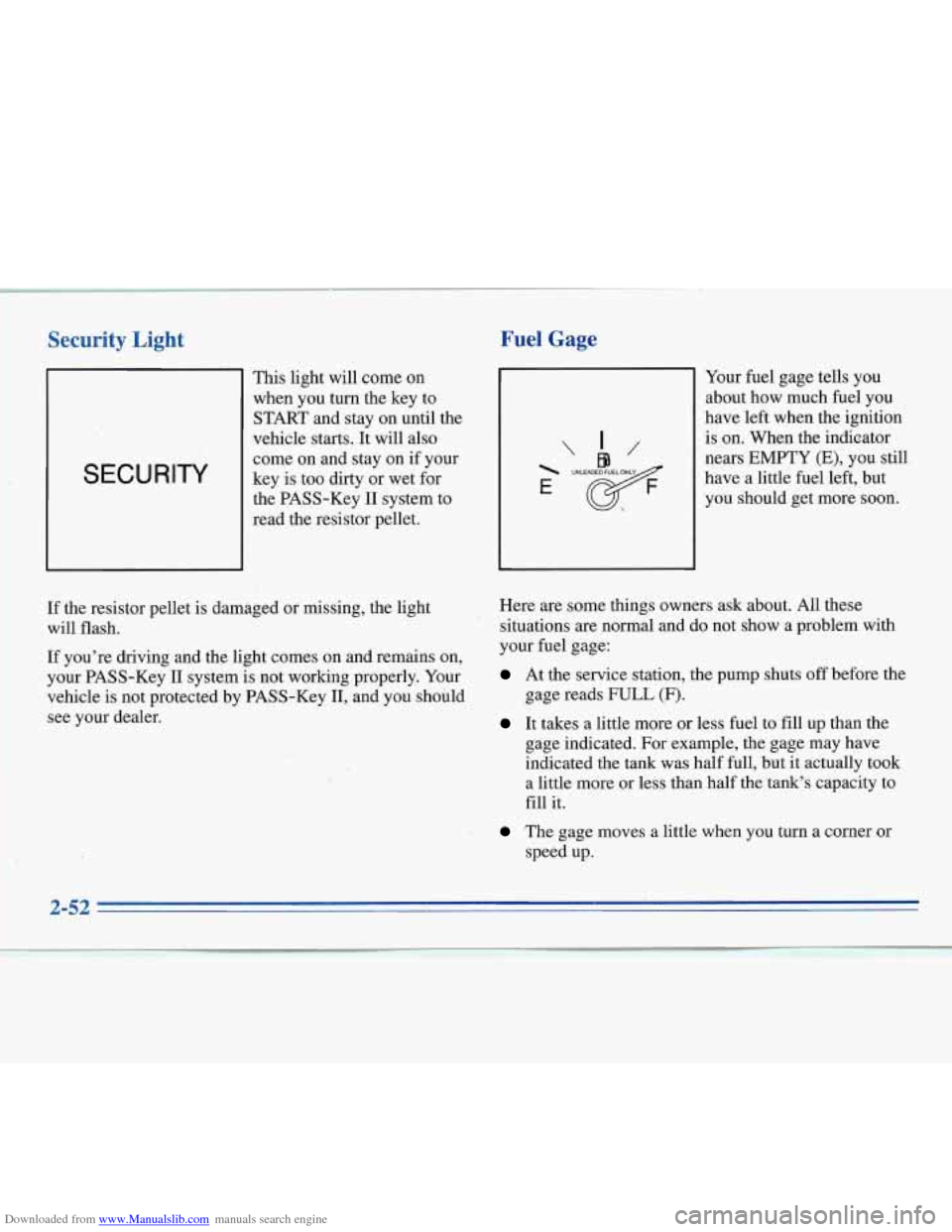
SECURITY
This light will come on
when you turn the key to
START and stay on until the
vehicle starts. It will also
come on and stay on if your
key is too dirty or wet for
the PASS-Key
I1 system to
read the resistor pellet.
Fuel Gage
"/@9 I/
E
If the resistor pellet is damaged or missing, the light
will flash.
If you're driving and the light comes on and remains on,
your PASS-Key
I1 system is not working properly. Your
vehicle is not protected by PASS-Key
11, and you should
see your dealer. Here are some
things owners ask about. All these
situations are normal and do not show a problem with
your fuel gage:
At the service station, the pump shuts off before the
gage reads
FULL (F).
It takes a little more or less fuel to fill up than the
gage indicated. For example, the gage may have
indicated the tank was half full, but it actually took
a little more or less than half the tank's capacity to
fill it.
The gage moves a little when you turn a corner or
speed up. Your
fuel gage tells you
about how much fuel you
have left when the ignition
is on. When the indicator
nears EMPTY (E), you still
have a little fuel left, but
you should get more soon.
2-52 7. I
....
Page 138 of 340

Downloaded from www.Manualslib.com manuals search engine Drunken Drivi Y
Death and injury associated with drinking and driving is
a national tragedy. It’s the number one contributor to
the highway death toll, claiming thousands of victims
every year.
Alcohol affects four things that anyone needs to drive
a vehicle:
Judgment
0 Muscular Coordination
Vision
Attentiveness.
Police records show that almost half of all motor
vehicle-related deaths involve alcohol.
In most cases,
these deaths are the result of someone who was drinking
and driving. In recent years, some 18,000 annual motor
vehicle-related deaths have been associated with the use
of alcohol, with more than
300,000 people injured.
lvlany adults
-- by some estimates, nearly half the
adult population
-- choose never to drink alcohol, so
they never drive after drinking. For persons under 2 I,
it’s against the law in every U.S. state to drink alcohol.
There are good medical, psychological and
developmental reasons for these laws.
The obvious way to solve this highway safety problem
is for people never to drink alcohol and then drive. But
what if people do? How much
is “too much” if the
driver plans to drive?
It’s a lot less than many might
think. Although
it depends on each person and situation,
here is some general information on the problem.
The Blood Alcohol Concentration (BAC) of someone
who is drinking depends upon
four things:
0 The amount of alcohol consumed
0 The drinker’s body weight
0 The amount of food that is consumed before and
during drinking
consume the alcohol.
0 The length of time it has taken the drinker to
According to the American Medical Association,
a
180-lb. (82 kg) person who drinks three 12-ounce
(355 ml) bottles of beer in an hour will end up with a
BAC of about 0.06 percent. The person would reach the
same BAC by drinking three 4-ounce
(1 20 ml) glasses
of wine or three mixed drinks if each had 1
- 1/2 ounces
(45 ml) of
a liquor like whiskey, gin or vodka.
4-2 1
Page 173 of 340
Downloaded from www.Manualslib.com manuals search engine # Section 5 Problems on the Road
Here you’ll find what to do about some problems that
can occur on the road.
Hazard Warning Flashers
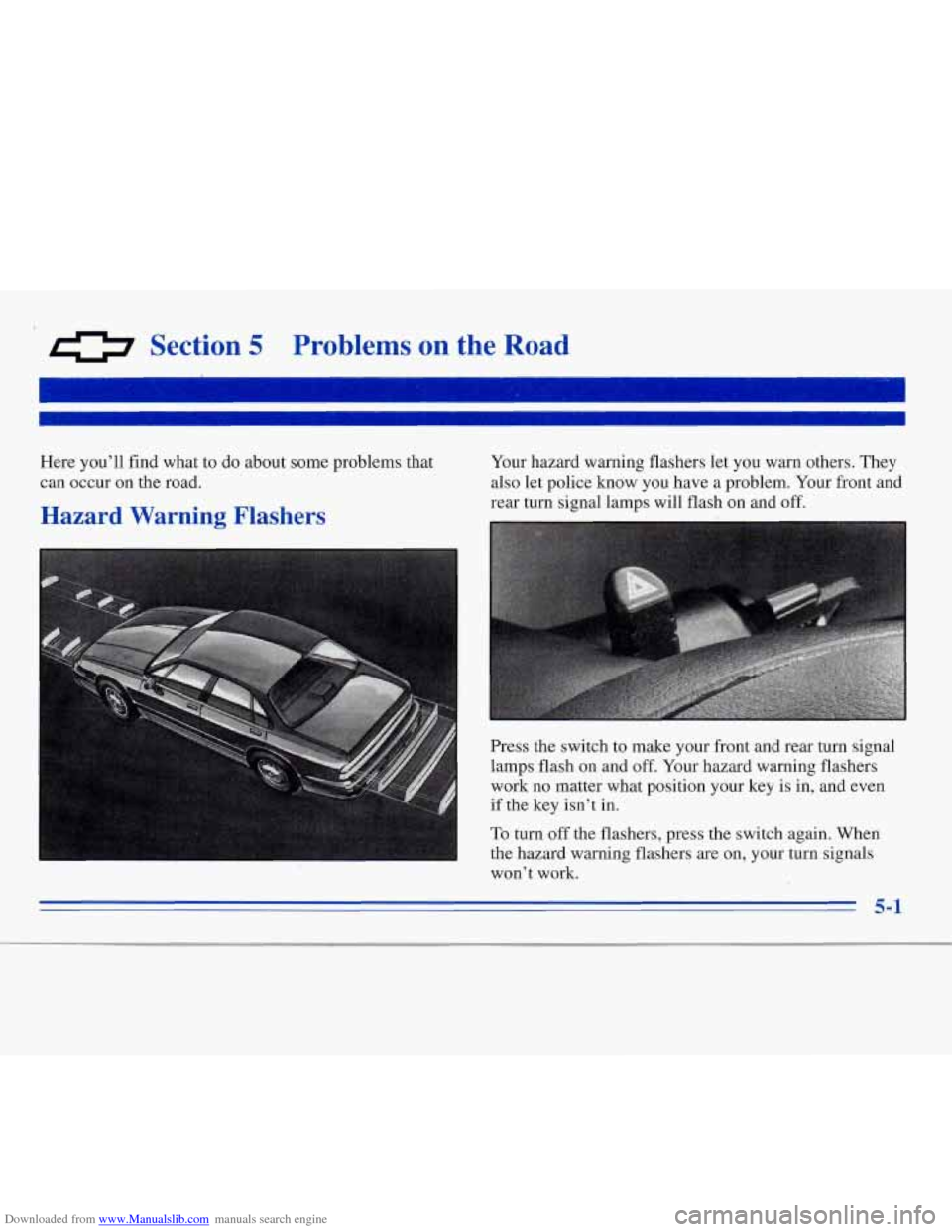
Your hazard warning flashers let you warn others. They
also let police know you have a problem. Your front and
rear turn signal lamps will flash on and
off.
Press the switch to make your front and rear turn signal
lamps flash on and
off. Your hazard warning flashers
work no matter what position your key is in, and even
if the key isn’t in.
To turn off the flashers, press the switch again. When
the hazard warning flashers are on, your turn signals
won’t work.
Page 263 of 340

Downloaded from www.Manualslib.com manuals search engine I
I'
Fuse
19
29
Rating Description
Trunk Courtesy Lamp, Door Lock Switches, Power Mirror S-witch
POWER ACCESSORY
#1--
21
AIR BAG -- Air Bag System
23 STOPLAMPS
-- TCCIBrake
24 CRUISE CONTROL Switch
28 CTSY LAMPS
-- Vanity Mirrors,
Defogger Relay,
I/P Compartment
Lamp, Header Courtesy and
Reading Lamp,
US Lighted
Rearview Mirror, Dome Lamp
WIPER
-- Wiper Switch
Fuse Rating Description
30 TURN SIGNAL -- Turn
Signal Flasher
32 POWER LOCKS
-- Door Lock
Relay, Keyless Entry Receiver
3-8 RADIO
-- Radio, Steering Wheel
Radio Switches
39
I/P ELECTRONICS IGNITION
FEED
-- Headlamp Switch,
Cruise Control Cut-Out Switch,
Air Bag System, TCClBrake
Switch, Instrument Cluster,
Chime Module, Keyless Entry
Receiver, Daytime Running
, Lamps Module (DRL)
6-55
Page 309 of 340

Downloaded from www.Manualslib.com manuals search engine Cassette Deck Service Automatic Transaxle Check
Clean cassette deck. Cleaning should
be done every
50 hours of tape play. See “Audio Systems” in the
Index for further details.
At Least Twice a Year
Restrain ystem Chc -1,
Make sure the sarety belt reminder light and all your
belts, buckles, latch plates, retractors and anchorages are
working properly. Look for any other loose
or damaged
safety belt system parts.
If you see anything that might
keep a safety belt system from doing its job, have
it
repaired. Have any torn or frayed safety belts replaced.
Also look for any opened
or broken air bag covers, and
have them repaired or replaced. (The air bag system
does not need regular maintenance.) Check the transaxle fluid level; add
if needed.
See
“Automatic Transaxle”
in the Index. A fluid loss may
indicate
a problem. Check the system and repair if needed.
At Least Once a Year
Key Lock Cylinders Service
Lubricate the key lock cylinders with the lubricant
specified in Part
D.
Body Lubrication Service
Lubricate all hinges and latches, including those for the
hood, rear compartment, glove box door, console door
and any folding seat hardware. Part
D tells you what to
use. More frequent lubrication may be required when
exposed to a corrosive environment.
Page 310 of 340

Downloaded from www.Manualslib.com manuals search engine Starter Switch Check Brake-Transaxle Shift Interlock (BTSI) Check
(Automatic Transaxle)
A CAUTION:
- ’ A CAUTION:
When you are doing this check, the vehicle could
move suddenly. If it does, you or others could be When you are doing this check, \
the vehicle could
injured. Follow the steps below. move suddenly. If it does, yo\
u or others could be --
: injured. Follow the steps below.
1.
2.
3.
Before you start, be sure you have enough room
around the vehicle.
Firmly apply both the parking brake (see “Parking
Brake” in
the Index if necessary) and the
regular brake.
NOTE: Do not use the accelerator pedal, and be
ready to turn off the engine immediately
if it starts.
Try to start the engine
in each gear. The starter
should work only in PARK
(P) or NEUTRAL (N). If
the starter works in any other position, your vehicle
needs service. 1.
Before you start, be sure
you have enough room
around the vehicle. It should be parked on
a
level surface.
2. Firmly apply the parking brake (see “Parking Brake”
in the Index if necessary).
NOTE: Be ready to apply the regular brake
immediately
if the vehicle begins to move.
3. With the eilgine off, turn the key to the RUN
position, but don’t start the engine. Without applying
the regular brake, try
to move the shift lever out
of PARK (P) with normal effort. If the shift lever
moves out
of PARK (P), your vehicle’s BTSI
needs service.
7-38
Page 311 of 340

Downloaded from www.Manualslib.com manuals search engine Steering Column Lock Check
While parked, and with the parking brake set, try
to turn
the key to
LOCK in each shift lever position.
The key should turn to LOCK only when the shift
lever is in PARK
(P).
The key should come out only in LOCK.
Parking Brake and Automatic Transaxle PARK (P)
Mechanism Check
CAUTION:
When you are doing this check, your vehicle
could begin to move. You
or others could be
injured and property could be damaged. Make
sure there is room in front of your vehicle in case
it begins to roll. Be ready to apply the regular
brake at once should the vehicle begin
to move. Park on
a fairly
steep hill, with the vehicle facing
downhill. Keeping your foot
on the regular brake, set the
parking brake.
To check the parking brake: With the engine running
and transaxle
in NEUTRAL (N), slowly remove foot
pressure from the regular brake pedal. Do this until
the vehicle is held by
the parking brake only.
To check the PARK (P) mechanism’s holding ability:
With the engine running, shift
to PARK (P). Then
release all brakes.
Underbody Flushing Service At least every spring, use plain water to flush any
corrosive materials from the underbody. Take care to
clean thoroughly any areas where mud and other debris
can collect.
Page 322 of 340
Downloaded from www.Manualslib.com manuals search engine Chevrolet Roadside Assistance Program
To enhance Chevrolet's strong commitment to customer
satisfaction, Chevrolet is excited to announce the
establishment
of the Chevrolet/Geo Roadside Assistance
Center.
As the owner of a 1996 Chevrolet/Geo,
membership in Roadside Assistance is free.
~~~ ~~ ~
~~ ~~
Roadside Assistance is available 24 hours a day,
365 days a year, by calling 1-800-CHEV-USA
(1-800-243-8872). This toll-free number will provide
you over-the-phone roadside assistance with minor
mechanical problems. If your problem cannot be
resolved over the phone, our advisors have access to a nationwide network of dealer recommended service
providers. Roadside memliership
is free, however some
services may incur costs.
Roadside offers two levels of service to the customer,
.
Basic Care and Courtesy" Care:
0 Toll-free number, 1 -800-CHEV-USA
0 Free towing for warranty repairs
0 Basic over-the-phone technical advice
0 Available dealer services at reasonable costs (ie.,
wrecker services, locksmith/key service, glass
repair, etc.)
ROADSIDE
Courtesy Care PROVIDES:
0 Roadside Basic Care services (as outlined above)
Plus:
0 FREE Non-Warranty Towing (to the closest dealer
from a legal roadway)
8-4 I
'