1996 CHEVROLET EXPRESS check engine
[x] Cancel search: check enginePage 77 of 376

Downloaded from www.Manualslib.com manuals search engine 1. Without pushing the accelerator pedal, turn your
ignition key to
START. When the engine starts, let
go of the key, The idle speed will go down as your
engine gets warm.
NOTICE:
Holding your key in START for longer than
15 seconds at a time will cause your battery to be
drained much sooner. And the excessive heat can
damage your starter motor.
2. If it doesn’t start right away, hold your key in
START. If it doesn’t start in 10 seconds, push the
accelerator pedal all the way down for five more
seconds,
or until it starts.
3. If your engine still won’t start (or starts but then
stops), wait
15 seconds and start over.
When the engine starts, let
go of the key and the
accelerator pedal.
NOTICE:
Your engine is designed to work with the
electronics in your vehicle. If you add electrical
parts or accessories, you could change the
way
the engine operates. Before adding electrical
equipment, check with your dealer.
If you don’t,
your engine might not perform properly.
If you ever have to have your vehicle towed, see
the part of this manual that tells how to do it
without damaging your vehicle. See “Towing
Your Vehicle” in the Index.
2-15
Page 83 of 376

Downloaded from www.Manualslib.com manuals search engine NOTICE:
Driving with the parking brake on can cause
your rear brakes to overheat. You may have to
replace them, and you could also damage other
parts of your vehicle. Always check to be sure
your parking brake is fully released before
you drive.
If you are towing a trailer and are parking on any hill,
see “Towing a Trailer” in the Index. That section shows
what to do first to keep the trailer from moving.
Shifting I: :o 11 C (P)
I A CAUTIJN:
I
It can be dangerous to get out of your vehicle if
the shift lever is not fully in
PARK (P) with the
parking brake firmly set. Your vehicle can roll.
If you have left the engine running, the vehicle
can move suddenly. You or others could be
injured. To be sure your vehicle won’t move,
even when you’re on fairly level ground, use the
steps that follow.
If you’re pulling a trailer, see
“Towing
a Trailer” in the Index.
1. Hold the brake pedal down with your right foot and
set the parking brake.
Page 92 of 376

Downloaded from www.Manualslib.com manuals search engine ’hrn Signal and Lane Change Signals
The turn signal has two upward (for right) and two
downward (for left) positions. These positions allow
you
to signal a turn or a lane change.
To signal
a turn, move the lever all the way up or down.
When the turn is finished, the lever will return
automatically.
An arrow on the instrument
panel will flash in the
direction of the turn or
lane change.
To signal a lane change, just raise or lower the lever
until
the arrow starts to flash. Hold it there until you
complete your lane change. The lever will return by
itself when
you release it. As
you signal
a turn or a lane change, if the arrows flash
at twice the normal rate, a signal bulb may be burned
out and other drivers may not see your turn signal.
If a bulb is burned out, replace it to help avoid an
accident. If.the arrows don’t go on at all when
you
signal a turn, check for burned-out bulbs and a blown
fuse (see “Fuses and Circuit Breakers” in the Index).
Headlamp High/Low Beam Changer
To change the headlamps from low beam to high or high
to low, pull the multifunction lever all the way toward
you. Then release it.
When the high beams are
on, this light on the
instrument panel also
will be on.
2-30
.-
Page 94 of 376

Downloaded from www.Manualslib.com manuals search engine Windshield Washer
At the top of the lever, there’s a paddle with the word
PUSH on it. To spray washer fluid on the windshield,
push the paddle.
Washer fluid will spray
as long as you push the paddle.
When
you let go of the paddle, the wipers will continue
to wipe for approximately two more wipe cycles and
then either stop or return to the preset speed.
Driving without washer fluid can be dangerous. A
bad mud splash can block your vision.
You could hit
another vehicle
or go off the road. Check your washer
fluid level often.
I A CAUTION:
I
Cruise Control (Option)
With cruise control, you can maintain a speed of about
25 mph (40 kmk) or more without keeping your foot
on
the accelerator. This can really help on long trips.
Cruise control does not work at speeds below about
25 mph (40 krnk).
When you apply your brakes, the cruise control
shuts off.
In freezing weather, don’t use your washer until
the windshield is warmed. Otherwise the washer
fluid can form ice on the windshield, blocking
your vision.
A CAUTION:
I
Cruise control can be dangerous where you
can’t drive safely at a steady speed. So,
don’t use your cruise control on winding
roads or in heavy traffic.
slippery roads. On such roads, fast changes
in tire traction can cause needless wheel
spinning, and you could lose control. Don’t
use cruise control on slippery roads.
Cruise control can be dangerous on
2-32
Page 98 of 376

Downloaded from www.Manualslib.com manuals search engine Rotate the switch knob clockwise again to the master
lighting symbol
to turn on all the lamps listed as well as
the headlamps.
Rotate the switch counterclockwise to
OFF to turn off
your lamps.
Rotate the thumb wheel next
to the switch knob up to
adjust instrument panel lights. Rotate the thumb wheel up
to the first notch to return the radio display and gearshift
indicator display
to full intensity when the headlamps or
parking lamps are
on.
Rotate the thumb wheel up to the second notch to
activate the interior dome lamps.
You can switch your headlamps from high to low beam
by pulling
on the turn signalhigh beam lever.
A circuit breaker protects your headlamps. If you have
an electrical overload, your headlamps will flicker on
and off. Have your headlamp wiring checked right away
if this happens.
Headlamps On Reminder
A buzzer will sound when your headlamps are turned on
and your ignition is in OFF, LOCK or ACCESSORY.
If
you need to use your headlamps when the ignition
switch is in
OFF, LOCK or ACCESSORY, the buzzer
can be turned off by turning the thumb wheel next to the
parking lampheadlamp switch all the way down.
Daytime Running Lamps (If Equipped)
Daytime Running Lamps (DRL) can make it easier for
others
to see the front of your vehicle during the day.
DRL can be helpful in many different driving
conditions, but they can be especially helpful in the
short periods after dawn and before sunset.
The DRL system will make your headlamps come
on at
a reduced brightness when:
0 The ignition is on,
The headlamp switch is off and
0 The parking brake is released.
If your vehicle was first sold, when new, in Canada,
your headlamps will come
on at reduced brightness.
2-36
Page 102 of 376
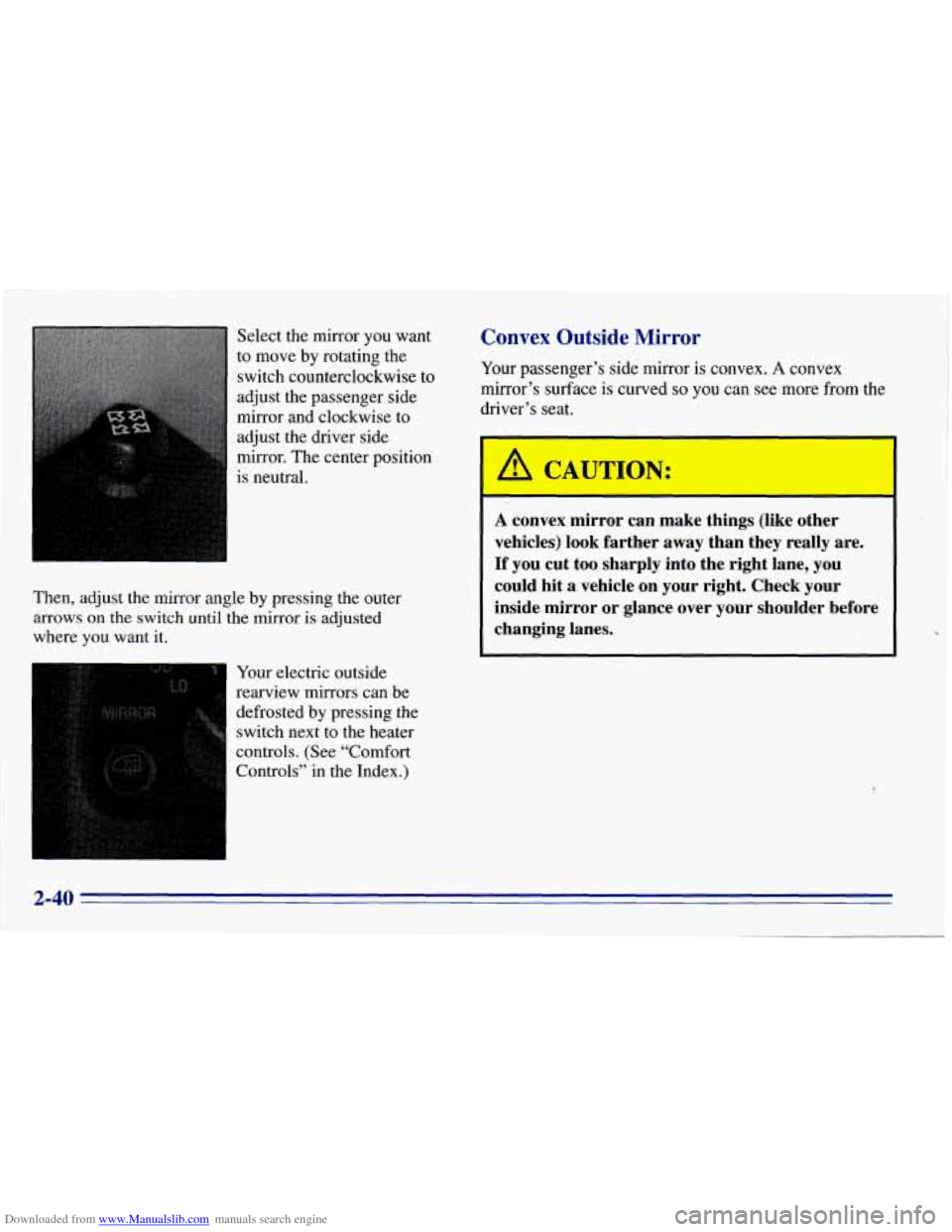
Downloaded from www.Manualslib.com manuals search engine Select the mirror you want
to move by rotating the
switch counterclockwise to
adjust the passenger side
mirror and clockwise to
adjust the driver side
mirror. The center position
is neutral.
Then, adjust the mirror angle by pressing the outer
arrows on the switch until the mirror is adjusted
where
you want it.
Your electric outside
rearview mirrors can be
defrosted by pressing the
switch next to the heater
controls. (See “Comfort
Controls” in the Index.)
Convex Outside .Mirror
Your passenger’s side mirror is convex. A convex
mirror’s surface
is curved so you can see more from the
driver’s seat.
CAUTION:
A convex mirror can make things (like other
vehicles) look farther away than they really are.
If you cut too sharply into the right lane, you
could hit a vehicle on your right. Check your
inside mirror or glance over your shoulder before
changing lanes.
I
2-40
Page 107 of 376

Downloaded from www.Manualslib.com manuals search engine Speedometer
Your speedometer lets you see your speed in both miles
per hour (mph) and kilometers per hour (km/h). Your
odometer shows how far your vehicle has been driven,
in either miles (used in the United States) or kilometers
(used in Canada).
You may wonder what happens if your vehicle needs a
new odometer installed. Laws vary as to the procedure
that must be followed,
so check with yo~~r state or
provincial vehicle registration office.
But generally, if
the new odometer can be set to the mileage total of the
old odometer, then
it must be. But if it can’t, then it’s set
at zero,
and a label must be put on the driver’s door to
show the old mileage reading
when the new odometer
was installed.
Trip Odometer
To reset the trip odometer, fu
The trip odometer can
tell you how fir your
vehicle has been driven
since you last set the trip
odometer to zero.
.lly press the reset
located near the trip odometer readout. button
The odometer can show either total miles or trip miles
by using the push control
in the cluster.
2-45
Page 108 of 376

Downloaded from www.Manualslib.com manuals search engine Warning Lights, Gages and Indicators
This part describes the warning lights and gages that
may be on your vehicle. The pictures will help
you
locate them.
Warning lights and gages can signal that something
is
wrong before it becomes serious enough to cause an
expensive repair or replacement. Paying attention to
your warning lights and gages could also save
you or
others from injury.
Warning lights come on when there may be or is a
problem with one
of your vehicle’s functions. As you
will see in the details on the next few pages, some
warning lights come on briefly when
you start the
engine just to let
you know they’re working. If you are
familiar with this section,
you should not be alarmed
when this happens.
Gages can indicate when there may be or is a problem
with one
of your vehicle’s functions. Often gages and
warning lights work together
to let you know when
there’s a problem with your vehicle.
When one of the warning lights comes
on and stays on
when
you are driving, or when one of the gages shows
there may
be a problem, check the section that tells you
what to do about it. Please follow this manual’s advice. Waiting
to do
repairs can be costly -- and even dangerous.
So please get to know your warning lights and gages.
They’re a big help.
Safety Belt Reminder Light
When the key is turned to RUN or START, a tone will
come on for about eight seconds
to remind people to
fasten their safety belts, unless the driver’s safety belt is
already buckled.
The safety belt light will
also come on and stay
on
for about 20 seconds, then
it will flash for about
55 seconds. If the driver’s
belt is already buckled,
neither the tone nor the
light will come
on.