Page 219 of 386
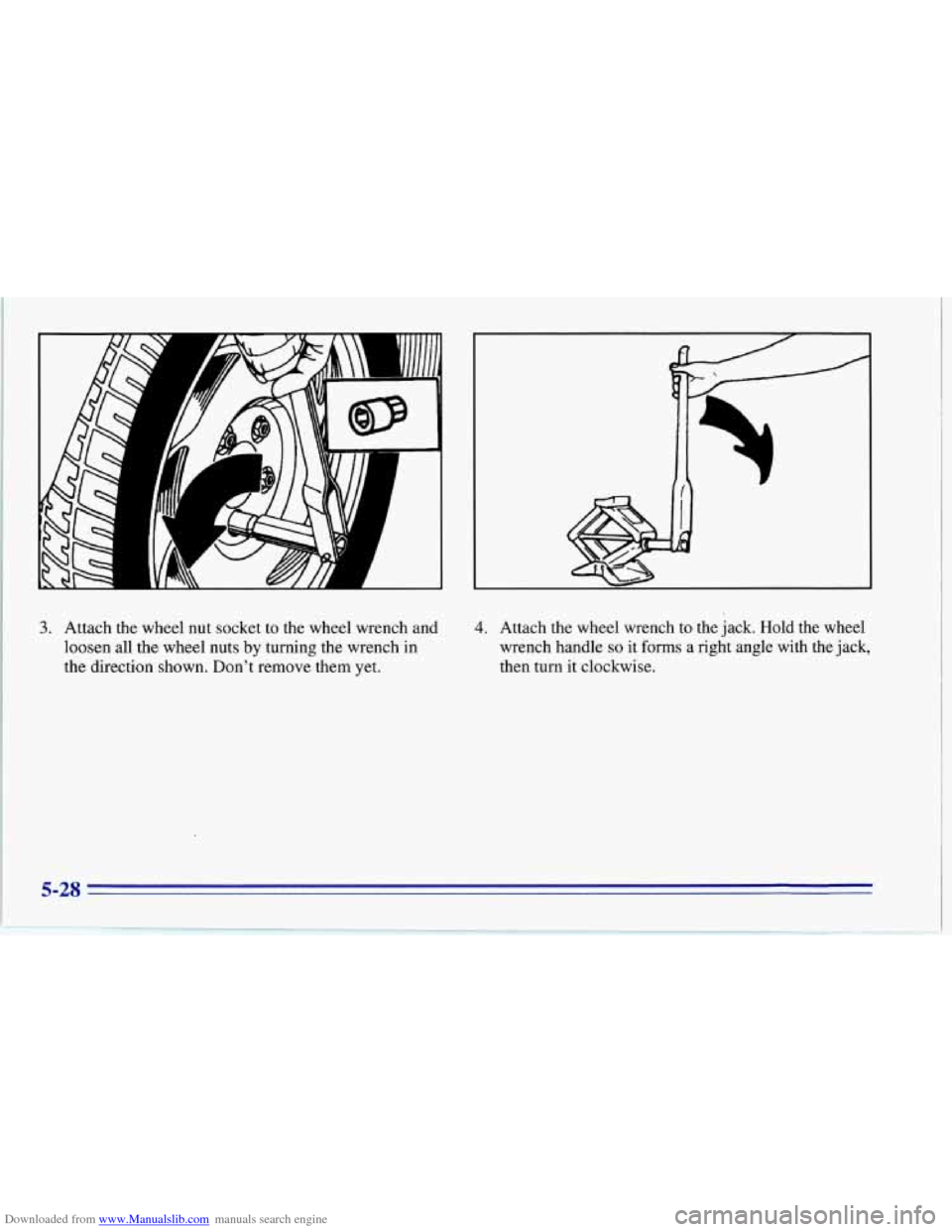
Downloaded from www.Manualslib.com manuals search engine 3. Attach the wheel nut socket to the wheel wrench and
loosen all the wheel nuts
by turning the wrench in
the direction shown. Don't remove them yet.
4. Attach the wheel wrench to the jack. Hold the wheel
wrench handle
so it forms a right angle with the jack,
then turn it clockwise.
5-28
Page 221 of 386
Downloaded from www.Manualslib.com manuals search engine Getting under a vehicle when it is jacked up is
dangerous.
If the vehicle slips off the jack, you
could be badly injured or killed. Never get under
a vehicle when it is supported only by a jack.
NOTICE:
Raising your vehicle with the jack improperly
positioned will damage the vehicle or may allow
the vehicle to fall off the jack. Be sure to fit the
jack lift head into the proper location before
raising your vehicle.
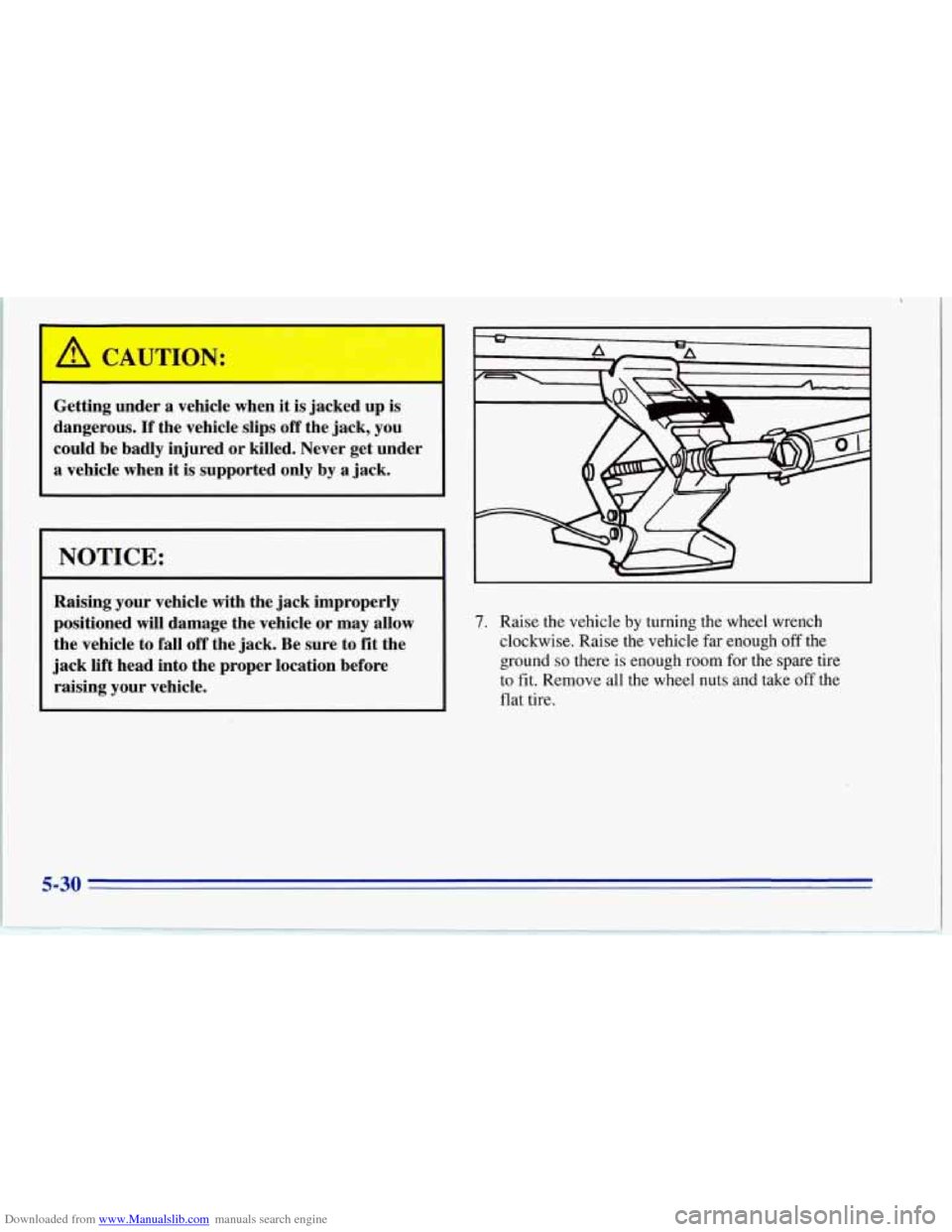
7. Raise the vehicle by turning the wheel wrench
clockwise. Raise the vehicle
far enough off the
ground
so there is enough room for the spare tire
to fit. Remove all the wheel
nuts and take off the
flat tire.
5-30
-
Page 223 of 386
Downloaded from www.Manualslib.com manuals search engine I
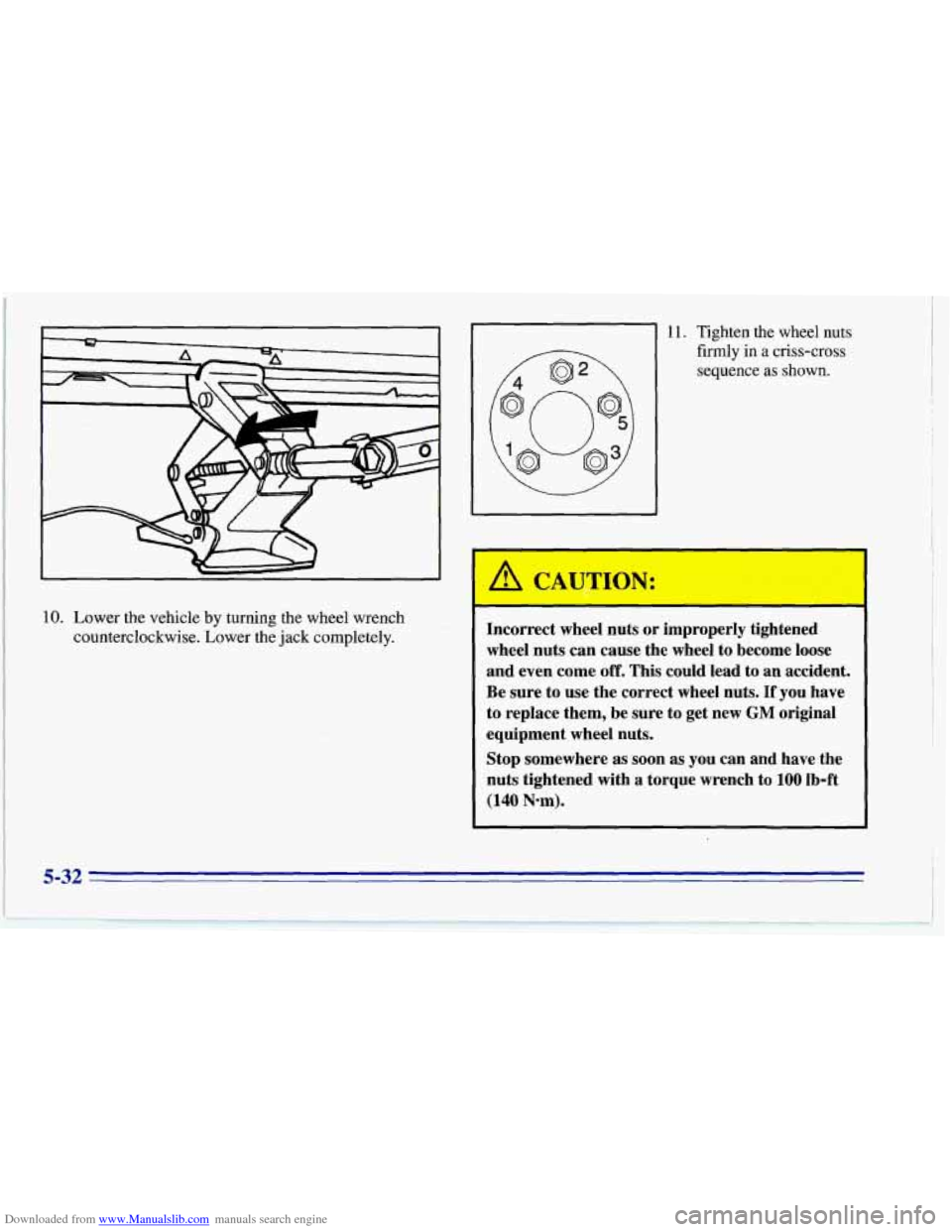
10. Lower the vehicle by turning the wheel wrench
counterclockwise. Lower the jack completely.
11. Tighten the wheel nuts
firmly in a criss-cross
sequence as shown.
Incorrect wheel nuts or improperly tightened
wheel nuts can cause the wheel to become loose
and even come
off. This could lead to an accident.
Be sure to use the correct wheel nuts. If you have
to replace them, be sure to get new
GM original
equipment wheel nuts.
Stop somewhere
as soon as you can and have the
nuts tightened with
a torque wrench to 100 lb-ft
(140 N-m).
Page 226 of 386
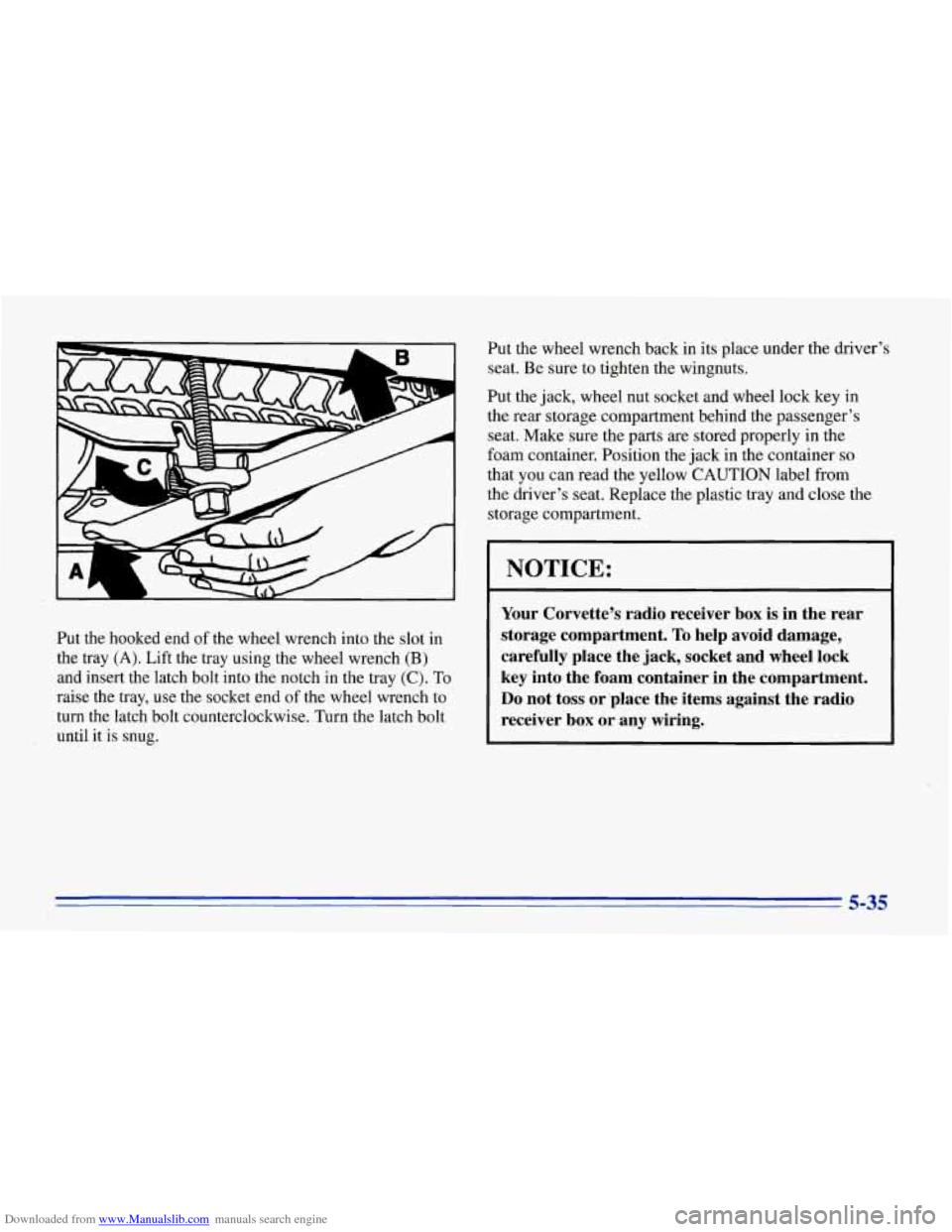
Downloaded from www.Manualslib.com manuals search engine Put the hooked end of the wheel wrench into the slot in
the tray
(A). Lift the tray using the wheel wrench (B)
and insert the latch bolt into the notch in the tray (C). To
raise the tray, use the socket end of the wheel wrench to
turn the latch bolt counterclockwise. Turn the latch bolt
until it is snug. Put
the wheel wrench back in its place under the driver’s
seat. Be sure to tighten the wingnuts.
Put the jack, wheel nut socket and wheel lock
key in
the rear storage compartment behind the passenger’s
seat. Make sure the
parts are stored properly in the
foam container. Position the jack in the container
so
that you can read the yellow CAUTION label from
the driver’s seat. Replace the plastic tray and close the
storage compartment.
I NOTICE: I
Your Corvette’s radio receiver box is in the rear
storage compartment.
To help avoid damage,
carefully place the jack, socket and wheel lock
key into the foam container in the compartment.
Do not toss or ‘place the items against the radio
receiver
box or any wiring.
5-35
Page 229 of 386

Downloaded from www.Manualslib.com manuals search engine Put the jack, wheel nut socket and wheel lock key in the
rear storage compartment behind the passenger’s seat.
Make sure the parts are stored properly in the foam
container. Position the jack in the container
so that you
can read the yellow CAUTION label fromthe driver’s
seat. Replace the plastic tray and close the storage
compartment.
NOTICE:
Your Corvette’s radio receiver box is in the rear
storage compartment.
To help avoid damage,
carefully place the jack, socket and wheel lock
key into the foam container in the compartment.
Do not toss or place the items against the radio
receiver box or any wiring.
Compact Spare Tire (If So Equipped)
Although the compact spare tire was fully inflated when
your vehicle was new, it can lose air after a time. Check
the’inflation pressure regularly. It should be
60 psi
(420 Wa).
After installing the compact spare on your vehicle, you should stop as soon as possible and make sure your spare
tire is correctly inflated. The compact spare is made to
perform well at posted speed limits for distances up to
3,000 miles (5 OOO km), so you can finish your trip and
have your full-size tire repaired or replaced where you
want.
Of course, it’s best to replace your spare with a
full-size tire as soon
as you can. Your spare will last
longer and
be in good shape in case you need it again.
When the compact spare is installed, your
vehicle’s handling capabilities will be reduced
during severe maneuvers.
If you drive too fast,
you could lose control
of your vehicle. You or
others could be injured. Don’t drive over
55 mph
(90 km/h) when the compact spare is installed.
5-38
Page 236 of 386
Downloaded from www.Manualslib.com manuals search engine Filling Your Tank
Gasoline vapor is highly flammable. It burns
violently, and that can cause very bad injuries.
Don’t smoke if you’re near gasoline or refueling
your vehicle. Keep sparks, flames, and smoking materials away from gasoline.
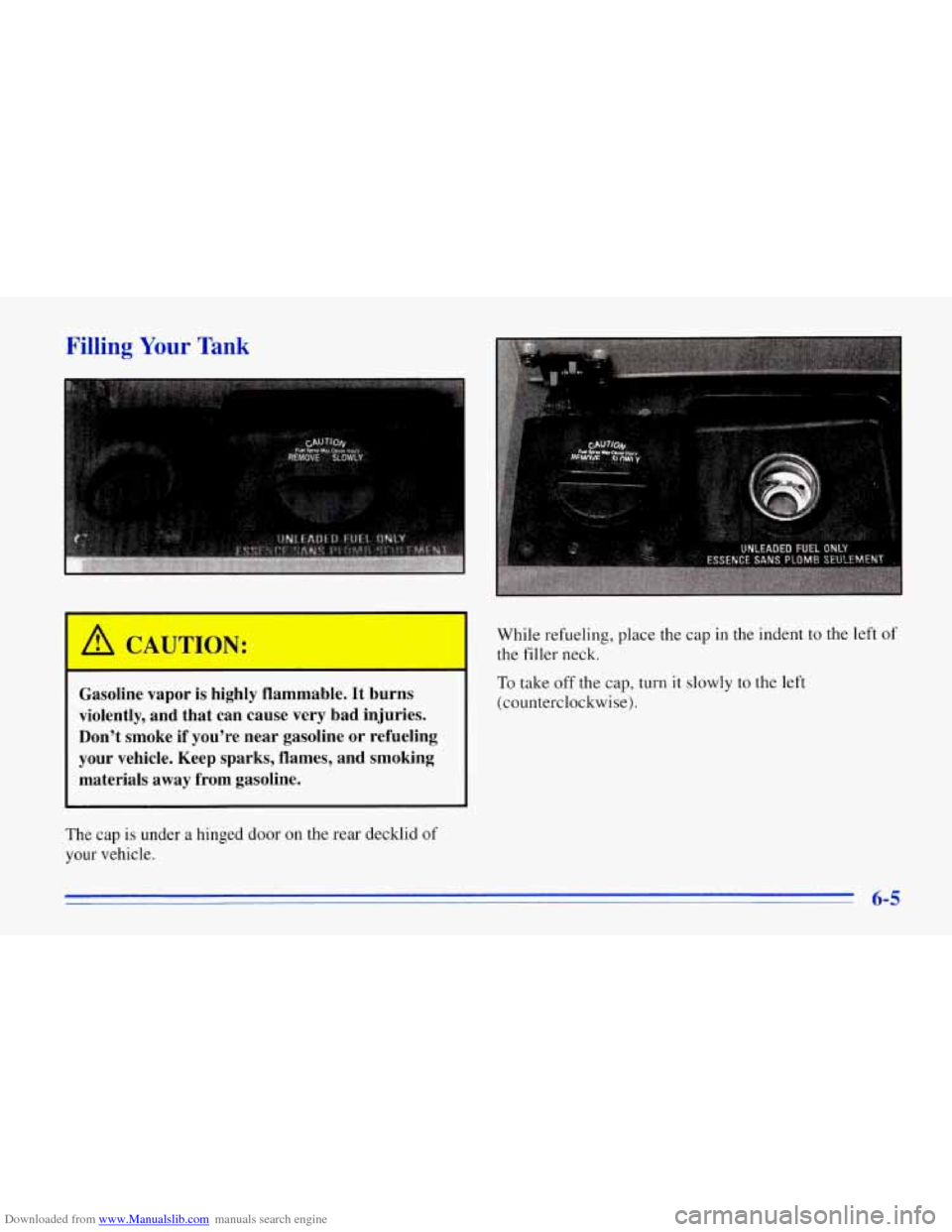
The cap is under a hinged door on the rear decklid of
your vehicle. While refueling, place the
cap
in the indent to the left of
the filler neck.
To take off the cap, turn it slowly to the left
(counterclockwise).
6-5
Page 242 of 386
Downloaded from www.Manualslib.com manuals search engine When to Add Oil
If the oil is at or below the ADD mark, you’ll need to
add some oil. But you must use the right kind. This part
explains what kind of oil to use.
For crankcase capacity,
see “Capacities and Specifications” in the Index.
NOTICE:
Don’t add too much oil. If your engine has so
much oil that the oil level gets above the upper
mark that shows the proper operating range,
your engine could be damaged.
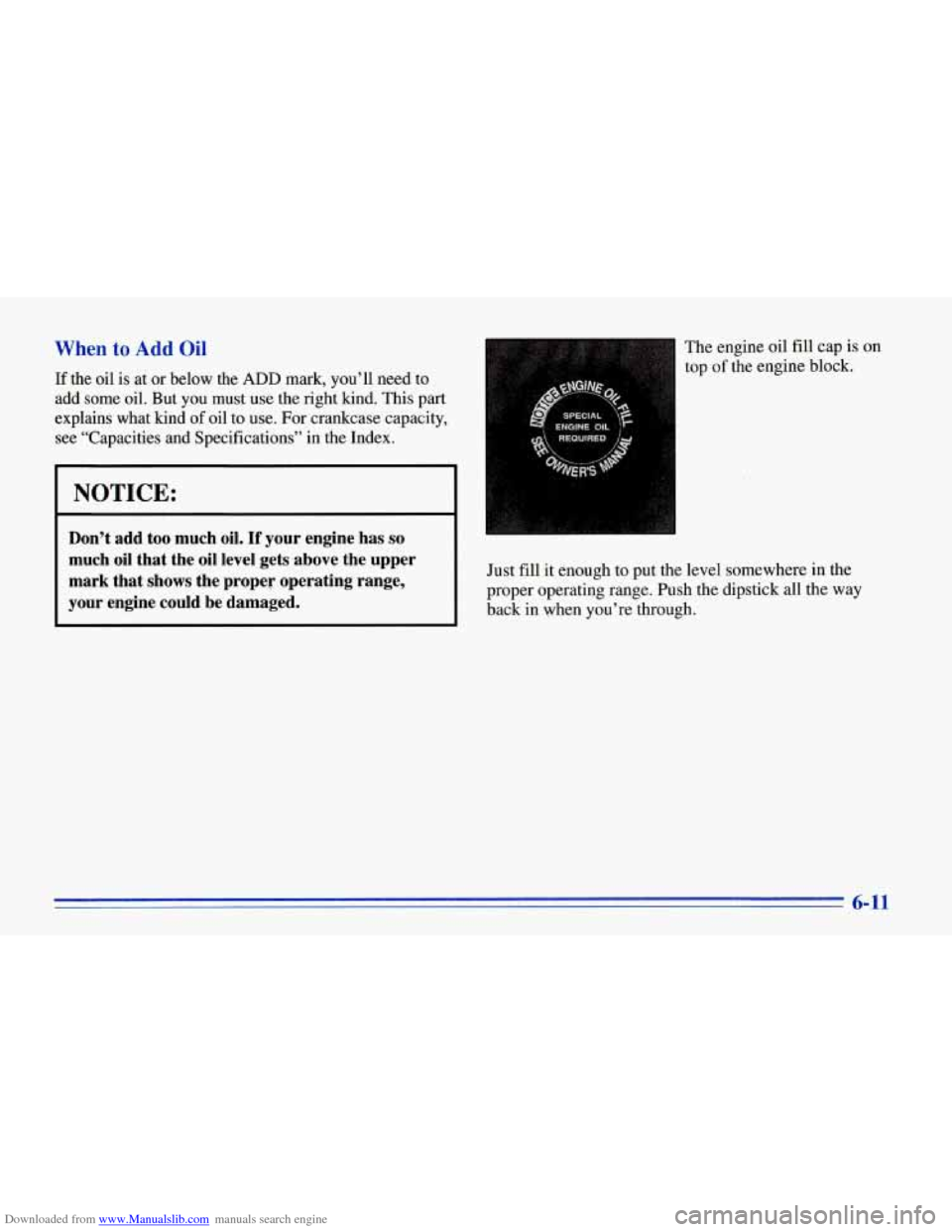
The engine oil fill cap is on
top
of the engine block.
Just fill it enough to put the level somewhere in the
proper operating range. Push the dipstick all the way
back in when you’re through.
6-11
Page 269 of 386
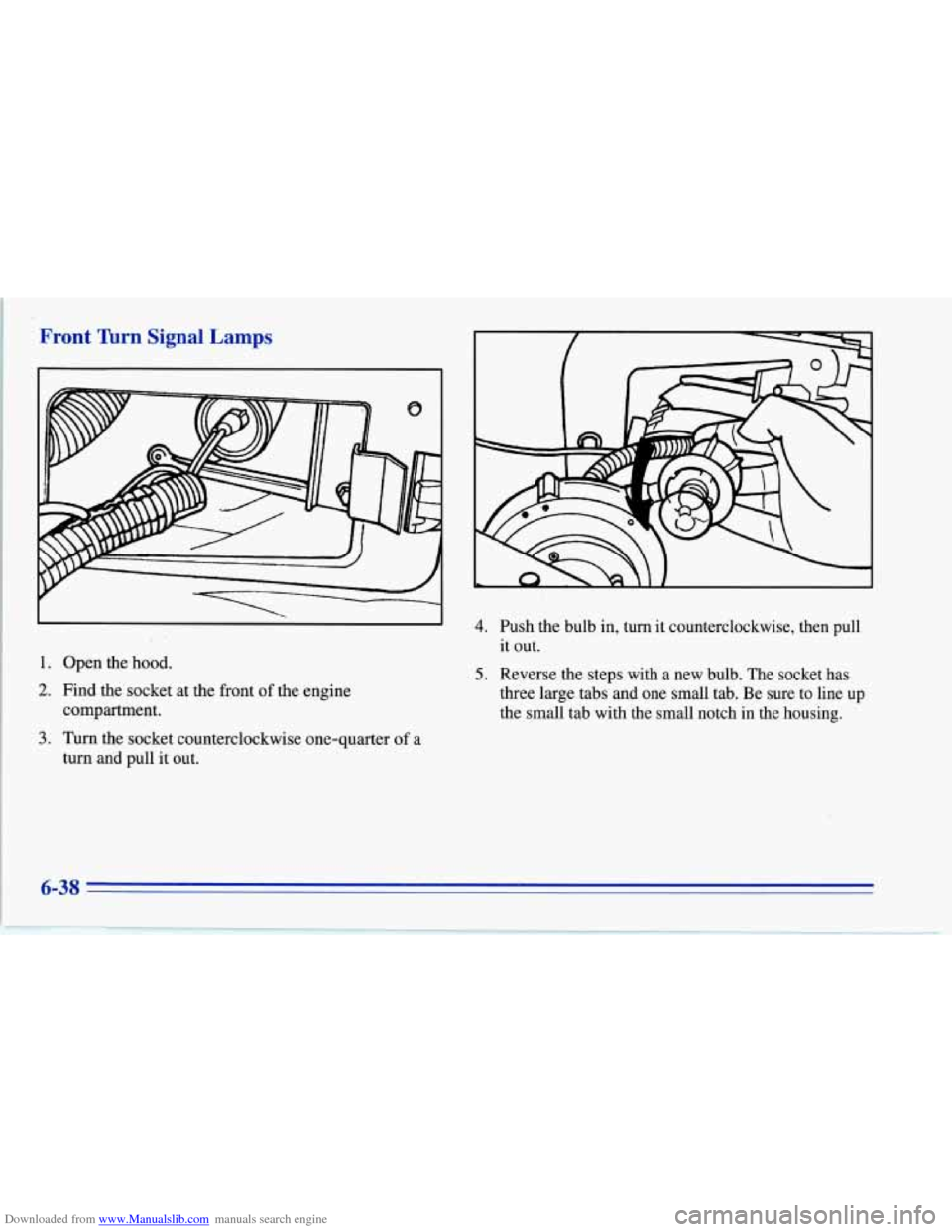
Downloaded from www.Manualslib.com manuals search engine Front Tbrn Signal Lamps
1. Open the hood.
2. Find the socket at the front of the engine
compartment.
3. Turn the socket counterclockwise one-quarter of a
turn and pull it out.
4. Push the bulb in, turn it counterclockwise, then pull
it out.
5. Reverse the steps with a new bulb. The socket has
three large tabs and one small tab. Be sure to line up
the small tab with the small notch in the housing.
6-38