1996 CHEVROLET CORVETTE Door
[x] Cancel search: DoorPage 279 of 386
Downloaded from www.Manualslib.com manuals search engine If a tire goes flat, you won’t need to stop on the side of
the road to change the tire.
You can just keep on driving.
The shorter the distance you drive and the slower the
speed, the greater the chance that the tire will not have
to be replaced. If you drive on a deflated EMT for
distances of
50 miles (80 km) or less and at speeds of
55 mph (90 km/h) or less, there is a good chance that the
tire can be repaired. The tire can operate effectively with
no air pressure for up to 200 miles (320 km) at speeds
up to
55 mph (90 km/h), but the tire would then have to
be replaced. Also remember: When a tire is filled with
air, it provides a cushion between the road and the
wheel. Because you do not have this cushion when
driving on a deflated tire, try to avoid potholes that
could damage your wheel and require replacement of it.
Some road hazards can damage a
tire beyond repair. This
damage could occur before you’ve driven on the tire in a
deflated condition. Whenever a tire has been damaged, or
if you’ve driven any distance on a deflated
EMT, check
with a Goodyear EMT Service Center to determine
whether the tire can be repaired or should be replaced. To
maintain your vehicle’s extended mobility feature,
all
replacement tires must be Extended Mobility Tires.
See the Goodyear Extended Mobility Tire Owner’s
Manual and Limited Warranty supplied with your
Corvette for additional information.
Inflation -- Tire Pressure
The Tire-Loading Information label, which is on
the rear edge of the driver’s door, shows the correct
inflation pressures for your tires when they’re cold.
“Cold” means your vehicle has been sitting for at least
three hours or driven no more than
1 mile (1.6 km).
For competitive driving or high-speed driving (over
150 mph or 240 km/h), make sure your tires are inflated
to 35 psi
(240 kPa). When you end this type of driving,
reduce the cold inflation pressures (if necessary) to those
listed on the Tire-Loading Information label.
I NOTICE:
Don’t let anyone tell you that underinflation or
overinflation is all right. It’s not. If your tires
don’t have enough air (underinflation), you can get the following:
0 Too much flexing
Too much heat
0 Tire overloading
0 Bad wear
0 Bad handling
Bad fuel economy.
NOTICE: (Continued)
Page 282 of 386
Downloaded from www.Manualslib.com manuals search engine Uniform Tire Quality Grading
The following information relates to the system
developed by the United States National Highway
Traffic Safety Administration, which grades tires by
treadwear, traction and temperature performance. (This
applies only to vehicles sold in the United States.) The
grades are molded on the sidewalls
of most passenger
car tires. The Uniform Tire Quality Grading system does
not apply to deep tread, winter-type snow tires,
space-saver or temporary
use spare tires, tires with
nominal rim diameters of 10 to 12 inches (25 to
30 cm),
or to some limited-production tires.
While the tires available on General Motors passenger
cars and light trucks may
vary with respect to these
grades, they must also conform to Federal safety
requirements and additional General Motors Tire
Performance Criteria (TPC) standards.
Treadwear
The treadwear grade is a comparative rating based on
the wear rate of the tire when tested under controlled
conditions on
a specified government test course. For
example, a tire graded 150 would wear one and a half
(1 1/2) times as well on the government course as a tire
graded 100. The relative performance of tires depends upon
the actual conditions of their use, however, and
may depart significantly from the norm due to variations
in driving habits, service practices and differences
in
road characteristics and climate.
Traction - A, B, C
The traction grades, from highest to lowest, are A, B, and
C, and they represent the tire’s ability to stop on wet
pavement as measured under controlled conditions on specified government test surfaces of asphalt and concrete.
A tire marked
C may have poor traction performance.
Warning: The traction grade assigned to this tire is based
on braking (straightahead) traction tests and does not
include cornering (turning) traction.
Temperature - A, B, C
The temperature grades are A (the highest), B, and C,
representing the tire’s resistance to the generation of
heat and its ability to dissipate heat when tested under
controlled conditions on
a specified indoor laboratory
test wheel. Sustained high temperature can cause the
material of the tire to degenerate and reduce tire life, and
excessive temperature can lead to ,sudden tire failure.
The grade C corresponds to a level of performance
which all passenger car tires must meet under the
Federal Motor Vehicle Safety Standard
No. 109.
6-51
Page 285 of 386
Downloaded from www.Manualslib.com manuals search engine Appearance Care
Remember, cleaning products can be hazardous. Some
are toxic. Others can burst into flame if you strike a
match or get them on a hot part of the vehicle. Some are
dangerous if you breathe their fumes in a closed space.
When you use anything from a container to clean your
Corvette, be sure to follow the manufacturer’s warnings
and instructions. And always open your doors or
windows when you’re cleaning the inside.
Never use these to clean your vehicle:
0
0
0
0
0
0
0
0
0
Gasoline
Benzene Naphtha Carbon Tetrachloride
Acetone
Paint Thinner
Turpentine Lacquer Thinner
Nail Polish Remover
They can all be hazardous
-- some more than
others
-- and they can all damage your vehicle, too. Don’t use
any of these unless this manual says you can.
In many uses, these will damage your vehicle:
Alcohol
0 Laundry Soap
0 Bleach
0 Reducing Agents
Cleaning the Inside of Your Corvette
Use a vacuum cleaner often to get rid of dust and loose
dirt. Wipe vinyl or leather with a clean, damp cloth.
Your Corvette dealer has two
GM cleaners, a
solvent-type spot lifter and a foam-type powdered
cleaner. They will clean normal spots and stains
very
well. Do not use them on vinyl or leather.
Here are some cleaning tips:
0 Always read the instructions on the cleaner label.
0 Clean up stains as soon as you can -- before they set.
Use a clean cloth or sponge, and change to a clean
area often. A soft brush may be used if stains are
stubborn.
0 Use solvent-type cleaners in a well-ventilated area
only. If you use them, don’t saturate the stained area.
6-54
Page 296 of 386
Downloaded from www.Manualslib.com manuals search engine Fuses and Circuit Breakers
The wiring circuits in your vehicle are protected from
short circuits by a combination of maxi-fuses,
mini-fuses and circuit breakers. This greatly reduces
the chance
of fires caused by electrical problems.
Look at the silver-colored band inside the fuse. If the
band is broken or melted, replace the fuse.
Be sure you
replace a bad fuse with a new one of the identical size
and rating.
If you ever have a problem
on the road and don’t have
a spare fuse,
you can borrow one that has the same
amperage. Just pick some feature of your vehicle that
you can get along without
-- like the radio or cigarette
lighter
-- and use its fuse, if it is the correct amperage.
Replace it as soon as you can.
Instrument Panel Fuse Block
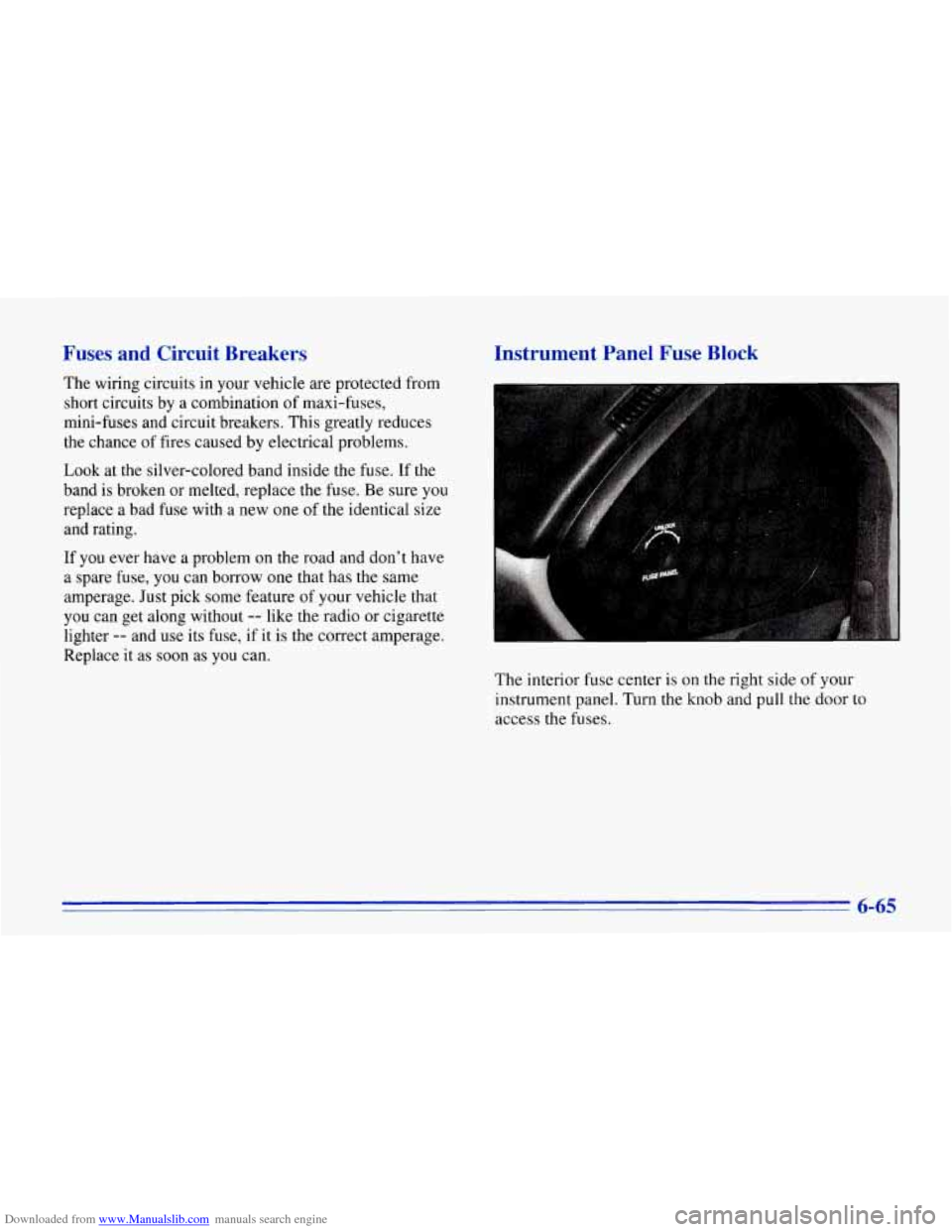
The interior fuse center is on the right side of your
instrument panel. Turn the knob and pull the door
to
access the fuses.
6-65
Page 299 of 386
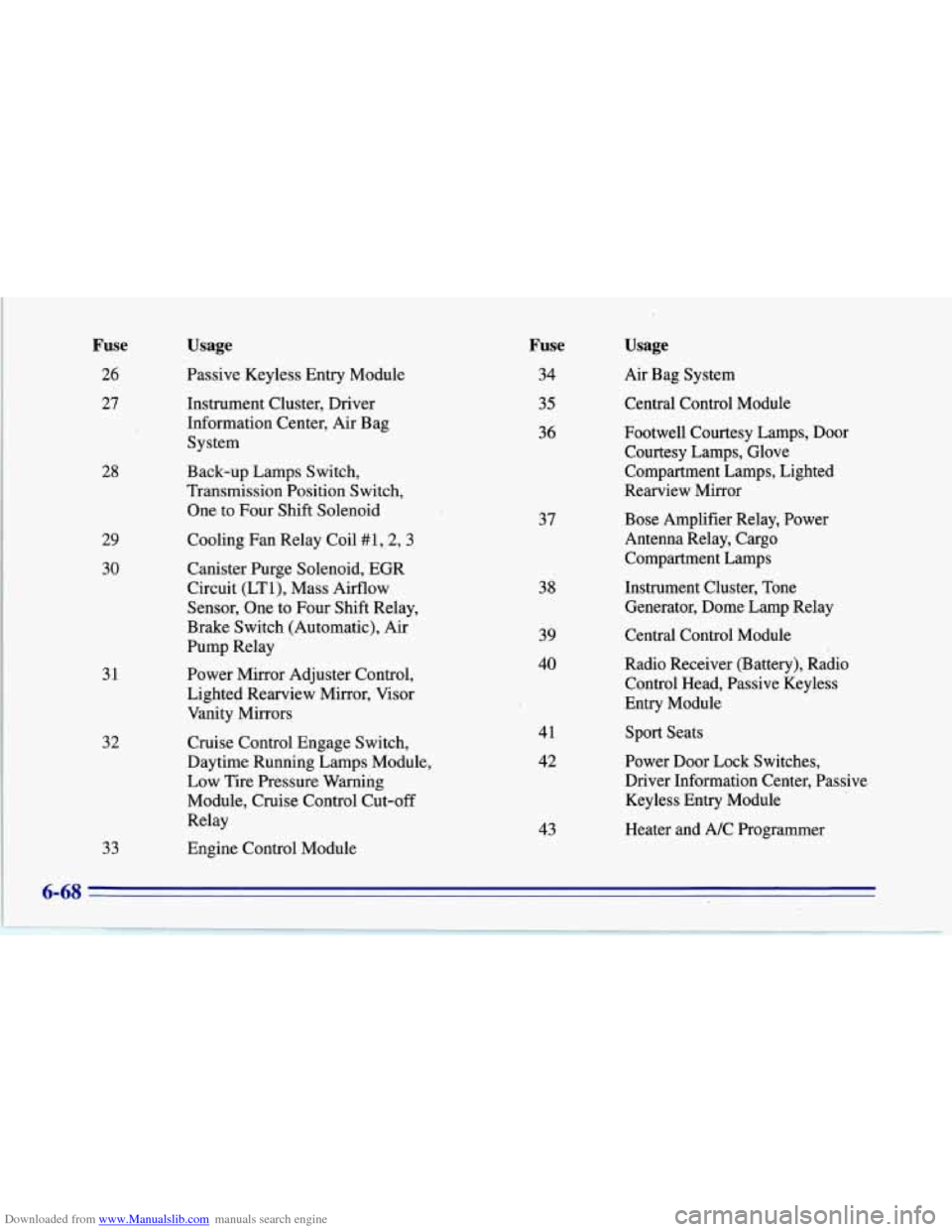
Downloaded from www.Manualslib.com manuals search engine Fuse
26 27
28
29
30
31
32
33
Usage
Passive Keyless Entry Module
Instrument Cluster, Driver
Information Center, Air Bag System
Back-up Lamps Switch,
Transmission Position Switch,
One to Four Shift Solenoid
Cooling Fan Relay Coil #1
, 2,3
Canister Purge Solenoid, EGR
Circuit (LTl), Mass Airflow
Sensor, One to Four Shift Relay,
Brake Switch (Automatic), Air
Pump Relay
Power Mirror Adjuster Control,
Lighted Rearview Mirror, Visor
Vanity Mirrors
Cruise Control Engage Switch,
Daytime Running Lamps Module,
Low Tire Pressure Warning
Module, Cruise Control Cut-off
Relay
Engine Control Module
Fuse
34
35
36
37
38
39
40
41 42
43
Usage
Air Bag System
Central Control Module
Footwell Courtesy Lamps, Door Courtesy Lamps, Glove
Compartment Lamps, Lighted
Rearview Mirror
Bose Amplifier Relay, Power
Antenna Relay, Cargo Compartment Lamps
Instrument Cluster, Tone
Generator, Dome Lamp Relay
Central Control Module
Radio Receiver (Battery), Radio
Control Head, Passive Keyless
Entry Module
Sport Seats
Power Door Lock Switches,
Driver Information Center, Passive Keyless Entry Module
Heater and A/C Programmer
6-68
Page 304 of 386
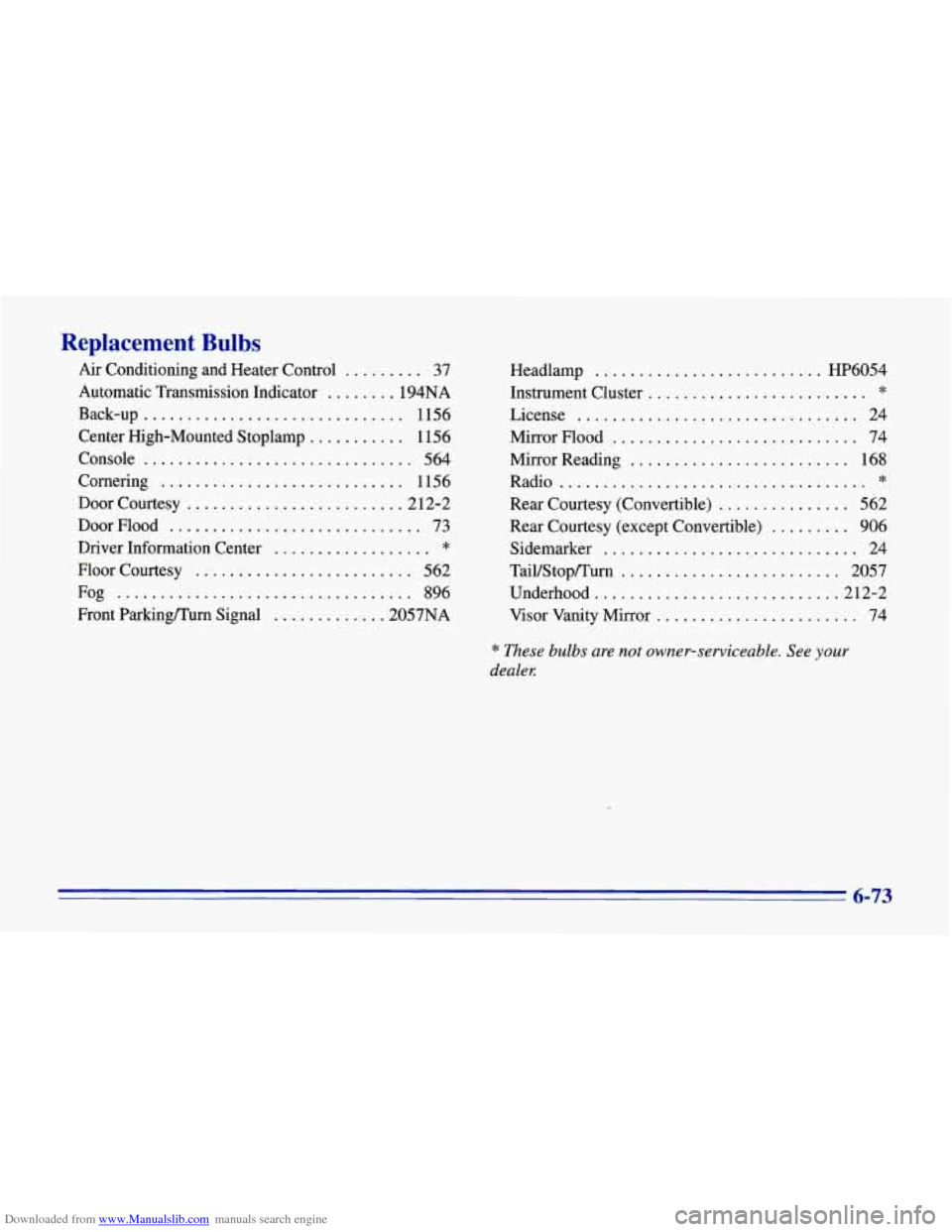
Downloaded from www.Manualslib.com manuals search engine Replacement Bulbs
Air Conditioning and Heater Control ......... 37
Automatic Transmission Indicator
........ 194NA
Center High-Mounted Stoplamp
........... 1156
Console
............................... 564
Door Courtesy
......................... 2 12-2
DoorFlood
............................. 73
Driver Information Center
.................. *
Back-up .............................. 1156
Cornering
............................ 1156
Floor Courtesy
......................... 562
Fog .................................. 896
Front ParkingDurn Signal
............. 2057NA Headlamp
.......................... HP6054
Instrument Cluster
License
................................ 24
Mirror Flood
............................ 74
Radio
* .........................
Mirror Reading ......................... 168
Rear Courtesy (Convertible)
............... 562
Rear Courtesy (except Convertible)
......... 906
Sidemarker
............................. 24
Tail/Stop/Turn
......................... 2057
Underhood
............................ 2 12-2
Visor Vanity Mirror
....................... 74
* ...................................
* These bulbs are not owner.serviceab1e . See your
dealel:
6-73
Page 307 of 386
Downloaded from www.Manualslib.com manuals search engine Capacities (Approximate)
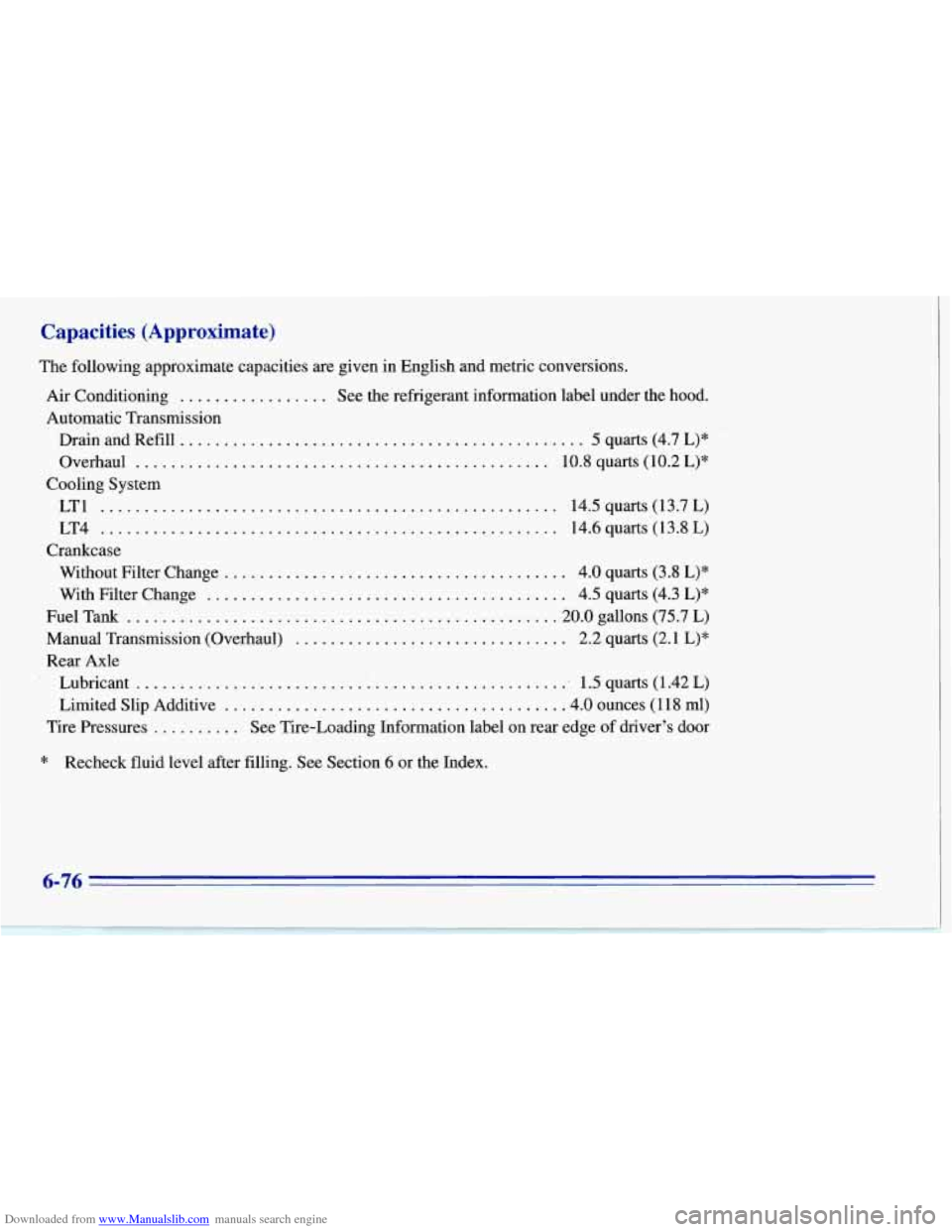
The following approximate capacities are given in English and metric conversions.
Air Conditioning ................. See the refrigerant information label under the hood.
Automatic Transmission
Drain and Refill
.............................................. 5 quarts (4.7 L)*
Overhaul
............................................. 10.8 quarts (10.2 L)*
LT1 ........... ................................... 14.5 quarts (13.7 L)
LT4
.................................................... 14.6quarts(13.8L)
Without Filter Change
....................................... 4.0 quarts (3.8 L)*
With Filter Change ......................................... 4.5 quarts (4.3 L)*
FuelTank ................................ ............. 20.0 gallons (75.7 L)
Manual Transmission (Overhaul)
............................. 2.2 quarts (2.1 L)*
Rear Axle
Lubricant
.................................................. 1.5 quarts (1.42 L)
Limited Slip Additive
...................................... .4.0 ounces (1 18 ml)
Tire Pressures
.......... See Tire-Loading Information label on rear edge of driver’s door
Cooling System
Crankcase
* Recheck fluid level after filling. See Section 6 or the Index.
6-76
Page 352 of 386
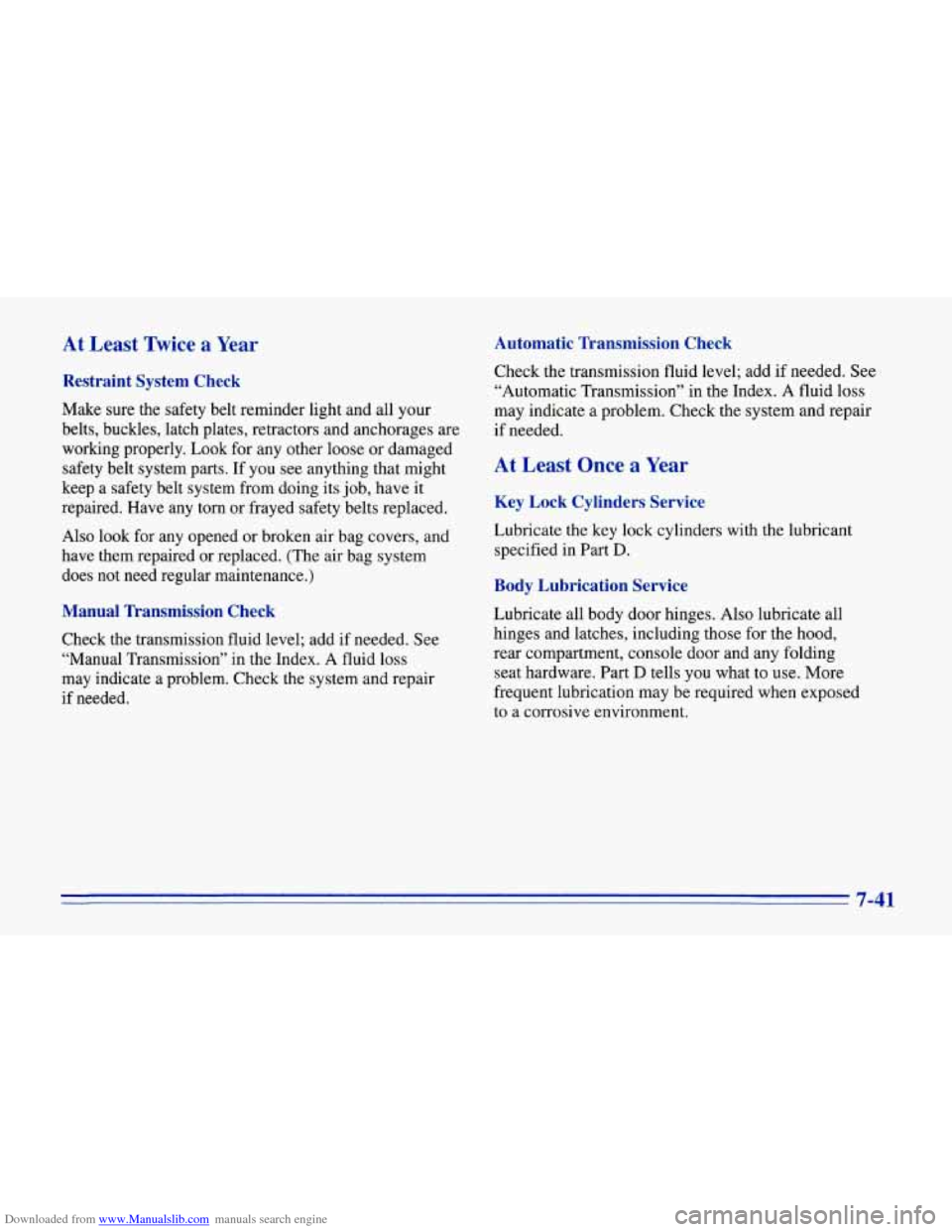
Downloaded from www.Manualslib.com manuals search engine At Least Twice a Year Automatic Transmission Check
Restraint System Check
Make sure the safety belt reminder light and all your
belts, buckles, latch plates, retractors and anchorages are
working properly. Look for any other loose or damaged
safety belt system parts. If
you see anything that might
keep a safety belt system from doing its job, have it
repaired. Have any torn or frayed safety belts replaced.
Also look for any opened or broken air bag covers, and
have them repaired or replaced. (The air bag system
does not need regular maintenance.)
Manual Transmission Check
Check the transmission fluid level; add if needed. See
“Manual Transmission” in the Index. A fluid loss
may indicate a problem. Check the system and repair
if needed. Check the transmission fluid level;
add if needed. See
“Automatic Transmission” in the Index. A fluid loss
may indicate a problem. Check the system and repair
if needed.
At Least Once a Year
Key Lock Cylinders Service
Lubricate the key lock cylinders with the lubricant
specified in Part
D.
Body Lubrication Service
Lubricate all body door hinges. Also lubricate all
hinges and latches, including those for the hood,
rear compartment, console door and any folding
seat hardware. Part
D tells you what to use. More
frequent lubrication may be required when exposed
to a corrosive environment.
7-41