1996 CHEVROLET CORVETTE light
[x] Cancel search: lightPage 56 of 386
Downloaded from www.Manualslib.com manuals search engine Universal Theft-Deterrent System
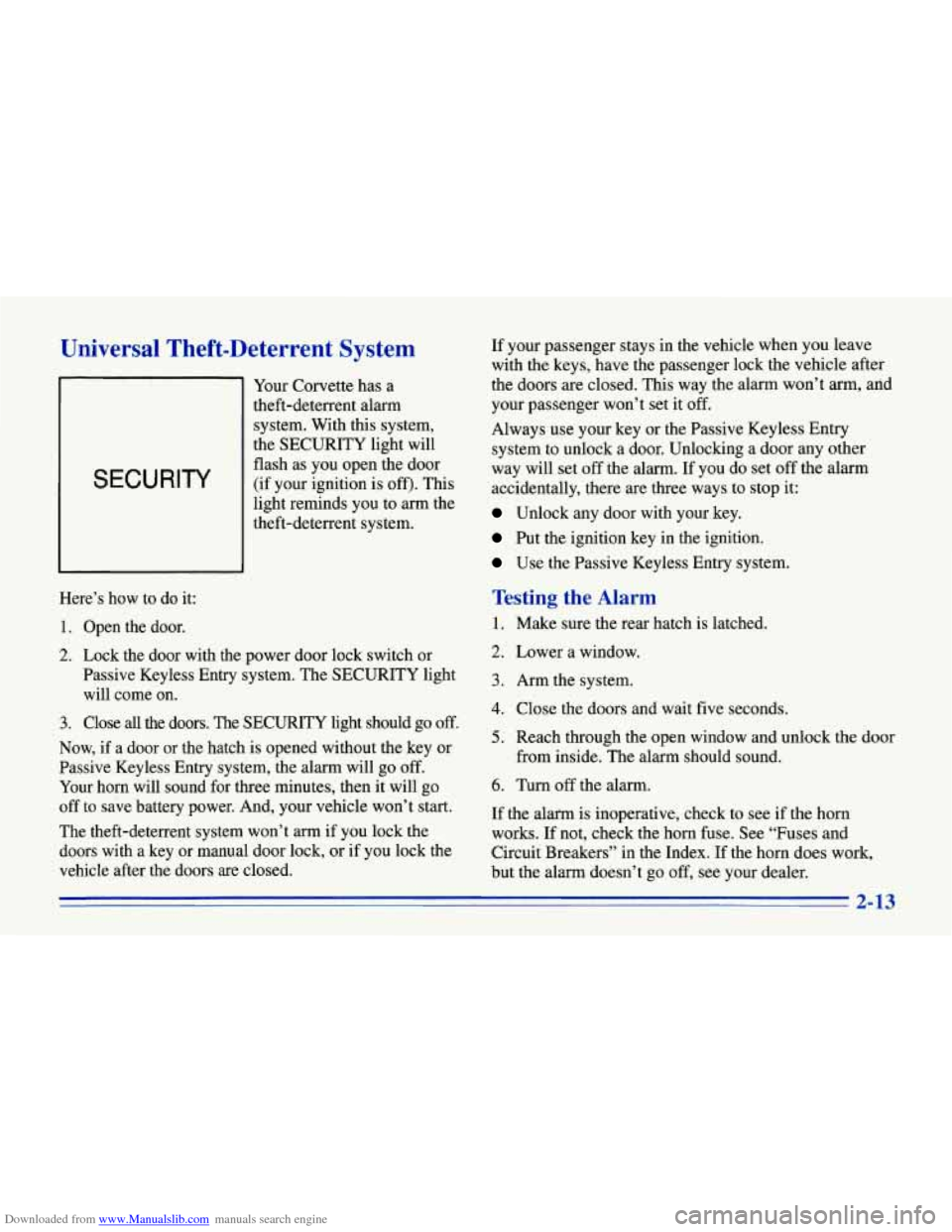
SECURITY
Your Corvette has a
theft-deterrent alarm system. With this system,
the SECURITY light will
flash as you open the door
(if your ignition is off). This
light reminds you to arm the
theft-deterrent system.
Here’s how to do it:
1. Open the door.
2. Lock the door with the power door lock switch or
Passive Keyless Entry system. The SECURITY light
will come
on.
3. Close all the doors. The SECURITY light should go off.
Now, if a door or the hatch is opened without the key or
Passive Keyless Entry system, the alarm will
go off.
Your horn will sound for three minutes, then it will go
off to save battery power. And, your vehicle won’t start.
The theft-deterrent system won’t arm
if you lock the
doors with a key or manual door lock, or
if you lock the
vehicle after the doors are closed. If
your passenger stays in the vehcle when you leave
with the keys, have the passenger lock
the vehicle after
the doors
are closed. This way the alarm won’t arm, and
your passenger won’t set it off.
Always use your key
or the Passive Keyless Entry
system to unlock a door. Unlocking a door any other
way will set
off the alarm. If you do set off the alarm
accidentally, there
are three ways to stop it:
Unlock any door with your key.
Put the ignition key in the ignition.
Use the Passive Keyless Entry system.
Testing the Alarm
1.
2.
3.
4.
5.
6.
Make sure the rear hatch is latched.
Lower a window.
Arm the system.
Close the doors and wait five seconds.
Reach through the open window and unlock the door
from inside. The alarm should sound.
Turn
off the alarm.
If the alam is inoperative, check to see if the horn
works. If not, check the horn fuse. See “Fuses and
Circuit Breakers” in the Index. If the horn does work,
but the alarm doesn’t
go off, see your dealer.
2-13
Page 57 of 386
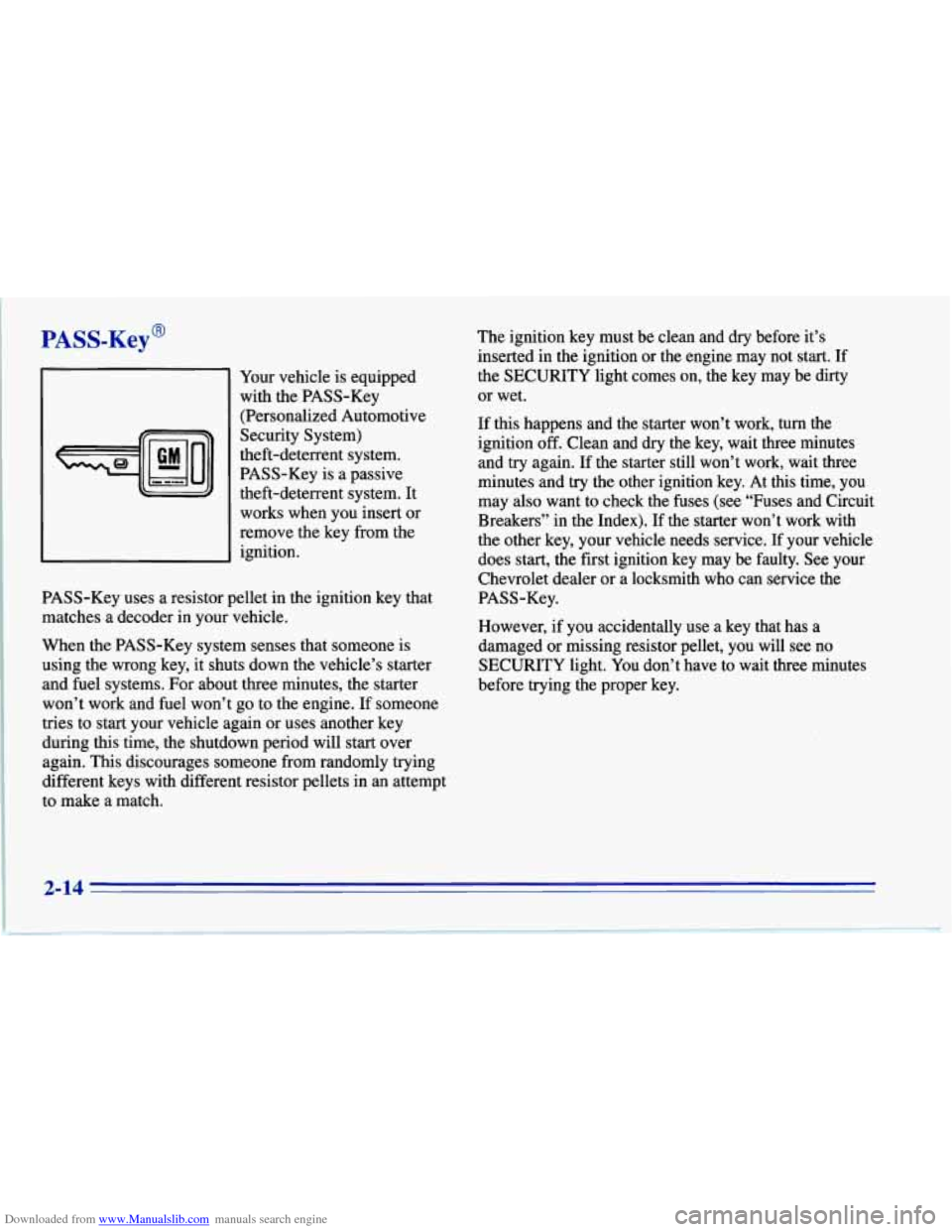
Downloaded from www.Manualslib.com manuals search engine PASS-Key@
Your vehicle is equipped
with the PASS-Key
(Personalized Automotive
Security System)
theft-deterrent system.
PASS-Key is a passive
theft-deterrent system.
It
works when you insert or
remove the key from the
ignition.
PASS-Key uses
a resistor pellet in the ignition key that
matches a decoder in your vehicle.
When the PASS-Key system senses that someone is
using the wrong key, it shuts down the vehicle’s starter
and fuel systems. For about three minutes, the starter
won’t work and fuel won’t go to the engine.
If someone
tries to start your vehicle again or uses another key
during this time, the shutdown period will start over
again. This discourages someone from randomly trying
different keys with different resistor pellets in an attempt
to make a match. The
ignition key must be clean and
dry before it’s
inserted in the ignition or the engine may not start. If
the SECURITY light comes on, the key
may be dirty
or wet.
If
this happens and the starter won’t work, turn the
ignition
off. Clean and dry the key, wait three minutes
and
try again. If the starter still won’t work, wait three
minutes and try the other ignition key. At this time, you
may also want to check the fuses (see “Fuses and Circuit
Breakers” in the Index). If the starter won’t work with
the other key, your vehicle needs service. If your vehicle
does start, the first ignition key may be faulty. See your
Chevrolet dealer or a locksmith who can service the
PASS-Key.
However, if you accidentally use a key that has a
damaged or missing resistor pellet, you will see no
SECURITY light. You don’t have to wait three minutes
before trying the proper key.
2-14
__
Page 58 of 386
Downloaded from www.Manualslib.com manuals search engine If the resistor pellet is damaged or missing, the starter
won’t work. Use the other ignition key, and see your
Chevrolet dealer or a locksmith who can service the
PASS-Key to have a new key made.
If the SECURITY light comes on while driving, have
your vehicle serviced as soon as possible.
If you lose or damage
a PASS-Key ignition key, see
your Chevrolet dealer or a locksmith who can service
PASS-Key. In an emergency, call the Chevrolet
Roadside Assistance Program at 1 -800-CHEV-USA
(1-800-243-8872).
New Vehicle “Break-In”
NOTICE:
Your modern Corvette doesn’t need an elaborate
“break-in.” But
it will perform better in the long
run if you follow these guidelines:
0 Keep your speed at 55 mph (88 km/h) or
less for the
first 500 miles (804 km).
0 Don’t drive at any one speed -- fast or
slow
-- for the first 500 miles (804 km).
Don’t make full-throttle starts.
200 miles (322 km) or so. During this time
your new brake linings aren’t yet broken
in. Hard stops with new linings can mean
premature wear and earlier replacement.
Follow this “breaking-in” guideline every
time you get new brake linings.
0 Avoid making hard stops for the first
2-15
Page 59 of 386
Downloaded from www.Manualslib.com manuals search engine Ignition Positions
C
I
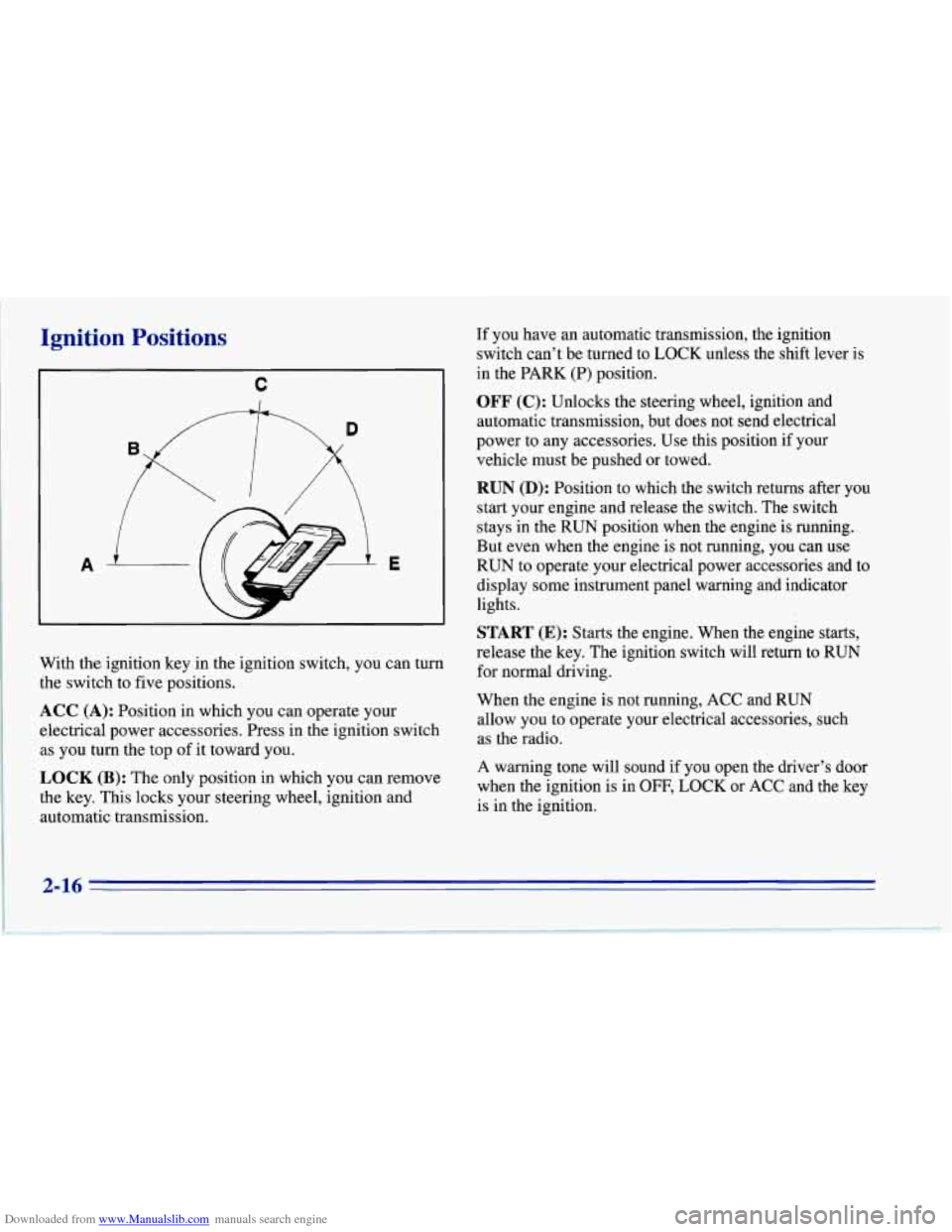
With the ignition key in the ignition switch, you can turn
the switch to five positions.
ACC (A): Position in which you can operate your
electrical power accessories. Press in the ignition switch
as you turn the top of it toward you.
OCK (B): The only position in which you can remove
the key. This locks your steering wheel, ignition and
automatic transmission. If you
have an automatic transmission, the ignition
switch can't be turned to LOCK unless the shift lever is
in the PARK (P) position.
OFF (C): Unlocks the steering wheel, ignition and
automatic transmission, but does not send electrical
power to any accessories. Use this position if your
vehicle must be pushed or towed.
RUN (D): Position to which the switch returns after you
start your engine and release the switch. The switch
stays in the RUN position when the engine is running.
But even when the engine is not running, you can use
RUN to operate your electrical power accessories and to
display some instrument panel warning and indicator
lights.
START (E): Starts the engine. When the engine starts,
release the key. The ignition switch will return to RUN
for normal driving.
When the engine is not running, ACC and RUN
allow you to operate your electrical accessories, such
as the radio.
A warning tone will sound
if you open the driver's door
when the ignition is in
OFF, LOCK or ACC and the key
is in the ignition.
2-16
Page 68 of 386
Downloaded from www.Manualslib.com manuals search engine Shift Speeds (Manual Transmission)
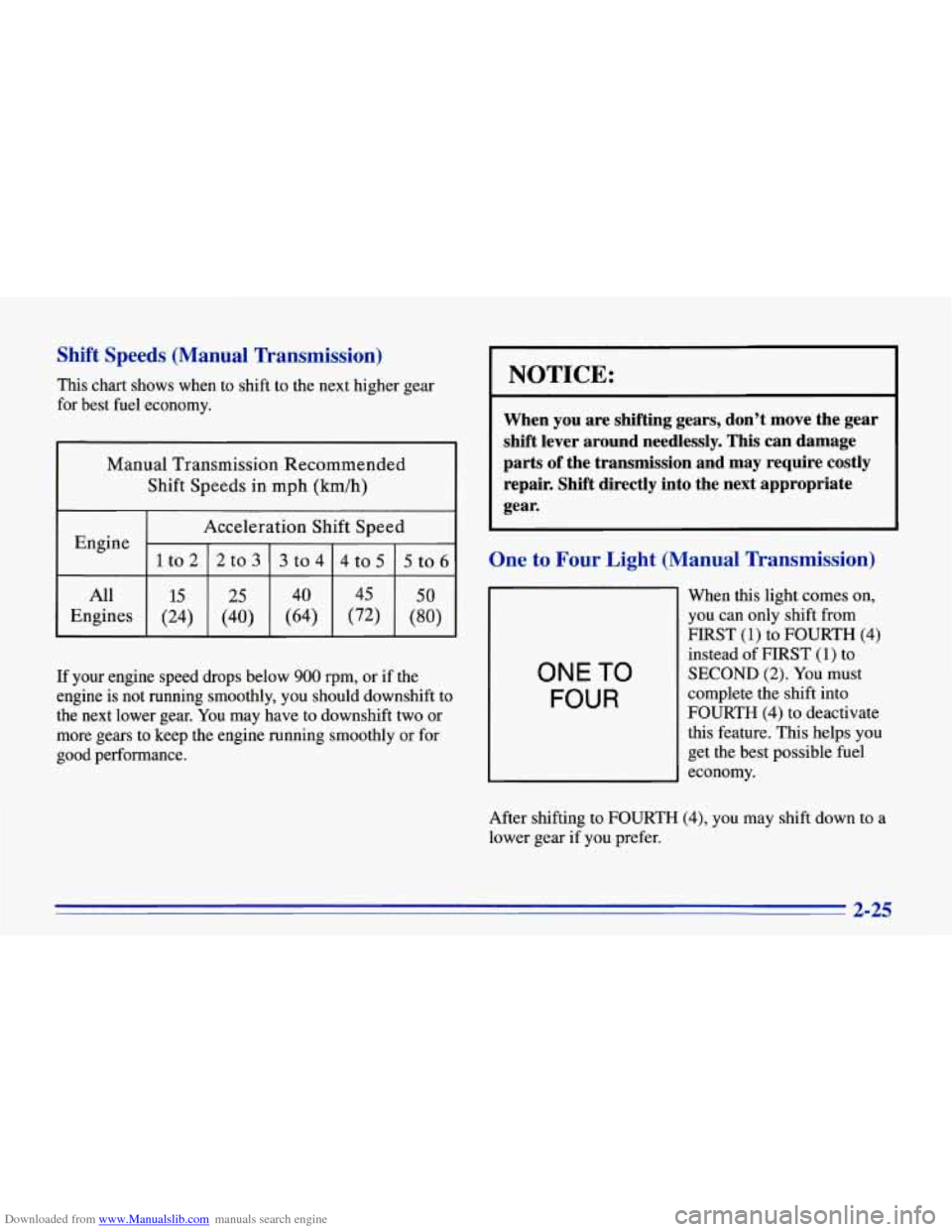
This chart shows when to shift to the next higher gear
for best fuel economy.
Manual Transmission Recommended
Shift Speeds in mph (km/h)
Acceleration Shift Speed
lto212to313to414to515to6
Engine -
All
(80) (72) (64) (40) (24) Engines
50 45 40 25 15
I NOTICE:
When you are shifting gears, don’t move the gear
shift lever around needlessly. This can damage
parts of the transmission and may require costly repair. Shift directly into the next appropriate
I gear.
One to Four Light (Manual Transmission)
If your engine speed drops below 900 rpm, or if the
engine is not running smoothly, you should downshift to
the next lower gear.
You may have to downshift two or
more gears to keep the engine running smoothly or for
good performance.
ONE TO
FOUR
When this light comes on,
you can only shift from
FIRST
(1) to FOURTH (4)
instead of FIRST (1) to
SECOND (2). You must
complete the shift into
FOURTH
(4) to deactivate
this feature. This helps you
get the best possible fuel
economy.
After shifting to FOURTH
(4), you may shift down to a
lower gear if you prefer.
2-25
Page 69 of 386
Downloaded from www.Manualslib.com manuals search engine NOTICE:
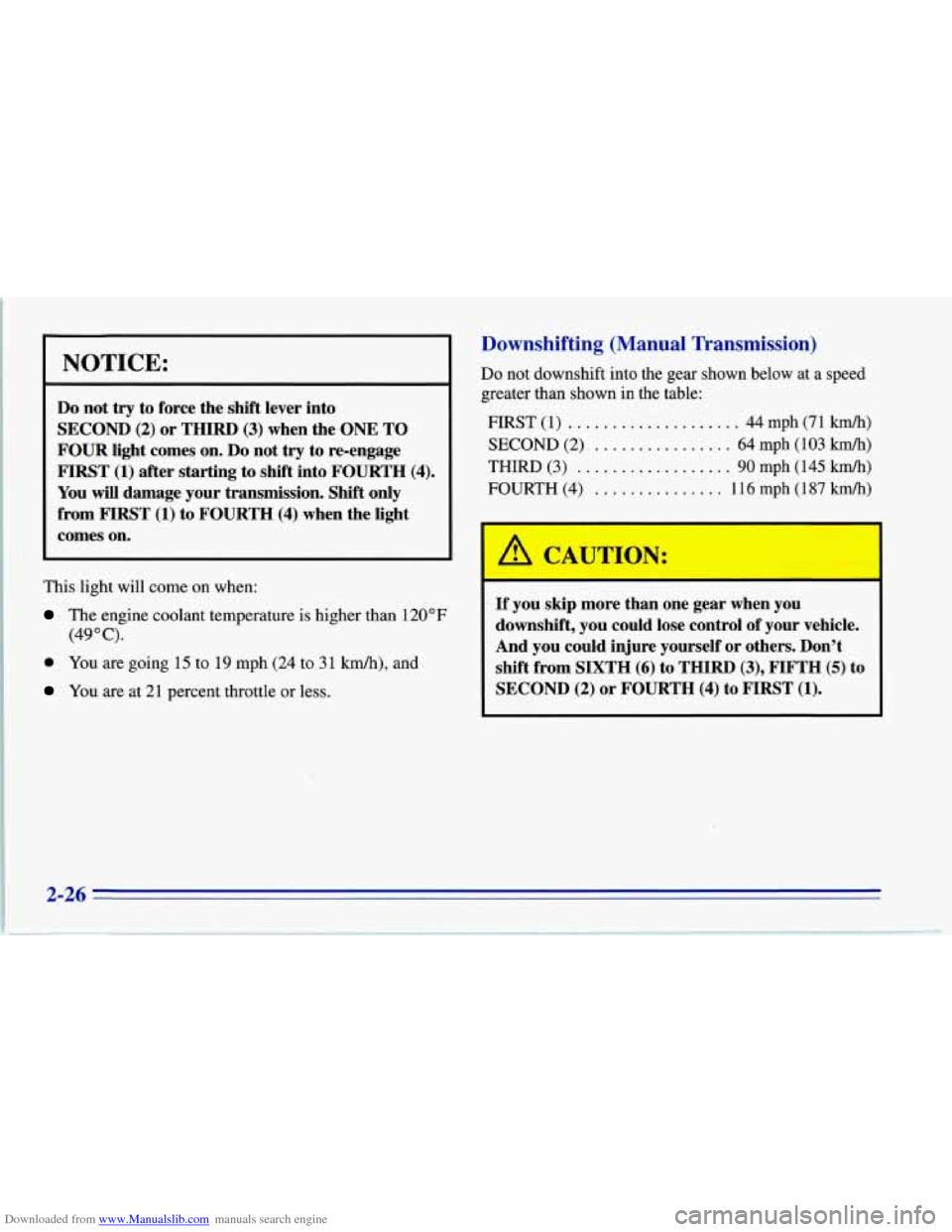
Do not try to force the shift lever into
SECOND (2) or THIRD (3) when the ONE TO
FOUR light comes on. Do not try to re-engage
FIRST (1) after starting to shift into FOURTH (4).
You will damage your transmission. Shift only
from FIRST
(1) to FOURTH (4) when the light
comes on.
This light will come on when:
The engine coolant temperature is higher than 120 OF
(49 O C).
0 You are going 15 to 19 mph (24 to 3 1 km/h), and
You are at 21 percent throttle or less.
Downshifting (Manual Transmission)
Do not downshift into the gear shown below at a speed
greater than shown in the table:
FIRST
(1) .......... :. ........ 44 mph (71 km/h)
SECOND (2) ................ 64 mph (103 km/h)
THIRD (3) .................. 90 mph (145 km/h)
FOURTH (4) ............... 116 mph (187 kmk)
If you skip more than one gear when you
downshift, you could lose control of your vehicle.
And you could injure yourself or others. Don’t
shift from SIXTH
(6) to THIRD (3), FIFTH (5) to
SECOND (2) or FOURTH (4) to FIRST (1).
Page 71 of 386
Downloaded from www.Manualslib.com manuals search engine TOUR: Use for city and highway driving. Provides a
smooth, soft ride. Parking Brake
SPORE Use where road conditions or personal
preference demand more control. Provides more “feel,”
or response to the road conditions.
PERF’: Use for performance driving. Provides a tight,
firm ride and precise response to road conditions.
You can select a setting at any time. Based on road
conditions and your vehicle speed, the system
automatically adjusts to provide the best ride and
handling. Select a new setting whenever driving
conditions change.
The SERVICE RIDE CONTROL light monitors the
system. Refer to “Service Ride Control Light” in
the Index.
Limited-Slip Rear Axle
Your rear axle can give you additional traction on snow,
mud, ice, sand
or gravel. It works like a standard axle
most
of the time, but when one of the rear wheels has no
traction and the other does, the limited-slip feature will
allow the wheel with traction to move the vehicle. To
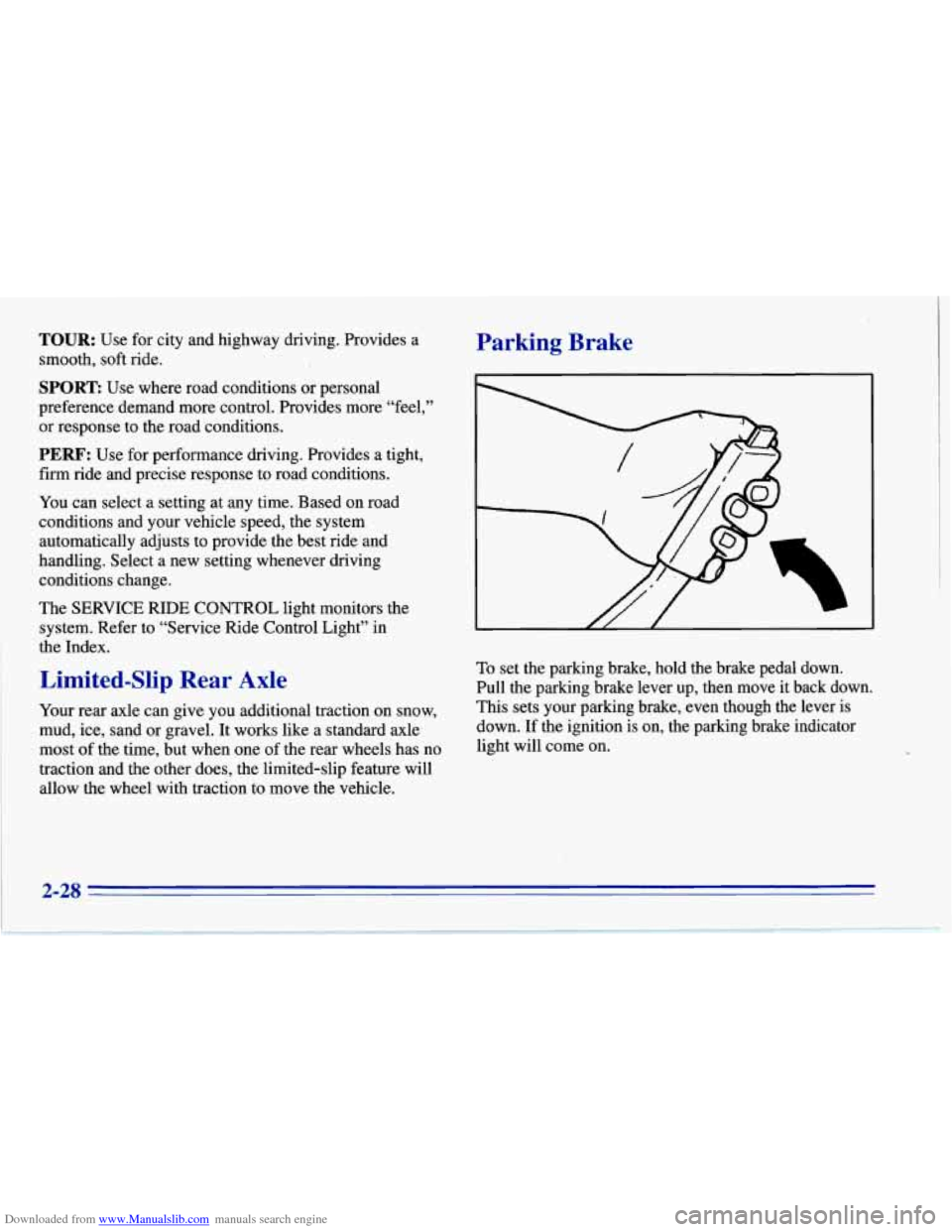
set the parking brake, hold the brake pedal down.
Pull the parking brake lever up, then move it back down.
This sets your parking brake, even though the lever is
down. If the ignition is on, the parking brake indicator
light will come on.
2-28
Page 79 of 386
Downloaded from www.Manualslib.com manuals search engine nrn and Lane Change Signals
The turn signal has two upward (for right) and two
downward (for left) positions. These positions allow you
to signal a turn or a lane change.
To signal a turn, move the multifunction lever all the
way up or down. When the turn is finished,
the lever
will return automatically.
A chime will remind you if you leave your turn signal
on for more than
1 mile (1.6 km) of driving.
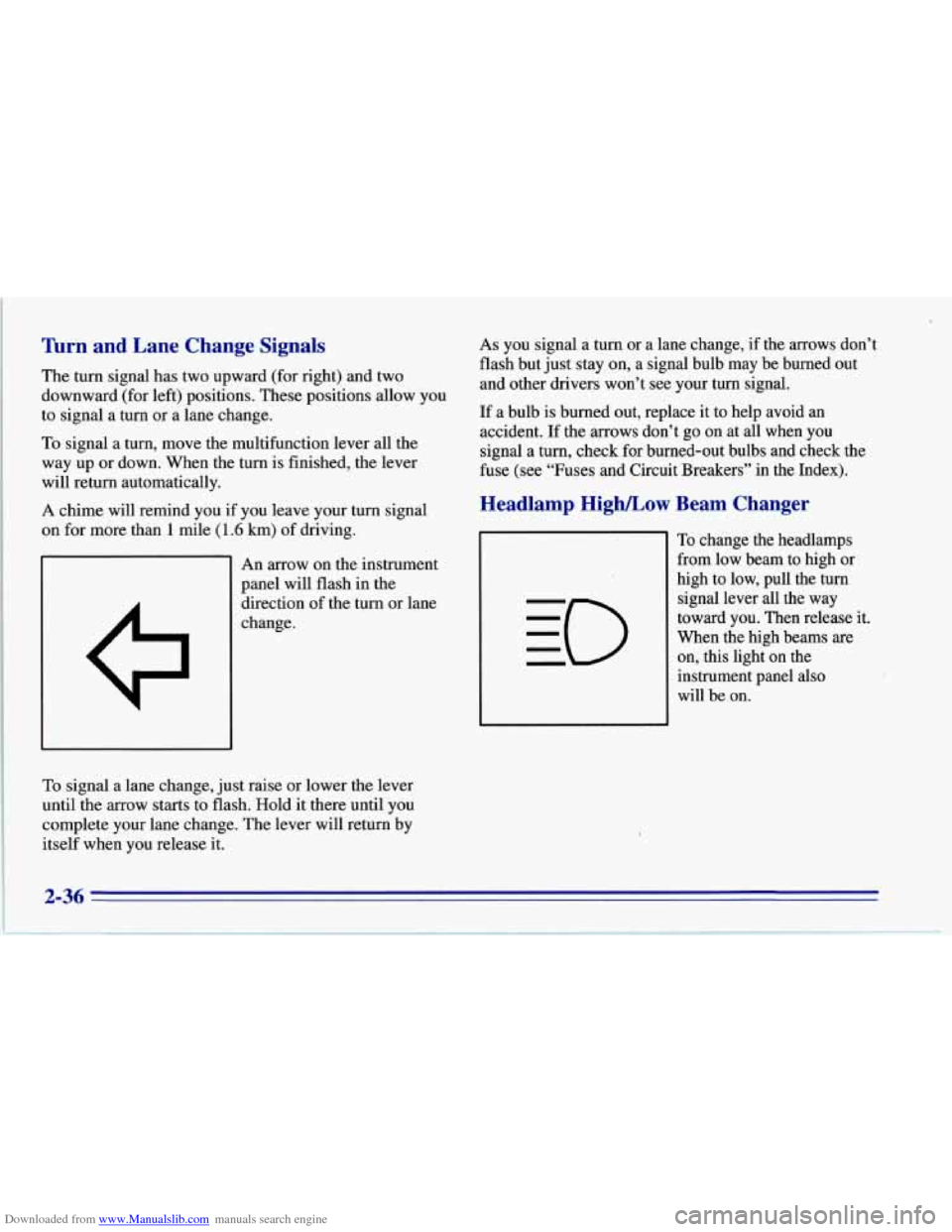
An arrow on the instrument
panel will flash in the
direction of the turn or lane
change.
To signal a lane change, just raise or lower the lever
until the
arrow starts to flash. Hold it there until you
complete your lane change. The lever will return by
itself when you release it.
As you signal a turn or a lane change, if the arrows don’t
flash but just stay on, a signal bulb may be burned out
and other drivers won’t see your turn signal.
If a bulb is burned out, replace it to help avoid an
accident.
If the arrows don’t go on at all when you
signal a turn, check for burned-out bulbs and check the
fuse (see “Fuses and Circuit Breakers” in the Index).
Headlamp High/Low Beam Changer
To change the headlamps
from low beam to high or
high to low, pull the turn
signal lever all the way
toward you. Then release it.
When the high beams
are
on, this light on the
instrument panel also
will be on.