Page 147 of 386
Downloaded from www.Manualslib.com manuals search engine Automatic Control
The system will adjust to maintain the'temperature you
set. It will select the best fan speed and aifflow setting to
keep you comfortable with the least amount of noise.
Press the arrows on the TEMP SET switch to set a
comfortable temperature. Then press AUTO and the fan
speed will adjust automatically unless you press the
arrows on the AUTO switch.
Manual Heating
The heater works best if you keep your windows closed
while using it.
Press the arrows on the TEMP SET switch to set a
comfortable temperature. Then press HEATER and, if
you don't like the automatic setting, press the arrows on
the fan speed switch. In AUTO FAN on cold days, the
fan will stay
off until the coolant warms up enough to
heat your vehicle.
If your vehicle has an engine coolant heater and you use
it in cold weather,
0 "F (- 18 O C) or lower, your heating
system can provide heat more quickly because the engine
coolant is already warmed. See "Engine Coolant Heater"
in the Index.
1
Manual Bi-Level
BI-LEVEL can heat or cool outside air and direct it in
two directions.
Press the arrows on the TEMP SET switch to set a
comfortable temperature. Press BI-LEVEL and, if you
don't like the automatic setting, press the arrows on the
fan speed switch.
Manual Ventilation
For mild outside temperatures, when little heating or
cooling
is needed, you can still direct outside air through
your vehicle.
Press the arrows on the TEMP SET switch to set a
comfortable temperature. For ventilation, the system
can't cool the vehicle below the outside temperature.
Press VENT and, if you don't like the automatic setting,
press the arrows on the fan speed switch.
3-6
Page 204 of 386
Downloaded from www.Manualslib.com manuals search engine Engine Overheating
You will find an engine coolant temperature gauge on
the instrument cluster and a
LOW COOLANT light on
the Driver Information Center.
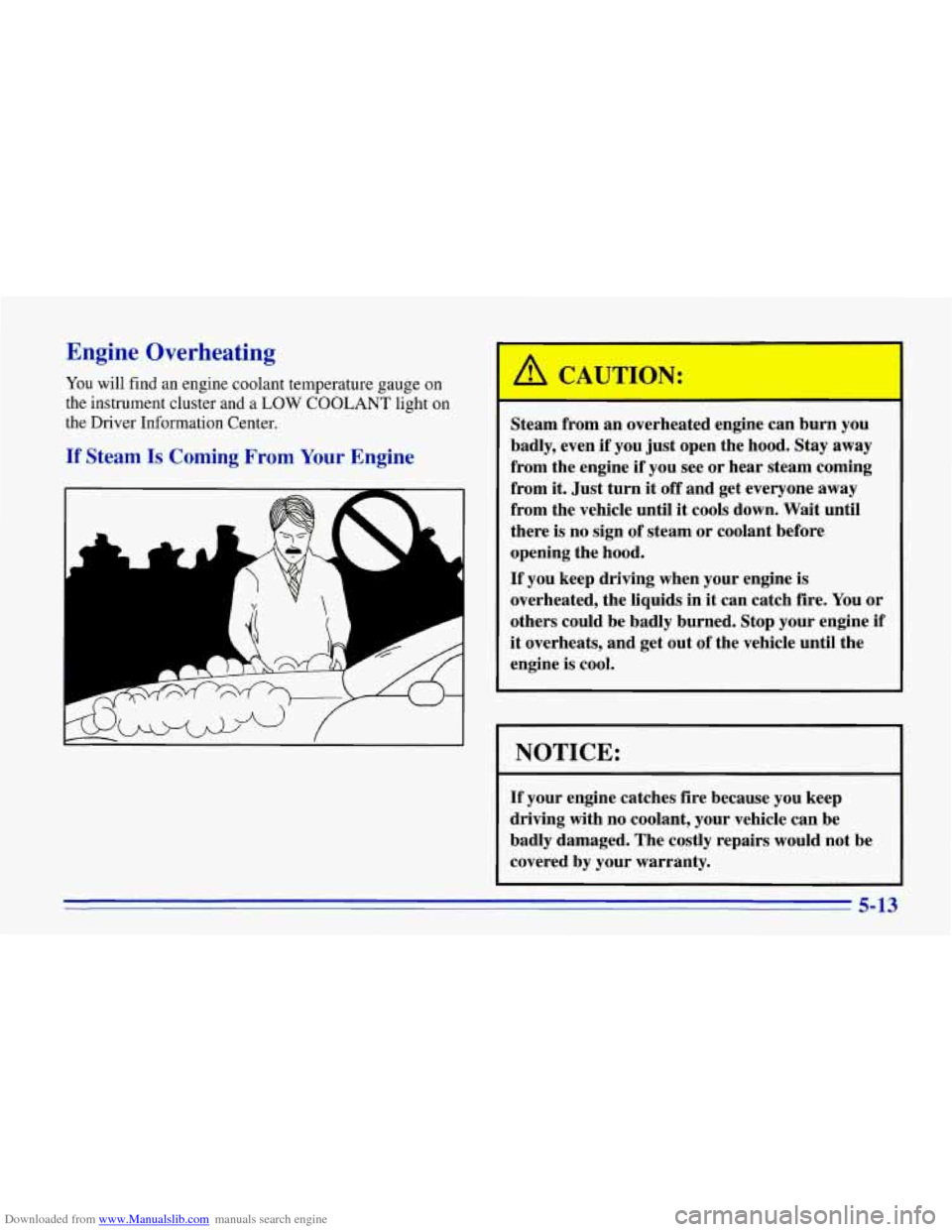
If Steam Is Coming From Your Engine
Steam from an overheated engine can burn you
badly, even if you just open the hood. Stay away
from the engine
if you see or hear steam coming
from it. Just turn it
off and get everyone away
from the vehicle until it cools down. Wait until
there is no sign of steam or coolant before
opening the hood.
If you keep driving when your engine is
overheated, the liquids in it can catch fire.
You or
others could be badly burned. Stop your engine if
it overheats, and get out of the vehicle until the
engine is cool.
I NOTICE:
If your engine catches fire because you keep
driving with no coolant, your vehicle can be
badly damaged. The costly repairs would not be
covered by your warranty.
Page 207 of 386
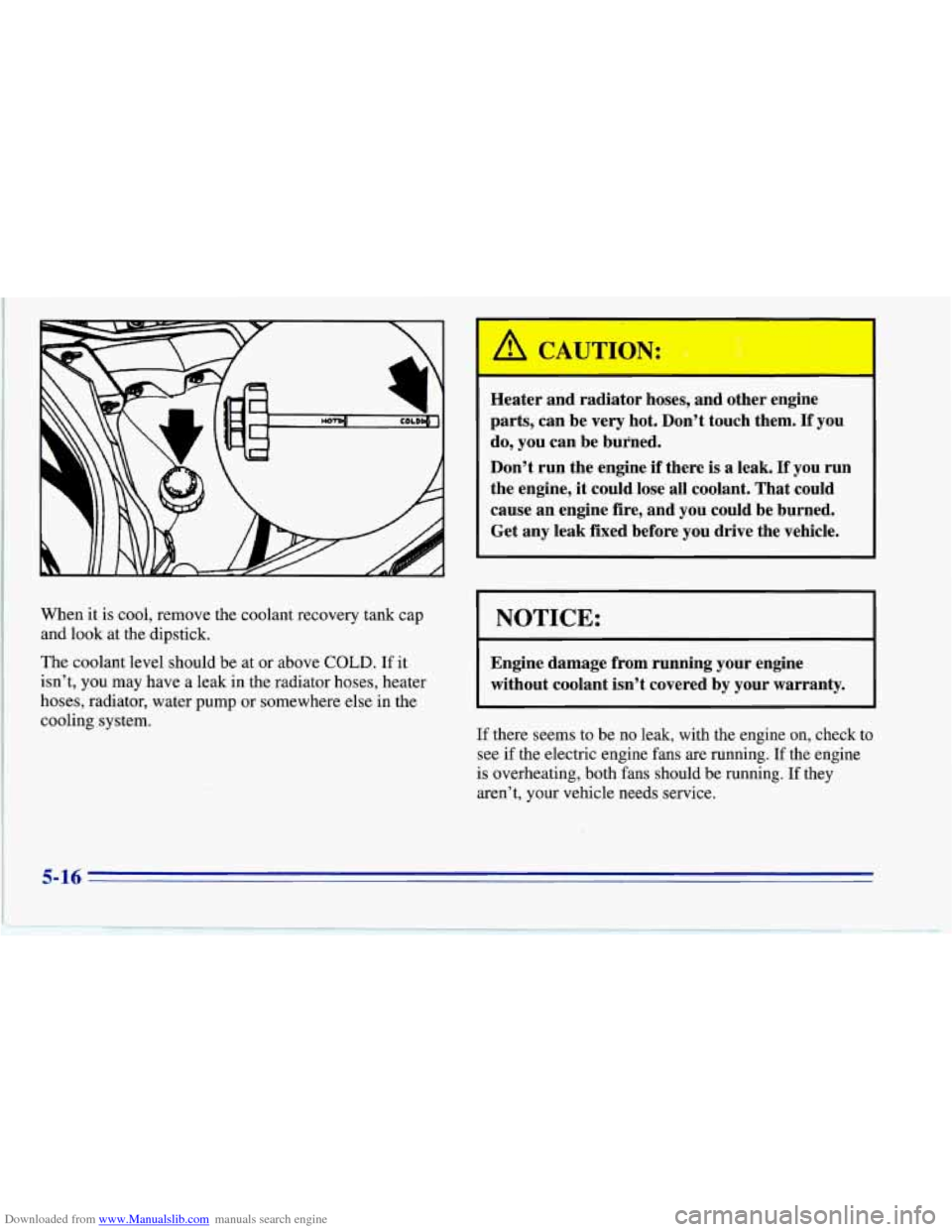
Downloaded from www.Manualslib.com manuals search engine When it is cool, remove the coolant recovery tank cap
and look at the dipstick.
The coolant level should be at or above
COLD. If it
isn’t, you may have a leak in the radiator hoses, heater
hoses, radiator, water pump
or somewhere else in the
cooling system.
.h CAUTION:
*
8’
Heater and radiator hoses, and other engine
parts, can be very
hot. Don’t touch them. If you
do, you can be bul‘ned.
Don’t run the engine
if there is a leak. If you run
the engine, it could lose all coolant. That could
cause an engine fire, and you could be burned.
Get any leak fixed before you drive the vehicle.
I NOTICE:
I
Engine damage from running your engine
without coolant isn’t covered by your warranty.
I
If there seems to be no leak, with the engine on, check to
see if the electric engine fans are running.
If the engine
is overheating, both fans should be running. If they
aren’t, your vehicle needs service.
5-16
Page 256 of 386
Downloaded from www.Manualslib.com manuals search engine What to Use
To add lubricant when the level is low, use Axle
Lubricant (GM
Part No. 12345977) or SAE SOW-90
GL-5 gear lubricant.
To completely refill after draining,
add 4 ounces
(1 18 ml) of Limited-Slip Differential
Lubricant Additive (GM Part
No. 1052358). Then fill to
the bottom
of the filler plug hole with Axle Lubricant
(GM
Part No. 12345977) or SAE SOW-90 GL-5 gear
lubricant.
Engine Coolant
The cooling system in your vehicle is filled with new
DEX-COOL (orange-colored, silicate-free) engine
coolant. This coolant is designed
to remain in your
vehicle for
5 years or 100,000 miles (166 000 km),
whichever occurs first.
The following explains your cooling system and how
to
add coolant when it is low. If you have a problem with
engine overheating or
if you need to add coolant to
your high fill reservoir, see “Engine Overheating”
in the Index.
A 50/50 mixture of water and the proper coolant for
your Corvette will:
0 Give freezing protection down to -34°F (-37°C).
0 Give boiling protection up to 265 OF ( 129 O C).
Protect against rust and corrosion.
Help keep the proper engine temperature.
0 Let the warning lights and gauges work as they should.
NOTICE:
When adding coolant it is important that you use
DEX-COOL (orange-colored, silicate-free)
coolant meeting GM Specification 6277M.
If
silicated coolant is added to the system,
premature engine, heater core or radiator
corrosion may result. In addition, the engine
coolant will require change sooner
-- at
30,000 miles (50 000 km) or 24 months,
whichever occurs first.
6-25
Page 258 of 386
Downloaded from www.Manualslib.com manuals search engine Checking Coolant
LOW
COOLANT
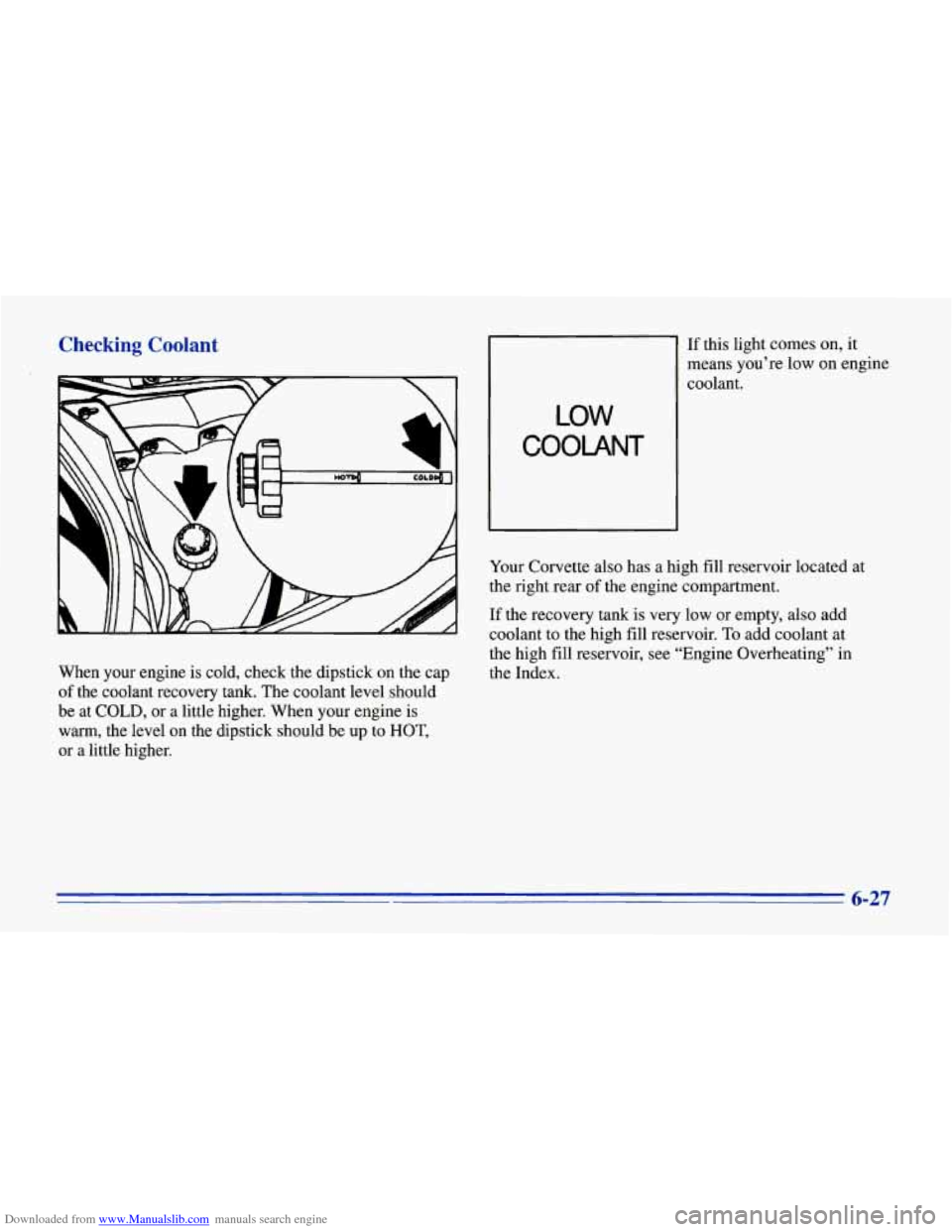
When your engine is cold, check the dipstick on the cap
of the coolant recovery tank. The coolant level should
be at COLD, or a little higher. When your engine is
warm, the level on the dipstick should be up to HOT,
or a little higher. If this
light comes on, it
means you’re
low on engine
coolant.
Your Corvette also has a high fill reservoir located at
the right rear
of the engine compartment.
If the recovery tank is very low or empty, also add
coolant to the high fill reservoir.
To add coolant at
the high fill reservoir, see “Engine Overheating” in
the Index.
6-27
Page 259 of 386
Downloaded from www.Manualslib.com manuals search engine Adding Coolant to the Recovery Tank
If you need more coolant, add the proper mix at the
coolant recovery tank, but only when your engine is
cool. If the tank is
very low or empty, also add coolant
to the coolant high fill reservoir. See “Engine
Overheating” in the Index for information.
.JTION:
r
Turning the coolant high fill reservoir pressure cap
when the engine and radiator are hot
can allow
steam and scalding liquids to blow out and burn
you badly. Never
turn the pressure cap -- even a
little
-- when the engine and radiator are hot.
Add coolant mix at the recovery tank, but be careful not
to spill it.
I
CAUTION:
You can be burned if you spill coolant on hot
engine
parts. Coolant contains ethylene glycol.
and
it will burn if the engine parts are hot
enough. Don’t spill coolant on a hot engine.
For complete drain, flush and refill of the engine,
contact your Chevrolet dealer or the procedure may be
found in a Chevrolet Corvette Service Manual.
To
purchase a service manual, see “Service and Owner
Publications” in the Index.
6-28
Page 260 of 386
Downloaded from www.Manualslib.com manuals search engine Coolant High Fill Reservoir Cap
NOTICE:
Your coolant high fill reservoir cap is a 15 psi
(105 kPa) pressure-type cap and must be tightly
installed to prevent coolant loss
and possible
engine damage from overheating. Be sure the
arrows on the cap line up with the overflow tube.
Thermostat
Engine coolant temperature is controlled by a thermostat
in the engine coolant system. The thermostat stops the
flow of coolant through the radiator until the coolant
reaches a pre-set temperature.
Power Steering Fluid
When to Check Power Steering Fluid
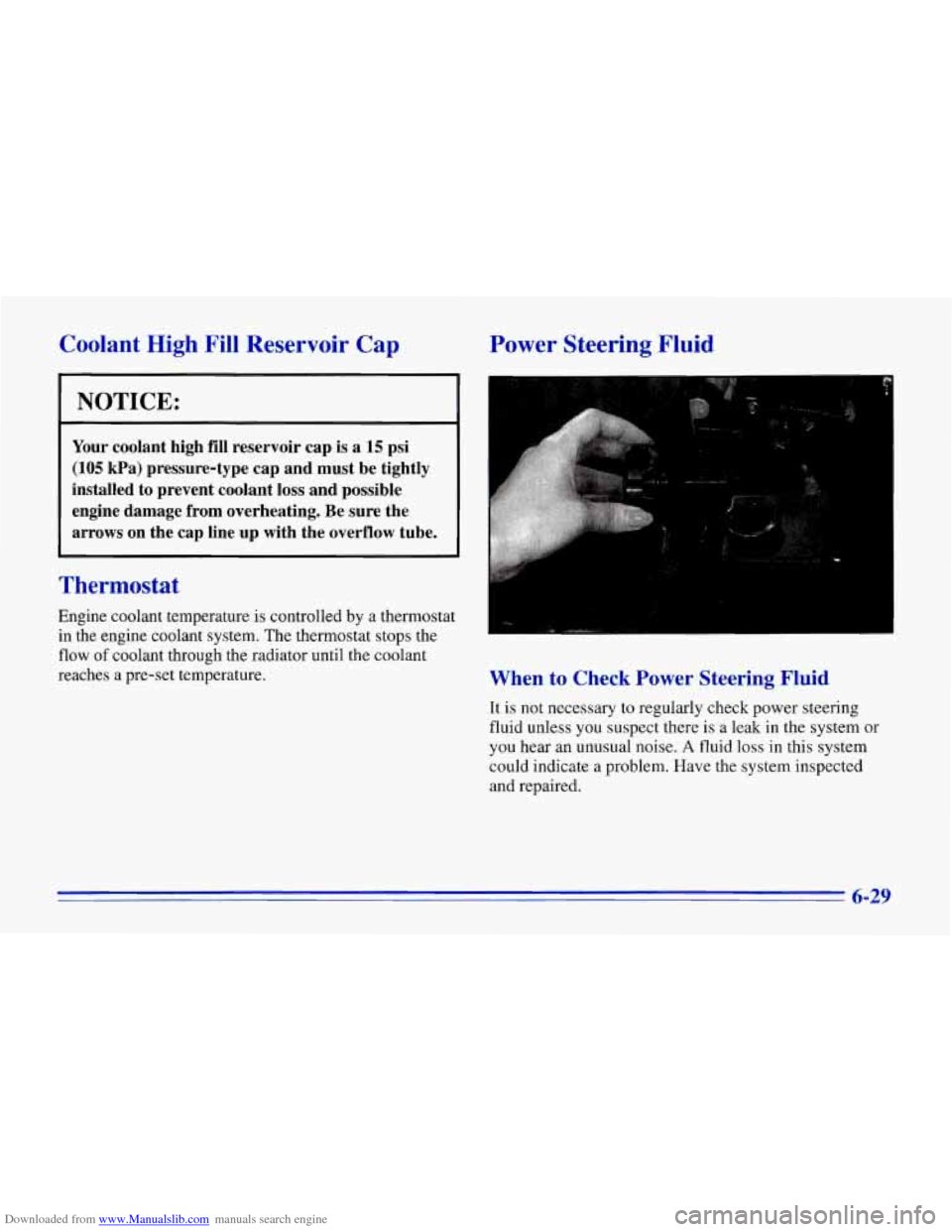
It is not necessary to regularly check power steering
fluid unless you suspect there is a leak in the system or
you hear an unusual noise.
A fluid loss in this system
could indicate a problem. Have the system inspected
and repaired.
6-29
Page 277 of 386
Downloaded from www.Manualslib.com manuals search engine Tires
We don’t make tires. Your new Corvette comes with
high-quality tires made by a leading tire manufacturer.
If you ever have questions about your tire warranty and
where to obtain service, see your Corvette Warranty
booklet for details.
Poorly maintained and improperly used tires are
dangerous.
Overloading your tires can cause
overheating as
a result of too much friction.
You could have an air-out and a serious
accident. See “Loading Your Vehicle” in
the Index.
CAUTION: (Continued) CAUTION: (Co
Underinflated tires
pose the same danger as
overloaded tires. The resulting accident
could cause serious injury. Check all tires
frequently to maintain the recommended
pressure. Tire pressure should be checked
when your tires are cold.
cut, punctured or broken by a sudden
impact
-- such as when you hit a pothole.
Keep tires
at the recommended pressure.
Worn, old tires can cause accidents. If your
tread
is badly worn, or if your tires have
been damaged, replace them.
Overinflated tires are more likely to be
See “1nfla.tion
-- Tire Pressure” in this section for
the correct inflation pressure for competitive or
high-speed driving.