1996 CHEVROLET CAVALIER engine oil
[x] Cancel search: engine oilPage 261 of 372
Downloaded from www.Manualslib.com manuals search engine NOTICE:
When adding coolant it is important that you
use DEX-COOL
TM (orange-colored, silicate-free)
coolant meeting
GM Specification 6277M.
If silicated coolant is added to the system,
premature engine, heater core or radiator
corrosion may result. In addition, the engine
coolant will require change sooner
-- at
30,000 miles (50 000 km) or 24 months
whichever occurs first.
What to Use
Use a mixture of one-half clean water (preferably
distilled) and one-half
DEX-COOL TM (orange-colored,
silicate-free) antifreeze that meets
GM Specification
6277M, which won’t damage aluminum parts. Use
GM Engine Coolant Supplement (sealer) (GM Part
No. 3634621) with any complete coolant change. If you
use this mixture, you don’t need to add anything else.
Adding only plain water to your cooling system
can be dangerous. Plain water, or
some other
liquid like alcohol, can boil before the proper
coolant mix will. Your vehicle’s coolant warning
system is set
for the proper coolant mix. With
plain water
or the wrong mix, your engine could
get too hot but you wouldn’t get the overheat
warning. Your engine could catch fire and you
or
others could be burned. Use a 50/50 mix of clean
water and DEX-COOL
TM (orange-colored,
silicate-free) antifreeze.
6-23
Page 267 of 372
Downloaded from www.Manualslib.com manuals search engine What to Add
When you do need brake fluid, use only DOT-3 brake
fluid
-- such as Delco Supreme 11 @ (GM Part
No. 1052535). Use new brake fluid from a sealed
container only, and always clean the brake fluid
reservoir cap before removing
it.
I
1
With the wrong kind of fluid in your brake
system, your brakes may not work well, or they
may not even work at all. This could cause
a
crash. Always use the proper brake fluid.
NOTICE:
Using the wrong fluid can badly damage
brake system parts. For example, just
a few
drops of mineral-based oil, such
as engine
oil, in your brake system can damage brake
system parts
so badly that they’ll have to be
replaced. Don’t let someone put in the
wrong kind of fluid.
0 If you spill brake fluid on your vehicle’s
painted surfaces, the paint finish can be
damaged. Be careful not to spill brake
fluid on your vehicle.
If you do, wash it off
immediately. See “Appearance Care” in
the Index.
6-29
Page 283 of 372
Downloaded from www.Manualslib.com manuals search engine Using Solvent-Type Cleaner on Fabric
First, see if you have to use solvent-type cleaner at all.
Some spots and stains will clean
off better with just
water and mild soap.
If you need to use a solvent:
Gently scrape excess soil from the trim material with
a clean, dull knife or scraper. Use very little cleaner,
light pressure and clean cloths (preferably
cheesecloth). Cleaning should start at the outside of
the stain, “feathering” toward the center. Keep
changing to a clean section of the cloth.
When you clean a stain from fabric, immediately
dry the area with a blow dryer
to help prevent a
cleaning ring.
Fabric Protection
Your Chevrolet has upholstery that has been treated with
Scotchgard” Fabric Protector, a
3M product. It protects
fabrics by repelling oil and water, which are the carriers
of most stains. Even with this protection, you still need
to clean your upholstery often to keep it looking new.
Further information on cleaning is available by calling
1-800-433-3296 (in Minnesota, 1-800-642-6 167).
Special Cleaning Problems
Greasy or Oily Stains
Stains caused by grease, oil, butter, margarine, shoe
polish, coffee with cream, chewing gum, cosmetic creams, vegetable oils, wax crayon, tar and asphalt
can
be removed as follows:
0 Carefully scrape off excess stain.
Follow the solvent-type instructions described
earlier.
Shoe polish, wax crayon, tar and asphalt will stain
if left on
a vehicle’s seat fabric. They should be
removed as soon as possible. Be careful, because
the cleaner will dissolve them and may cause them
to spread.
Non-Greasy Stains
Stains caused by catsup, coffee (black), egg, fruit, fruit
juice, milk, soft drinks, wine, vomit, urine and blood can
be removed as follows:
Carefully scrape off excess stain, then sponge the
soiled area with cool water.
If a stain remains, follow the foam-type instructions
described earlier.
6-45
Page 286 of 372
Downloaded from www.Manualslib.com manuals search engine soft, clean chamois or a 100% cotton towel to avoid
surface scratches and water spotting.
High pressure
car washes may cause water to enter
your vehicle.
Finish Care
Occasional waxing or mild polishing of your Chevrolet
by hand may
be necessary to remove residue from the
paint finish. You can get GM-approved cleaning
products from your dealer.
(See “Appearance Care and
Materials” in the Index.)
Your Chevrolet has
a “basecoat/clearcoat” paint finish.
The clearcoat gives more depth and gloss to the colored
basecoat. Always use waxes and polishes that
are
non-abrasive and made for a basecoat/clearcoat paint finish.
NOTICE:
Machine compounding or aggressive polishing on
a basecoatklearcoat paint finish may dull the
finish
or leave swirl marks.
Foreign materials such as calcium chloride and other
salts, ice melting agents, road oil and tar, tree sap, bird
droppings, chemicals from industrial chimneys,
etc. can
damage your vehicle’s finish if they remain on painted
surfaces. Wash the vehicle as soon as possible. If
necessary,
use non-abrasive cleaners that are marked
safe for painted surfaces to remove foreign matter.
Exterior painted surfaces are subject
to aging, weather
and chemical fallout that can take their toll over a period
of
years. You can help to keep the paint finish looking
new by keeping your Chevrolet garaged or covered
whenever possible.
Cleaning Your Convertible Top
Your convertible top should be cleaned often. If you use
an automatic car wash, use one with water jets and
hanging cloths. High pressure car washes may cause
water
to enter your vehicle.
When you hand wash the top, do it in partial shade. Use
a mild soap, lukewarm wat.er and a soft sponge.
A
chamois or cloth may leave lint on the top, and a brush
can chafe the threads in the top fabric. Don’t use
detergents, harsh cleaners, solvents or bleaching agents.
When you clean
the top, put one hand under it to
support it. Wet the entire vehicle and wash the top
evenly to avoid spots or rings. Let the soap remain on
the fabric for a few minutes. When the top is really dirty,
use a mild foam-type cleaner. Thoroughly rinse the
entire vehicle, then
let the top dry in direct sunlight.
6-48
Page 289 of 372
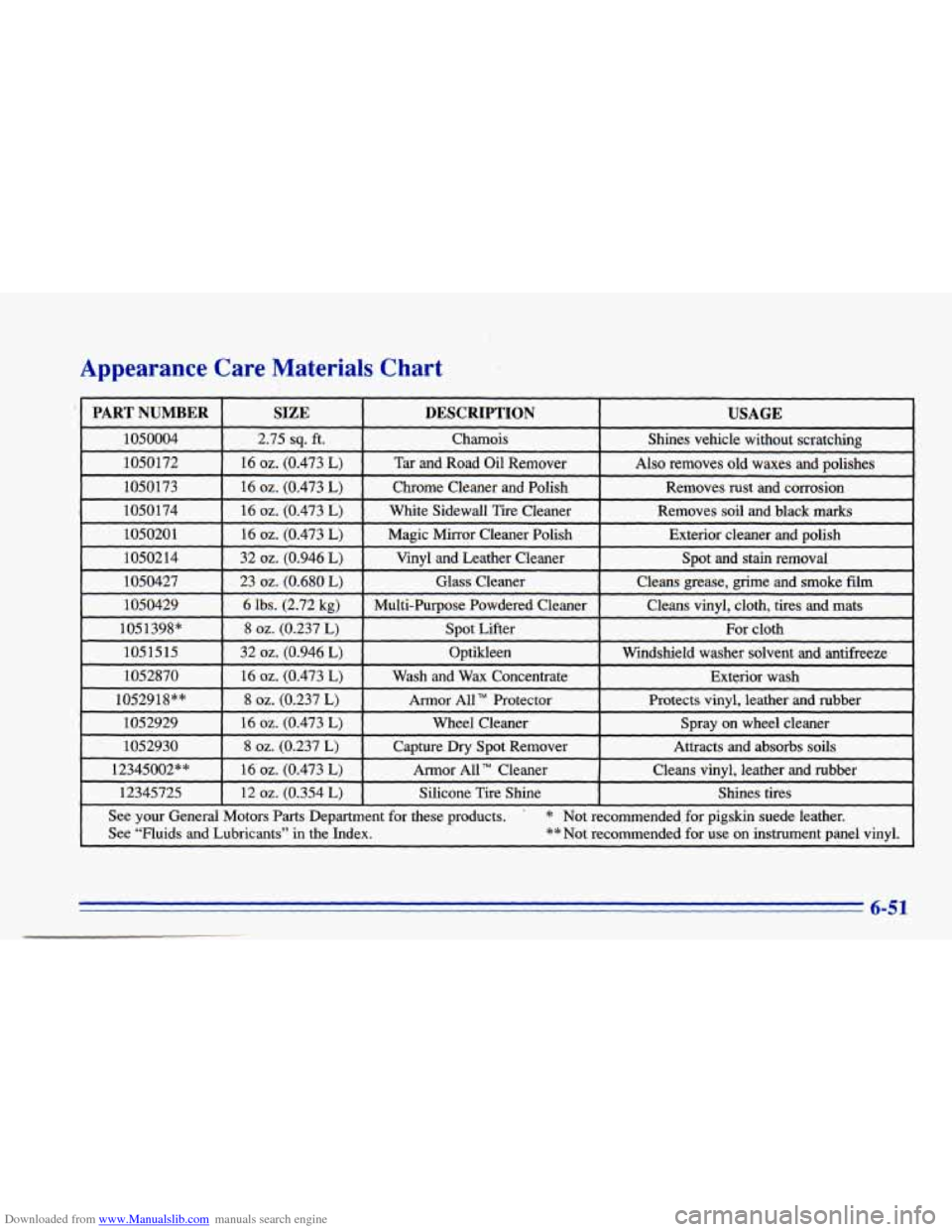
Downloaded from www.Manualslib.com manuals search engine Appearance Care Materials Chart
1052929 16 02. (0.473 L) Wheel Cleaner
Spray on wheel cleaner
1052930 8 oz. (0.237 L) Capture Dry Spot Remover Attracts and absorbs soils
12345002** 16 oz. (0.473 L) Armor All” Cleaner Cleans Vinyl, leather and rubber
12345725 12 oz. (0.354 L) Silicone Tire Shine Shines tires
See your General Motors Parts Department for these products. ’ * Not recommended. for pigskin suede leather.
See “Fluids and Lubricants”
in the Index. ** Not recommended for use on instrument panel vinyl.
6-51
Page 298 of 372
Downloaded from www.Manualslib.com manuals search engine Normal Maintenance Replacement
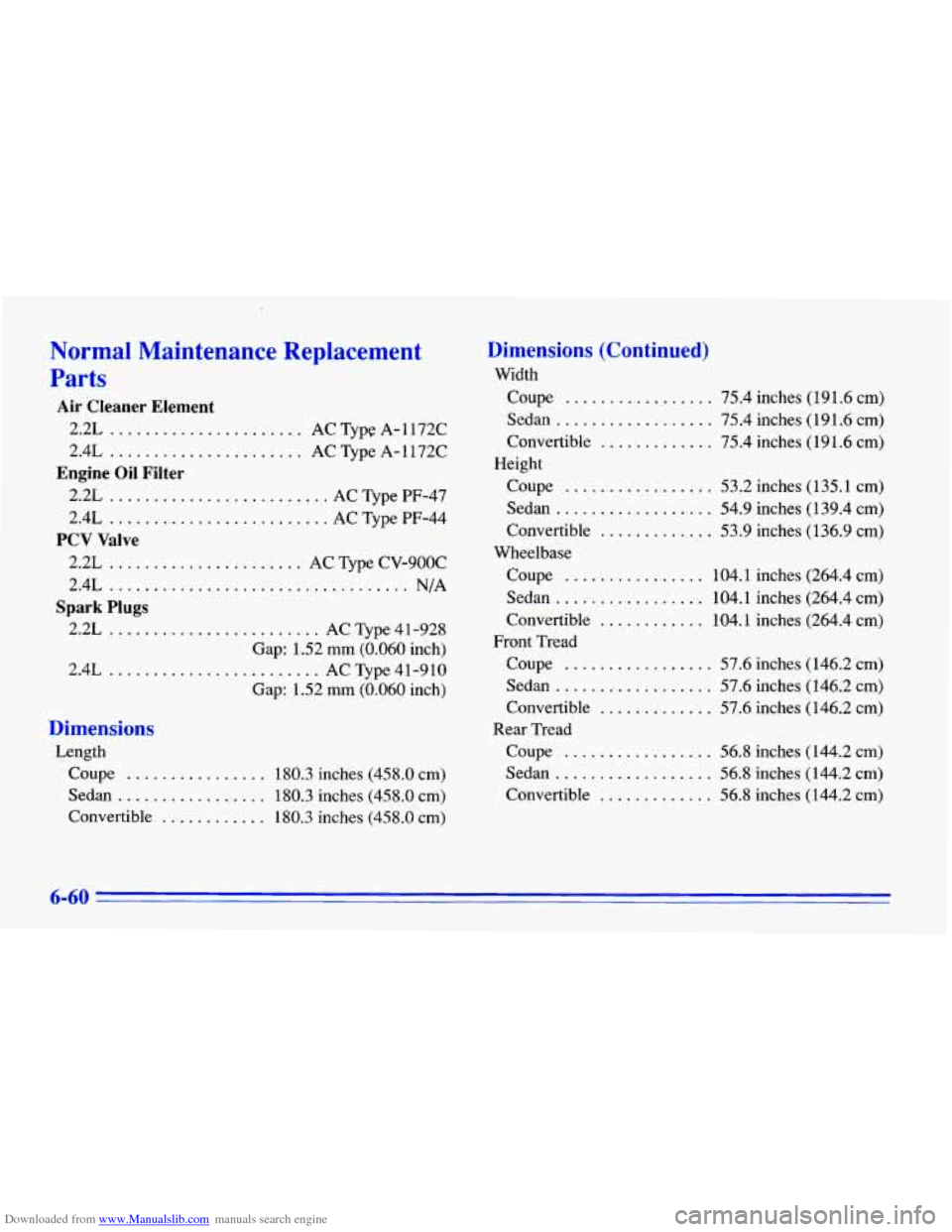
Parts
Air Cleaner Element
2.2L ...................... AC Type A-1172C
2.4L
...................... AC Type A-1172C
2.2L
......................... AC Type PF-47
2.4L
......................... AC Type PF-44
2.2L
...................... AC Type CV-900C
Engine Oil Filter
PCV Valve
2.4L .................................. N/A
Spark Plugs
2.2L ........................ AC Type 41 -928
2.4L ........................ AC Type 41-910
Gap: 1.52 mm (0.060
inch)
Gap: 1.52 mm (0.060 inch)
Dimensions
Length
Coupe
................ 180.3 inches (458.0 cm)
Sedan
................. 180.3 inches (458.0 cm)
Convertible
............ 180.3 inches (458.0 cm)
Dimensions (Continued)
Width
Coupe
................. 75.4 inches (191.6 cm)
Sedan
.................. 75.4 inches (191.6 cm)
Convertible
............. 75.4 inches (19 1.6 cm)
Coupe
................. 53.2 inches (135.1 cm)
Sedan
.................. 54.9 inches (139.4 cm)
Height
Convertible
............. 53.9 inches ( 136.9 cm)
Wheelbase Coupe
................. 104.1 inches (264.4 cm)
Sedan
................. 104.1 inches (264.4 cm)
Convertible
............ 104.1 inches (264.4 cm)
Coupe
................. 57.6 inches (146.2 cm)
Sedan
.................. 57.6 inches (146.2 cm)
Convertible
............. 57.6 inches (146.2 cm)
Coupe
................. 56.8 inches (144.2 cm)
Sedan
.................. 56.8 inches (144.2 cm)
convertible
............. 56.8 inches (144.2 cm)
Front Tread
Rear Tread
6-60
Page 299 of 372
Downloaded from www.Manualslib.com manuals search engine 0 Section 7 Maintenance Schedule
I
I
IMPORTANT.
KEEP ENGINE OIL
AT THE PROPER
LEVEL AND CHANGE AS
RECOMMENDED
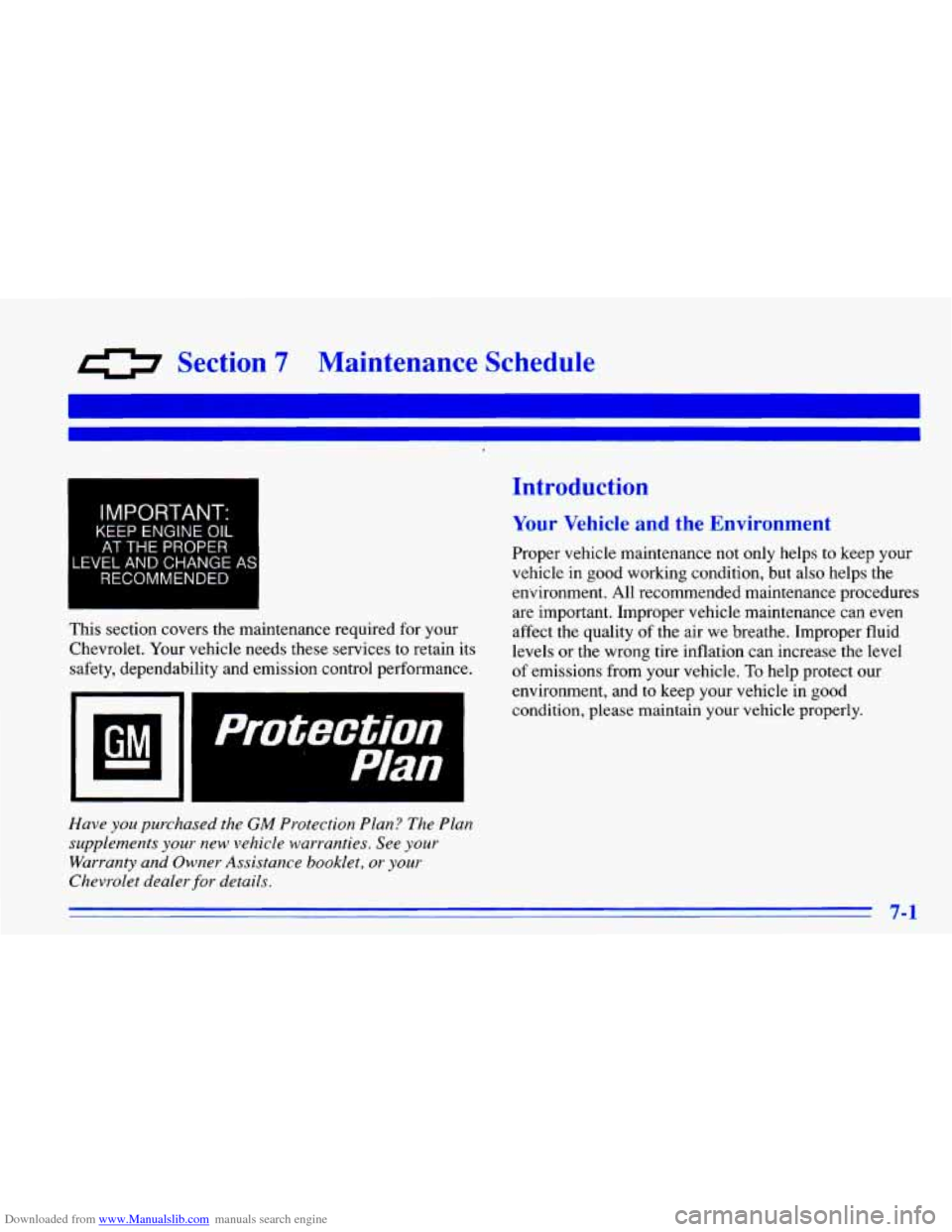
This section covers the maintenance required for your
Chevrolet. Your vehicle needs these services to retain its
safety, dependability and emission control performance.'
Introduction
Your Vehicle and the Environment
Proper vehicle maintenance not only helps to keep your
vehicle in good working condition, but also helps the
environment. All recommended maintenance procedures
are important. Improper vehicle maintenance can even
affect the quality
of the air we breathe. Improper fluid
levels or the wrong tire inflation can increase the level
of emissions from your vehicle. To help protect our
environment, and to keep your vehicle in
good
condition, please maintain your vehicle properly.
Have you purchased the GM Protection Plan? The Plan
supplements your new vehicle warranties. See your
Warranty and Owner Assistance booklet,
or your
Chevrolet dealer for details.
7-1
Page 302 of 372
Downloaded from www.Manualslib.com manuals search engine Maintenance Schedule
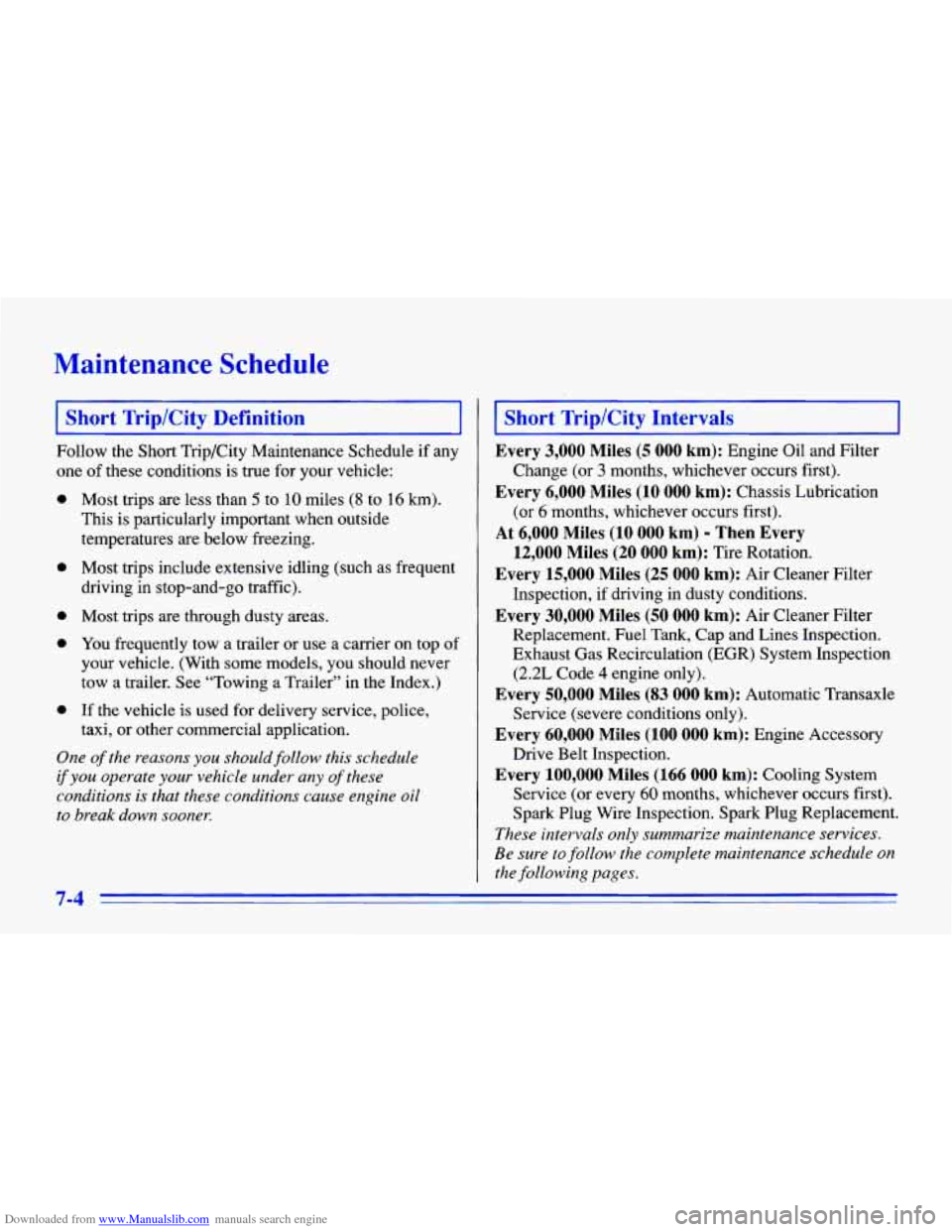
I Short Trip/City Definition
~~
I
Follow the Short Trip/City Maintenance Schedule if any
one of these conditions is true for your vehicle:
0
0
e
0
e
Most trips are less than 5 to 10 miles (8 to 16 km).
This is particularly important when outside
temperatures are below freezing.
Most trips include extensive idling (such as frequent
driving in stop-and-go traffic).
Most trips
are through dusty areas.
You frequently tow
a trailer or use a carrier on top of
your vehicle. (With some models, you should never
tow a trailer. See “Towing a Trailer” in the Index.)
If the vehicle is used for delivery service, police,
taxi, or other commercial application.
One of the reasons you should follow this schedule
if you operate your vehicle under any of these
conditions is that these conditions cause engine oil
to break down sooner.
Short Trip/City Intervals
Every 3,000 Miles (5 000 km): Engine Oil and Filter
Change (or
3 months, whichever occurs first).
Every 6,000 Miles (10 000 km): Chassis Lubrication
(or
6 months, whichever occurs first).
At 6,000 Miles (10 000 km) - Then Every
12,000 Miles (20 000 km): Tire Rotation.
Every 15,000 Miles (25 000 km): Air Cleaner Filter
Inspection,
if driving in dusty conditions.
Every 30,000 Miles (50 000 km): Air Cleaner Filter
Replacement. Fuel Tank, Cap and Lines Inspection.
Exhaust Gas Recirculation (EGR) System Inspection
(2.2L Code 4 engine only).
Every 50,000 Miles (83 000 km): Automatic Transaxle
Service (severe conditions only).
Every 60,000 Miles (100 000 km): Engine Accessory
Drive Belt Inspection.
Every 100,000 Miles (166 000 km): Cooling System
Service (or every
60 months, whichever occurs first).
Spark Plug Wire Inspection. Spark Plug Replacement.
These intervals only summarize maintenance services.
Be sure to follow the complete maintenance schedule
on
the following pages.
7-4