Page 81 of 372
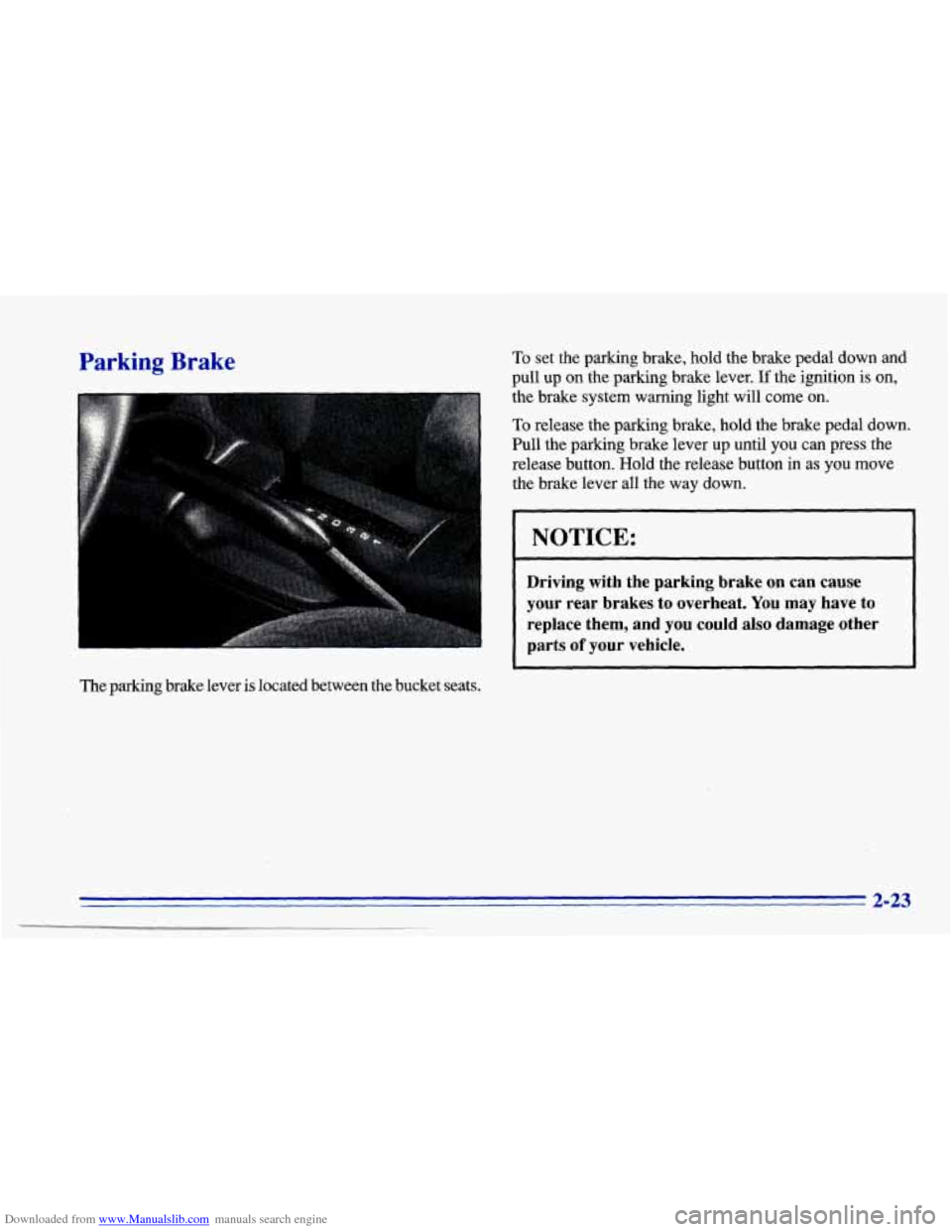
Downloaded from www.Manualslib.com manuals search engine Parking Brake To set the parking brake, hold the brake pedal down and
pull up on the parking brake lever. If the ignition is on,
the brake system
warning light will come on.
To release the
parking brake, hold the brake pedal down.
Pull the parking brake lever up until you can press the
release button. Hold the release button in as you move
the brake lever all the way down.
NOTICE:
-
Driving with the parking brake on can cause
your rear brakes to overheat.
You may have to
replace them, and you could also damage other
parts
of your vehicle.
The parking brake lever is located between the bucket seats.
2-23
Page 141 of 372
Downloaded from www.Manualslib.com manuals search engine Heating
On cold days, use FLOOR with the temperature knob all
the way in the red area. The system will bring in outside
air, heat it and send it to the floor ducts.
Your vehicle has heat ducts that are directed toward
the rear seat. Keep the area under the front seats clear
of obstructions so the heated air can reach the rear
seat passengers.
If your vehicle has an engine coolant heater, you can use
it
to help your system provide warm air faster when it’s
cold outside
(0°F (-18°C) or lower). An engine coolant
heater warms the coolant your engine and heating
system
use to provide heat. See “Engine Coolant
Heater’’ in the Index.
Ventilation System
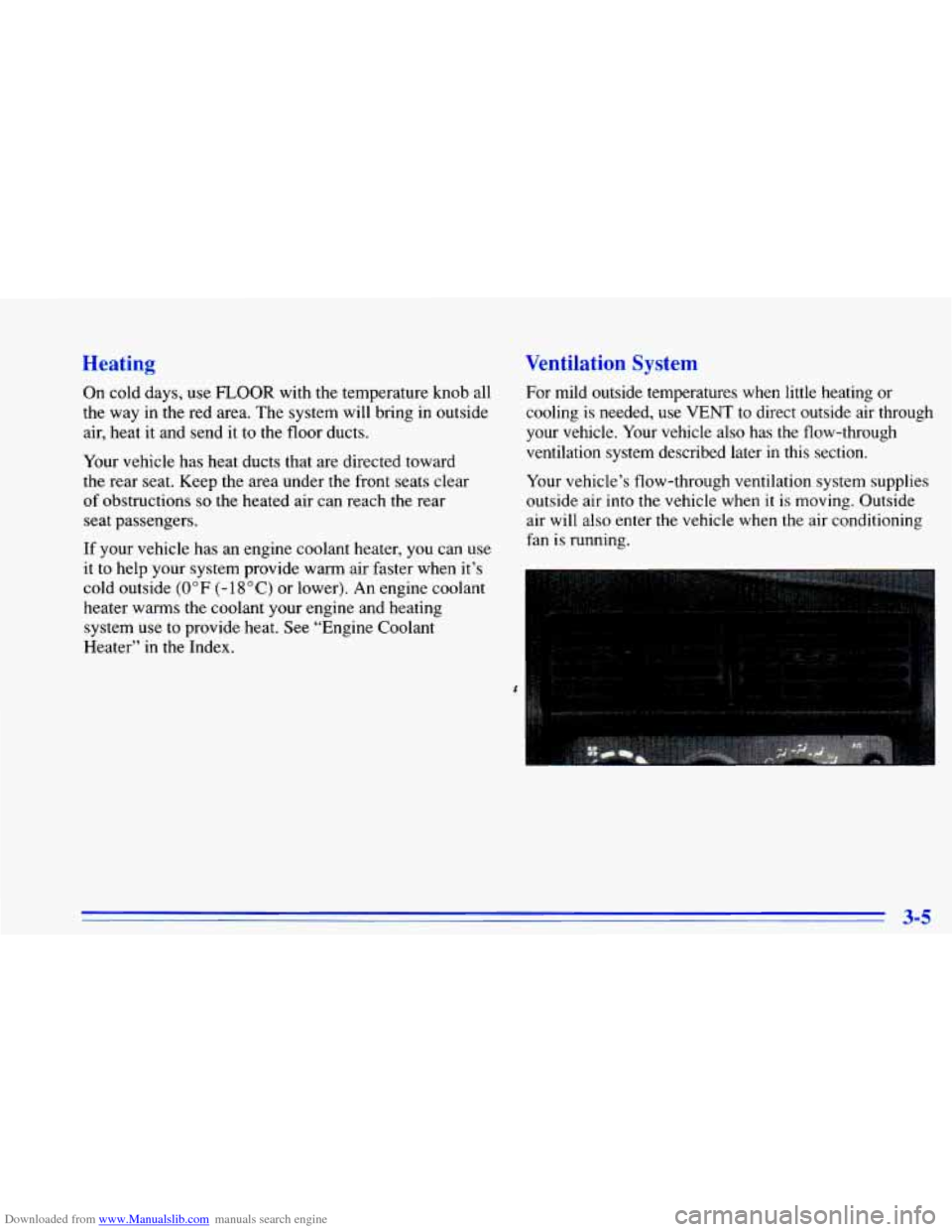
For mild outside temperatures when little heating or
cooling
is needed, use VENT to direct outside air through
your vehicle. Your vehicle
also has the flow-through
ventilation system described later in this section.
Your vehicle’s flow-through ventilation system supplies
outside air into
the vehicle when it is moving. Outside
air will also enter the vehicle when the air conditioning
fan
is running.
3-5
Page 142 of 372
Downloaded from www.Manualslib.com manuals search engine Ventilation Tips
0
0
0
Keep the hood and front air inlet free of ice, snow or
any other obstruction, such as leaves. The heater and
defroster will work far better? reducing the chance of
fogging the inside of your windows.
When you enter a vehicle in cold weather, adjust the
mode knob to
FLOOR and the fan to the highest speed
for a fcw moments before driving
off. This helps clear
the intake ducts of snow and moisture and reduces the
chance
of fogging the inside of your windows.
Keep the
air path under the front seats clear of objects.
This helps air circulate throughout your vehicle.
Defogging and Defrosting Windows
Your system has two settings for clearing the front and
side windows.
To defrost the windows quickly, use
DEFROST with the temperature knob all the way in
the red area.
To warm passengers while keeping the
windows clean, use DEFOG.
To defog the side windows, set the right control to
BI-LEVEL and the fan control to the highest setting.
To defog the side windows while using the air
conditioner, set the right control to BI-LEVEL, the fan
control to the highest setting, and press the
A/C button.
For both systems, aim the side vents toward the side
windows. For increased airflow to the side vents,
close
the center vents.
3-6
Page 195 of 372
Downloaded from www.Manualslib.com manuals search engine A CAUTI-N:
I
- I
Things you put inside your vehicle can strike and
injure people in
a sudden stop or turn, or in a crash.
Put things in the trunk or rear area of your
vehicle. In
a trunk, put them as far forward
as you can.
Try to spread the weight evenly.
If you have fold-down rear seats, you’ll
find four anchors on the back wall of your
trunk.
You can use these anchors to tie
down lighter loads. They’re not strong
enough for heavy things, however,
so put
them as far forward
as you can in the trunk
or rear area.
Never stack heavier things, like suitcases,
inside the vehicle
so that some of them are
above the tops of the seats.
Don’t leave an unsecured child restraint in
your vehicle.
When you carry something inside the
vehicle, secure it whenever you can.
Don’t leave a seat folded down unless you
need to.
Towing a Trailer (Models with
2.4L Engine a1 1 $-Speed mtomatic
Transaxle)
,A CAUTION:
If you don’t use the correct equipment and drive
properly, you can lose control when you pull
a
trailer. For example, if the trailer is too heavy, the
brakes may not work well
-- or even at all. You
and your passengers could be seriously injured.
Pull
a trailer only if you have followed all the
steps in this section. Ask your Chevrolet dealer
for advice and information about towing
a trailer
with your vehicle.
4-33
Page 367 of 372
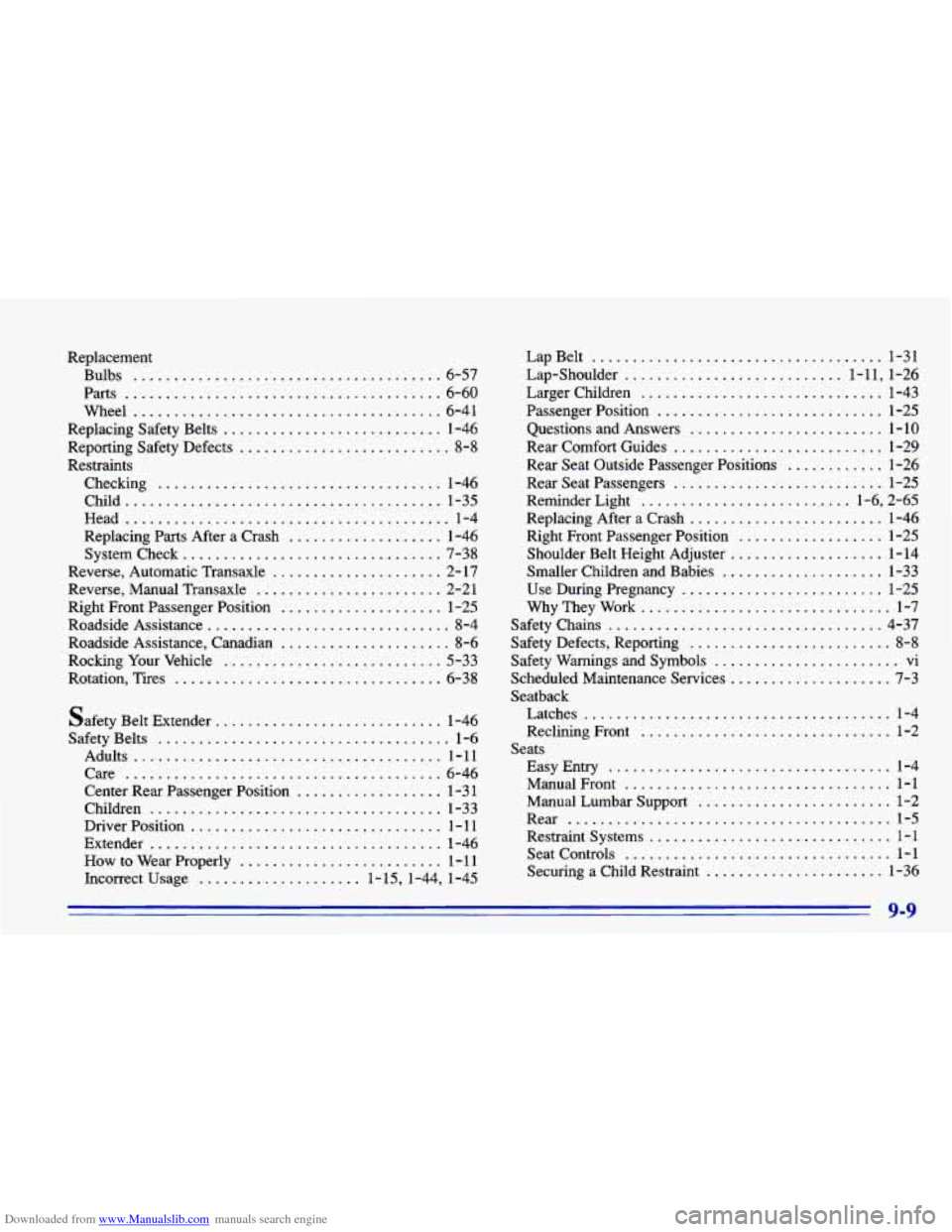
Downloaded from www.Manualslib.com manuals search engine Replacement Bulbs
...................................... 6-57
Parts
....................................... 6-60
Wheel
...................................... 6-41
Replacing Safety Belts
........................... 1-46
Reporting Safety Defects
.......................... 8-8
Restraints Checking
................................... 1-46
Child
....................................... 1-35
Head
........................................ 1-4
Replacing Parts After a Crash
................... 1-46
Systemcheck
................................ 7-38
Reverse, Automatic Transaxle
..................... 2- 17
Reverse, Manual Transaxle
....................... 2-21
Right Front Passenger Position
.................... 1-25
Roadside Assistance
.............................. 8-4
Roadside Assistance, Canadian
..................... 8-6
Rocking Your Vehicle ........................... 5-33
Rotation, Tires
................................. 6-38
Safety Belt Extender
............................ 1-46
Safety Belts
.................................... 1-6
Adults
...................................... 1-11
Care
....................................... 6-46
Center Rear Passenger Position
.................. 1-3 1
Children .................................... 1-33
Driver Position
............................... 1 - 1 1
Extender
.................................... 1-46
How to Wear Properly
......................... 1 - 1 1
Incorrect Usage
.................... 1-15, 1-44, 1-45 Lap Belt
.................................... 1-3 1
Lap-Shoulder
........................... 1 . 1 1. 1-26
Larger Children
.............................. 1-43
Passenger Position
............................ 1-25
Questions and Answers
........................ 1 . 10
Rear Comfort Guides
.......................... 1-29
Rear Seat Outside Passenger Positions
............ 1-26
Rear Seat Passengers
.......................... 1-25
Reminder Light
.......................... 1.6. 2.65
Replacing After a Crash
........................ 1-46
Right Front Passenger Position
.................. 1-25
Shoulder Belt Height Adjuster
................... 1 . 14
Smaller Children and Babies
.................... 1-33
Use During Pregnancy
......................... 1-25
WhyTheyWork
............................... 1-7
Safety Chains
.................................. 4-37
Safety Defects. Reporting
......................... 8-8
Safety Warnings and Symbols ....................... vi
Scheduled Maintenance Services
.................... 7-3
Seatback
Latches
...................................... 1-4
Reclining Front
............................... 1-2
Easy Entry
................................... 1-4
ManualFront
................................. 1-1
Rear
........................................ 1-5
Restraint Systems
.............................. 1 . 1
Seat Controls
................................. 1-1
Securing a Child Restraint
...................... 1-36
Seats
Manual Lumbar Support
........................ 1-2
9-9