1996 CHEVROLET CAVALIER change time
[x] Cancel search: change timePage 231 of 372
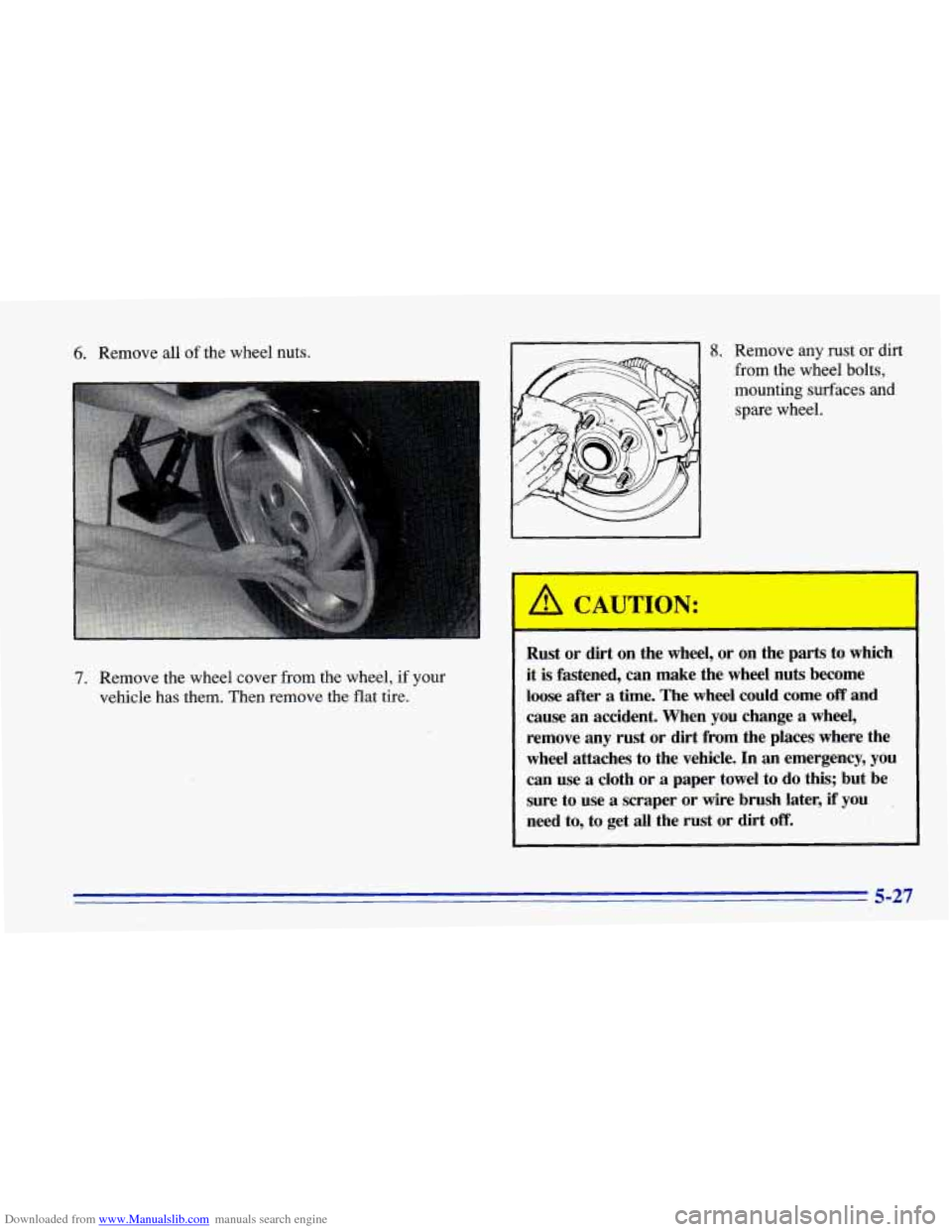
Downloaded from www.Manualslib.com manuals search engine 6. Remove all of the wheel nuts.
7. Remove the wheel cover from the wheel, if your
vehicle has them. Then remove the flat tire.
8. Remove any rust or dirt
from the wheel bolts,
mounting surfaces and spare wheel.
A CAUTION:
I- -
Rust or dirt on the wheel, or on the parts to which
it is fastened, can make the wheel nuts become
loose after
a time. The wheel could come off and
cause an accident. When you change
a wheel,
remove any rust or dirt from the places where the
wheel attaches to the vehicle. In an emergency, you
can use
a cloth or a paper towel to do this; but be
sure to use
a scraper or wire brush later, if you
need to, to get
all the rust or dirt off.
5-27
Page 255 of 372
Downloaded from www.Manualslib.com manuals search engine Automatic Transaxle Fluid (Except 2.4L Code
T Engine)
When to Check and ~ anee
A good time to check your automauc transaxle fluid
level is when the engine oil is changed.
Change both the fluid and filter every
50,000 miles
(83
000 km) if the vehicle is mainly driven under one or
more of these conditions:
In heavy city traffic where the outside temperature
regularly reaches
90°F (32°C) or higher.
In hilly or mountainous terrain.
When doing frequent trailer towing.
Uses such as found in taxi, police or delivery service.
If you do not use your vehicle under any of these
conditions, the fluid and filter do not require changing.
See “Scheduled Maintenance Services’’ in the Index.
How to Check
Because this operation can be a little difficult, you may
choose to have this done at your Chevrolet dealership
Service Department.
If you do it yourself, be sure to follow all the instructions
here, or you could get a false reading on the dipstick.
NOTICE:
Too much or too little fluid can damage your
transaxle.
Too much can mean that some of the
fluid could come out and fall on hot engine parts
or exhaust system parts, starting a fire. Be sure to
get
an accurate reading if you check your
transaxle fluid.
Wait at least 30 minutes before checking the transaxle
fluid level if you have been driving:
When outside temperatures are above 90°F (32°C).
At high speed for quite a while.
In heavy traffic -- especially in hot weather.
While pulling a trailer.
To get the right reading, the fluid should be at normal
operating temperature, which is 180”
F to 200” F
(82°C to 93°C).
Get
the vehicle warmed up by driving about 15 miles
(24 km) when outside temperatures are above 50” F
(10°C). If it’s colder than 50°F (lOOC), you may have
to drive longer.
6-17
Page 257 of 372
Downloaded from www.Manualslib.com manuals search engine How to Add Fluid
Refer to the Maintenance Schedule to determine what
kind of transaxle fluid to use. See “Recommended
Fluids and Lubricants” in the Index.
If the fluid level is low, add only enough of the proper
fluid to bring the level into the cross-hatched area on
the dipstick.
1. Pull out the dipstick.
2. Using a long-neck funnel, add enough fluid at the
dipstick hole to bring it to the proper level.
It doesn’t take much fluid, generally less than a pint
(OSL). Don’t overfill. We recommend you use only fluid
labeled DEXRON@-111, because fluid with that
label is made especially for your automatic transaxle.
Damage caused by fluid other than DEXRON@-I11 is
not covered by
your new vehicle warranty.
0 After adding fluid, recheck the fluid level as
described under “How to Check.”
When the correct fluid level is obtained, push the
dipstick back in all the way.
Automatic Transaxle Fluid
(2.4L Code T Engine Only)
If you have the optional 2.4L Code T engine (see
“Engine Identification” in the Index) and
an automatic
transaxle, it is not necessary to check the transaxle fluid
level.
A transaxle fluid leak is the only reason for fluid
loss.
If a leak occurs, take the vehicle to your Chevrolet
dealer Service Department and have it repaired
as soon
as possible. You may also have your fluid level checked
by your dealer or service center when you have your
oil changed.
Manual Transaxle Fluid
When to Check
A good time to have it checked is when the engine oil is
changed. However, the fluid in your manual transaxle
doesn’t require changing.
6-19
Page 269 of 372
Downloaded from www.Manualslib.com manuals search engine Brake Pedal Travel
See your dealer if the brake pedal does not return to
normal height, or if there is a rapid increase in pedal
travel. This could be a sign of brake trouble.
Brake Adjustment
Every time you make a moderate brake stop, your disc
brakes adjust for wear.
If you rarely make a moderate or
heavier stop, then your brakes might not adjust correctly. If you drive in that way, then
-- very carefully -- make
a few moderate brake stops about every
1,000 miles
(1 600 km), so your brakes will adjust properly.
If your brake pedal goes down farther than normal, your
rear drum brakes may need adjustment. Adjust them by
backing up and firmly applying the brakes a few times.
Replacing Brake System Parts
The braking system on a modern vehicle is complex. Its
many parts have to be of top quality and work well
together if the vehicle is to have really good braking. Vehicles we
design and test have top-quality GM brake
parts in them, as your Chevrolet does when it is new.
When you replace parts of your braking system
-- for
example, when your brake linings wear down and you
have to have new ones put in
-- be sure you get new
genuine GM replacement parts. If you don’t, your
brakes may no longer work properly. For example, if
someone puts in brake linings that are wrong for your
vehicle, the balance between your front and rear brakes
can change
-- for the worse. The braking performance
you’ve come to expect can change in many other ways if
someone puts in the wrong replacement brake parts.
Battery
Every new Chevrolet has a Delco Freedom@ battery.
You never have to add water to one of these. When it’s
time for a new battery, we recommend
a Delco
Freedom@ battery. Get one that has the replacement
number shown on the original battery’s label.
6-31
Page 276 of 372
Downloaded from www.Manualslib.com manuals search engine Tire Inspection and Rotation
1 Tires should be inspected every 6,000 to 8,000 miles
(10 000 to 13 000 km) for any signs of unusual wear.
If unusual wear is present, rotate your tires as soon as
possible and check wheel alignment. Also check for
damaged tires or wheels. See “When It’s Time for New
Tires” and “Wheel Replacement” later in this section for
more information.
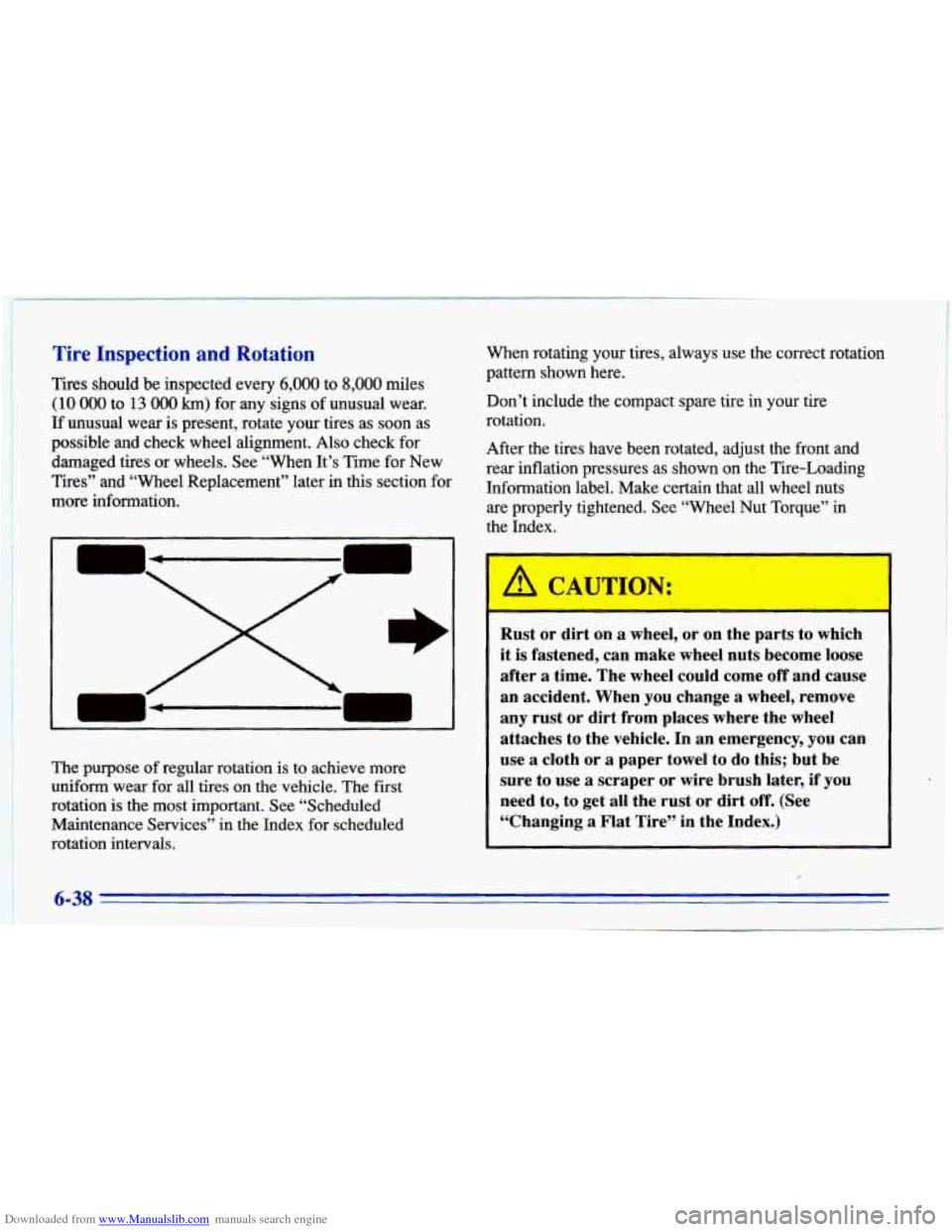
The purpose of regular rotation is to achieve more
uniform wear for all tires on the vehicle. The first
rotation is the most important. See “Scheduled
Maintenance Services” in the Index for scheduled
rotation intervals. When rotating your tires, always use the Correct rotation
pattern shown here.
Don’t include the compact spare tire
in your tire
rotation.
After the tires have been rotated, adjust the front and
rear inflation pressures as shown on the Tire-Loading
Information label. Make certain that all wheel nuts are properly tightened. See “Wheel Nut Torque” in
the Index.
A CAUTION:
Rust or dirt on a wheel, or on the parts to which
it is fastened, can make wheel nuts become loose
after
a time. The wheel could come off and cause
an accident. When you change
a wheel, remove
any rust or dirt from places where the wheel
attaches to the vehicle. In an emergency, you can
use a cloth or a paper towel to do this; but be
sure to use
a scraper or wire brush later, if you
need to, to get all the rust or dirt
off. (See
“Changing
a Flat Tire” in the Index.)
,
6-38
Page 352 of 372
Downloaded from www.Manualslib.com manuals search engine Canadian Roadside Assistance
Vehicles purchased in Canada have an extensive
Roadside Assistance program accessible from anywhere in Canada or the United States. Please refer to the
separate brochure provided by the dealer or call
1-800-268-6800 for emergency services.
Courtesy Transportation
Chevrolet/Geo offers Courtesy Transportation for
customers needing warranty service. Courtesy
Transportation will be offered in conjunction with the
coverage provided by the BUMPER-TO-BUMPER
New Vehicle Limited Warranty to retail purchasers
of
1996 Chevrolet/Geo passenger cars and light duty trucks
(please see your selling dealer for details).
Courtesy Transportation includes:
One way shuttle ride for any warranty repair
completed during the same day.
0 Up to $30 maximum daily vehicle rental allowance
for any overnight warranty repair up to
5 days, OR
Up to $30 maximum daily cab, bus, or other
transportation allowance in lieu of rental for any
overnight warranty repair up to
5 days, OR
Up to $10 daily fuel allowance for rides provided by
another person (ie., friend, neighbor, etc.)
in lieu of
rental for any Overnight warranty repair up to
5 days.
Note: All Courtesy Transportation arrangements will
be administered by your Chevrolet/Geo dealer
service management. Claim amounts should reflect
all actual costs.
0 Chevrolet/Geo Courtesy Transportation is not part of
the BUMPER-TO-BUMPER New Vehicle Limited
Warranty. Chevrolet/Geo reserves the right to make
any changes or discontinue Courtesy Transportation
at any time without notification.
For additional program details, contact your
Chevrolet/Geo dealer.
In Canada, please consult your GM dealer for
information on Courtesy Transportation.
Some state insurance regulations make it impractical to
rent vehicles to people under 21 years
of age. If you are
under
21 and have difficulty renting a vehicle, Chevrolet
will reimburse you, up to $30/day, for documented
transportation you receive.
For warranty repairs during the Complete Vehicle Coverage period in the New Vehicle Limited Warranty,
interim transportation may be available under the
Courtesy Transportation Program. Please consult your
dealer for details. The Roadside Assistance program is
available only in the United States and Canada.