1996 CHEVROLET BLAZER door lock
[x] Cancel search: door lockPage 116 of 392
Downloaded from www.Manualslib.com manuals search engine Ashtrays and Cigarette Lighter
To use the lighter, press it in all the way, and let go.
When it’s ready, it will pop back by itself.
NOTICE:
Don’t hold a cigarette lighter in with your hand
while it is heating.
If you do, it won’t be able to
back
away from the heating element when it’s
ready. That can make it overload, damaging the
lighter and the heating element.
The front ashtray must be completely pulled out to the
open position before the ashtray cover opens and
smoking material can be deposited.
NOTICE:
Don’t put papers and other things that burn
into your ashtray.
If you do, cigarettes or other
smoking materials could set them on fire
causing damage.
To nove the front ashtray, lift the release tab as high
as possible, then remove the tray.
Four-door vehicles have smaller ashtrays inside the rear
doors. Press
PUSH to turn the ashtray around for use.
Sun Visors
To block out glare, you can swing down the top and
bottom visors. You can also swing the bottom visor from
side
to side. Your visors may have an extension that can
be pulled out for additional glare protection and a strap
for holding small items, such as maps.
2-58
Page 210 of 392
Downloaded from www.Manualslib.com manuals search engine Maintenance When Trailer Towing
Your vehicle will need service more often when you’re
pulling
a trailer. See the Maintenance Schedule for more
on this. Things that are especially important in trailer
operation are automatic transmission fluid (don’t
overfill), engine oil, axle lubricant, belt, cooling system
and brake adjustment. Each of these is covered
in this
manual, and the Index will help you find them quickly.
If you’re trailering, it’s a good idea to review these
sections before you start your trip.
Check periodically to see that all hitch nuts and bolts
are tight.
Trailer Wiring Harness
The light duty trailer wiring is a six-wire harness
assembly. The heavy duty trailer wiring is an eight-wire
harness assembly. The harnesses are stored under
the
vehicle, along the passenger-side frame crossmember on
two-door vehicles or on the driver’s side corner frame
crossmember
on four-door vehicles. The heavy duty
trailer wiring has a 30-amp feed wire with an inline fuse
located by the junction block. See “Fuses and Circuit
Breakers” in
the Index. Both harnesses have no
connector and should be wired
by a qualified electrical technician. The technician can
use the following color code chart when connecting the
wiring harness
to your trailer.
0
0
0
0
0
0
0
0
DARK BLUE: Use for electric trailer brakes or
auxiliary wiring.
RED: Use for battery charging; it connects to the
starter solenoid (eight-wire harness
only).
LIGHT GREEN: Back-up lamps (eight-wire
harness only).
BROWN: Taillamps and parking lamps.
YELLOW Left stoplamp and turn signal.
DARK GREEN: Right stoplamp and turn signal.
WHITE (Heavy Gage): Ground wire.
WHITE (Light Gage): Auxiliary stoplamp.
Securely attach the harness
to the trailer, then tape or
strap it to your vehicle’s frame rail. Be sure you leave
it loose enough
so the wiring doesn’t bend or break,
but
not so loose that it drags on the ground. Store the
harness in its original place. Wrap the harness together
and
tie it neatly so it won’t be damaged.
4-56
Page 253 of 392
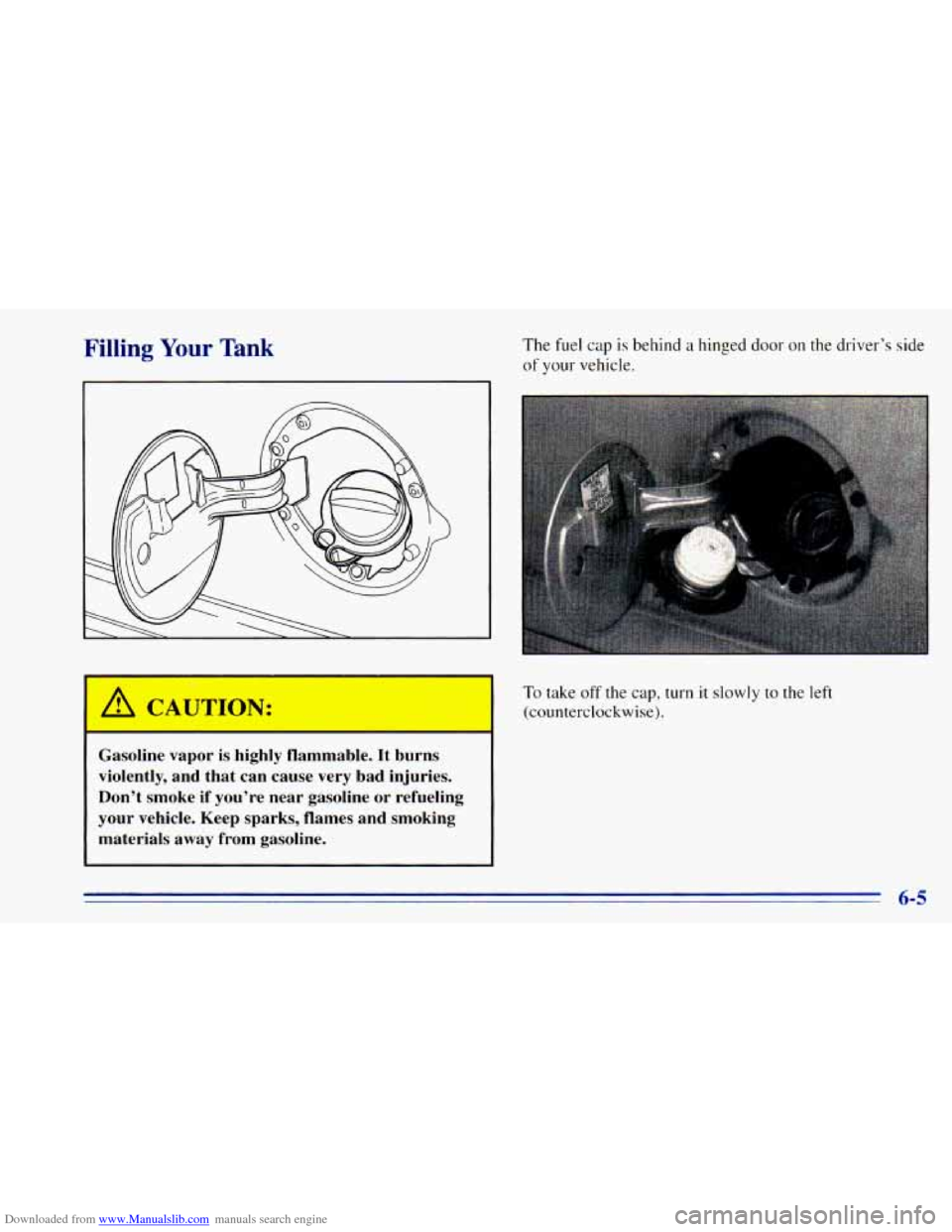
Downloaded from www.Manualslib.com manuals search engine Filling Your Tank The fuel cap is behind a hinged door on the driver’s side
of your vehicle.
To take off the cap, turn it slowly to the left
(counterclockwise).
JTION:
-
Gasoline vapor is highly flammable. It burns
violently, and that can cause very bad injuries.
Don’t smoke if you’re near gasoline or refueling
your vehicle. Keep sparks, flames and smoking
materials away from gasoline.
- 6-5
Page 260 of 392
Downloaded from www.Manualslib.com manuals search engine When to Change Engine Oil
See if any one of these is true for you:
e
0
0
e
e
Most trips are less than 5 to 10 miles (8 to 16 km),
This is particularly important when outside
temperatures are below freezing.
Most trips include extensive idling (such as frequent
driving in stop-and-go traffic).
You operate your vehicle in dusty areas or off-road
frequently.
You frequently tow a trailer or use a carrier on top of
your vehicle.
The vehicle is used for delivery service, police, taxi
or other commercial application.
Driving under these conditions causes engine oil
to
break down sooner. If any one of these is true for your
vehicle, then you need to change your oil and filter
every
3,000 miles (5 000 km) or 3 months -- whichever
occurs first.
If none of them is true, change the oil and filter every
7,500 miles (12 500 km) or 12 months -- whichever
occurs first. Driving a vehicle with a
fully warmed
engine under highway conditions causes engine oil
to
break down slower.
Remote Oil Filter (Four-Wheel Drive)
The access door for the remote oil filter is in the steering
linkage shield assembly located under the radiator
support. Twist the screw to unlock or lock the door.
What to Do with Used Oil
Did you know that used engine oil contains certain
elements that may be unhealthy for your skin and could
even cause cancer? Don’t let used oil stay
on your skin
for very long. Clean
your skin and nails with soap and
water, or a good hand cleaner. Wash or properly throw
away clothing or rags containing used engine oil. (See
the manufacturer’s warnings about the use and disposal
of
oil products.)
Used oil can be a real threat to the environment.
If you
change your own oil, be sure to drain all free-flowing oil
from the filter before disposal. Don’t ever dispose of oil
by putting
it in the trash, pouring it on the ground, into
sewers, or into streams or bodies
of water. Instead,
recycle
it by taking it to a place that collects used oil. If
you have a problem properly disposing of your used oil,
ask your dealer, a service station or
a local recycling
center for help.
6-12
Page 308 of 392

Downloaded from www.Manualslib.com manuals search engine FuseKircuit Usage
Breaker
1
2
3
FuseKircuit Usage
Breaker
A
B
Power Door Locks, Power Seat,
Power Seat Lumbar, Remote Keyless Entry
Power Windows 4
Stoplamps, Hazard Lamps, Chime,
Center High-Mounted Stoplamp
Relay, Center High-Mounted
Stoplamp
Dome Lamps, Cargo Lamps, Visor
Vanity Mirror, Cigarette Lighter,
Inside Rearview Mirror Lamp,
Overhead Console Lamps, Glove
Box
Lamp, Horns, Horn Relay, IP
Courtesy Lamps, Power Outside
Rearview Mirror, Liftglass Release
Motor, Illuminated Entry Module
Parking Lamps, License Plate Lamps,
Electric Shift Transfer Case Module,
Underhood Lamp, Rear Wiper,
Ashtray Lamp, Door Switch Lamp
Alternator Field, A/C Compressor
Relay, Cluster Chime Module, DRL
Relay Coil, Four-Wheel-Drive
Indicator Lamp, DRL Module, Rear
Defog Timer, Transfer Case Control
Module Ignition, SIR Redundant
Ignition, RKE Ignition
6-60
Page 309 of 392

Downloaded from www.Manualslib.com manuals search engine FuseKircuit Usage
Breaker
5
7
8
9
10
11
Oxygen Sensor Heater, Exhaust Gas
Recirculation, Cam Sensor, CANN.
Purge, MAS
Blower Motor, Temperature Door
Motor, HI Blower Relay Coil
Power Auxiliary Outlets, Assembly
Line Diagnostic Link
Rear Window Defogger
PCMNCM Battery, ABS Battery
PCMNCM Ignition, Injectors, Crank
Sensor, Coil Driver Module
Radio, Inside Rearview Mirror Map
Lamp, Overhead Console Reading
Lamps, Rear Wiper, Rear Washer,
Overhead Console Display
12 DRAC, Anti-Lock Braking System, VCM IGN-3
13
14
Clock, Radio, Battery, CD Player
A/C Compressor Battery Feed
FuseKircuit Usage
Breaker
15
16
17
19
20
21
22 24 Daytime Running Lamps,
Fog Lamps,
Fog Lamp Relay
Turn Signals and Back-up Lamps,
Brake-Transmission Shift Interlock
Solenoid
Windshield Washer, Windshield
Wiper Motor
Electric Shift Transfer Case
Crank Signal, Air Bag System
Cluster Illumination, Radio
Illumination, Heater Lamp, Four-Wheel-Drive Illumination,
Chime Module, Fog Lamp
Illumination, Rear Wiper Switch, Rear
Defog Switch Illumination, Liftglass
Release Switch Illumination,
Overhead Console Illumination
Air Bag System
PRNDL Power, 4L60E Automatic
Transmission
6-61
Page 360 of 392
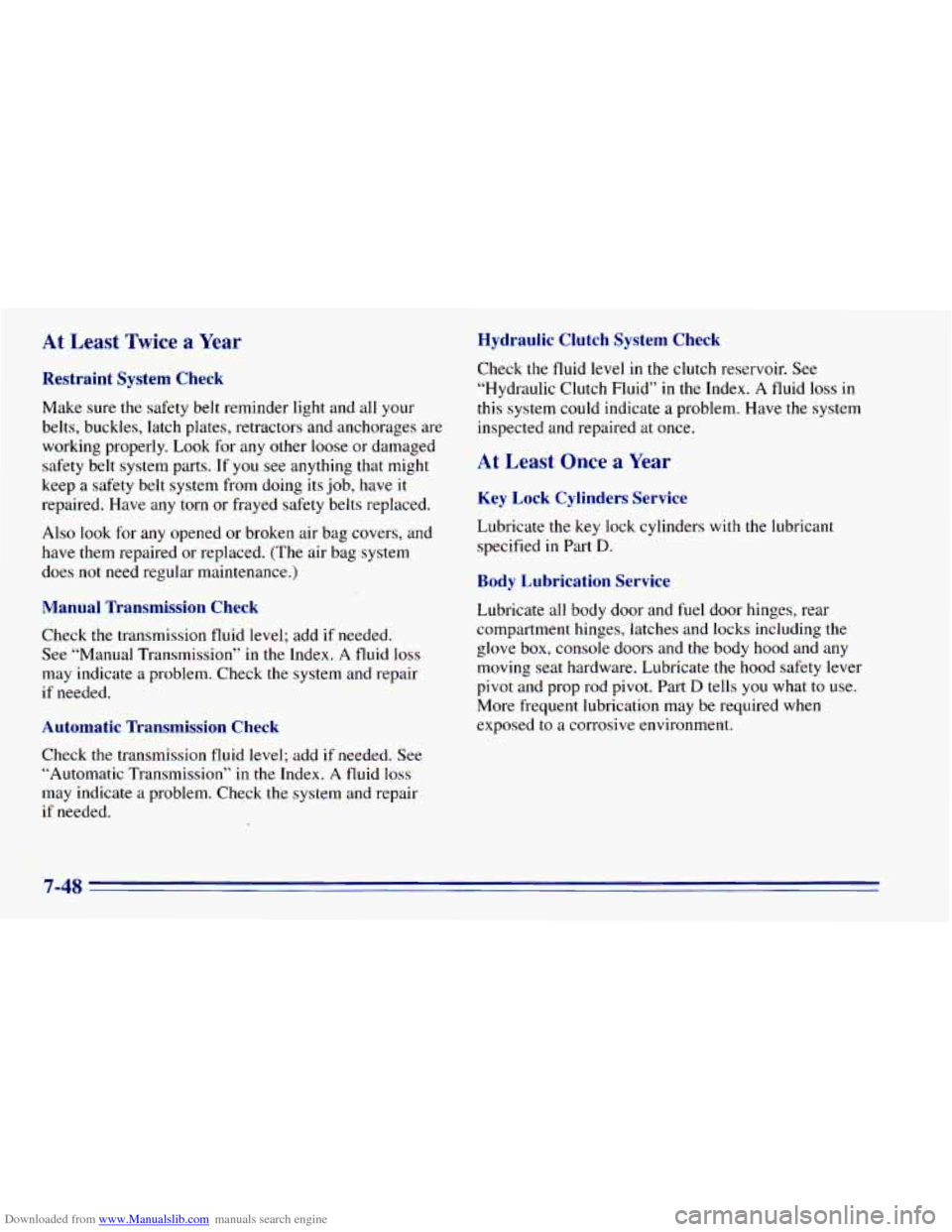
Downloaded from www.Manualslib.com manuals search engine At Least Twice a Year
Restraint System Check
Make sure the safety belt reminder light and all your
belts, buckles, latch plates, retractors and anchorages are working properly. Look for any other loose or damaged
safety belt system parts. If
you see anything that might
keep a safety belt system from doing its job, have
it
repaired. Have any torn or frayed safety belts replaced.
Also look for any opened or broken air bag covers, and
have them repaired or replaced. (The air bag system
does not need regular maintenance.)
Manual Transmission Check
Check the transmission fluid level; add if needed.
See “Manual Transmission” in the Index.
A fluid loss
may indicate a problem. Check the system and repair
if needed.
Automatic Transmission Check
Check the transmission fluid level; add if needed. See
“Automatic Transmission” in the Index.
A fluid loss
may indicate a problem. Check the system and repair
if needed.
Hydraulic Clutch System Check
Check the fluid level in the clutch reservoir. See
“Hydraulic Clutch Fluid” in the Index.
A fluid loss in
this system could indicate a problem. Have the system
inspected and repaired at once.
At Least Once a Year
Key Lock Cylinders Service
Lubricate the key lock cylinders with the lubricant
specified in Part
D.
Body Lubrication Service
Lubricate all body door and fuel door hinges, rear
compartment hinges, latches and locks including the
glove box, console doors and
the body hood and any
moving seat hardware. Lubricate the hood safety lever
pivot and prop rod pivot. Part
D tells you what to use.
More frequent lubrication may be required when
exposed to a corrosive environment.
7-48
Page 383 of 392
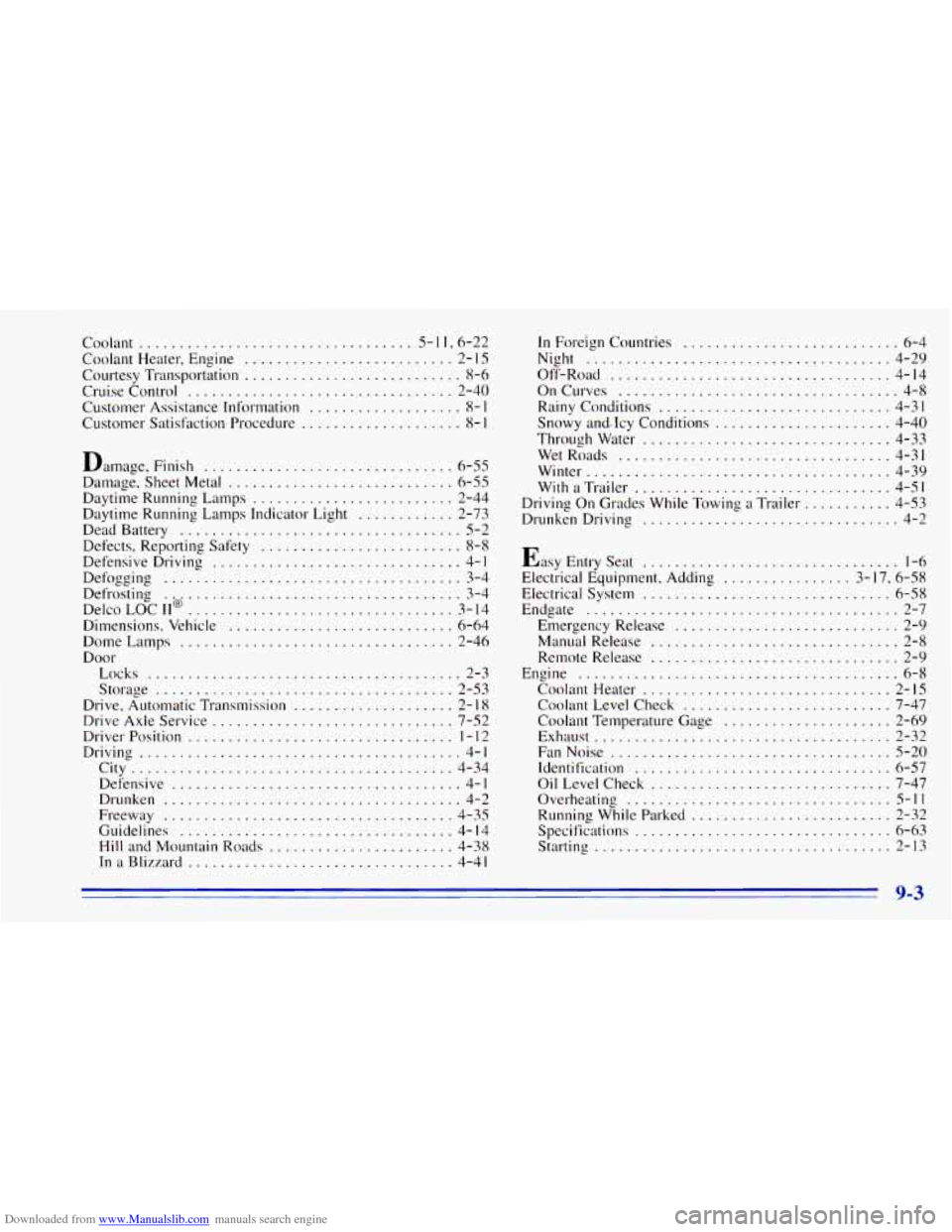
Downloaded from www.Manualslib.com manuals search engine Coolant .............................. 5- 1 1. 6-22
Courtesy Transportation
........................... 8-6
Cruise Control ................................. 2-40
Customer Assistance Information
................... 8- 1
Customer Satisfaction Procedure .................. 8- 1
Coolant Heater. Engine .......................... 2- I5
Damage. Finish ............................... 6-55
Damage. Sheet Metal
............................ 6-55
Daytime Running Lamps
......................... 2-44
Daytime Running Lamps Indicator Light
............ 2-73
Dead Battery
................................... 5-2
Defensive Driving
............................... 4- I
Defogging ..................................... 3-4
Defrosting
................................ 3-4
DelcoLOCII
................................. 3-14
Dimensions. Vehicle
............................ 6-64
Dome Lamps
............ .................. 2-46
Door Defects. Reporting Safety
......................... 8-8
@ **
Locks ....................................... 2-3
Storage
..................................... 2-53
Drive. Automatic Transmission
.................... 2- I8
Drive Axle Service .............................. 7-52
Driver Position
................................. I - 12
Driving ........................................ 4-1
City
........................................ 4-34
Defensive
.................................... 4-1
Drunken
..................................... 4-2
Freeway
.................................... 4-35
Guidelines
.................................. 4- I4
Hill and Mountain Roads ....................... 4-38
InaBlizzard
................................. 4-41
In Foreign Countries ........................... 6-4
Night
...................................... 4-29
Off-Road
................................... 4-14
OnCurves
................................... 4-8
Rainy Conditions
............................. 4-31
Snowy and. Icy Conditions
...................... 4-40
Throughwater
............................... 4-33
Wet Roads
.................................. 4-31
Winter
...................................... 4-39
With a Trailer
................................ 4-51
Driving On Grades While Towing a Trailer
........... 4-53
Drunken Driving
................................ 4-2
Easy Entry Seat
................................ 1-6
Electrical Equipment. Adding
................ 3- 17. 6-58
Electrical System
............................... 6-58
Endgate
....................................... 2-7
Emergency Release
............................ 2-9
ManualRelease
............................... 2-8
Remote Release ............................... 2-9
Coolant Heater
............................... 2-15
Coolant Level Check
.......................... 7-47
Coolant Temperature Gage
..................... 2-69
FanNoise
................................... 5-20
Identification
................................ 6-57
OilLevelCheck
.............................. 7-47
Overheating ................................. 5-11
Specifications ................................ 6-63
Engine
........................................ 6-8
Exllaust
..................................... 2-32
Running While Parked
......................... 2-32
Starting
..................................... 2-13
9-3