Page 262 of 392
Downloaded from www.Manualslib.com manuals search engine .. Automatic Transmission Fluid
When to Check and Change
A good time to check your automatic transmission fluid
level
is when the engine oil is changed.
Change both
the fluid and filter every 50,000 miles
(83 000 km) if the vehicle is mainly driven under one or
more
of these conditions:
In heavy city traffic where the outside temperature
regularly reaches
90°F (32°C) or higher.
0 In hilly or mountainous terrain.
When doing frequent trailer towing.
0 Uses such as found in taxi, police or delivery service.
If you do not use your vehicle under any of these
conditions, the fluid and filter
do not require changing.
See “Scheduled Maintenance Services” in the Index.
How to Check
Because this operation can be a little difficult, you
may choose to have this done at your GM dealer
Service Department.
If you do it yourself, be sure to follow all the instructions
here, or you could get
a false reading on the dipstick.
I NOTICE:
Too much or too little fluid can damage your
transmission.
Too much can mean that some of
the fluid could come out and fall on hot engine
parts or exhaust system parts, starting a fire. Be
sure to get an accurate reading if you check your
transmission fluid.
Wait at least 30 minutes before checking the
transmission fluid level
if you have been driving:
When outside temperatures are above 90°F (32°C).
At high speed for quite a while.
In heavy traffic -- especially in hot weather.
While pulling a trailer.
To get the right reading, the fluid should be at normal
operating temperature, which is
180°F to 200°F
(82°C to 93°C).
. 6-14
Page 264 of 392
Downloaded from www.Manualslib.com manuals search engine 2. Push it back in all the way, wait three seconds and
then
pull it back out again,
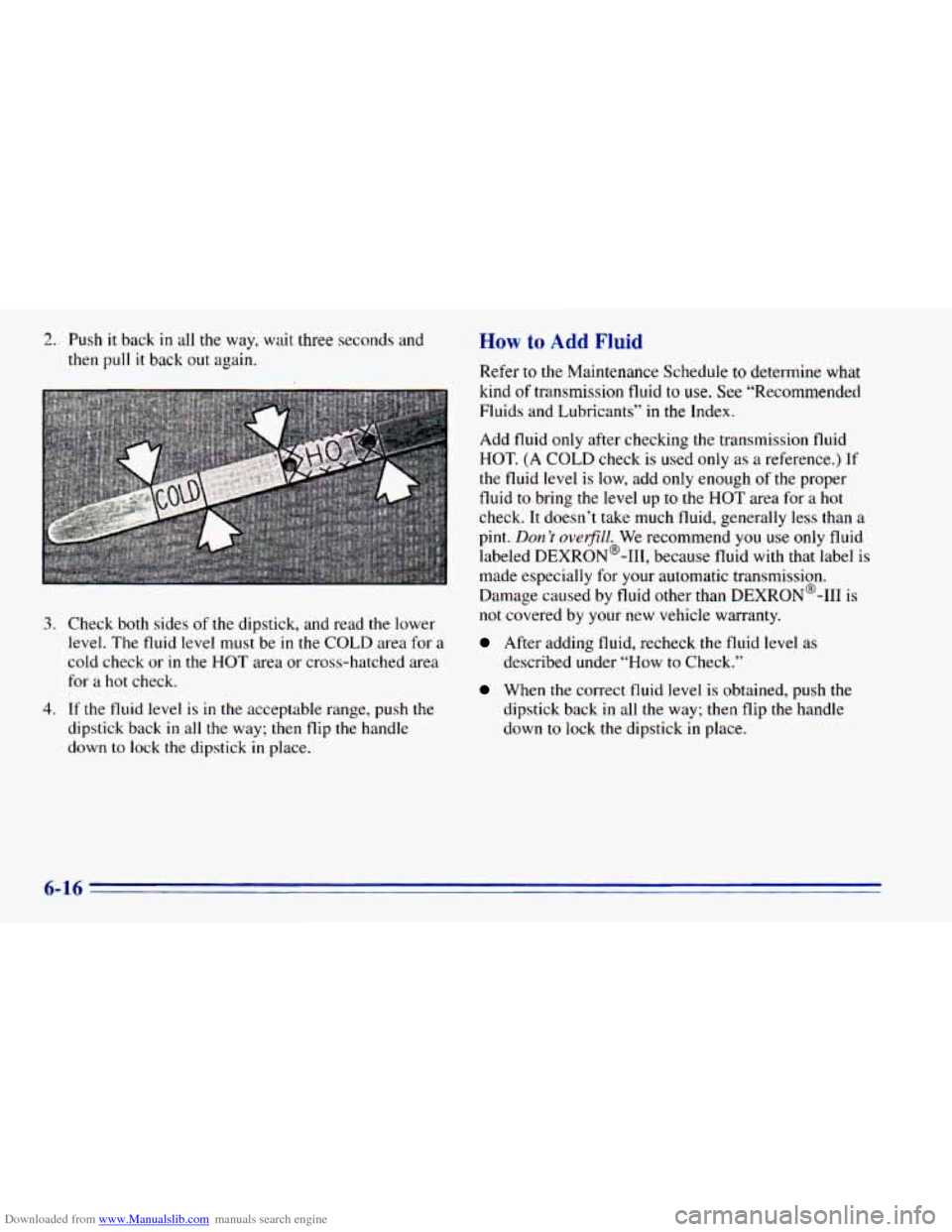
3. Check both sides of the dipstick, and read the lower
level. The fluid level must be in the COLD area for a
cold check or in the HOT area or cross-hatched area
for a hot check.
4. If the fluid level is in the acceptable range, push the
dipstick back in all
the way; then flip the handle
down
to lock the dipstick in place.
How to Add Fluid
Refer to the Maintenance Schedule to determine what
kind
of transmission fluid to use. See “Recommended
Fluids and Lubricants”
in the Index.
Add fluid only after checking the transmission fluid
HOT. (A COLD check is used only as
a reference.) If
the fluid level is low, add only enough
of the proper
fluid to bring the level up
to the HOT area for a hot
check. It doesn’t take much fluid, generally less than a
pint. Don ’t overfill. We recommend you use only fluid
labeled DEXR0N’-111, because fluid with that label is
made especially
for your automatic transmission.
Damage caused by fluid other than DEXRON@-I11 is
not covered by your new vehicle warranty.
After adding fluid, recheck the fluid level as
described under “How to Check.”
When the correct fluid level is obtained, push the
dipstick back in all the way; then flip the handle
down to lock the dipstick in place.
Page 267 of 392
Downloaded from www.Manualslib.com manuals search engine How to Check
The proper fluid should be added if the level does not
reach the bottom
of the diaphragm when it’s in place in
the reservoir. See the instructions on the reservoir cap.
Rear Axle
How to Check Lubricant
When
to Check and Change Lubricant
Refer to the Maintenance Schedule to determine how
often to check the lubricant and when to change
it. See
“Scheduled Maintenance Services”
in the Index.
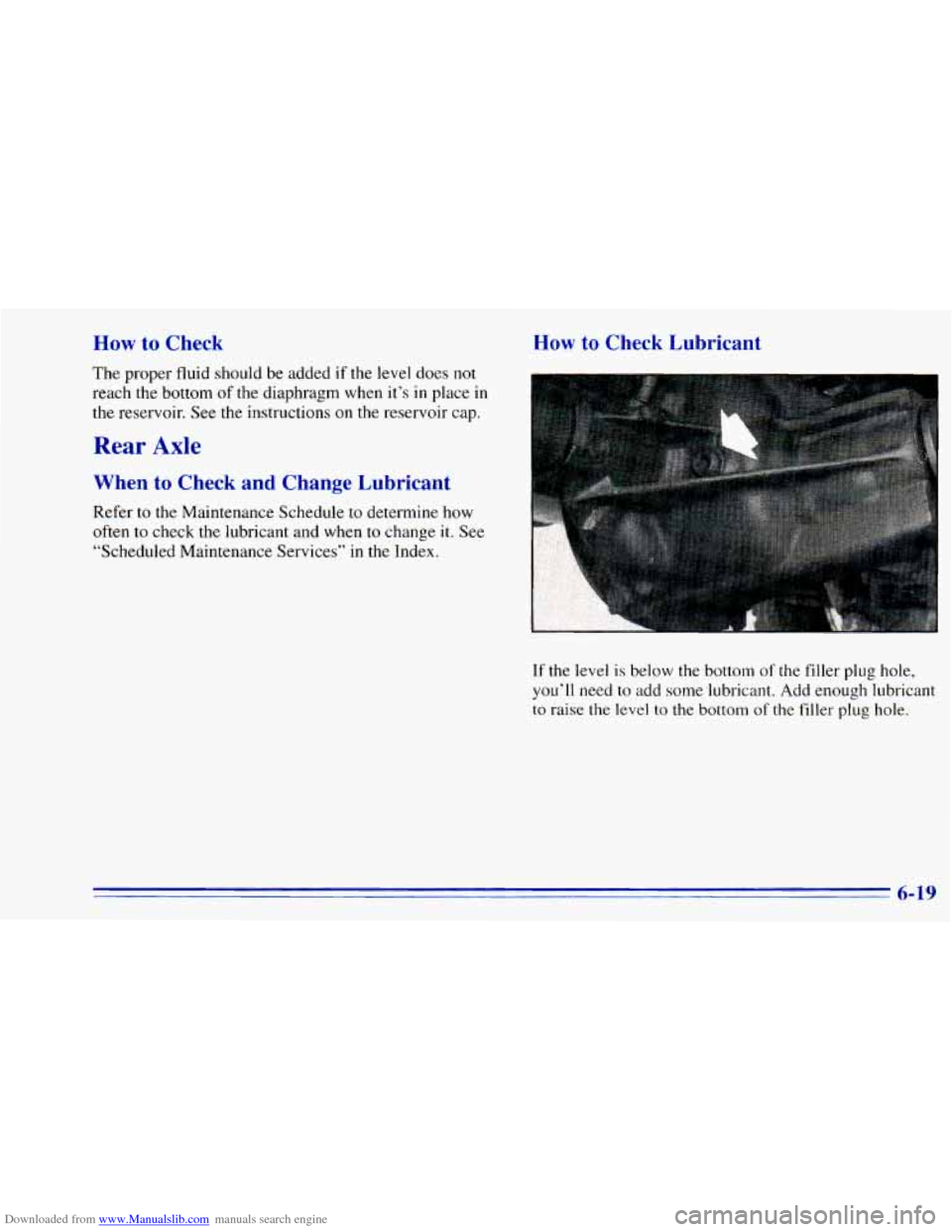
If the level is below the bottom of the filler plug hole,
you’ll need to
add some lubricant. Add enough lubricant
to raise the level to the bottom of the filler plug hole.
6-19
Page 268 of 392
Downloaded from www.Manualslib.com manuals search engine What to Use
‘Refer to the Maintenance Schedule to determine what
kind
of lubricant to use. See “Recommended Fluids and
Lubricants” in the Index.
Four-wheel Drive and
All-Wheel Drive
Most lubricant checks in this section also apply to
four-wheel-drive vehicles. However, they have two
additional systems that need lubrication.
Transfer Case
When to Check Lubricant
Refer to the Maintenance Schedule to dererrnme how
often
to check the lubricant. See “Periodic Maintenance
Inspections” in the Index.
How to Check Lubricant
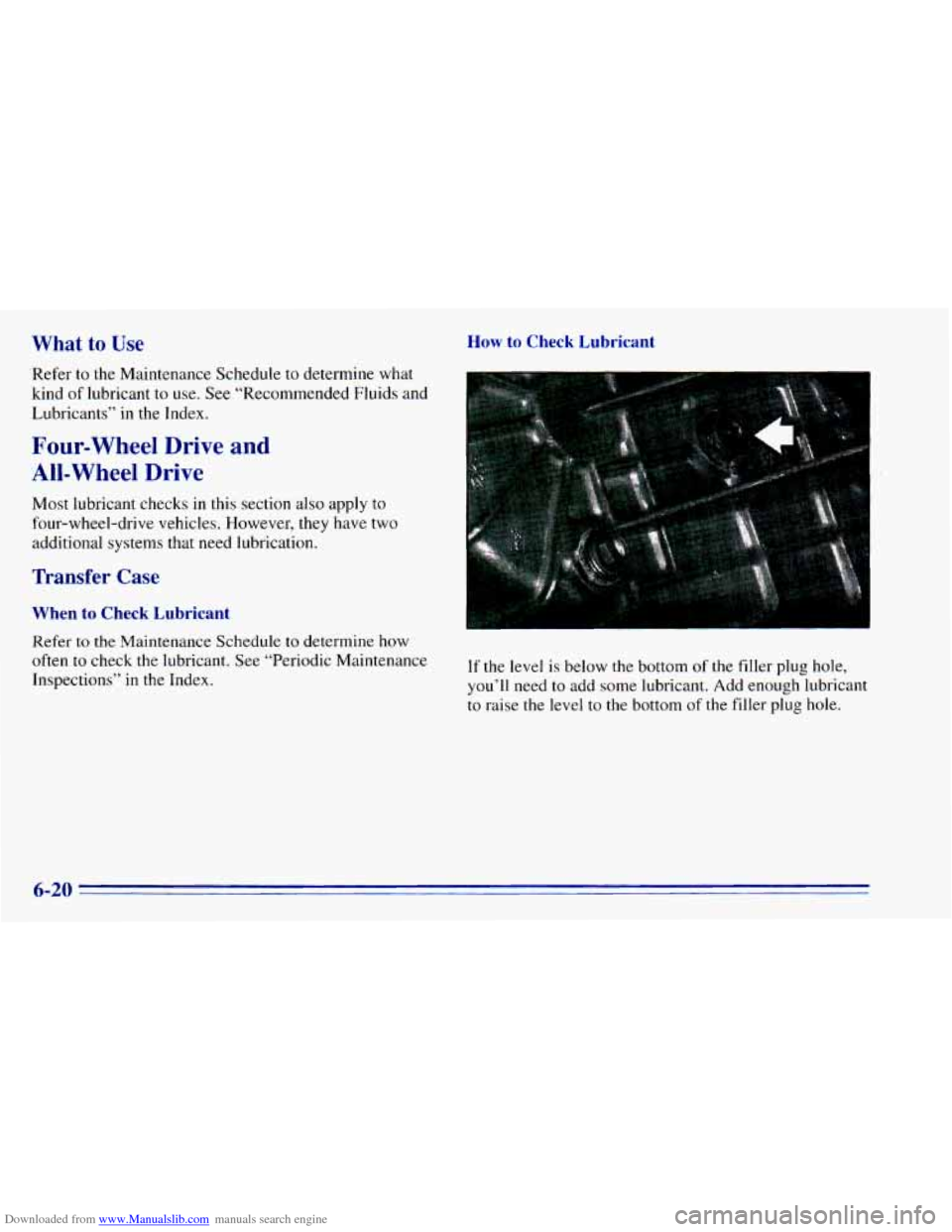
If the level is below the bottom of the filler plug hole,
you’ll need to add some lubricant. Add enough lubricant
to raise the level
to the bottom of the filler plug hole.
6-20
Page 269 of 392
Downloaded from www.Manualslib.com manuals search engine What to Use
Refer to the Maintenance Schedule to determine what
kind of lubricant to use. See “Recommended Fluids and
Lubricants” in the Index.
Front Axle
When to Check and Change Lubricant
Refer to the Maintenance Schedule to determine how
often to check the lubricant and when to change it. See
“Scheduled Maintenance Services” in the Index.
How to Check Lubricant
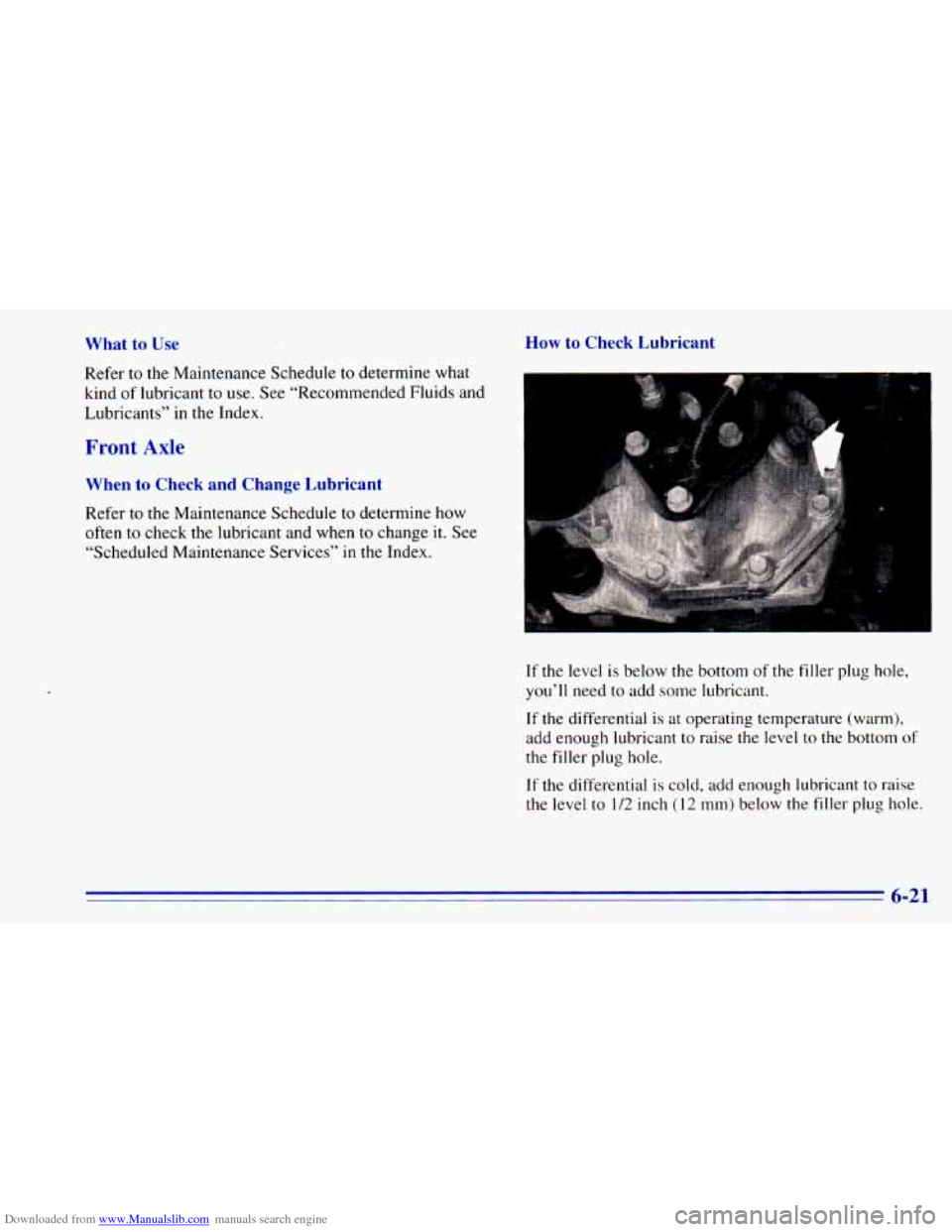
If the level is below the bottom of the filler plug hole,
you’ll need
to add some lubricant.
If the differential is at operating temperature (warm),
add enough lubricant
to raise the level to the bottom of
the filler plug hole.
If the differential is cold, add enough lubricant to raise
the level to
1/2 inch (12 mm) below the filler plug hole.
6-21
Page 270 of 392
Downloaded from www.Manualslib.com manuals search engine What to Use
Refer to the Maintenance Schedule to determine what
kind of lubricant to use. See “Recommended Fluids and
Lubricants” in the Index.
Engine Coolant
The cooling system in your vehicle is filled with new
DEX-COOL TM (orange-colored, silicate-free) engine
coolant. This coolant is designed to remain
in your
vehicle for
5 years or 100,000 miles (166 000 km),
whichever occurs first.
The following explains your cooling system and how
to add coolant when
it is low. If you have a problem
with engine overheating, see “Engine Overheating” in
the Index.
A 50/50 mixture of water and the proper coolant for
your vehicle will:
0 Give freezing protection down to -34°F (-37 “C).
Give boiling protection up to 265 “F (129°C).
0 Protect against rust and corrosion.
Help keep the proper engine temperature.
0 Let the warning lights and gages work as they should.
I 1
NOTICE:
When adding coolant it is important that you use
DEX-COOL TM (orange-colored, silicate-free)
coolant meeting
GM Specification 6277M.
If silicated coolant is added to the system,
premature engine, heater core or radiator
corrosion may result. In addition, the engine coolant
will require change sooner -- at
30,000 miles (50 000 km) or 24 months whichever
occurs first.
6-22
Page 274 of 392
Downloaded from www.Manualslib.com manuals search engine Power Steering Fluid
When to Check Power Steering Fluid
It is not necessary to regularly check power steering
fluid unless you suspect there
is a leak in the system or
you hear an unusual noise.
A fluid loss in this system
could indicate a problem. Have the system inspected
and repaired.
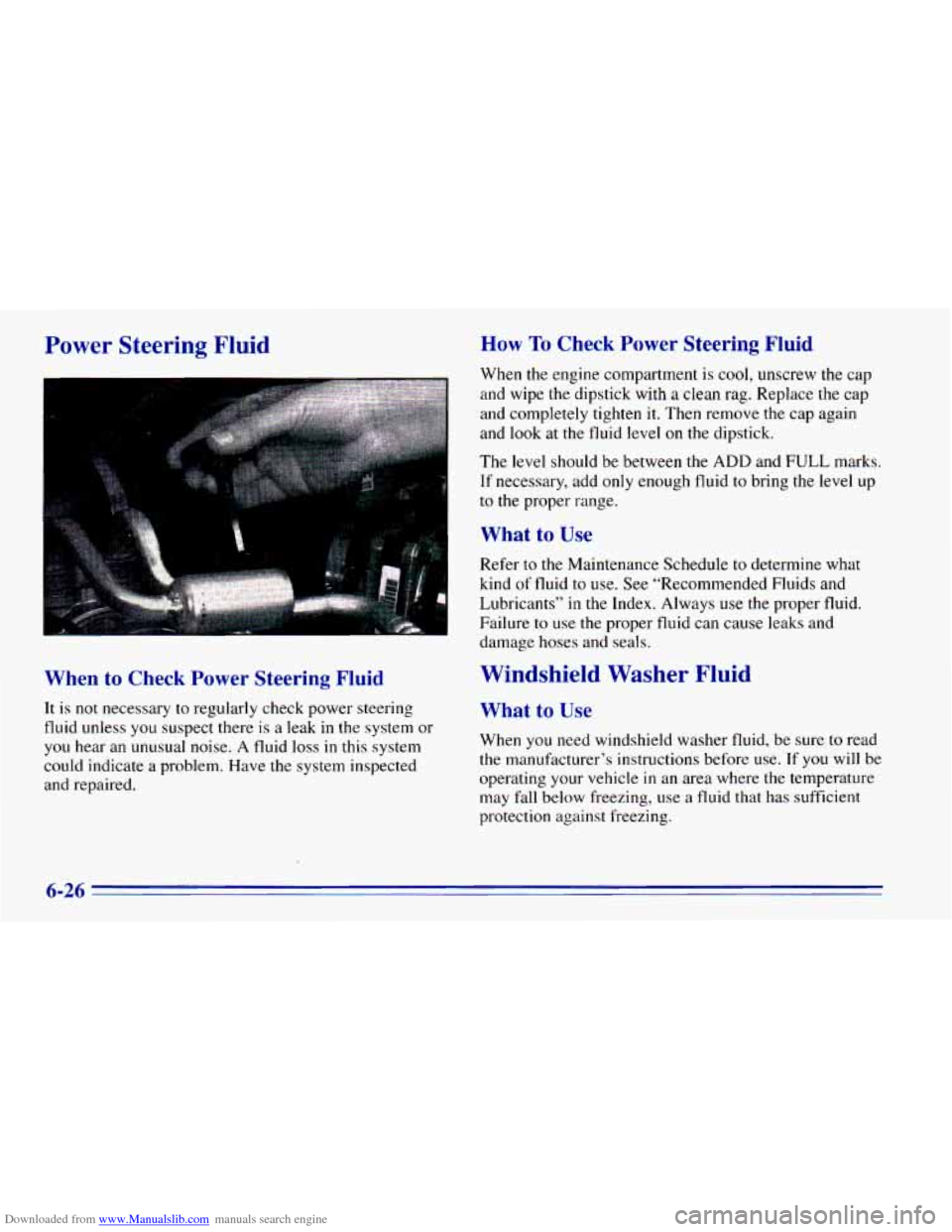
How To Check Power Steering Fluid
When the engine compartment is cool, unscrew the cap
and wipe the dipstick
with a clean rag. Replace the cap
and completely tighten it. Then remove the cap again
and look at the fluid level on the dipstick.
The level should be between the
ADD and FULL marks.
If necessary, add
only enough fluid to bring the level up
to the proper range.
What to Use
Refer to the Maintenance Schedule to determine what
kind
of fluid to use. See “Recommended Fluids and
Lubricants”
in the Index. Always use the proper fluid.
Failure to use the proper fluid can cause leaks and
damage hoses and seals.
Windshield Washer Fluid
What to Use
When you need windshield washer fluid, be sure to read
the manufacturer’s instructions before use. If you will be
operating your vehicle
in an area where the temperature
may fall below freezing, use a fluid that
has sufficient
protection against freezing.
6-26
Page 276 of 392
Downloaded from www.Manualslib.com manuals search engine Brakes
Bra.ke Fluid
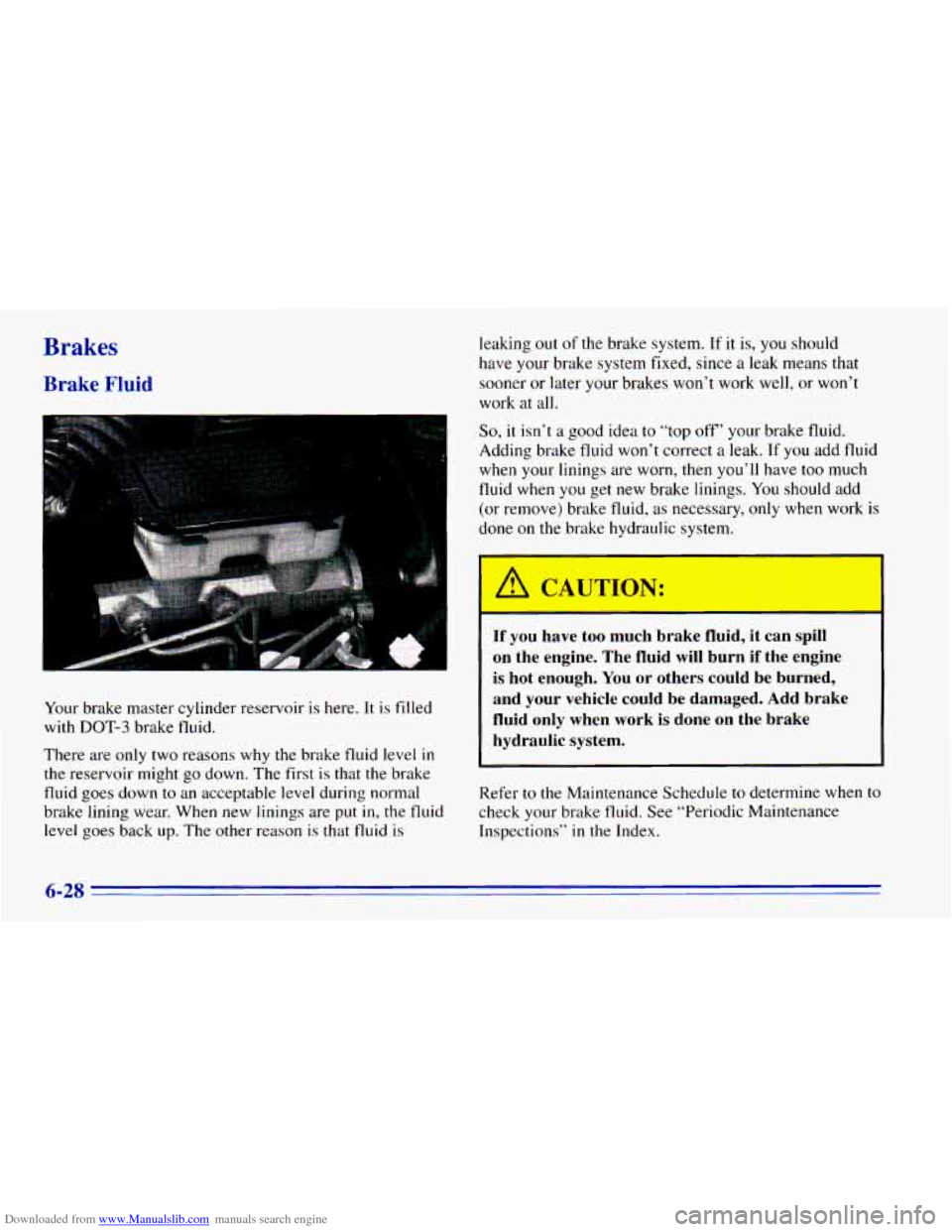
Your brake master cylinder reservoir is here. It is filled
with
DOT-3 brake fluid.
There are only two reasons why the brake fluid level
in
the reservoir might go down. The first is that the brake
fluid goes down
to an acceptable level during normal
brake lining wear. When new linings are
put in, the fluid
level goes back up. The other reason
is that fluid is
leaking out of the brake system. If it is, you should
have your brake system fixed, si.nce
a leak means that
sooner or later your brakes won’t work well, or won’t
work at all.
So, it isn’t a good idea to “top off’ your brake fluid.
Adding brake fluid won’t correct a leak. If
you add fluid
when your linings are worn,
then you’ll have too much
fluid when
you get new brake linings. You should add
(or remove) brake fluid, as necessary, only when work
is
done on the brake hydraulic system.
I A CAUTION:
If you have too much brake fluid, it can spill
on the engine. The fluid
will burn if the engine
is hot enough. You or others could be burned,
and your vehicle could be damaged. Add brake
fluid only when work is done on the brake
hydraulic system.
Refer to the Maintenance Schedule to determine when to
check your brake fluid. See “Periodic Maintenance
Inspections’’
in the Index.
6-28