1996 CHEVROLET BLAZER check engine
[x] Cancel search: check enginePage 355 of 392
Downloaded from www.Manualslib.com manuals search engine I Long Tripmighway Maintenance Schedule 1
0 Check readfront axle fluid level and add
fluid as needed. Check constant velocity
joints and axle seals for leaking.**
0 Rotate tires. See “Tire Inspection and
Rotation” in the Index for proper rotation
pattern and additional information. During
tire rotation, check brake calipers for
freedom of movement.
Refer to the
appropriate GM service manual for proper
caliper service procedures.
DATE ACTUAL MILEAGE SERVICED BY
90,000 Miles (150 000 kt)
0 Change engine oil and filter (or every
12 months, whichever occurs first).
An Emission Control Service.
0 Lubricate the front suspension, ball joints,
steering linkage and transfer case shift
linkage, parking brake cable guides,
propshaft splines, universal joints, brake
pedal springs and clutch pedal springs at
every oil change (or every 12 months,
whichever occurs first).
0 Check readfront axle fluid level and add
fluid
as needed. Check constant velocity
joints and axle seals for leaking.**
(Continued)
7-43
Page 357 of 392
Downloaded from www.Manualslib.com manuals search engine I Long Tripmighway Maintenance Schedule I
0 Check readfront axle fluid level ana aaa
fluid as needed. Check constant velocity
joints and axle seals for leaking.**
0 Rotate tires. See “Tire Inspection and
Rotation” in the Index for proper rotation
pattern and additional information. During
tire rotation, check brake calipers for
freedom of movement. Refer
to the
appropriate
GM service manual for proper
caliper service procedures.
DATE ACTUAL MILEAGE SERVICED BY
100,000 Miles (1 66 000 km)
0 Drain, flush and refill cooling system
(or every
60 months since last service,
whichever occurs first). See “Engine
Coolant’’ in
the Index for what to use.
Inspect hoses. Clean radiator, condenser,
pressure cap and neck. Pressure test the
cooling system and pressure cap.
An Emission Control Service.
0 Inspect spark plug wires.
0 Replace spark plugs.
An Emission Control Service.
An Emission Control Service.
(Continued)
7-45
Page 359 of 392
Downloaded from www.Manualslib.com manuals search engine Part B: Owner Checks and Services
Listed below are owner checks and services which
should be performed at the intervals specified to help
ensure the safety, dependability and emission control
performance of your vehicle.
Be sure any necessary repairs are completed at once.
Whenever any fluids or lubricants are added to your
vehicle, make sure they are the proper ones, as shown
in Part D.
At Each Fuel Fill
It is important for you or a service station attendant to
perform these underhood checks
at each fuel fill.
Engine Oil Level Check
Check the engine oil level and add the proper oil if
necessary. See “Engine Oil” in the Index for
further details.
Engine Coolant Level Check
Check the engine coolant level and add the proper
coolant mix if necessary. See “Engine Coolant” in the
Index for further details.
Windshield Washer Fluid Level Check
Check the windshield washer fluid level in the
windshield washer tank and add the proper fluid if
necessary. See “Windshield Washer Fluid” in the Index
for further details.
At Least Once a Month
Tire Inflation Check
Make sure tires are inflated to the correct pressures.
See “Tires”
in the Index for further details.
Cassette Deck Service
Clean ca :tte deck. Cleaning should be done every
50 hours or tape play. See “Audio Systems” in the Index
for further details.
7-47
Page 360 of 392
Downloaded from www.Manualslib.com manuals search engine At Least Twice a Year
Restraint System Check
Make sure the safety belt reminder light and all your
belts, buckles, latch plates, retractors and anchorages are working properly. Look for any other loose or damaged
safety belt system parts. If
you see anything that might
keep a safety belt system from doing its job, have
it
repaired. Have any torn or frayed safety belts replaced.
Also look for any opened or broken air bag covers, and
have them repaired or replaced. (The air bag system
does not need regular maintenance.)
Manual Transmission Check
Check the transmission fluid level; add if needed.
See “Manual Transmission” in the Index.
A fluid loss
may indicate a problem. Check the system and repair
if needed.
Automatic Transmission Check
Check the transmission fluid level; add if needed. See
“Automatic Transmission” in the Index.
A fluid loss
may indicate a problem. Check the system and repair
if needed.
Hydraulic Clutch System Check
Check the fluid level in the clutch reservoir. See
“Hydraulic Clutch Fluid” in the Index.
A fluid loss in
this system could indicate a problem. Have the system
inspected and repaired at once.
At Least Once a Year
Key Lock Cylinders Service
Lubricate the key lock cylinders with the lubricant
specified in Part
D.
Body Lubrication Service
Lubricate all body door and fuel door hinges, rear
compartment hinges, latches and locks including the
glove box, console doors and
the body hood and any
moving seat hardware. Lubricate the hood safety lever
pivot and prop rod pivot. Part
D tells you what to use.
More frequent lubrication may be required when
exposed to a corrosive environment.
7-48
Page 361 of 392
Downloaded from www.Manualslib.com manuals search engine Starter Switch Check
When you are doing this check, the vehicle could
move suddenly. If it does, you or others could be
injured. Follow the steps below. Brake-Transmission Shift Interlock
(BTSI) Check
(Automatic Transmission)
1. Before you start, be sure you have enough room
around the vehicle.
2. Firmly apply both the parking brake (see “Parking
Brake” in the Index if necessary) and the regular brake.
NOTE: Do not use the accelerator pedal, and be
ready to turn
off the engine immediately if it starts.
3. On automatic transmission vehicles, try to start the
engine
in each gear. The starter should work only in
PARK (P) or NEUTRAL
(N). If the starter works in
any other position, your vehicle needs service.
On manual transmission vehicles, put the shift lever
in NEUTRAL (N), push the clutch down halfway
and try
to start the engine. The starter should work
only when
the clutch is pushed down all the way to
the floor. If the starter works when the clutch isn’t
pushed all the way down,
your vehicle needs service.
When you are doing this check, the vehicle could
move suddenly.
If it does, you or others could be
injured. Follow the steps below.
1. Before you start, be sure you have enough room
around the vehicle. It should be parked
on a
level surface.
2. Firmly apply the parking brake (see “Parking Brake”
in the Index if necessary).
NOTE: Be ready to apply the regular brake
immediately
if the vehicle begins to move.
3. With the engine off, turn the key to the RUN
position, but don’t start the engine. Without applying
the regular brake, try to move the shift lever out of
PARK (P) with normal effort. If the shift lever
moves out
of PARK (P), your vehicle’s BTSI
needs service.
7-49
Page 362 of 392
Downloaded from www.Manualslib.com manuals search engine Steering Column Lock Check While parked, and with the parking brake set, try to turn
the key to LOCK in each shift lever position.
With an automatic transmission, the key should turn
to LOCK only when the shift lever
is in PARK (P).
With a manual transmission, the key should
turn to LOCK only when the shift lever is in
REVERSE (R).
On vehicles with a key release button, try to turn the key
to LOCK without pressing the button. The key should
turn to LOCK only when
you press the key button.
On
dl vehicles, the key should come out only in LOCK.
.f
Parking Brake and Automatic Transmission
PARK
(P) Mechanism Check
/! CAUTION:
When you are doing this check, your vehicle
could begin to move. You or others could be
injured and property could be damaged, Make
sure there
is room in front of your vehicle in case
it begins to roll, Be ready to apply the regular
brake at once should the vehicle begin to move.
Park
on a fairly steep hill, with the vehicle facing
downhill. Keeping your
foot on the regular brake, set the
parking brake.
To check the parking brake: With the engine running
and transmission in
NEUTRAL (N), slowly remove
foot pressure from the regular brake pedal. Do this
until the vehicle is held by the parking brake
only.
To check the PARK (P) mechanism’s holding ability:
With the engine running, shift
to PARK (P). Then
release all brakes.
7-50
Page 364 of 392
Downloaded from www.Manualslib.com manuals search engine Drive Axle Service
Check readfront axle fluid level and add as needed.
Check constant velocity joints and axle seals for leaking.
Transfer Case (All-Wheel Drive) Inspection
Every 12 months or at oil change intervals, check front
axle and transfer case and add lubricant when necessary.
Oil the control lever pivot point and all exposed control
linkage. Check vent
hose at transfer case for kinks and
proper installation.
Transfer Case (Four-wheel Drive)
Inspection
Every 12 months or at oil change intervals, check front
axle and transfer case and add lubricant when necessary.
Check vent hose at transfer case for kinks and proper
installation. More frequent lubrication may
be required
on off-road use.
Brake System Inspection
Inspect the complete system. Inspect brake lines and
hoses for proper hook-up, binding, leaks, cracks,
chafing, etc. Inspect disc brake pads for wear and rotors
for surface condition. Also inspect drum brake linings
for wear and cracks. Inspect other brake parts, including
drums, wheel cylinders, calipers, parking brake, etc.
Check parking brake adjustment. You may need to have
your brakes inspected more often
if your driving habits
or conditions result in frequent braking.
7-52
Page 368 of 392
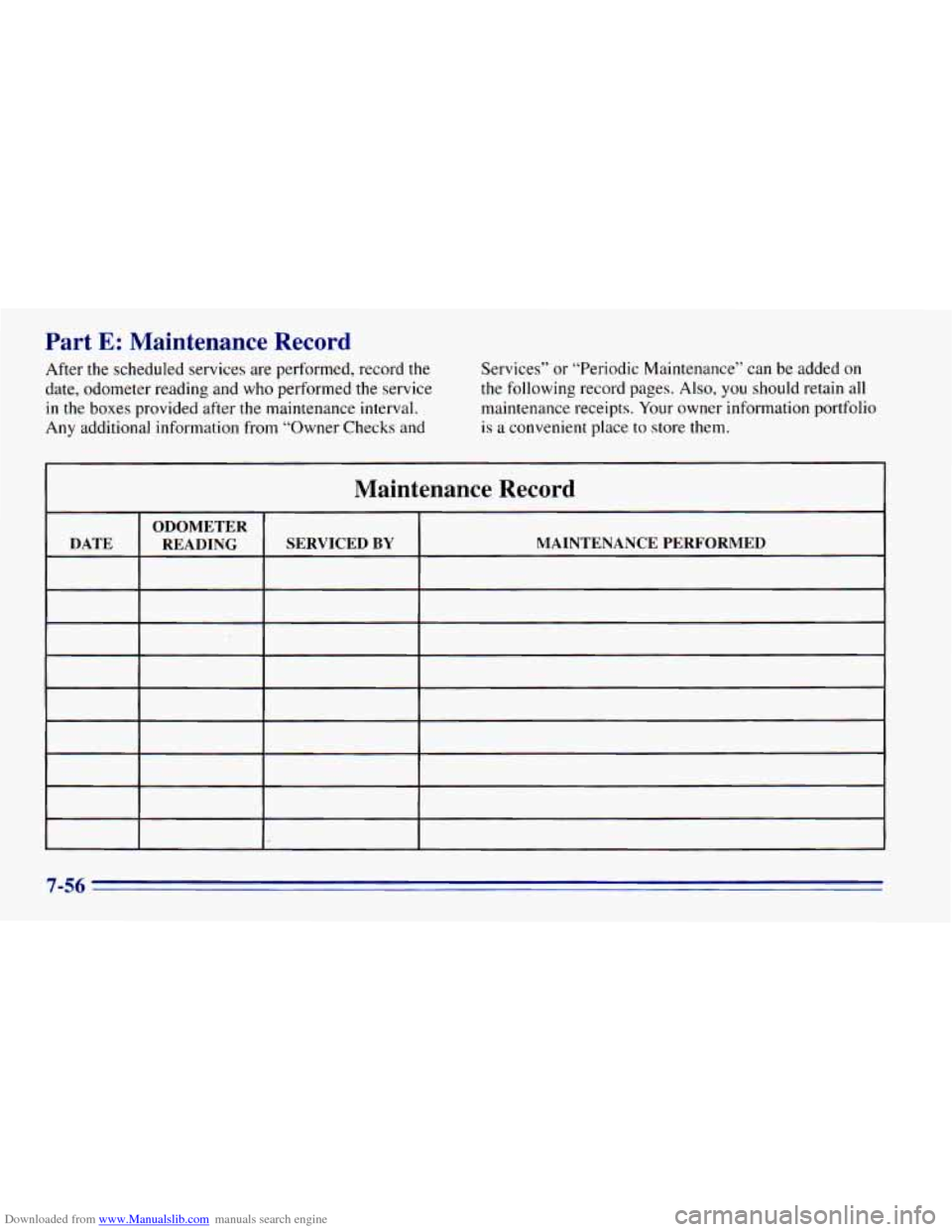
Downloaded from www.Manualslib.com manuals search engine Part E: Maintenance Record
After the scheduled services are performed, record the
date, odometer reading and who performed the service
in the boxes provided after the maintenance interval.
Any additional information from “Owner Checks and Services” or
“Periodic Maintenance” can be added on
the following record pages. Also, you should retain all
maintenance receipts. Your owner information portfolio
is a convenient place to store them.
Maintenance Record
ODOMETER
DATE READING SERVICED
BY MAINTENANCE PERFORMED
7-56