1996 CADILLAC FLEETWOOD gas
[x] Cancel search: gasPage 36 of 306
Downloaded from www.Manualslib.com manuals search engine In any particular crash, no one can say whether an air
bag should have inflated simply because of the damage
to a vehicle or because of what the repair costs were.
Inflation is determined by the angle of the impact and
the vehicle’s deceleration. Vehicle damage is only one
indication of this.
What makes an air bag inflate?
In a frontal or near-frontal impact of sufficient severity,
the air bag sensing system detects that the vehicle is
suddenly stopping as a result of a crash. The sensing
system triggers a chemical reaction of
the sodium azide
sealed in the inflator. The reaction produces nitrogen
gas, which inflates the air bag. The inflator, air bag and
related hardware
are all part of the air bag modules
packed inside the steering wheel and in the instrument
panel in front of the right front passenger.
How does an air bag restrain?
In moderate to severe frontal or near-frontal collisions,
even belted occupants can contact the steering wheel or
the instrument panel. The air bag supplements the
protection provided by safety belts. Air bags distribute the force
of the impact more evenly over the occupant’s
upper body, stopping the occupant more gradually. But
air bags would not help you
in many types of collisions,
including rollovers, rear impacts and side impacts,
primarily because an occupant’s motion is not toward the
air bag.
Air bags should never be regarded as anything
more than a supplement to safety belts, and then
only in
moderate to severe frontal or near-frontal collisions.
What will you see after an air bag inflates?
After the air bag inflates, it quickly deflates. This occurs
so quickly that some people may not even realize the air
bag inflated. Some components of the air bag module in
the steering wheel hub for the driver’s air bag, or the
instrument panel for
the right front passenger’s bag, will
be hot for a short time. The part of the bag that comes
into contact with you may be warrn, but it will never be
too hot to touch. There will be some smoke and dust
coming from vents in the deflated air bags. Air bag
inflation will not prevent
the driver from seeing or fiom
being able to steer the vehicle,
nor will it stop people
from leaving the vehicle.
1-21
Page 76 of 306
Downloaded from www.Manualslib.com manuals search engine Starting Your 5.7 Liter LTl Engine
1. Without pushing the accelerator pedal, turn the ignition key to START. When the engine starts, let
go of
the key. The idle speed will go down as your
engine gets warm.
NOTICE:
Holding your key in START for longer than
15 seconds at a time will cause your battery to be
drained much sooner. And the excessive heat can
damage your starter motor.
2. If it doesn’t start within 10 seconds, push the
accelerator pedal all the way to the floor, while you
hold the ignition key in START. When the engine
starts, let
go of the key and let up on the accelerator
pedal. Wait about
15 seconds between each try to
help avoid draining your battery.
When starting your engine in very cold weather (below
0°F or -18”C), do this:
1. With your foot off the accelerator pedal, turn the
ignition key to START and hold
it there. When the
engine starts, let
go of the key. Use the accelerator pedal
to maintain engine speed, if you have to, until
your engine has run for a while.
2. If your engine still won’t start (or starts but then
stops), it could be flooded with too much gasoline.
Try pushing your accelerator pedal all the way to the
floor and holding it there as you hold the key in
START for about three seconds.
If the vehicle starts
briefly but then stops again, do the same thing, but
this time keep the pedal down for five or six seconds.
This clears the extra gasoline from the engine.
NOTICE:
Your engine is designed to work with the
electronics in your vehicle.
If you add electrical
parts or accessories, you could change the way
the engine operates. Before adding electrical
equipment, check with your dealer.
If you don’t,
your engine might not perform properly.
If you ever have to have your vehicle towed, see
the part of this manual that tells how to do it
without damaging your vehicle. See “Towing
Your Vehicle” in the Index.
Page 86 of 306
Downloaded from www.Manualslib.com manuals search engine Parking Over Things That Burn
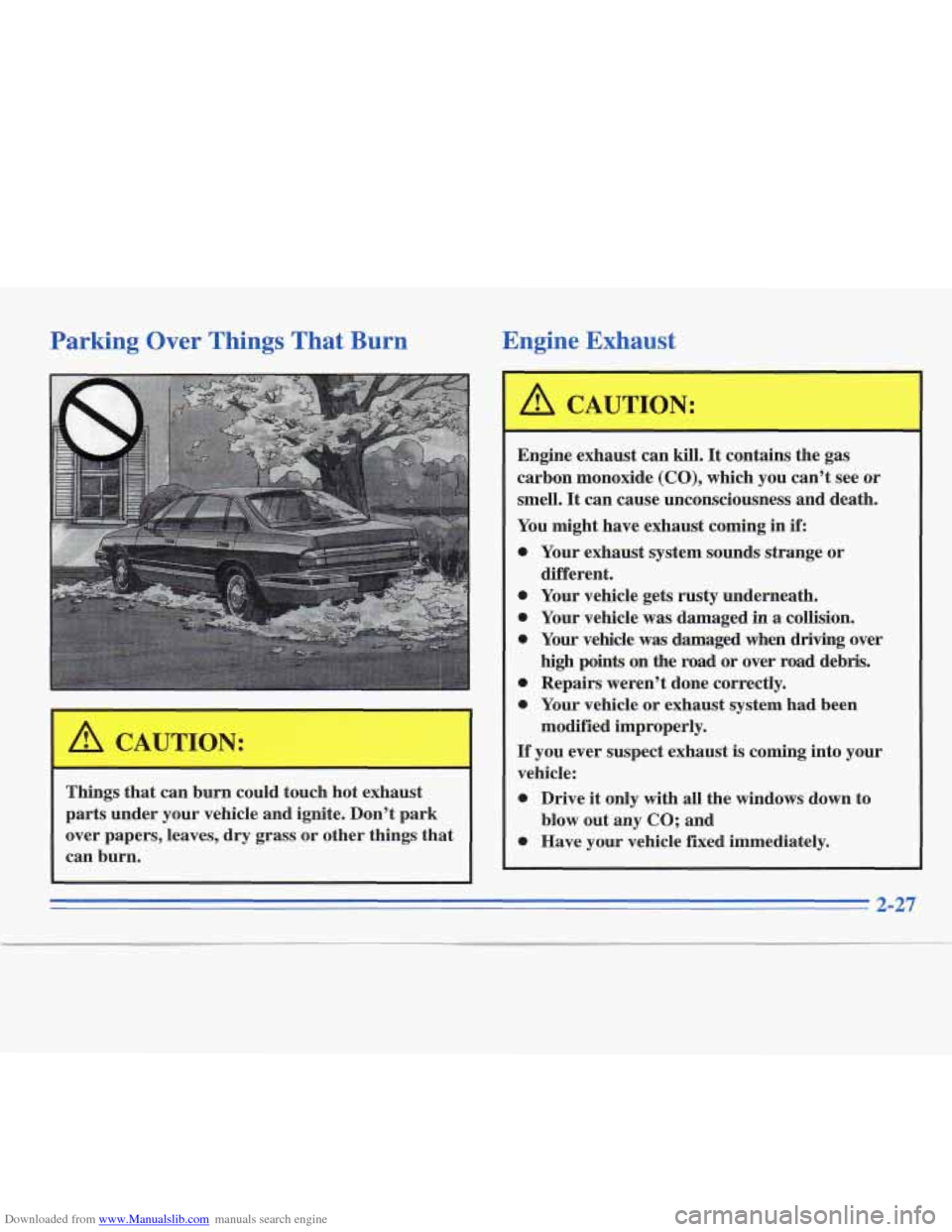
Things that can burn could touch hot exhaust
parts under your vehicle and ignite. Don’t park
over papers, leaves,
dry grass or other things that
can burn.
Engine Exhaust
A CAUTEOIPJ:
Engine exhaust can kill. It contains the gas
carbon monoxide
(CO), which you can’t see or
smell.
It can cause unconsciousness and death.
You might have exhaust coming in
if:
0 Your exhaust system sounds strange or
0 Your vehicle gets rusty underneath.
0 Your vehicle was damaged in a collision.
0 Your vehicle was damaged when driving over
high points on the road or over road debris.
0 Repairs weren’t done correctly.
0 Your vehicle or exhaust system had been
If you ever suspect exhaust is coming into your
vehicle:
0 Drive it only with all the windows down to
0 Have your vehicle fixed immediately.
different.
modified improperly.
blow out any
CO; and
2-27
Page 127 of 306
Downloaded from www.Manualslib.com manuals search engine Fuel Gage
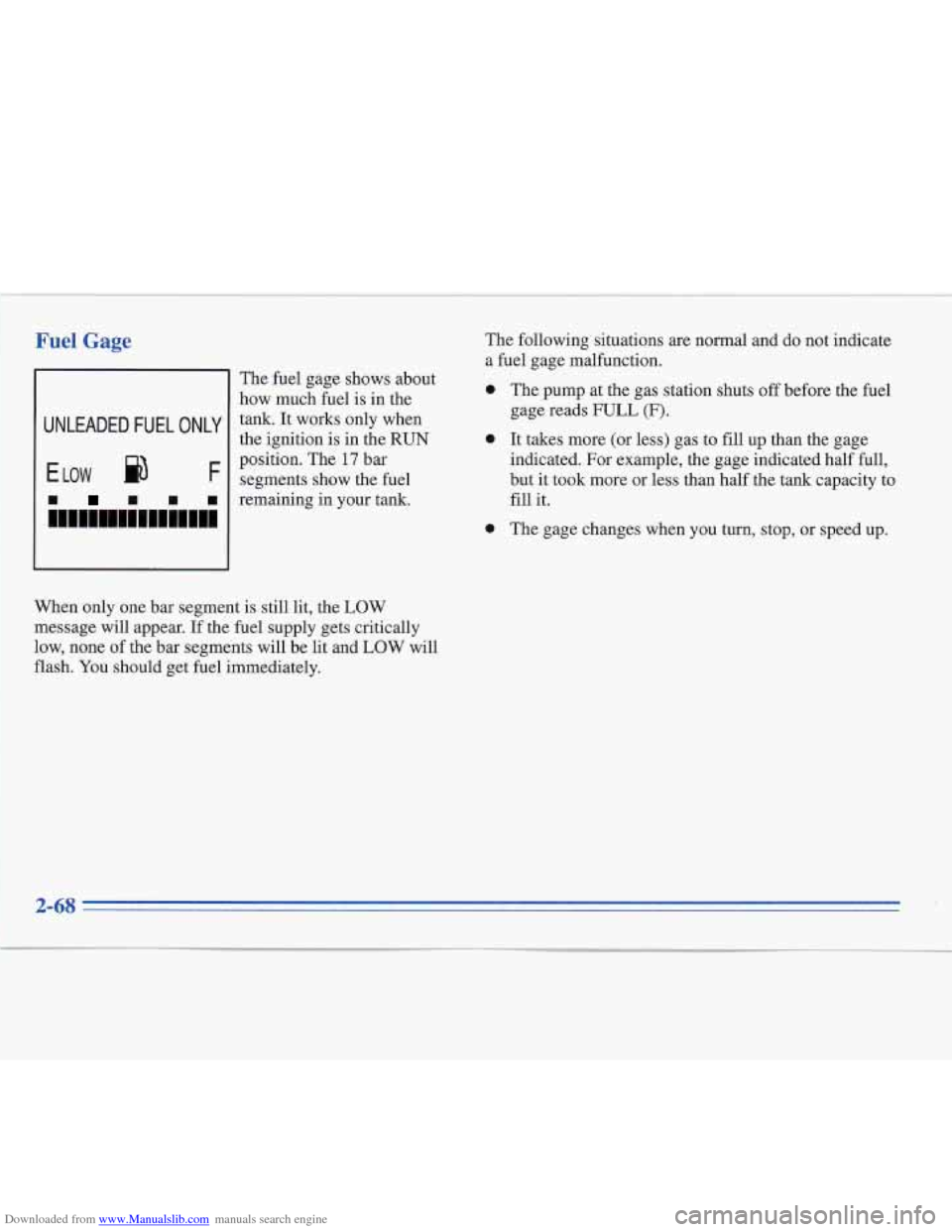
The fuel gage shows about
how much fuel is in the The
following situations
are normal and do not indicate
a
fuel gage malfunction.
a
I UNLEADED FUEL ONLY I tank. It works only when
the ignition is in the RUN
position. The 17 bar
segments show the fuel
-
I I I I remaining in your tank.
~wmmmnrn
When only one bar segment is still lit, the LOW
message will appear. If the
fuel supply gets critically
low, none of the bar segments will be lit and LOW will
flash. You should get fuel immediately.
a
0
The pump at the gas station shuts off before the fuel
gage reads FULL (F).
It takes more (or less) gas to fill up than the gage
indicated. For example, the gage indicated half full,
but it took more or less than half the tank capacity to
fill it.
The gage changes when you turn,
stop, or speed up.
Page 219 of 306
Downloaded from www.Manualslib.com manuals search engine Your vehicle has an air bag system. Before attempting to
do your own service work, see “Servicing Your Air
Bag-Equipped Cadillac” in the Index.
You should keep a record with all parts receipts and list
the mileage and the date of any service work you
perform. See “Maintenance Record” in the Index.
You can be injured and your vehicle could be
damaged
if you try to do service work on a
vehicle without knowing enough about it.
0 Be sure you have sufficient knowledge,
experience, and the proper replacement
parts and tools before you attempt any
vehicle maintenance task.
0 Be sure to use the proper nuts, bolts and
other fasteners. “English” and “metric”
fasteners can be easily confused.
If you use
the wrong fasteners, parts can later break
or
fall off. You could be hurt.
Fuel
Use regular unleaded gasoline rated at 87 octane or
higher. At
a minimum, it should meet specifications
ASTM D4814
in the United States and CGSB 3.5-M93
in Canada. Improved gasoline specifications have been
developed by the American Automobile Manufacturers
Association (AAMA) €or better vehicle performance
and engine protection. Gasolines meeting the AAMA
specification could provide improved driveability and
emission control system protection compared to
other gasolines.
Be sure the posted octane is at least 87.
If the octane is
less than 87, you may get a heavy knocking noise when
you drive. If it’s bad enough, it can damage your engine.
If you’re using fuel rated at 87 octane or higher and you
still hear heavy knocking, your engine needs service.
But don’t
worry if you hear a little pinging noise when
you’re accelerating or driving up a hill. That’s normal,
and you don’t have to buy a higher octane fuel to get rid
of pinging. It’s the heavy, constant knock that means
you have a problem.
6-2
Page 221 of 306
Downloaded from www.Manualslib.com manuals search engine Fuels in Foreign Countries
If you plan on dnviqg in another country outside the
United States or Canada, the proper fuel may be hard to
find. Never use leaded gasoline or any other fuel not
recommended in the previous text on fuel. Costly repairs
caused by use of improper fuel wouldn’t be covered by
your warranty.
To check on fuel availability, ask an auto club, or
contact a major oil company that does business in the
country where you’ll be driving.
You can also write us at the following address for
advice. Just tell
us where you’re going and give your
Vehicle Identification Number (VIN).
General Motors Overseas Distribution Corporation
North American Export Sales (NAES)
1908 Colonel Sam Drive
Oshawa, Ontario
L1H 8P7
Filling Your Tank
Gasoline vapor is highly flammable. It burns
violently, and that can cause very bad injuries.
Don’t smoke if you’re near gasoline or refueling
your vehicle. Keep sparks, flames, and smoking
materials away from gasoline.
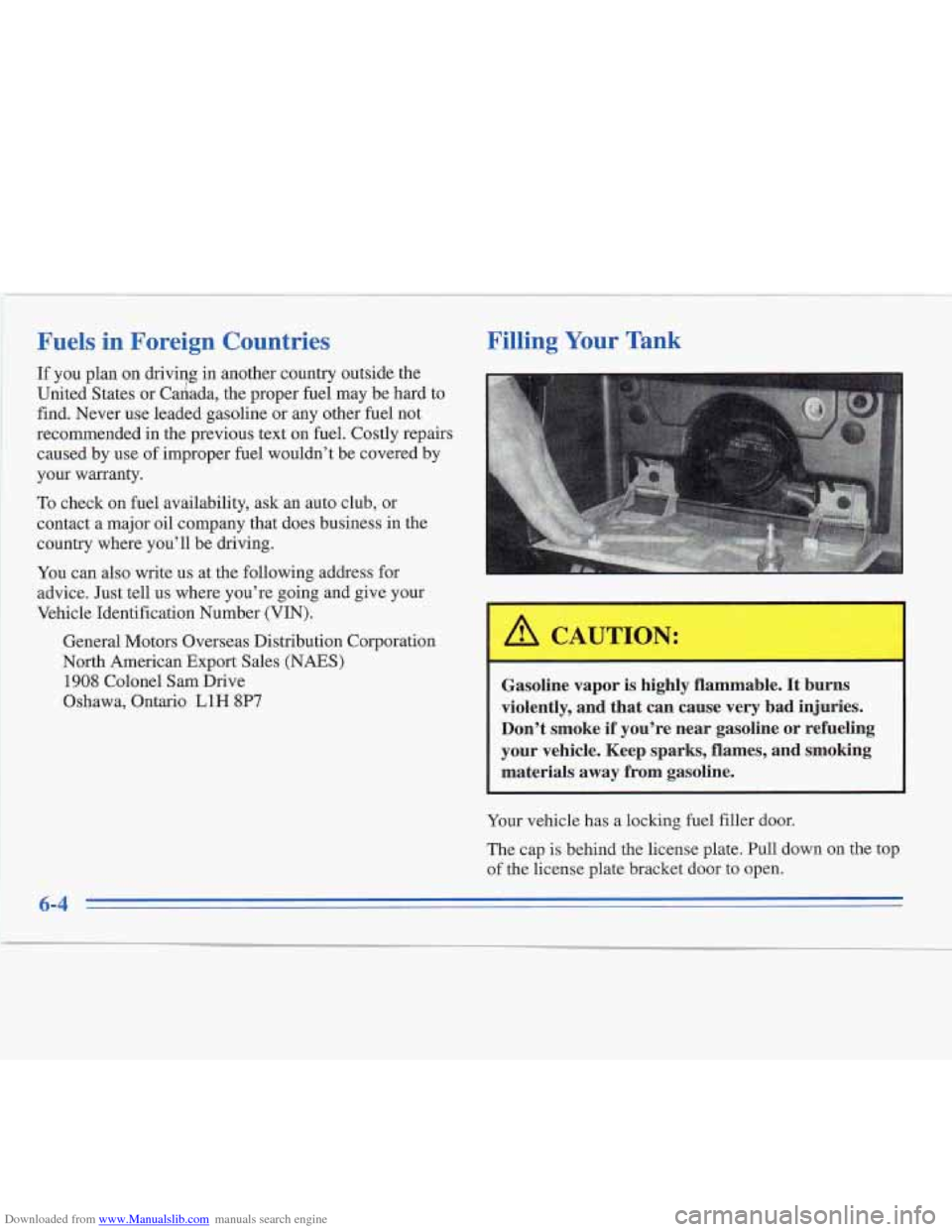
Your vehicle has a locking fuel filler door.
The cap is behind the license plate. Pull down on the top
of the license plate bracket door
to open.
6-4
Page 222 of 306
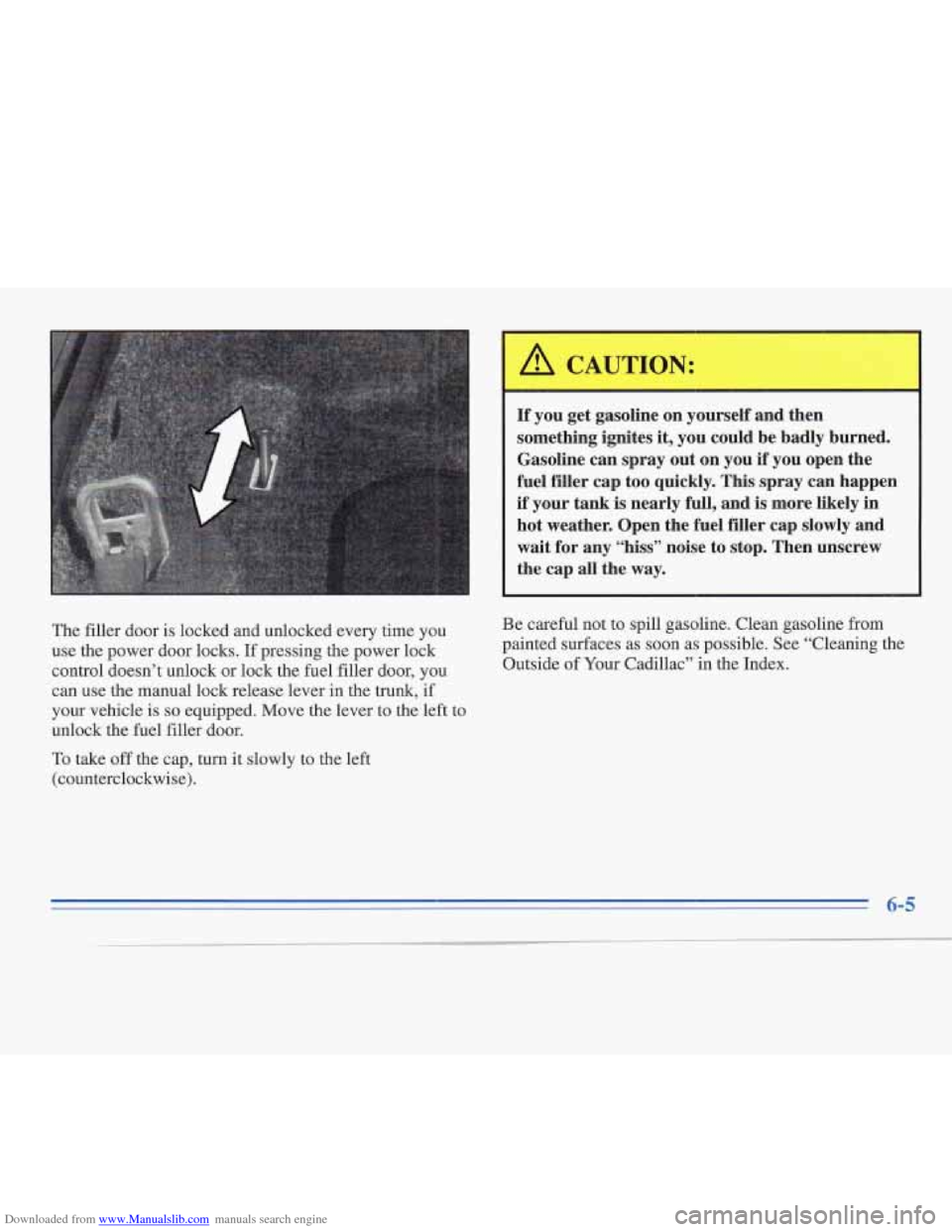
Downloaded from www.Manualslib.com manuals search engine The filler door is locked and unlocked every time you
use the power door locks.
If pressing the power lock
control doesn’t unlock or lock the fuel filler door, you
can use the manual lock release lever in
the trunk, if
your vehicle is
so equipped. Move the lever to the left to
unlock the fuel filler door.
To take
off the cap, turn it slowly to the left
(counterclockwise).
A CAUTION:
If you get gasoline on yourself and then
something ignites
it, you could be badly burned.
Gasoline can spray out on you
if you open the
fuel filler cap too quickly.
This spray can happen
if your tank is nearly full, and is more likely in
hot weather. Open the fuel filler cap slowly and
wait for any “hiss” noise to stop. Then unscrew
the cap all the way.
Be careful not to spill gasoline. Clean gasoline from
painted surfaces as soon as possible. See “Cleaning the
Outside of Your Cadillac” in the Index.
Page 223 of 306
Downloaded from www.Manualslib.com manuals search engine When you put the cap back on, turn it to the right until
you hear at least three clicks. Make sure you fully install
the cap.
The diagnostic system can determine if the fuel
cap has been left off or improperly installed. This would
allow fuel to evaporate into the atmosphere. See
“Malfunction Indicator Lamp” in the Index.
NOTICE:
If you need a new cap, be sure to get the right
type. Your dealer can get one for you.
If you get
the wrong type,
it may not fit or have proper
venting, and your fuel tank and emissions system
might be damaged.
Checking Things Under the Hood
A CkmON’:
An electric fan under the hood can start up and
injure you even when the engine
is not running.
Keep hands, clothing and tools away from any
underhood electric fan.
Things that burn can get on hot engine parts and
start a fire. These include liquids like gasoline,
oil, coolant, brake fluid, windshield washer and
other fluids, and plastic or rubber. You or others
could be burned. Be careful not to drop or spill
things that will burn onto a hot engine.
6-6