1996 CADILLAC FLEETWOOD Weight
[x] Cancel search: WeightPage 179 of 306
Downloaded from www.Manualslib.com manuals search engine Weight of the Trailer Tongue
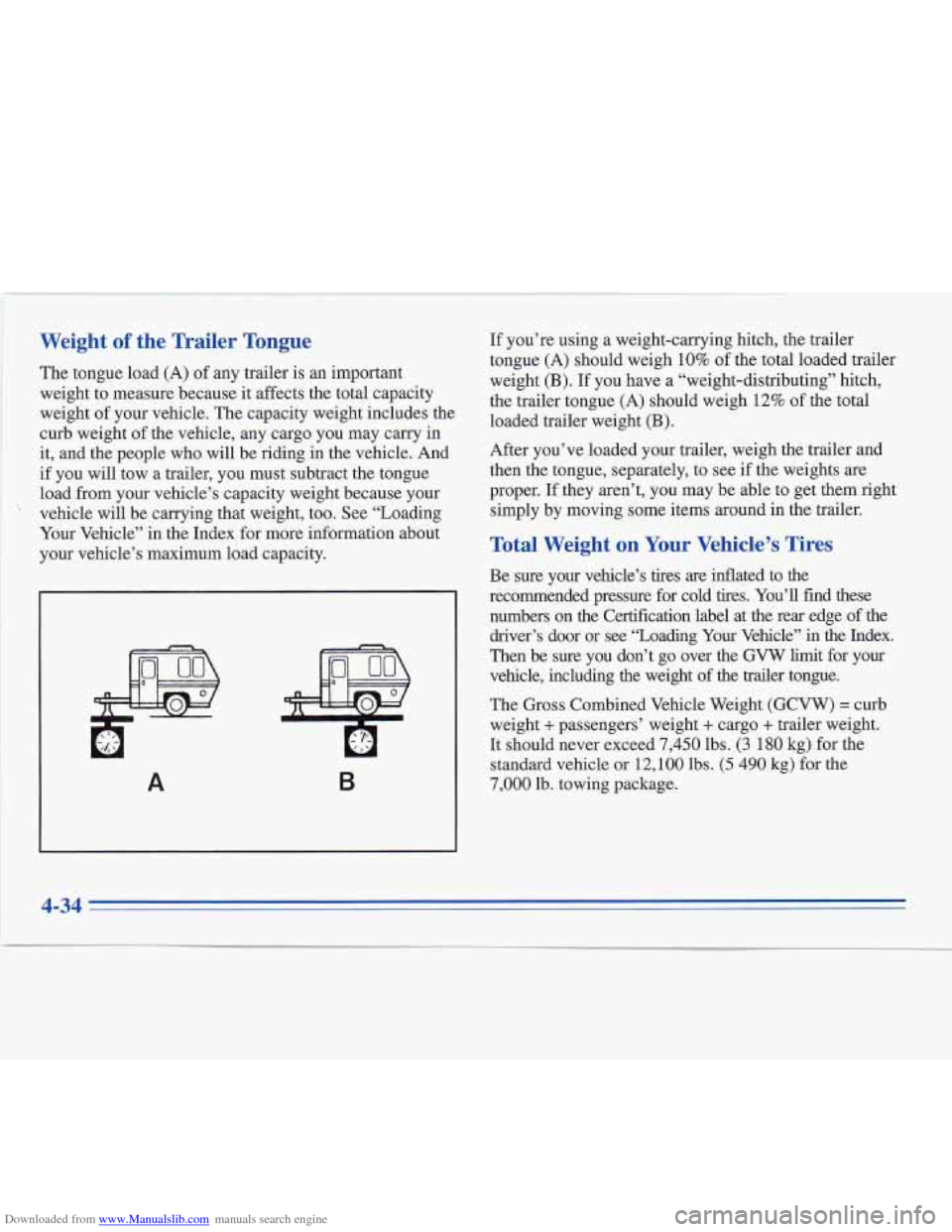
The tongue load (A) of any trailer is an important
weight to measure because it affects the total capacity
weight of your vehicle.
The capacity weight includes the
curb weight of the vehicle, any cargo you may carry in
it, and the people who will be riding in the vehicle. And
if you will tow a trailer, you must subtract the tongue
load from your vehicle’s capacity weight because your
vehicle will be carrying that weight, too. See “Loading
Your Vehicle” in the Index for more information about
your vehicle’s maximum load capacity.
B A
If you’re using a weight-carrying hitch, the trailer
tongue
(A) should weigh 10% of the total loaded trailer
weight
(B). If you have a “weight-distributing” hitch,
the trailer tongue
(A) should weigh 12% of the total
loaded trailer weight
(B).
After you’ve loaded your trailer, weigh the trailer and
then the tongue, separately, to see if the weights
are
proper. If they aren’t, you may be able to get them right
simply by moving some items around in the trailer.
Total Weight on Your Vehicle’s Tires
Be sure your vehicle’s tires are inflated to the
recommended pressure for cold tires. You’ll find these numbers on the Certification label at the
rear edge of the
driver’s door or
see “Loading Your Vehicle” in the Index.
Then be sure you don’t go over
the GVW limit for your
vehicle, including the weight
of the trailer tongue.
The Gross Combined Vehicle Weight (GCVW)
= curb
weight
+ passengers’ weight + cargo + trailer weight.
It should never exceed 7,450 lbs.
(3 1 SO kg) for the
standard vehicle
or 12,100 lbs. (5 490 kg) for the
7,000 lb. towing package.
4-34
Page 180 of 306
Downloaded from www.Manualslib.com manuals search engine Hitches
It’s important to have the correct hitch equipment.
Crosswinds, large trucks going by and rough roads are a
few reasons why you’ll need the right hitch. Here
are
some rules to follow:
e
e
e
If you’ll be pulling a trailer that, when loaded, will
weigh more than 2,000 lbs.
(900 kg), be sure to use a
properly mounted, weight-distributing hitch and
sway control of the proper size. This equipment
is
very important for proper vehicle loading and good
handling when you’re dnving.
Will you have to make any holes in the body of your
vehicle when you install a trailer hitch? If you do,
then be sure to seal the holes later when you remove
the hitch. If you don’t seal them, deadly carbon
monoxide (CO) from your exhaust can get into your
vehicle (see “Carbon Monoxide” in the Index). Dirt
and water can, too.
Don’t
let the steel in a hitch contact the aluminum on
your bumper. If you do, the two will corrode. You
can use something like paint or plastic tape to
separate the steel and aluminum. The same steel to
aluminum problem can happen with fasteners, too.
Using A Weight-Carrying Trailer Hitch
(Recommended for loaded trailers weighing less than
3,000 lbs. or
1 362 kg.)
The trailer tongue should weigh 10 percent of the
total trailer load (maximum 300 lbs. or 136 kg) or as
specified by the trailer manufacturer to minimize
sway.
Trailers that weigh more than 1,000 lbs. (454 kg)
should be equipped with trailer brakes.
Consider using sway control if your loaded trailer
will weigh 3,000 lbs.
(1 362 kg) or more.
Trailer Hitching Procedure Using A Weight
Distributing (Equalizing) Hitch
(Recommended for loaded trailers weighing 3,000 lbs.
to
7,000 lbs. or 1 362 kg to 3 178 kg.)
Using a weight distributing hitch without disabling the
Electronic Level Control (ELC) system may defeat the
purpose
of the weight distributing hitch. Also, your rear
tires may become overloaded. A weight distributing
hitch should spread the load to all axles. If you use a
weight distributing hitch, always disable the ELC by
following the proper steps.
4-35
Page 181 of 306
Downloaded from www.Manualslib.com manuals search engine Your vehicle is equipped with an Electronic Level
Control (ELC) feature. When hooking up a trailer
using a weight distributing hitch, always use the
following procedure:
a
a
a
a
0
Place the vehicle on a level surface without the
trailer hitched. With the ignition off, and all doors
closed, allow the vehicle to level automatically.
Disable the Electronic Level Control (ELC) by
pulling the LEVEL CTRL fuse from the underhood
electrical center located on the passenger-side wheel
housing in the engine compartment. Remove the
cover to gain access.
Attach the trailer to the vehicle. The trailer tongue
should weigh
12 percent of the total loaded
trailer weight.
Level the vehicle with the load-leveling spring
bars (equalizers).
Leave the fuse out while towing your trailer.
Once you have completed towing your trailer, be sure
to
reinstall the Electronic Level Control (ELC) fuse.
In Addlon
a
a
a
0
0
Use two friction sway controls if your trailer is over
5,000 lbs. (2 270 kg) loaded weight, and/or is over
24 feet (7.3 m) long.
Use at least one friction sway control if your
trailer is over
2,000 lbs. (900 kg) loaded weight,
and consider using one for trailers under
2,000 lbs.
(900 kg).
Trailers that weigh more than
1,000 lbs. (454 kg)
should be equipped with trailer brakes.
Surge brakes work with most weight-distributing
hitches as long as all the equipment is properly
installed. Check with the hitch manufacturer for
advice and installation instructions.
If a trailer is over 5,000 lbs. (2 270 kg), adjust
the vehicle's rear tire pressures to
35 psi (240 Pa)
(cold tire pressure).
4-36
Page 182 of 306
Downloaded from www.Manualslib.com manuals search engine Safety Chains Trailer Wiring Harness
You
should always attach chains between your vehicle
and your
trailer. Cross the safety chains under the tongue
of the trailer
so that the tongue will not drop to the road
if it becomes separated from the hitch. Instructions
about safety chains may be provided by the hitch
manufacturer or by the trailer manufacturer. Follow the
manufacturer’s recommendation for attaching safety
chains and do not attach them to the bumper. Always
leave just enough slack
so you can turn with your rig.
And, never allow safety chains to drag on the ground.
Trailer Brakes
If your trailer weighs more than 1,000 lbs. (450 kg)
when loaded,
it needs to be equipped with adequate
brakes. Be sure to read and follow the instructions
for
the trailer brakes so you’ll be able to maintain
them properly.
Because you have anti-lock brakes, do not
try to tap into
your vehicle hydraulic brake system.
If you do, both
brake systems won’t work well, or at all.
If your Fleetwood is equipped with the heavy duty
trailering option, a five-wire trailering harness is
located in the trunk. You may have to have it wired
to your vehicle.
These trailer harness color codes should be followed
when connecting to your trailer:
0 White: Direct Trailer Ground for Trailer Lamps
0 Brown: Parking Lamps
Yellow: Left Turn and Stoplamps
Dark Green: Right Turn and Stoplamps
Dark Blue: Auxiliary Circuit
Driving with a Trailer
Towing a trailer requires a certain amount of experience.
Before setting out for
the open road, you’ll want to get
to know your rig. Acquaint yourself with the feel of
handling and braking with the added weight of the
trailer. And always keep
in mind that the vehicle you are
driving is now a good deal longer and not nearly as
responsive as your vehicle is by itself.
Page 304 of 306
Downloaded from www.Manualslib.com manuals search engine Towing a Trailer ................................ 4-31
Towing Your Vehicle
............................. 5-7
Traction Control System
.......................... 4-8
Traction Control System Active Light
........... 2.58. 4.8
Traction Control System Warning Light
......... 2.58. 4.9
Trailer Brakes
..................................... 4-37
Driving on Grades
............................ 4-39
Engine Cooling When Towing
................... 4-40
Hitches
..................................... 4-35
Maintenance When Towing
..................... 4-40
Safety Chains
................................ 4-37
Tongueweight
............................... 4-34
Total Weight on Tires
.......................... 4-34
Towing
..................................... 4-31
Turnsignals
................................. 4-39
Wiring Harness
............................... 4-37
Transmission Fluid. Automatic
.................... 6- 16
Transmitters. Keyless Entry System
................. 2-6
Trip Odometer
................................. 2-53
AjarLight
................................... 2-67
Automatic Pull-Down Feature
.................... 2-9
Release. Remote
............................... 2-9
TTYUsers
..................................... 7-3
DrivingWith
................................ 4-37
ParkingonHills
.............................. 4-39
Weight
..................................... 4-33
Transportation. Courtesy
.......................... 7-7
Tr~nk
......................................... 2-8 Turn
Signal and Lane Change Indicator
.............
Underbody Maintenance ........................ 6-54
Underhood Lamp
............................... 2-41
Universal Transmitter
............................ 2-48
Vehicle Control
...................................... 4-5
Damage Warnings
.............................. xii
Dimensions
................................. 6-66
Identification Number ......................... 6-56
Loading
.................................... 4-29
Ventilation System
............................... 3-3
Visor Vanity Mirror
............................. 2-47
Visors, Sun
.................................... 2-47
Storage
..................................... 6-31
warning
Devices ............................... 5-2
Warning Lights. Gages and Indicators ............... 2-54
Washer Fluid Low Light
......................... 2-66
Washer Fluid. Windshield
........................ 6-25
Washing Your Vehicle
........................... 6-52
Weatherstrips
.................................. 6-52
... 8-9