1996 CADILLAC ELDORADO steering wheel
[x] Cancel search: steering wheelPage 195 of 354
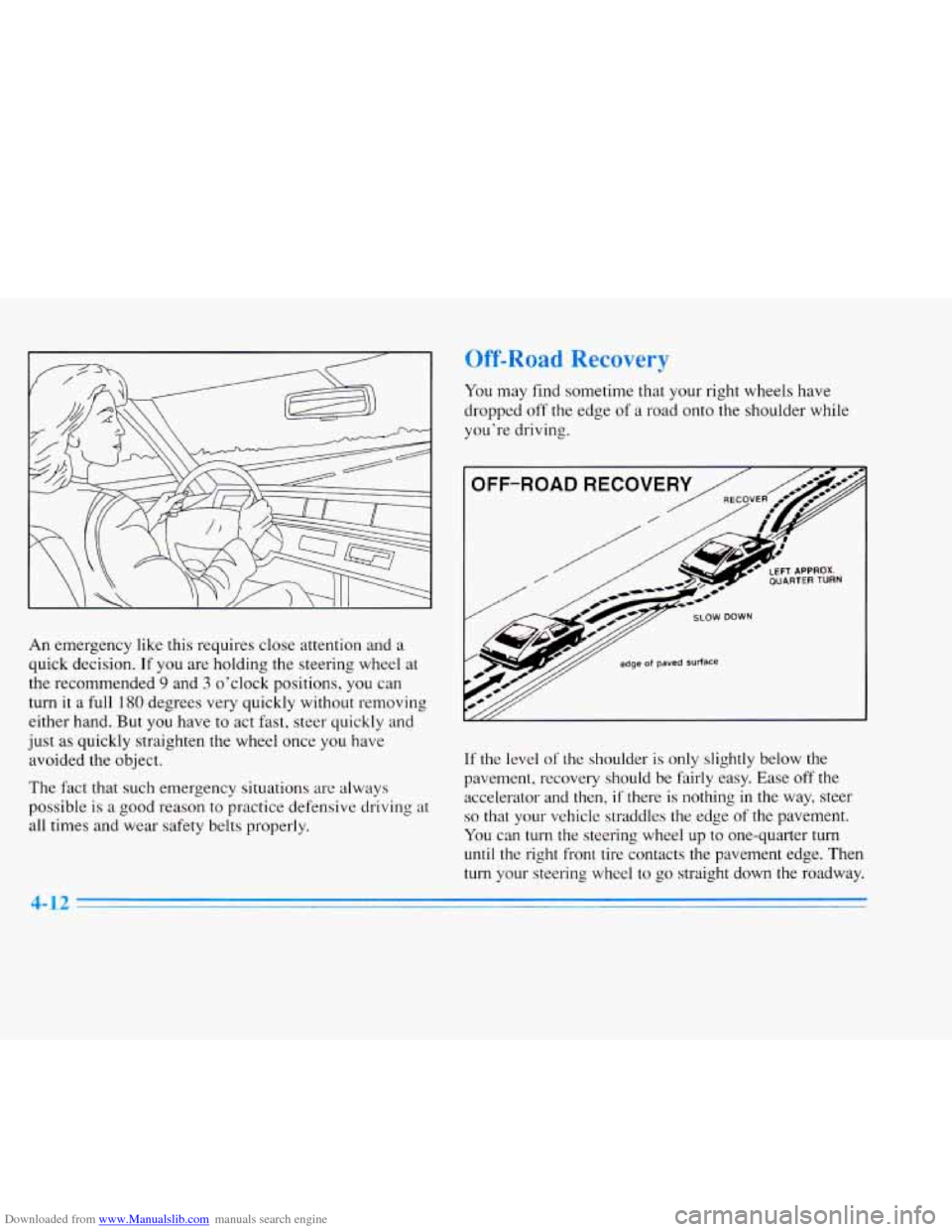
Downloaded from www.Manualslib.com manuals search engine An emergency like this requires close attention and a
quick decision. If you are holding the steering wheel at
the recommended
9 and 3 o’clock positions, you can
turn it a full 180 degrees very quickly without removing
either hand. But
you have to act fast, steer quickly and
just
as quickly straighten the wheel once you have
avoided the object.
The fact that such emergency situations are always
possible is
a good reason to practice defensive driving at
all times and wear safety belts properly. You
may find sometime that your right wheels have
dropped off the edge
of a road onto the shoulder while
you’re driving.
OFF-ROAD RECOVER
/
// edge of paved Surface
If the level of‘ the shoulder is only slightly below the
pavement, recovery should be fairly easy. Ease off the accelerator and then,
if there is nothing in the way, steer
so that your vehicle straddles the edge of the pavement.
You can turn the steering wheel up to one-quarter turn
until the right front tire contacts the pavement edge. Then
turn your steering wheel to go straight down the roadway.
4-12
Page 197 of 354
Downloaded from www.Manualslib.com manuals search engine 0 Check your mirrors, glance over your shoulder and start your left lane change signal before moving out
of the right lane to pass. When you are far enough
ahead of the passed vehicle to see its front
in your
inside mirror, activate your right lane change signal
and move back into the right lane. (Remember that
your right outside mirror is convex. The vehicle you
just passed may seem
to be farther away from you
than
it really is.)
Try not to pass more than one vehicle at a time on
two-lane roads. Reconsider before passing the next
vehicle.
Don’t overtake a slowly moving vehicle too rapidly.
Even though the brake lamps are not flashing, it may
be slowing down or starting to turn.
If you’re being passed, make it easy for the
following driver
to get ahead of you. Perhaps you
can ease a little to the right.
’C
s review wnat arlving experts say about what
happens when the three control systems (brakes, steering
and acceleration) don’t have enough friction where the
tires meet the road
to do what the driver has asked.
In any emergency, don’t give up. Keep trying to steer and
constantly seek an escape route or area
of less danger.
In a skid, a driver can lose control of the vehicle.
Defensive drivers avoid most skids by taking reasonable
care suited to existing conditions, and by not
“overdriving” those conditions. But skids are always
possible.
The
three types of skids correspond to your Cadillac’s
three control systems. In the braking skid, your wheels
aren’t rolling.
In the steering or cornering skid, too
much speed or steering
in a curve causes tires to slip and
lose cornering force. And in the acceleration skid, too
much throttle causes the driving wheels to spin.
A cornering skid is best handled by easing your foot off
the accelerator pedal.
Remember:
Any traction control system helps avoid
only the acceleration skid.
If your traction control system is
off, then an
acceleration skid is also best handled by easing your
foot off the accelerator pedal.
If your vehicle starts to slide, ease your foot off the
accelerator pedal and quickly steer the way you want the
vehicle to
go. If you start steering quickly enough, your
vehicle may straighten out. Always be ready
for a
second skid
if it occurs.
Page 218 of 354

Downloaded from www.Manualslib.com manuals search engine leave just enough slack so you can turn with your rig.
And, never allow safety chains to drag on the ground.
Trailer Brakes
Because you have anti-lock brakes, don’t try to tap into
your vehicle’s hydraulic brake system. If you do, both
brake systems won’t work
Be sure to read and follow
brakes
so you’ll be able to
them properly. well,
or at all.
the instructions for the trailer
install, adjust and maintain
Driving with a ”hailer
Towing a trailer requires a certain amount of experience.
Before setting out for the open road, you’ll want to get
to know your rig. Acquaint yourself with the feel of
handling and braking with the added weight of the
trailer. And always keep in mind that the vehicle you are
driving
is now a good deal longer and not nearly as
responsive as your vehicle is by itself.
Before you start, check the trailer hitch and platform
(and attachments), safety chains, electrical connector,
lamps, tires and mirror adjustment.
If the trailer has
electric brakes, start your vehicle and trailer moving and
then apply the trailer brake controller by hand to be sure
the brakes
are working. This lets you check your
electrical connection at the same time. During your trip, check occasionally
to be sure that the
load is secure, and that the lamps and any trailer brakes
are still working.
Following Distance
Stay at least twice as far behind the vehicle ahead as you
would when driving your vehicle without a trailer. This
can help you avoid situations that require heavy braking
and sudden turns.
Passing
You’ll need more passing distance up ahead when
you’re towing a trailer. And, because you’re a good deal
longer, you’ll need to go much farther beyond the
passed vehicle before you can return to your lane.
Backing Up
Hold the bottom of the steering wheel with one hand.
Then, to move the trailer to the left, just move that hand
to the left.
To move the trailer to the right, move your
hand to the right. Always back up slowly and, if
possible, have someone guide you.
4-35
Page 231 of 354

Downloaded from www.Manualslib.com manuals search engine A vehicle can fall from a car carrier if it isn’t
adequately secured. This can cause
a collision,
serious personal injury and vehicle damage. The
vehicle should be tightly secured with chains or
steel cables before it is transported.
Don’t use substitutes (ropes, leather straps,
canvas webbing, etc.) that can be cut by sharp
edges underneath the towed vehicle. Always use
T-hooks inserted in the front T-hook slots or
R-hooks inserted in the
rear R-hook slots.
Never use J-hooks. They will damage drivetrain
and suspension components.
When your vehicle is being towed, have the ignition key
turned to the
OFF position. The steering wheel should
be clamped in a straight-ahead position, with a clamping
device designed for towing service.
Do not use the
vehicle’s steering column lock for this. The transaxle
should be in NEUTRAL (N) and the parking brake
released.
Don’t have your vehicle towed on the drive wheels
unless you must. If the vehicle must be towed on the
drive wheels, be sure to follow the speed and distance
restrictions later in this section or your transaxle will be
damaged.
If these limitations must be exceeded, then the
drive wheels have to be supported on a dolly.
Page 246 of 354
Downloaded from www.Manualslib.com manuals search engine If a Tire Goes Flat
It’s unusual for a tire to “blow out” while you’re driving,
especially if you maintain your tires properly. If air goes
out of a tire, it’s much more likely to leak out slowly.
But if you should ever have a “blowout,” here are
a few
tips about what to expect and what
to do:
If a front tire fails,
the flat tire will create a drag that
pulls the vehicle toward that side. Take your foot
off the
accelerator pedal and grip the steering wheel firmly.
Steer to maintain lane position, and then gently brake to
a stop well
out of the traffic lane.
A rear blowout, particularly on a curve, acts much like a
skid and may require the same correction you’d use in a
skid.
In any rear blowout, remove your foot from the
accelerator pedal. Get the vehicle under control by
steering the way
you want the vehicle to go. It may be
very bumpy and noisy, but you can still steer. Gently
brake to a stop
-- well off the road if possible.
If a tire goes flat, the next part shows how to use your
jacking equipment to change a flat tire safely.
Changing a Flat Tire
If a tire goes flat, avoid further tire and wheel damage
by driving slowly to a level place. Turn on your hazard
warning flashers.
A CAUTION:
Changing a tire can cause an injury. The vehicle
can slip
off the jack and roll over you or other
people.
You and they could be badly injured.
Find
a level place to change your tire. To help
prevent the vehicle from moving:
1. Put the shift lever in PARK (P).
2. Set the parking brake firmly.
3. ”urn off the engine.
To be even more certain the vehicle won’t move,
you can put blocks at the front and rear of the
tire farthest away from the one being changed.
That would be the tire on the other side
of the
vehicle, at the opposite end.
5-25
Page 258 of 354
Downloaded from www.Manualslib.com manuals search engine NOTICE:
Spinning your wheels can destroy parts of your
vehicle as well as the tires. If you spin the wheels
too fast while shifting your transaxle back and
forth, you can destroy your transaxle.
~
For information about using tire chains on your vehicie,
see “Tire Chains” in the Index.
Rocking your vehicle to get it out:
First, turn your steering wheel left and right. That will
clear the area around your front wheels. You should turn
your traction control system off. (See “Traction Control
System” in the Index.) Then shift back and forth
between REVERSE
(R) and a forward gear, spinning the
wheels as little as possible. Release the accelerator pedal
while you shift, and press lightly on the accelerator
pedal when the transaxle is in gear. If that doesn’t get
you out after
a few tries, you may need to be towed out.
If you do need to be towed out,
see “Towing Your
Vehicle’’ in the Index.
5-37
1
Page 320 of 354

Downloaded from www.Manualslib.com manuals search engine Fuse
IGN 0- BODY
TURN CONSOLE
Usage
PRNDL, Heated Windshield (Optional), PZM, Cluster, Air
Control Module (ACM), Upper and Lower Zone Motor, HVAC
Solenoids, Climate Control Panel
(Optional), Rear Defog Relay,
ELC Relay
Cornering Lamp Switch, Right
and Left Cornering Lamps,
Electronic Flasher Module,
Turn/Hazard Switch, Right and Left Rear Turn Signal Lamps,
Right and Left Front
Turn Signal
Lamps, Repeater Lamps (Export)
Cellular Phone Portable Docking
Station, Washer Circuit Board,
Heated Seat Switch, Rear Zone
Blower, Right and Left Heated Seat Switches, Headlamp Wash Relay
Fuse
COMFORT
AMP
(Optional)
PZM
RADIO/ PHONE
CLUSTER
ACC
RR DEFOG
Usage
CD Player, Remote Function
Actuator (RFA), Controlled Power
Relay, Air Control Module (ACM), PZM
Right and Left Hand Bose Relay,
Right Front and Rear Speaker
(On Door), Left Front and Rear
Speaker (On Door)
PZM
Radio Receiver, Radio Interface Module (RIM)(Bose Only),
Phone, DAB Relay, Trunk Release
Relay, Fuel Door Release Relay,
High Beam Relay
Steering Wheel Controls, Cluster
PZM, Electrochromic Mirror, Rain
Sensor (Optional), Accessory Relay
Rear Defog
6-
-I
Page 342 of 354
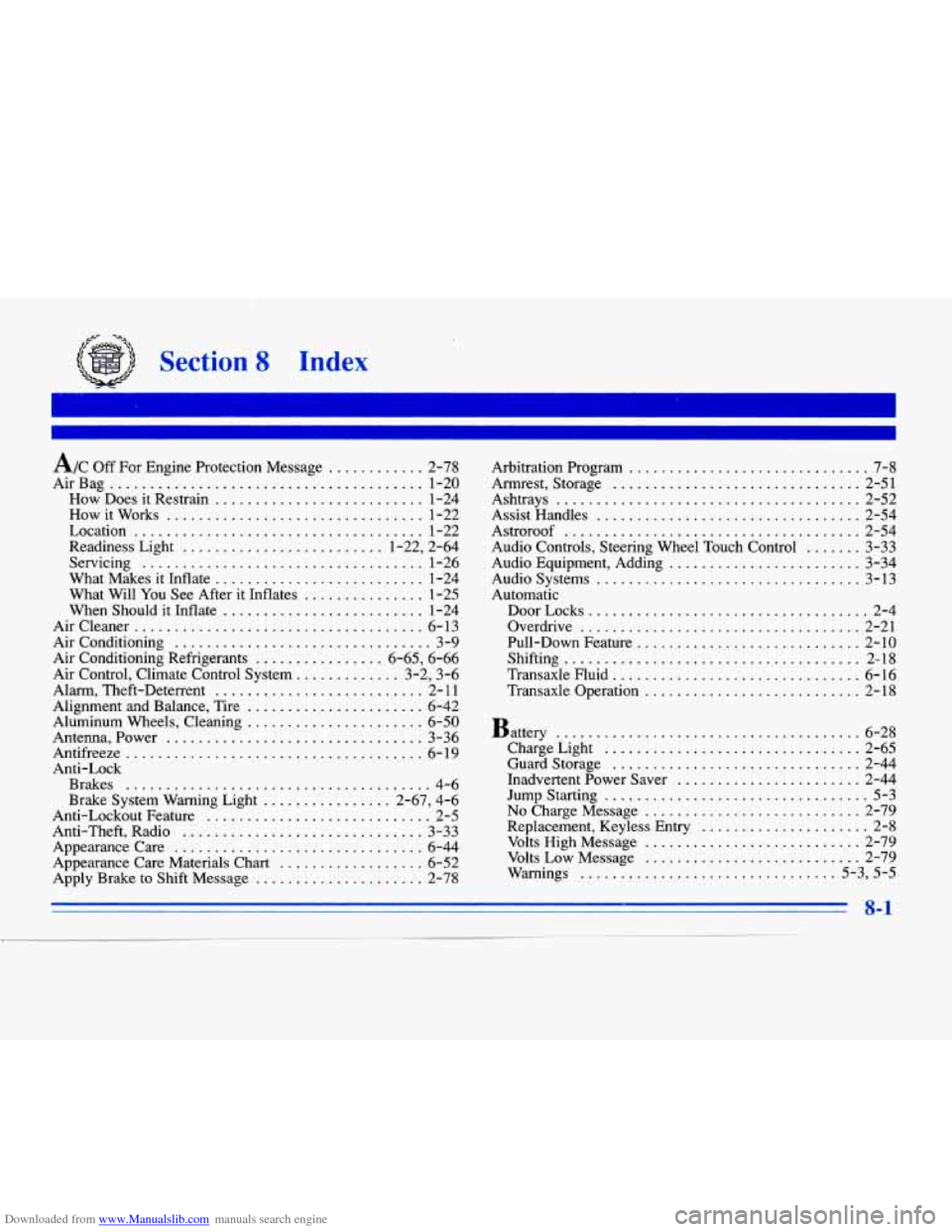
Downloaded from www.Manualslib.com manuals search engine ........
Section 8 Index
. .
.
A/C Off For Engine Protection Message ............ 2-78
AirBag
....................................... 1-20
How Does it Restrain
.......................... 1-24
How it Works
................................ 1-22
Location
.................................... 1-22
Readiness Light
......................... 1.22. 2.64
Servicing
................................... 1-26
What Makes
it Inflate .......................... 1-24
What Will You See After it Inflates
............... 1-25
When Should it Inflate
......................... 1-24
Air Cleaner
.................................... 6- 13
Air Conditioning
................................ 3-9
Air Conditioning Refrigerants
................ 6.65. 6.66
Air Control. Climate Control System
............. 3.2. 3.6
Alarm. Theft-Deterrent
.......................... 2- 11
Alignment and Balance. Tire
...................... 6-42
Aluminum Wheels. Cleaning
...................... 6-50
Antenna. Power
................................ 3-36
Antifreeze
..................................... 6- 19
Anti-Lock
Brakes
...................................... 4-6
Brake System Warning Light
................ 2.67. 4.6
Anti-Lockout Feature
............................ 2-5
Anti.Theft. Radio
.............................. 3-33
Appearance Care
............................... 6-44
Appearance Care Materials Chart
.................. 6-52
Apply Brake to Shift Message
..................... 2-78 Arbitration Program
.............................. 7-8
Armrest. Storage ............................... 2-51
Ashtrays
...................................... 2-52
Assist Handles
................................. 2-54
Astroroof
..................................... 2-54
Audio Controls. Steering Wheel Touch Control
....... 3-33
Audio Equipment. Adding
........................ 3-34
Audio Systems
................................. 3-13
Automatic
DoorLocks
................................... 2-4
Overdrive
................................... 2-21
Pull-Down Feature
............................ 2-10
Shifting
..................................... 2-18
Transaxle Fluid
............................... 6-16
Transaxle Operation
........................... 2-18
Battery
...................................... 6-28
ChargeLight
................................ 2-65
Guard Storage
............................... 2-44
Inadvertent Power Saver
....................... 2-44
Jump Starting
................................. 5-3
Replacement. Keyless Entry
..................... 2-8
Volts High Message
........................... 2-79
Volts Low Message
........................... 2-79
Warnings
................................ 5-3. 5-5
No Charge Message ........................... 2-79
8-1
I