1996 BUICK REGAL torque
[x] Cancel search: torquePage 8 of 356

In World War 11, Buick built aircraft engines, tanks and
other military hardware. This post-war period brought
great styling and engineering changes which resulted
in
increased sales. The torque converter automatic
transmission, Dynaflow, was introduced
in the 1948
Roadmaster. Buick’s Fdmous “portholes” came along
in 1949.
1949 Roadmaster
A high-compression V-8 engine was introduced in 1953.
And Buick’s famous vertical pillar “toothy” grille,
(introduced in 1942), became more massive
in the
post-war era.
~ 1.953 Skylark
Motor Trend magazine named the 1962 Buick Special
“Car of the Year.” The first production V-6 engine was
used in the Special.
ProCarManuals.com
Page 87 of 356
Leaving Your Vehicle With the Engine
Running
It can be dangerous to leave your vehicle with
the engine running. Your vehicle could move
suddenly if the shift lever is not fully in PARK
(P)
with the parking brake firmly set. And, if you
leave the vehicle with the engine running, it could
overheat and even catch fire. You
or others could
be injured. Don’t leave your vehicle with the
engine running unless you have to.
If you have to leave your vehicle with the engine
running, be sure your vehicle is
in PARK (P) and your
parking brake is firmly set before you leave
it. After
you’ve moved the shift lever into the PARK
(P)
position, hold the regular brake pedal down. Then, see if
you can move the shift lever away from PARK (P)
without first pulling it toward you (or, if you have the
console shift lever, without first pushing the button). If
you can, it means that the shift lever wasn’t fully locked
into PARK
(P).
Torque Lock
If you are parking on a hill and you don’t shift your
transaxle into PARK (P) properly, the weight of the
vehicle
may put too much force on the parking pawl in
the transaxle.
You may find it difficult to pull the shift
lever out
of PARK (P). This is called “torque lock.” To
prevent torque lock, set the parking brake and then shift
into PARK
(P) properly before you leave the driver’s
seat. To find out how, see “Shifting Into PARK
(P)” in
the Index.
When you are ready to drive, move
the shift lever out of
PARK (P)
bqfore you release the parking brake.
If torque lock does occur, you may need to have another
vehicle push yours
a little uphill to take some of the
pressure from the transaxle,
so you can pull .the shift
lever out of PARK (P).
ProCarManuals.com
Page 217 of 356
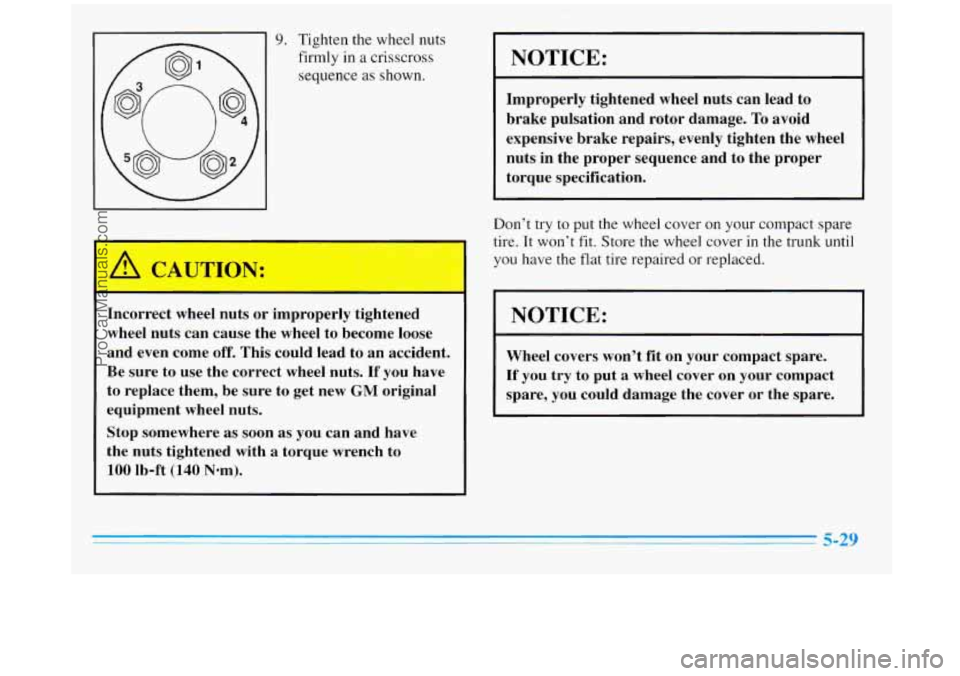
9. Tighten the wheel nuts
firmly in a crisscross
sequence as shown.
I
Incorrect wheel nuts or improperly tightened
wheel nuts can cause the wheel to become loose
and even come
off. This could lead to an accident.
Be sure to use the correct wheel nuts.
If you have
to replace them, be sure to get new
GM original
equipment wheel nuts.
Stop somewhere
as soon as you can and have
the nuts tightened with a torque wrench to
100 lb-ft (140 Nom).
NOTICE:
Improperly tightened wheel nuts can lead to
brake pulsation and rotor damage. To avoid
expensive brake repairs, evenly tighten the wheel nuts in the proper sequence and to the proper
torque specification.
Don‘t try
to put the wheel cover on your compact spare
tire. It won’t
fit. Store the wheel cover in the trunk until
you have the flat tire repaired or replaced.
NOTICE:
~
~~
Wheel covers won’t fit on your compact spare.
If you try to put a wheel cover on your compact
spare, you could damage the cover
or the spare.
ProCarManuals.com
Page 251 of 356
Brake Wear
Your Buick has four-wheel disc brakes.
Disc brake pads have built-in wear indicators that make
a
high-pitched warning sound when the brake pads are
worn and new pads are needed. The sound may come and
go or be heard all the time your vehicle is moving (except
when you are pushing on the brake pedal firmly).
A CAUTION:
I
The brake wear warning so Id means that
sooner or later your brakes won’t work well.
That could lead to an accident. When you hear the brake wear warning sound, have your
vehicle serviced.
I NOTICE:
Continuing to drive with worn-out brake pads
could result in costly brake repair.
Some driving conditions or climates may cause a brake
squeal when the brakes are first applied or lightly
applied. This does not mean something is wrong with
your brakes.
Free movement of brake calipers and properly torqued
wheel nuts are necessary to help prevent brake
pulsation. When tires are rotated, inspect brake calipers
for movement, brake pads for wear,
and evenly torque
wheel nuts
in the proper sequence to GM specifications.
Brake linings should always be replaced
as complete
axle sets.
Brake Pedal Travel
See your dealer if the brake pedal does not return to
normal height, or
if there is a rapid increase in pedal
travel. This could be
a sign of brake trouble.
Brake Adjustment
Every time you apply the brakes, with or without the
vehicle moving, your brakes adjust for wear.
ProCarManuals.com
Page 259 of 356
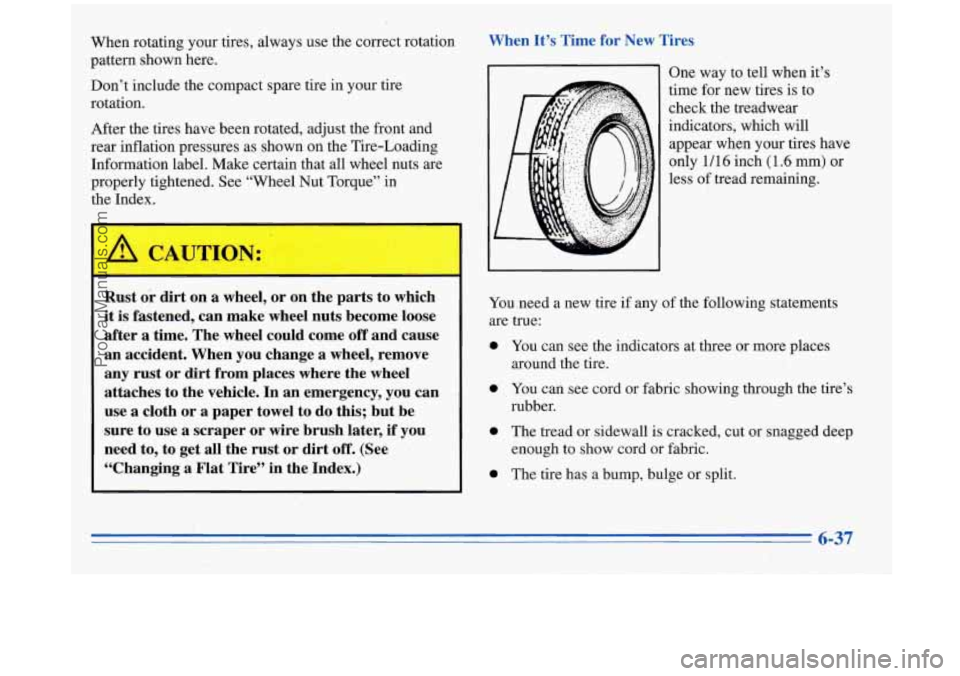
When rotating your tires, always use the correct rotation
pattern shown here.
Don’t include the compact spare tire in your tire
rotation.
After the tires have been rotated, adjust the front and
rear inflation pressures as shown on the Tire-Loading
Information label. Make certain that all wheel nuts are
properly tightened. See “Wheel Nut Torque” in
the Index.
Rust or dirt on a wheel, or on the parts to which
it is fastened, can make wheel nuts become loose
after a time. The, wheel could come
off and cause
an accident. When you change
a wheel, remove
any rust or
dirt from.places where the wheel
attaches to the vehicle. In an emergency, you can
use a cloth or a paper towel to
do this; but be
sure to use a scraper or wire brush later,
if you
need to, to get
all the rust or dirt off. (See
“Changing a Flat Tire” in the Index.) When
It’s Time for New Tires
One way to tell when it’s
time for new tires is to
check the treadwear
indicators, which will
appear when your tires have
only
1/16 inch (1.6 mm) or
less of tread remaining.
You, need a new tire if any of the following statements
are true:
0
0
0
0
You can see the indicators at three or more places
around the tire.
You can see cord or fabric showing through the tire’s
rubber.
The tread or sidewall
is cracked, cut or snagged deep
enough to show cord or fabric.
The tire has a bump, bulge or split.
6-37
ProCarManuals.com
Page 283 of 356
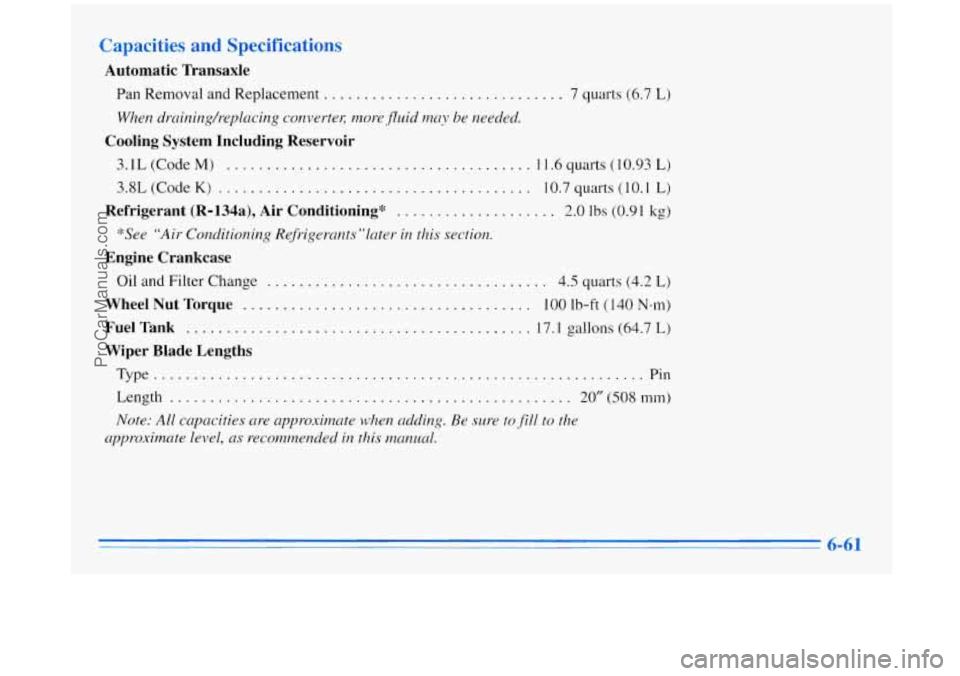
Capacities and Specifications
Automatic Transaxle
Pan Removal and Replacement .............................. 7 quarts (6.7 L)
When draiizilzg/replacil.Ig convertec more,fluid may be needed.
Cooling System Including Reservoir
3.1L(CodeM) ...................................... 11.6quarts(10.93L)
3.8L (Code
K) ....................................... 10.7 quarts (10.1 L)
Refrigerant (R-l34a), Air Conditioning* .................... 2.0 lbs (0.91 kg)
*See “Air Conditioning Refriger~-lnts”l~~tel- in th,is section.
Engine Crankcase
Oil and Filter Change ................................... 4.5 quarts (4.2 L)
Wheel Nut Torque .................................... 100 Ib-ft (140 N.m)
Fuel Tank ........................................... 17.1 gallons (64.7 L)
Wiper Blade Lengths
Type ............................................................. Pin
Length
.................................................. 20”(508mm)
Note: All capacities are approximate when adding. Be sure to Jill to the
approximate level, as recommended in this manual.
6-61
ProCarManuals.com
Page 353 of 356
Spare Tire. Compact ............................. 5-32
Specifications and Capacities
...................... 6-6 I
Specifications. Engine ........................... 6-62
Speech Impaired. Customer Assistance
............... 8-3
Speedometer
................................... 2-45
SRS
......................................... 1-18
Stains. Cleaning
................................ 6-43
Starter Switch Check
............................ 7-37
Starting Your Engine
....................... 2- 1 I. 2- 12
Steam
........................................ 5-12
Steering
....................................... 4-8
Column Lock Check
.......................... 7-38
In Emergencies ................................ 4-9
Power ....................................... 4-8
Tips
......................................... 4-8
Variable Assist
................................ 4-8
Wheel. Tilt
.................................. 2-25
Steering Wheel Touch Controls
.................... 3-23
Storage Compartments
........................... 2-38
Storage. Vehicle
................................ 6-30
Stuck:
In Sand. Mud. Ice or Snow .................. 5-33
Sunvisors
.................................... 2-40
Supplemental Restraint System
.................... 1 - I8
Symbols. Vehicle
.................................. x
System Controls. Electronic Climate Control .......... 3- 1
Tachometer .................................. 2-45
Taillamp Bulb Replacement
....................... 6-32
Tape Player Care
............................... 3-25
Temperature Control. Passenger
.................... 3-2
Theft
.......................................... 2-7
Theft-Deterrent Alarm System
..................... 2-8 Theft-Deterrent Feature.
CD Player
................ 3-21
Thermostat
.................................... 6-24
Third Gear. Automatic Transaxle
................... 2-16
Tilt Steering Wheel
............................. 2-25
Time. Setting the
................................ 3-6
Tire-Loading Information Label
................... 4-27
Tires
......................................... 6-34
Alignment and Balance
........................ 6-40
BuyingNew
................................. 6-38
Chains
...................................... 6-42
Changing a Flat
.............................. 5-22
Cleaning
.................................... 6-48
Compact Spare
............................... 5-32
Inflation .................................... 6-35
Inflation Check
............................... 7-35
Inspection and Rotation
........................ 6-36
Loading
.................................... 4-27
Pressure
.................................... 6-35
Storing the Flat
............................... 5-30
Storing the Spare
............................. 5-31
Temperature
................................. 6-39
Traction
.................................... 6-39
Treadwear
................................... 6-39
Uniform Quality Grading
....................... 6-38
Wear Indicators
.............................. 6-37
Wheel Replacement
........................... 6-40
When It’s Time for New
....................... 6-37
TorqueLock
................................... 2-21
Torque, Wheel
Nut ......................... 5-29, 6-61
Towing a Trailer ................................ 4-29
Towing Your Vehicle
............................. 5-7
THEFTLOCK
TM ................................ 3-21
TopStrap
..................................... 1-38
9-9
ProCarManuals.com
Page 354 of 356

Trailer Brakes
..................................... 4-32
Driving
on Grades ............................ 4-34
Driving with
................................. 4-33
Hitches
..................................... 4-32
Maintenance When Towing
..................... 4-35
Safety Chains
................................ 4-32
Tongueweight
............................... 4-31
Total Weight on Tires
.......................... 4-32
Towing
...................................... 4-29
Turnsignals
................................. 4-34
Weight
..................................... 4-30
Transaxle Fluid, Automatic
....................... 6- 17
Transmitters, Remote Keyless Entry ................. 2-4
Transportation, Courtesy
.......................... 8-5
Trunk
......................................... 2-6
Lock
........................................ 2-7
Release, Remote
............................... 2-7
TTYUsers
..................................... 8-3
Turn Signal and Lane Change Indicator
............. 2-26
Turn Signal On Chime
........................... 2-27
Turn Signal/Multifunction Lever
................... 2-26
Turn Signals When Towing a Trailer
................ 4-34
Two-way Manual Seat
........................... 1 - 1
Underbody Flushing Service ................... 7-38
Underbody Maintenance
......................... 6-49
Vehicle
. Parking on Hills .............................. 4-35
Trip Odometer
................................. 2-45
Control
...................................... 4-5
Damage Warnings .............................. ix
Dimensions ................................. 6-62
Identification Number
......................... 6-51
Loading .................................... 4-27
Storage
..................................... 6-30
Ventilation System
............................... 3-4
Visor Vanity Mirrors
............................ 2-41
Visors. Sun
.................................... 2-40
warning Devices
............................... 5-2
Warning Lights. Gages and Indicators ............... 2-46
Washer Fluid. Windshield
........................ 6-26
Washing Your Vehicle
........................... 6-47
Weatherstrips
.................................. 6-46
Wheel
Alignment
.................................. 6-40
Nut Torque
............................. 5-29. 6-61
Replacement
................................. 6-40
WindowLock
.................................. 2-25
Windows
..................................... 2-24
Auto-Down
................................. 2-25
Power
...................................... 2-24
Windshield Washer
............................. 2-28
Fluid
.................................. 2-28. 6-26
Fluid Level Check
............................ 7-35
Windshield Wiper
.............................. 2-27
Blade Replacement
........................... 6-34
Fuses
...................................... 6-52
Wiring. Headlamp
.............................. 6-52
WreckerTowing
................................. 5-7
Winter Driving
................................. 4-23
ProCarManuals.com