1996 BUICK REGAL run flat
[x] Cancel search: run flatPage 3 of 356

The 1996 Buick Regal Owner’s Manual
7-
Seats and Restraint Systems ............................................................. 1-1
This section tells you how to use your seats and safety belts properly. It also explains “SRS” system.
This section explains how to start and operate your Buick.
This section tells you how to adjust the ventilation and comfort controls and how to operate your
audio system.
Here you’ll find helpful information and tips about the road and how to drive under different conditions.
This section tells you
what to do if you have a problem while driving, such as a flat tire or
overheated engine, etc.
Here the manual tells you how to keep
your Buick running properly and looking good.
This section tells
you when to perform vehicle maintenance and what fluids and lubricants to use.
This section tells you how to contact Buick for assistance and how to get service publications.
It also
gives you information on “Reporting Safety Defects” on page
8-7.
Index ........................................................................\
........ 9-1
Here’s an alphabetical listing of almost every subject in this manual. You can use it to quickly find something
you want to read.
Features and Controls .................................................................. 2-1
Comfort Controls and Audio Systems ..................................................... 3-1
YourDrivingandtheRoad .............................................................. 4-1
ProblemsontheRoad .................................................................. 5-1
Service and Appearance Care. ........................................................... 6-1
Maintenanceschedule .................................................................. 7-1
Customer Assistance Information ........................................................ 8-1
i
ProCarManuals.com
Page 59 of 356
7. Push and pull the child restraint in different
directions to be sure it is secure. If it isn’t, secure
the
restraint in a different place in the vehicle and
contact the child restraint maker for their advice
about how to attach the child restraint properly.
To remove the child restraint, just unbuckle the vehicle’s
safety belt. It will be ready to work for an adult or larger
child passenger.
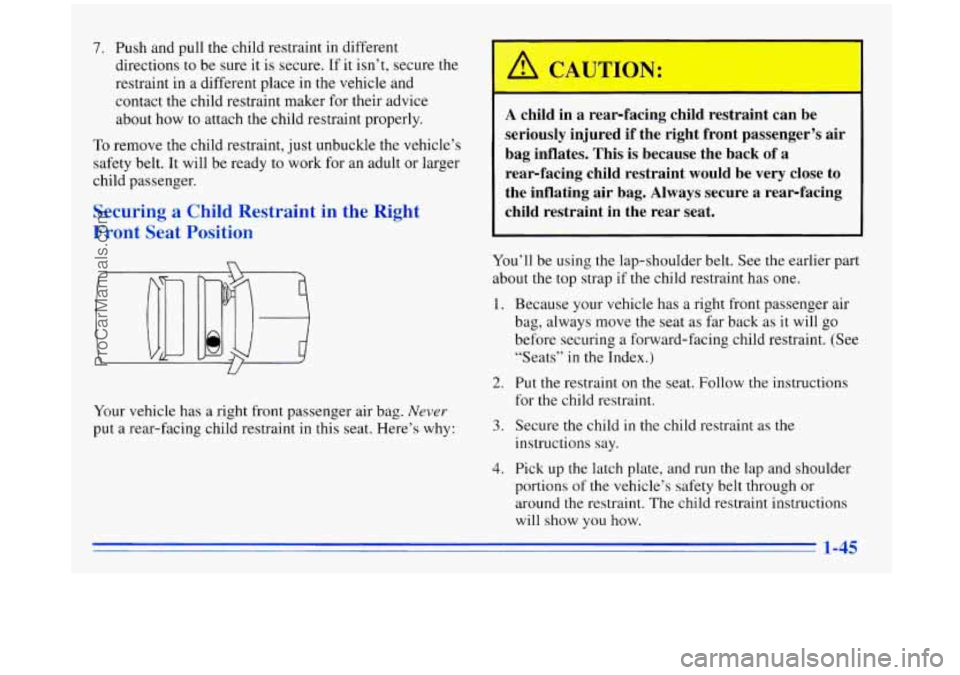
Securing a Child Restraint in the Right
Front Seat Position
U
Your vehicle has a right front passenger air bag. Never
put a rear-facing child restraint in this seat. Here’s why:
A child in a rear-facing child restraint can be
seriously injured if the right front passenger’s air
bag inflates. This is because the back of a
rear-facing child restraint would be very close to
the inflating air bag. Always secure a rear-facing
child restraint in the rear seat.
You’ll be using the lap-shoulder belt. See the earlier part
about
the top strap if the child restraint has one.
1.
2.
3.
4.
Because your vehicle has a right front passenger air
bag, always move the seat as far back as it will go
before securing a forward-facing child restraint. (See
“Seats”
in the Index.)
Put the restraint
on the seat. Follow the instructions
for the child restraint.
Secure the child
in the child restraint as the
instructions
say.
Pick up the latch plate, and run the lap and shoulder
portions of the vehicle’s safety belt through or
around the restraint. The child restraint instructions
will show you how.
1-45
ProCarManuals.com
Page 72 of 356
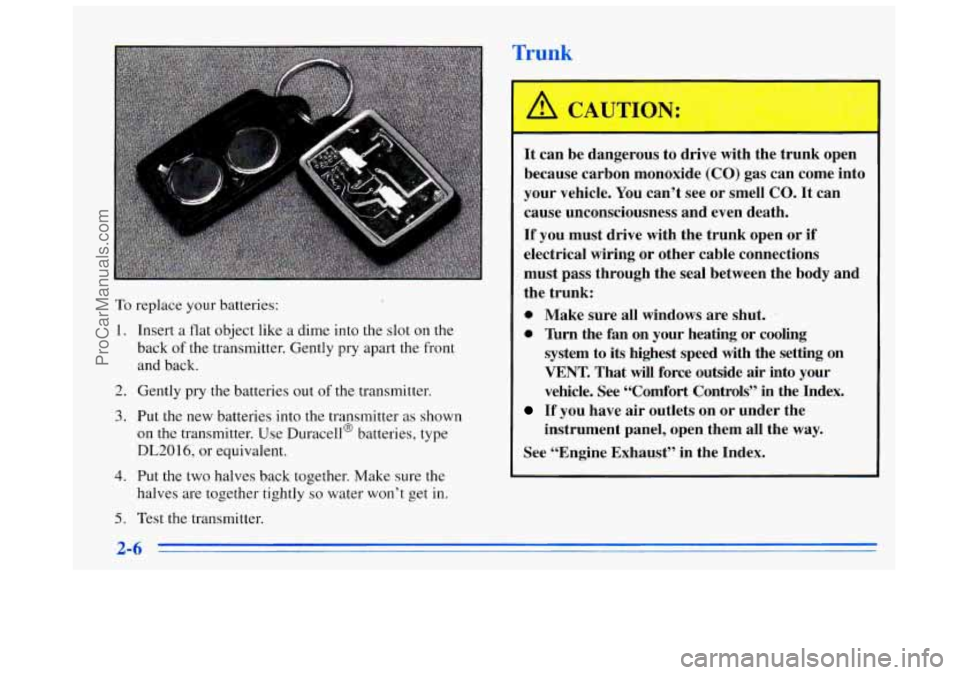
To replace your batteries:
1. Insert a flat object like a dime into the slot on the
back
of the transmitter. Gently pry apart the front
and back.
2. Gently pry the batteries out of the transmitter.
3. Put the new batteries into the transmitter as shown
on the transmitter. Use Duracell@ batteries, type
DL20 16, or equivalent.
4. Put the two halves back together. Make sure the
halves are together tightly
so water won’t get in.
5. Test the transmitter.
I
It can be dangerous to drive with the trunk open
because carbon monoxide (CO) gas can come into
your vehicle. You can’t see or smell
CO. It can
cause unconsciousness and even death.
If you must drive with the trunk open or if
electrical wiring
or other cable connections
must pass through the seal between the body
and
the trunk:
0 Make sure all windows are shut.
0 lbrn the fan on your heating or cooling
system to its highest speed with the setting on
VENT. That will force outside air into your
vehicle. See “Comfort Controls”
in the Index.
instrument panel, open them all the
way.
If you have air outlets on or under the
See “Engine Exhaust” in the Index.
ProCarManuals.com
Page 105 of 356
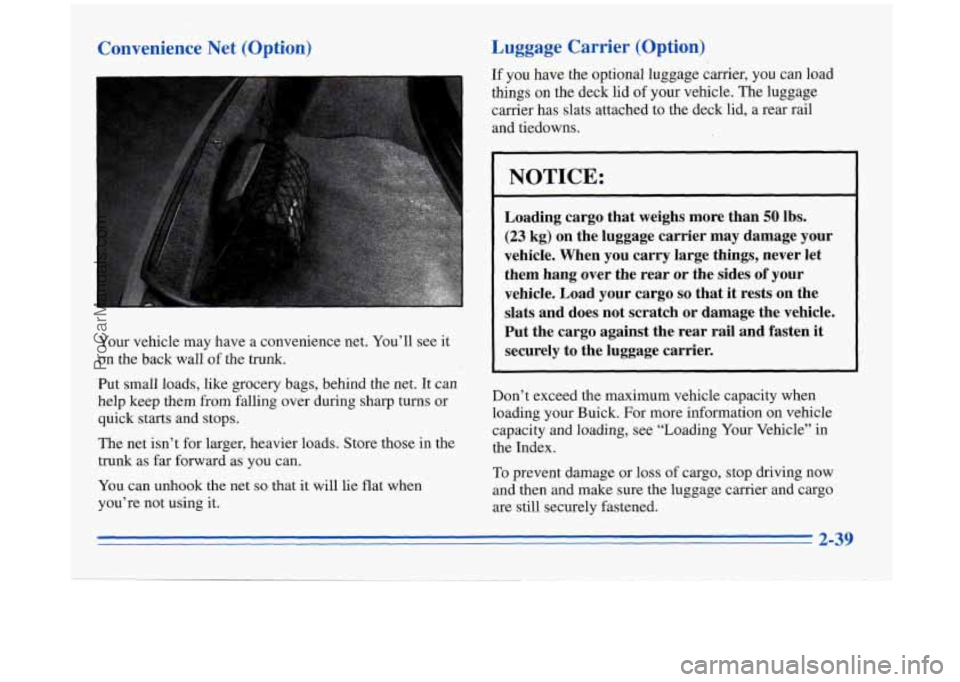
Convenience Net (Option)
I:x
Your vehicle may have a convenience net. You’ll see it
on the back wall of the
trunk.
Luggage Carrier (Option)
If you have the optional luggage carrier, you can load
things on the deck lid
of your vehicle. The luggage
carrier has slats attached to the deck lid, a rear rail
and tiedowns.
NOTICE:
~~
Loading cargo that weighs more than 50 lbs.
(23 kg) on the luggage carrier may damage your
vehicle. When you carry large things, never let
them hang over the rear or the sides of your
vehicle.
Load your cargo so that it rests on the
slats and does not scratch or damage the vehicle.
Put the cargo against the rear rail and fasten
it
securely to the luggage carrier.
Put small loads, like grocery bags, behind the net. It can
help keep them from falling over during sharp turns or
quick starts and stops.
The net isn’t for larger, heavier loads. Store those in the
trunk
as far forward as you can.
You can unhook the net
so that it will lie flat when
you’re not using it. Don’t exceed the maximum vehicle capacity when
loading your Buick. For more information on vehicle
capacity and loading, see “Loading Your Vehicle” in
the Index.
To prevent damage or loss of cargo, stop driving now
and then and make sure the luggage carrier and cargo are still securely fastened.
2-39
ProCarManuals.com
Page 179 of 356
OCCUPANTS VEHICLE CAP. WT.
TIRE-LOADING INFORMATION
FRT. CTR.
RR. TOTAL LBS.
KG
MAX. LOADING
& GVWR SAME AS VEHICLE
CAPACITY WEIGHT XXX COLD TIRE
TIRE
SIZE SPEED PRESSURE
RTG
PSliKPa
FRT.
RR.
SPA.
IF TIRES ARE HOT, ADD 4PSIi28KPa
SEE OWNER‘S MANUAL FOR ADDITIONAL
. INFORMATION MFDBYGENERALMOTORSCORP
DATE GVWR GAWR FRT
GAWR RR
THIS VEHICLE CONFORMS TO ALL APPLI-
CABLE
U.S. FEDERAL MOTOR VEHICLE
SAFETY, BUMPER, AND THEFT PREVENTION
STANDARDS IN EFFECT ON
THE DATE OF
MANUFACTURE SHOWN ABOVE.
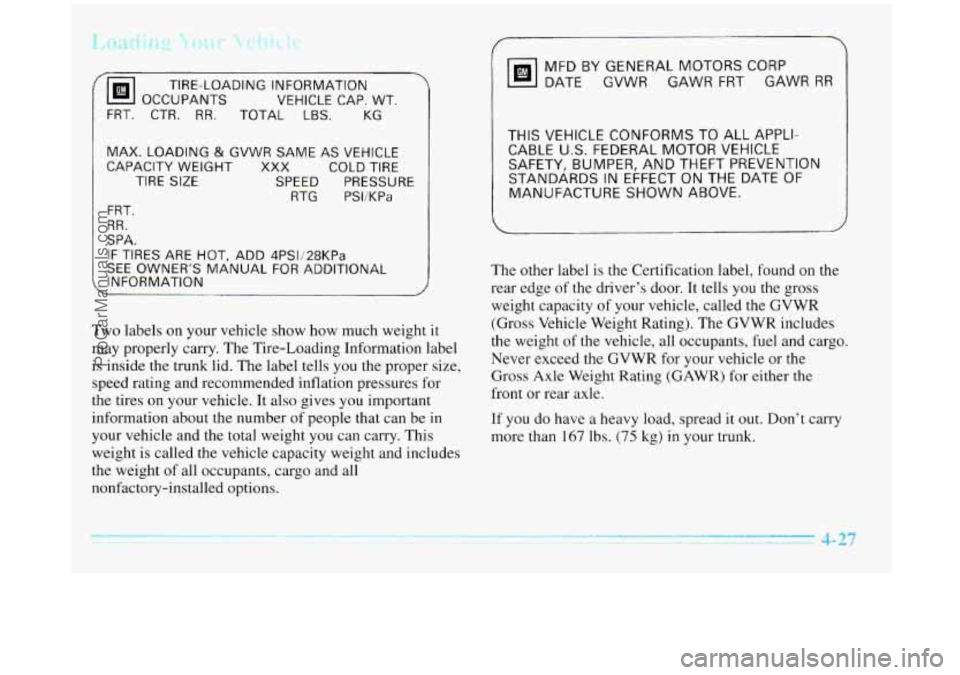
The other label is the Certification label, found on the
rear edge
of the driver’s door. It tells you the gross
weight capacity
of your vehicle, called the GVWR
Two labels on your vehicle show how much weight it
may properly carry.
The Tire-Loading Information label
is inside the trunk lid. The label tells
you the proper size,
speed rating and recommended inflation pressures for
the tires on your vehicle. It also gives you important
information about the number
of people that can be in If you do have a heavy load, spread it out. Don’t carry
your vehicle and the total weight you can carry. This more than
167 ibs. (75 kg) in your trunk.
weight is called the vehicle capacity weight and includes
the weight
of all occupants, cargo and all
nonfactory-installed options. (Gross
Vehicle Weight Rating). The GVWR includes
the weight of the vehicle, all occupants, fuel and cargo.
Never exceed the GVWR for your vehicle or the
Gross Axle Weight Rating (GAWR) for either the
front or rear axle.
4-27
ProCarManuals.com
Page 184 of 356
Total Weight on Your Vehicle’s Tires
Be sure your vehicle’s tires are inflated to the
recommended pressure for cold tires. You’ll find these numbers on the Tire-Loading Information label (found
inside the trunk lid) or see “Loading Your Vehicle”
in the
Index. Then be sure you don’t go over the
GVW limit for
your vehicle, including the weight of the trailer tongue.
Hitches
It’s important to have the correct hitch equipment.
Crosswinds, large trucks going by and rough roads are a
few reasons
why you’ll need the right hitch. Here are
some rules to follow:
0
0
Will you have to make any holes in the body of your
vehicle when you install a trailer hitch? If you do,
then be sure to seal the holes later when you remove
the hitch. If you don’t seal them, deadly carbon
monoxide (CO) from your exhaust can get into your
vehicle (see “Carbon Monoxide”
in the Index). Dirt
and water can, too.
The bumpers on your vehicle are not intended
for hitches.
Do not attach rental hitches or other
bumper-type hitches
to them. Use only a
frame-mounted hitch that does not attach to
the bumper.
Safety Chains
You should always attach chains between your vehicle
and your trailer. Cross the safety chains under the tongue
of the trailer
so that the tongue will not drop to the road
if it becomes separated from
the hitch. Instructions
about safety chains may be provided by the hitch
manufacturer or by the trailer manufacturer. Follow the
manufacturer’s recommendation for attaching safety
chains and do not attach them to the bumper. Always
leave just enough slack
so you can turn with your rig.
And, never allow safety chains to drag on the ground.
Trailer Brakes
If your trailer weighs more than 1,000 lbs. (450 kg)
loaded, then
it needs its own brakes -- and they must be
adequate. Be sure to read and follow the instructions for
the trailer brakes
so you’ll be able to install, adjust and
maintain them properly. Because you have anti-lock
brakes, do not try to tap into your vehicle’s brake
system. If you do, both brake systems won’t work well,
or at all.
4-32
ProCarManuals.com
Page 217 of 356
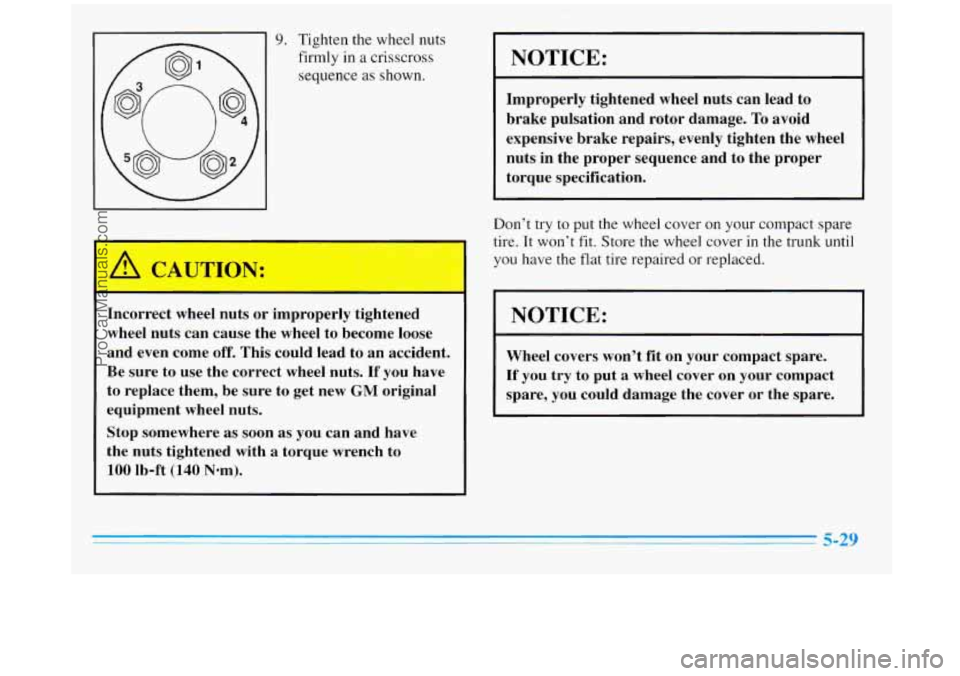
9. Tighten the wheel nuts
firmly in a crisscross
sequence as shown.
I
Incorrect wheel nuts or improperly tightened
wheel nuts can cause the wheel to become loose
and even come
off. This could lead to an accident.
Be sure to use the correct wheel nuts.
If you have
to replace them, be sure to get new
GM original
equipment wheel nuts.
Stop somewhere
as soon as you can and have
the nuts tightened with a torque wrench to
100 lb-ft (140 Nom).
NOTICE:
Improperly tightened wheel nuts can lead to
brake pulsation and rotor damage. To avoid
expensive brake repairs, evenly tighten the wheel nuts in the proper sequence and to the proper
torque specification.
Don‘t try
to put the wheel cover on your compact spare
tire. It won’t
fit. Store the wheel cover in the trunk until
you have the flat tire repaired or replaced.
NOTICE:
~
~~
Wheel covers won’t fit on your compact spare.
If you try to put a wheel cover on your compact
spare, you could damage the cover
or the spare.
ProCarManuals.com
Page 218 of 356
Storing the Flat Tire and Tools
~~
F< .&.ye ~ __
Storing a jack, a tire or other equipment in the
passenger compartment
of the vehicle could
cause injury. In a sudden stop or collision, loose
equipment could strike someone. Store all these
in the proper place.
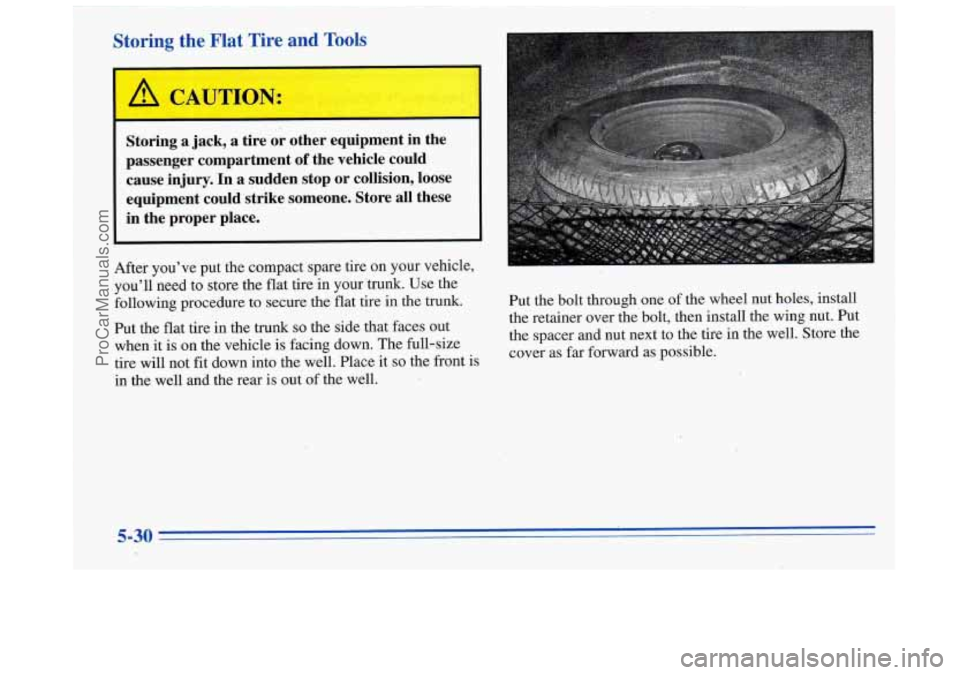
After you’ve put the compact spare tire on your vehicle,
you’ll need to store the flat tire in your trunk. Use the
following procedure
to secure the flat tire in the trunk.
Put the flat tire in the trunk
so the side that faces out
when it is on the vehicle is facing down. The full-size
tire will not fit down into the well. Place it
so the front is
in the well and the rear is out of the well. Put the bolt through
one of the wheel nut holes, install
the retainer over the’bolt, then install the wing nut. Put
the spacer and nut next to the tire in the well. Store the
cover as far forward as possible.
5-30
ProCarManuals.com