1996 BUICK REGAL light
[x] Cancel search: lightPage 245 of 356
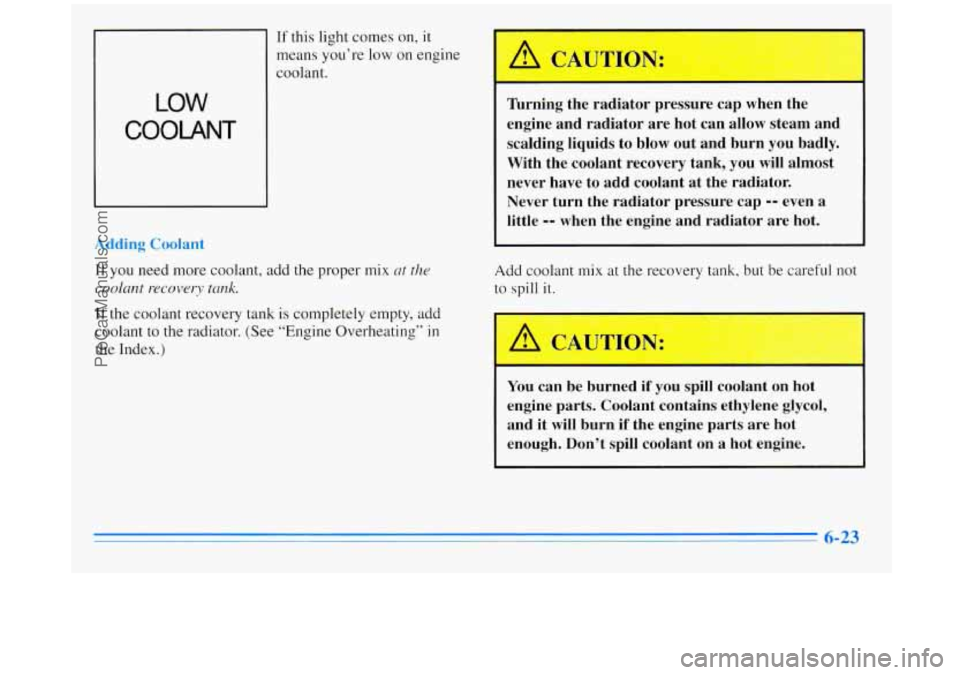
LOW
COOLANT
If this light comes on, it
means you’re low on engine
coolant.
Addinq Coolar A
If you need more coolant, add the proper mix at the
coolant recovery tank.
If the coolant recovery tank is completely empty, add
coolant to the radiator. (See “Engine Overheating” in
the Index.)
I
Turning the radiator pressure cap when the
engine and radiator are hot can allow steam and
scalding liquids to blow out and burn you badly.
With the coolant recovery tank, you will almost
never have to add coolant at the radiator.
Never turn the radiator pressure cap
-- even a
little -- when the engine and radiator are hot.
Add coolant mix at
the recovery tank, but be careful not
to spill
it.
I
You can be burned if you spill coolant on hot
engine parts. Coolant contains ethylene glycol,
and it will burn
if the engine parts are hot
enough. Don’t spill coolant on
a hot engine.
ProCarManuals.com
Page 249 of 356
Brakes
Bri lid
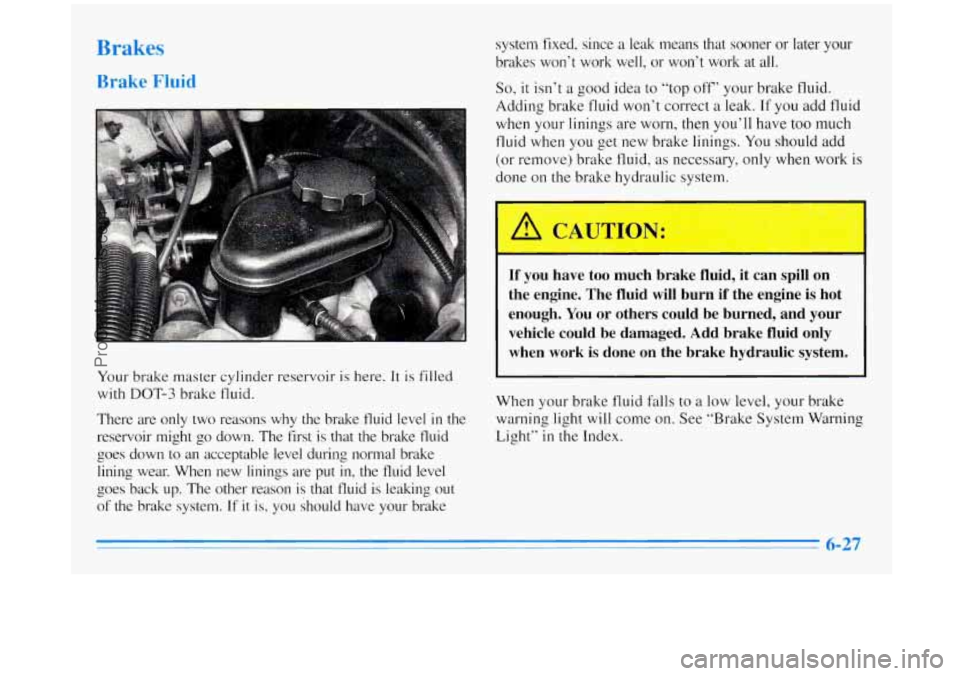
Your brake master cylinder reservoir is here. It is filled
with
DOT-3 brake fluid.
There are only two reasons why the brake fluid level
in the
reservoir might go down. The first is that the brake fluid
goes down to an acceptable level during normal brake lining wear. When new linings are put in, the fluid level
goes back up. The other reason is that fluid is leaking out
of the brake system. If it is, you should have your brake system fixed, since
a leak means that sooner or later your
brakes won’t work well, or won’t work at all.
So, it isn’t a good idea to “top off’ your brake fluid.
Adding brake fluid won’t correct
a leak. If you add fluid
when your linings are worn, then you’ll have too much
fluid when you get new brake linings.
You should add
(or remove) brake fluid,
as necessary, only when work is
done on the brake hydraulic system.
If you have too much brake fluid, it can spill on
the engine. The fluid
will burn if the engine is hot
enough. You or others could be burned, and your
vehicle could be damaged. Add brake fluid only
when work is done
on the brake hydraulic system
When your brake fluid falls to a low level, your brake
warning light will come on. See “Brake System Warning
Light”
in the Index.
6-27
ProCarManuals.com
Page 251 of 356
Brake Wear
Your Buick has four-wheel disc brakes.
Disc brake pads have built-in wear indicators that make
a
high-pitched warning sound when the brake pads are
worn and new pads are needed. The sound may come and
go or be heard all the time your vehicle is moving (except
when you are pushing on the brake pedal firmly).
A CAUTION:
I
The brake wear warning so Id means that
sooner or later your brakes won’t work well.
That could lead to an accident. When you hear the brake wear warning sound, have your
vehicle serviced.
I NOTICE:
Continuing to drive with worn-out brake pads
could result in costly brake repair.
Some driving conditions or climates may cause a brake
squeal when the brakes are first applied or lightly
applied. This does not mean something is wrong with
your brakes.
Free movement of brake calipers and properly torqued
wheel nuts are necessary to help prevent brake
pulsation. When tires are rotated, inspect brake calipers
for movement, brake pads for wear,
and evenly torque
wheel nuts
in the proper sequence to GM specifications.
Brake linings should always be replaced
as complete
axle sets.
Brake Pedal Travel
See your dealer if the brake pedal does not return to
normal height, or
if there is a rapid increase in pedal
travel. This could be
a sign of brake trouble.
Brake Adjustment
Every time you apply the brakes, with or without the
vehicle moving, your brakes adjust for wear.
ProCarManuals.com
Page 261 of 356

nominal rim diameters of 10 to 12 inches (25 to 30 cm),
or to some limited-production tires.
While the tires available on General Motors passenger
cars and light trucks may vary with respect to these
grades, they must
also conform to Federal safety
requirements and additional General Motors Tire
Performance Criteria (TPC) standards.
Treadwear
The treadwear grade is a comparative rating based on
the wear rate of the tire when tested under controlled
conditions on
a specified government test course. For
example,
a tire graded 150 would wear one and a half
(1 1/2) times as well on the government course as a tire
graded
100. The relative performance of tires depends
upon
the actual conditions of their use, however, and
may depart significantly from the norm due to variations
in driving habits, service practices and differences in
road characteristics and climate.
Traction - A, B, C
The traction grades, from highest to lowest, are A, B,
and C, and they represent the tire’s ability to stop on wet
pavement
as measured under controlled conditions on
specified government test surfaces of asphalt and
concrete.
A tire marked C may have poor traction
performance.
Warning: The traction grade assigned to this tire is based
on braking (straightahead) traction tests and does not
include cornering (turning) traction.
Temperature - A, B, C
The temperature grades are A (the highest), B, and C,
representing the tire’s resistance to the generation of
heat and its ability to dissipate heat when tested under
controlled conditions on a specified indoor laboratory
test wheel. Sustained high temperature can cause
the
material of the tire to degenerate and reduce tire life, and
excessive temperature can lead to sudden
tire failure.
The grade
C corresponds to a level of performance
which all passenger car tires must meet under the
Federal Motor Vehicle Safety Standard
No. 109. Grades
B and A represent higher levels of performance on the
laboratory test wheel than the minimum required by law.
6-39
ProCarManuals.com
Page 265 of 356

Don’t use any of these unless this manual says you can.
In many uses, these will damage your vehicle:
Alcohol
0 Laundry Soap
Bleach
Reducing Agents
Cleaning the Inside of Your Buick
Use a vacuum cleaner often to get rid of dust and loose
dirt. Wipe
vinyl or leather with a clean, damp cloth.
Your Buick dealer has two
GM cleaners, a solvent-type
spot lifter and
a foam-type powdered cleaner. They will
clean normal spots and stains very well.
Do not use
them on
vinyl or leather.
Here are some cleaning tips:
Using Foam-Type Cleaner on Fabric
0 Vacuum and brush the area to remove any loose dirt.
Always clean a whole trim panel or section. Mask
surrounding trim along stitch or welt lines.
Mix Multi-Purpose Powdered Cleaner following the
directions on the container label.
Use suds only and apply with a clean sponge.
0 Don’t saturate the material.
0 Don’t rub it roughly.
As soon as you’ve cleaned the section, use a sponge
to remove the suds.
Rinse the section with a clean, wet sponge.
Wipe off what’s left with a slightly damp paper towel
or cloth.
0 Always read the instructions on the cleaner label.
0 Clean up stains as soon as you can -- before they set.
0 Use a clean cloth or sponge, and change to a clean area
0 Then dry it immediately with a blow dryer.
0 Wipe with a clean cloth.
often. A
soft brush may be used if stains are stubborn.
0 Use solvent-type cleaners in a well-ventilated area
only.
If you use them, don’t saturate the stained area.
If a ring forms after spot cleaning, clean the entire
area immediately or
it will set.
6-43
ProCarManuals.com
Page 266 of 356
Using Solvent-Qpe Cleaner on Fabric
First, see if you have to use solvent-type cleaner at all.
Some spots and stains will clean off better with just
water and mild soap.
If you need to use
a solvent:
0 Gently scrape excess soil from the trim material with
a clean, dull knife or scraper. Use very little cleaner,
light pressure and clean cloths (preferably
cheesecloth). Cleaning should start at the outside of
the stain, “feathering” toward the center. Keep
changing to
a clean section of the cloth.
0 When you clean a stain from fabric, immediately
dry the area with
a blow dryer to help prevent a
cleaning ring.
Special Cleaning Problems
Greasy or Oily Stains
Stains caused by grease, oil, butter, margarine, shoe
polish, coffee with cream, chewing gum, cosmetic
creams, vegetable oils, wax crayon, tar and asphalt can
be removed
as follows:
0 Carefully scrape off excess stain.
0 Follow the solvent-type instructions
described earlier.
Shoe polish, wax crayon, tar and asphalt will stain if
left on
a vehicle’s seat fabric. They should be removed
as
soon as possible. Be careful, because the cleaner
will dissolve them and mdy cause them to spread.
Non-Greasy Stains
Stains caused by catsup, coffee (black), egg, fruit, fruit
juice, milk, soft drinks, wine, vomit, urine and blood can
be removed
as follows:
0 Carefully scrape off excess stain, then sponge the
soiled
area with cool water.
0 If a stain remains, follow the foam-type instructions
described earlier.
6-44
ProCarManuals.com
Page 267 of 356
0 If an odor lingers after cleaning vomit or urine,
treat the area with
a watedbaking soda solution:
1 teaspoon
(5 ml) of baking soda to 1 cup (250 ml)
of lukewarm water.
If needed, clean lightly with solvent-type cleaner.
Combination Stains
Stains caused by candy, ice cream, mayonnaise, chili
sauce and unknown stains can be removed
as follows:
Carefully scrape off excess stain, then clean with
cool water and allow to dry.
If a stain remains, clean it with solvent-type cleaner.
Cleaning Vinyl
Use warm water and a clean cloth.
0 Rub with a clean, damp cloth to remove dirt. You
may have to do it more than once.
Things like tar, asphalt and shoe polish will stain if
you don’t get them off quickly. Use
a clean cloth and
a GM Vinyl/Leather Cleaner or equivalent product.
Cleaning Leather
Use a soft cloth with lukewarm water and a mild soap or
saddle soap.
For stubborn stains, use a GM Vinylkeather Cleaner
or equivalent product.
Never use oils, varnishes, solvent-based or abrasive
cleaners, furniture polish or shoe polish on leather.
Soiled leather should be cleaned immediately. If
dirt is allowed to work into the finish, it can harm
the leather.
Cleaning the Top of the Instrument Panel
Use only mild soap and water to clean the top surfaces
of the instrument panel. Sprays containing silicones or
waxes may cause annoying reflections in the windshield
and
even make it difficult to see through the windshield
under certain conditions.
ProCarManuals.com
Page 276 of 356

Circuit
Breaker
C
D
Description
Power Windows
Power Seats
Fuse
1
3
4
5
6
7
10
11
12
13
14
Description
CIGAR LIGHTER -- Instrument
Panel Cigarette Lighter
DRL MDL
HVAC
#2 -- HVAC Control
Assembly, Solenoid Box
HAZARD FLASHER
POWER ACCESSORY
#2 -- Sunroof Control Unit
LOCK CONTROL
-- Door
Lock Relay
I/P ELECTRONICS BATTERY
FEED
-- Chime Module,
Electronic Brake Control Module
(EBCM), Theft-Deterrent Module,
Radio, Radio Amplifier, Trip
Computer
STARTER RELAY
ANTI-THEFT
-- Theft-Deterrent
Module
ABS
-- Electronic Brake Control
Module (EBCM), ABS Relay
HVAC
BLOWER
MOTOR -- Blower Motor Relay
ProCarManuals.com