Page 236 of 356
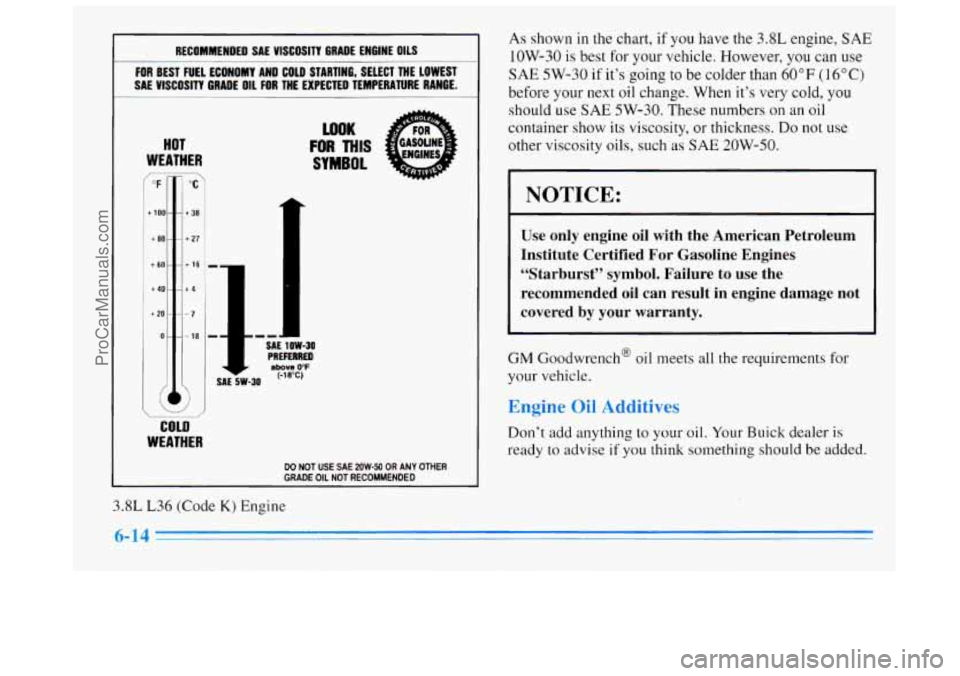
RECOMMENDED SAE VISCOSITY GRADE ENGINE OILS
FOR BEST FUEL r---'--lY AND COLD STARTING, SELECT THE LOWEST
SAE
VISCOSITY G...."- ,I1 FOR THE EXPECTED TEMPERATURE RANGE.
HOT
WEATHER
- "F "C
+loo- - +38
+eo- - +27
+60--+16
t40--+4
t20---7
0---18
/
WOK
FOR MIS
SYMBOL
'I I I--
SAE 1OW-3fl PREFERRED above 0°F
SAE 5W-30 (-1eOc)
COLD
WEATHER
DO NOT USE SAE 2OW-50 OR ANY OTHER
GRADE OIL NOT RECOMMENDED
As shown in the chart, if you nave the 3.8L engine, SAE
low-30 is best for your vehicle. However, you can use
SAE 5W-30 if it's going to be colder than 60°F (16°C)
before your next oil change. When it's very cold, you
should use
SAE 5W-30. These numbers on an oil
container
show its viscosity, or thickness. Do not use
other viscosity oils, such as
SAE 20W-50.
NOTICE:
Use only engine oil with the American Petroleum
Institute Certified For Gasoline Engines "Starburst" symbol. Failure to use the
recommended oil can result in engine damage not
covered by your warranty.
GM Goodwrench@ oil meets all the requirements for
your vehicle.
1 .ILIVC
Don't add anything to your oil. Your Buick dealer is
ready to advise
if you think something should be added.
3.8L L36 (Code
K) Engine
ProCarManuals.com
Page 237 of 356
When to Change Engine Oil
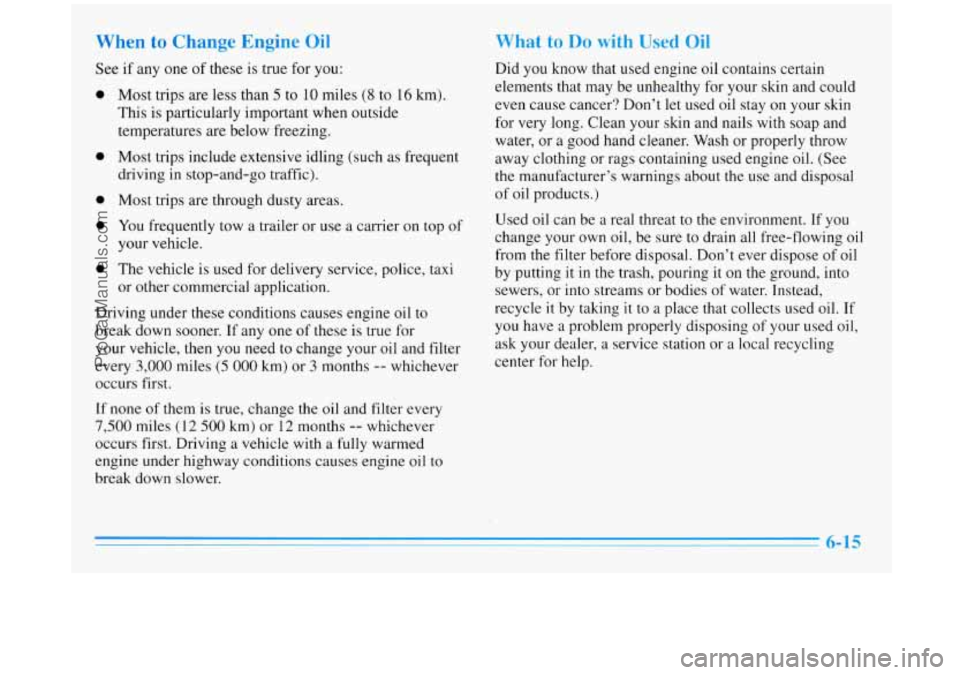
See if any one of these is true for you:
0
0
0
0
0
Most trips are less than 5 to 10 miles (8 to 16 km).
This is particularly important when outside
temperatures are below freezing.
Most trips include extensive idling (such as frequent
driving in stop-and-go traffic).
Most trips are through dusty areas.
You frequently tow a trailer or use a carrier on top of
your vehicle.
The vehicle is used for delivery service, police, taxi
or other commercial application.
Driving under these conditions causes engine oil
to
break down sooner. If any one of these is true for
your vehicle, then
you need to change your oil and filter
every
3,000 miles (5 000 km) or 3 months -- whichever
occurs first.
If none
of them is true, change the oil and filter every
7,500 miles (12 500 km) or 12 months -- whichever
occurs first. Driving a vehicle with a fully warmed
engine under highway conditions causes engine oil to
break down slower.
What to Do with Used Oil
Did you know that used engine oil contains certain
elements that may be unhealthy for your skin and could
even cause cancer? Don’t let used oil stay
on your skin
for very long. Clean your skin and nails with soap and
water, or a good hand cleaner. Wash or properly throw
away clothing
or rags containing used engine oil. (See
the manufacturer’s warnings about the use and disposal
of oil products.)
Used oil can be a real threat
to the environment. If you
change your own oil, be sure to drain all free-flowing oil
from
the filter before disposal. Don’t ever dispose of oil
by putting it in the trash, pouring it on the ground, into
sewers, or into streams or bodies of water. Instead,
recycle it by taking
it to a place that collects used oil. If
you have a problem properly disposing of your used oil,
ask your dealer, a service station or a local recycling
center for help.
6-15
ProCarManuals.com
Page 239 of 356
L
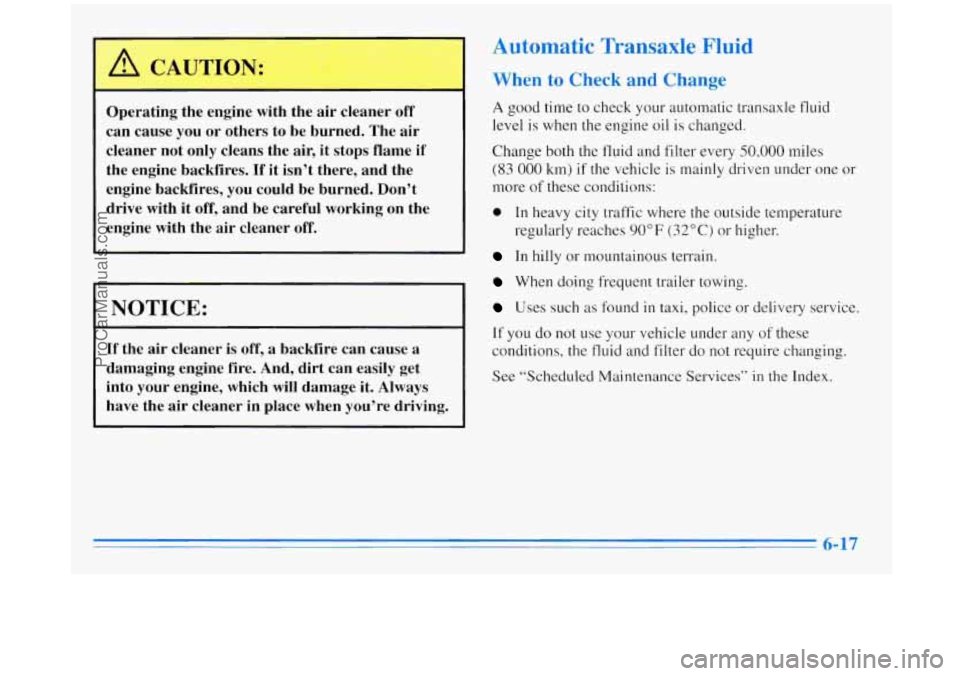
Operating the engine with the air cleaner off
can cause you or others to be burned. The air
cleaner not only cleans the air, it stops flame if
the engine backfires.
If it isn’t there, and the
engine backfires, you could be burned. Don’t
drive with it
off, and be careful working on the
engine with the air cleaner
off.
NOTICE:
If the air cleaner is off, a backfire can cause a
damaging engine fire. And, dirt can easily get into your engine, which will damage it. Always
have the air cleaner in place when you’re driving.
Automatic Transaxle Fluid
When to Check and Change
A good time to check your automatic transaxle fluid
level is when the engine
oil is changed.
Change both the fluid and filter every
50,000 miles
(83 000 km) if the vehicle is mainly driven under one or
more of these conditions:
0 In heavy city traffic where the outside temperature
regularly reaches
90°F (32°C) or higher.
In hilly or mountainous ten-ain.
When doing frequent trailer towing.
Uses such as found in taxi, police or delivery service.
If you do not use your vehicle under any of these
conditions, the fluid and filter do not require changing.
See “Scheduled Maintenance Services”
in the Index.
6-17
ProCarManuals.com
Page 242 of 356
How to Add Fluid
Refer to the Maintenance Schedule to determine what
kind
of transaxle fluid to use. See “Recommended
Fluids and Lubricants’’
in the Index.
If the fluid level is low, add
only enough of the proper
fluid to bring the level into the cross-hatched area on
the dipstick.
1.
2.
0
0
Pull out the dipstick.
Using
a long-neck funnel, add enough fluid at the
dipstick hole to bring
it to the proper level. It doesn’t
take much fluid, generally less than a pint
(0.5 L).
Don t overfill. We recommend you use only fluid
labeled DEXRONO-111, because fluid with that label
is made especially for your automatic transaxle.
Damage caused by fluid other than DEXRON@-I11
is not covered by your new vehicle warranty.
After adding fluid, recheck the fluid level
as
described under “How to Check.”
When
the correct fluid level is obtained, push the
dipstick back in all the way.
Engine Coolant
The cooling system in your vehicle is filled with new
DEX-COOL
TM (orange-colored, silicate-free) engine
coolant. This coolant
is designed to remain in your
vehicle for
5 years or 100,000 miles (166 000 km),
whichever occurs first.
The following explains your cooling system and how to
add coolant when
it is low. If you have a problem with
engine overheating or
if you need to add coolant to your
radiator, see “Engine Overheating” in the Index.
A 50/50 mixture of water and the proper coolant for
your Buick will:
Give freezing protection down to
-34°F (-37°C).
Give boiling protection up
to’ 265 “F ( 129” C).
Protect against rust and corrosion.
Help keep the proper engine temperature.
Let the warning lights and gages work as
they should.
ProCarManuals.com
Page 243 of 356

NOTICE:
When adding coolant it is important that you use
DEX-COOL TM (orange-colored, silicate-free)
coolant meeting
GM Specification 6277M.
If silicated coolant is added to the system,
premature engine, heater core or radiator corrosion may result. In addition, the engine
coolant will require change sooner
-- at
30,000 miles (50 000 km) or 24 months whichever
occurs first
.
What to Use
Use a mixture
of one-half clean water (preferably
distilled) and one-half
DEX-COOL TM (orange-colored,
silicate-free) antifreeze that meets GM Specification
6277M, which won’t damage aluminum parts. Use
GM Engine Coolant Supplement (sealer) (GM Part
No. 3634621) with any complete coolant change. If you
use this mixture, you don’t need to add anything else.
CAUTION
-
Adding only plain water to your cooling system
can be dangerous. Plain water, or some other
liquid like alcohol, can boil before the proper
coolant mix will. Your vehicle’s coolant warning
system is set for the proper coolant mix. With
plain water or the wrong mix, your engine could
get too hot but you wouldn’t get the overheat
warning.
Your engine could catch fire and you or
others could be burned. Use a 50/50 mix of clean
water and
DEX-COOL TM (orange-colored,
silicate-free) antifreeze.
6-21
ProCarManuals.com
Page 250 of 356
What to Add
When you do need brake fluid, use only
DOT-3 brake
fluid
-- such as Delco Supreme 11 @ (GM Part
No. 1052535). Use new brake fluid from a sealed
container only, and always clean the brake fluid
reservoir cap before removing it.
-
With the wrong kind of fluid in your brake
system, your brakes may not work well, or they
may not even work at all. This could cause a
crash. Always use the proper brake fluid.
NOTICE:
0 Using the wrong fluid can badly damage
brake system parts. For example, just
a few
drops
of mineral-based oil, such as engine
oil, in your brake system can damage brake
system parts
so badly that they'll have to be
replaced. Don't let someone put in the
wrong kind
of fluid.
0 If you spill brake fluid on your vehicle's
painted surfaces, the paint finish can be damaged. Be careful not to spill brake fluid
on your vehicle. If you do, wash it
off
immediately. See "Appearance Care" in
the Index.
6-28
ProCarManuals.com
Page 283 of 356
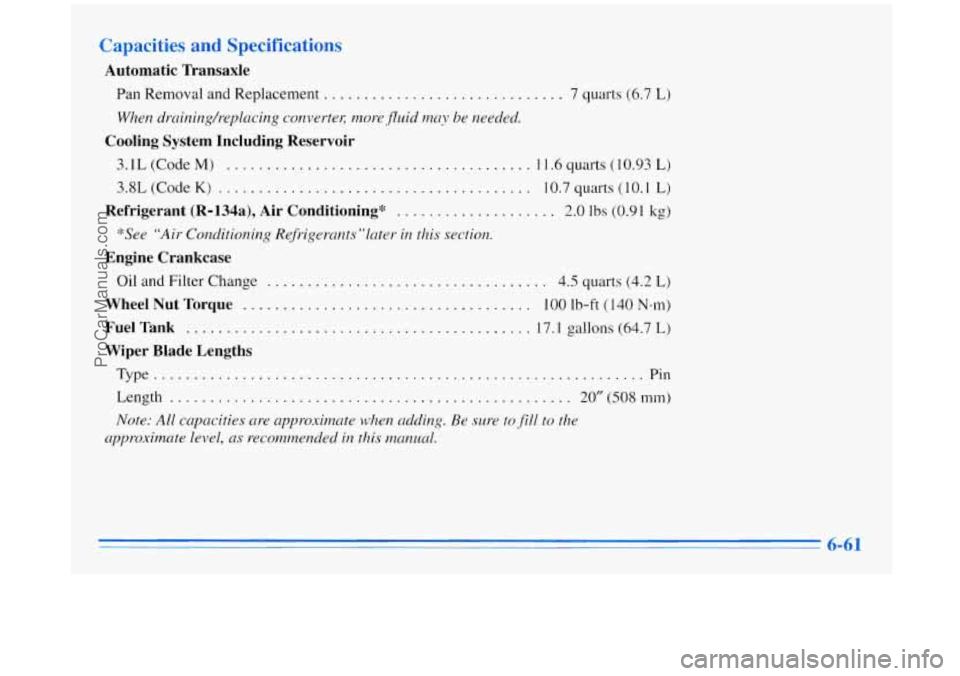
Capacities and Specifications
Automatic Transaxle
Pan Removal and Replacement .............................. 7 quarts (6.7 L)
When draiizilzg/replacil.Ig convertec more,fluid may be needed.
Cooling System Including Reservoir
3.1L(CodeM) ...................................... 11.6quarts(10.93L)
3.8L (Code
K) ....................................... 10.7 quarts (10.1 L)
Refrigerant (R-l34a), Air Conditioning* .................... 2.0 lbs (0.91 kg)
*See “Air Conditioning Refriger~-lnts”l~~tel- in th,is section.
Engine Crankcase
Oil and Filter Change ................................... 4.5 quarts (4.2 L)
Wheel Nut Torque .................................... 100 Ib-ft (140 N.m)
Fuel Tank ........................................... 17.1 gallons (64.7 L)
Wiper Blade Lengths
Type ............................................................. Pin
Length
.................................................. 20”(508mm)
Note: All capacities are approximate when adding. Be sure to Jill to the
approximate level, as recommended in this manual.
6-61
ProCarManuals.com
Page 285 of 356
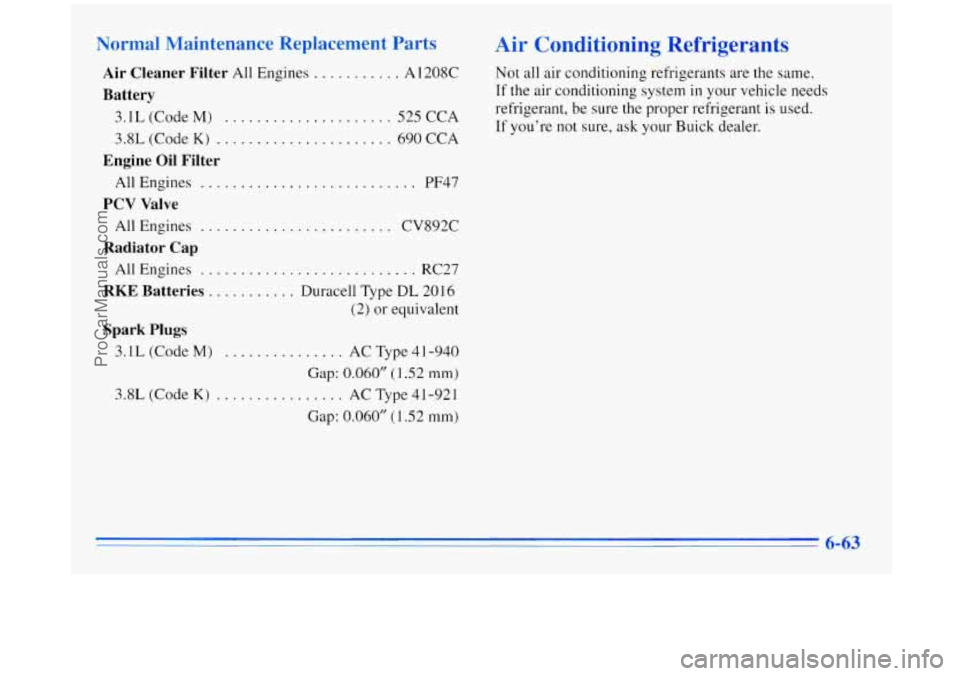
Normal Maintenance Replacement Parts
Air Cleaner Filter All Engines ........... A 1208C
Battery
3.1L (Code M) ..................... 525 CCA
3.8L (Code
K) ...................... 690 CCA
Engine Oil Filter
PCV Valve
All Engines ........................... PF47
All Engines
........................ CV892C
Radiator Cap
All Engines ........................... RC27
RKE Batteries ........... Duracell Type DL 2016
(2) or equivalent
Spark Plugs
3.1L (Code M) ............... AC Type 41 -940
Gap: 0.060” (1.52 mm)
3.8L (Code K) ................ AC Type 41-921
Gap:
0.060” (1.52 mm)
Air Conditioning Refrigerants
Not all air conditioning refrigerants are the same.
If the air conditioning system in your vehicle needs
refrigerant, be sure the proper refrigerant is used.
If you’re not sure, ask your Buick dealer.
6-63
ProCarManuals.com