Page 180 of 356
Do not load your vehicle any heavier than the
GVWR, or either the maximum front or rear
GAWR. If you do, parts on your vehicle can
break, or it can change the way your vehicle
handles. These could cause you to lose control.
Also, overloading can shorten the life of
your vehicle.
NOTICE:
Your warranty does not cover parts or
components that fail because of overloading.
If you put things inside your vehicle -- like suitcases,
tools, packages
or anything else -- they will go as fast as
the vehicle goes.
If you have to stop or turn quickly, or
if there is a crash, they’ll keep going.
Things you put inside your vehicle can strike
and injure people in
a sudden stop or turn, or
in
a crash.
Put things in the trunk of your vehicle. In a
trunk, put them as far forward as you can.
Try to spread the weight evenly.
0 Never stack heavier things, like suitcases,
inside the vehicle
so that some of them are
above the
tops of the seats.
Don’t leave an unsecured child restraint in
your vehicle.
When you carry something inside the
vehicle, secure it whenever you can.
4-28
ProCarManuals.com
Page 184 of 356
Total Weight on Your Vehicle’s Tires
Be sure your vehicle’s tires are inflated to the
recommended pressure for cold tires. You’ll find these numbers on the Tire-Loading Information label (found
inside the trunk lid) or see “Loading Your Vehicle”
in the
Index. Then be sure you don’t go over the
GVW limit for
your vehicle, including the weight of the trailer tongue.
Hitches
It’s important to have the correct hitch equipment.
Crosswinds, large trucks going by and rough roads are a
few reasons
why you’ll need the right hitch. Here are
some rules to follow:
0
0
Will you have to make any holes in the body of your
vehicle when you install a trailer hitch? If you do,
then be sure to seal the holes later when you remove
the hitch. If you don’t seal them, deadly carbon
monoxide (CO) from your exhaust can get into your
vehicle (see “Carbon Monoxide”
in the Index). Dirt
and water can, too.
The bumpers on your vehicle are not intended
for hitches.
Do not attach rental hitches or other
bumper-type hitches
to them. Use only a
frame-mounted hitch that does not attach to
the bumper.
Safety Chains
You should always attach chains between your vehicle
and your trailer. Cross the safety chains under the tongue
of the trailer
so that the tongue will not drop to the road
if it becomes separated from
the hitch. Instructions
about safety chains may be provided by the hitch
manufacturer or by the trailer manufacturer. Follow the
manufacturer’s recommendation for attaching safety
chains and do not attach them to the bumper. Always
leave just enough slack
so you can turn with your rig.
And, never allow safety chains to drag on the ground.
Trailer Brakes
If your trailer weighs more than 1,000 lbs. (450 kg)
loaded, then
it needs its own brakes -- and they must be
adequate. Be sure to read and follow the instructions for
the trailer brakes
so you’ll be able to install, adjust and
maintain them properly. Because you have anti-lock
brakes, do not try to tap into your vehicle’s brake
system. If you do, both brake systems won’t work well,
or at all.
4-32
ProCarManuals.com
Page 217 of 356
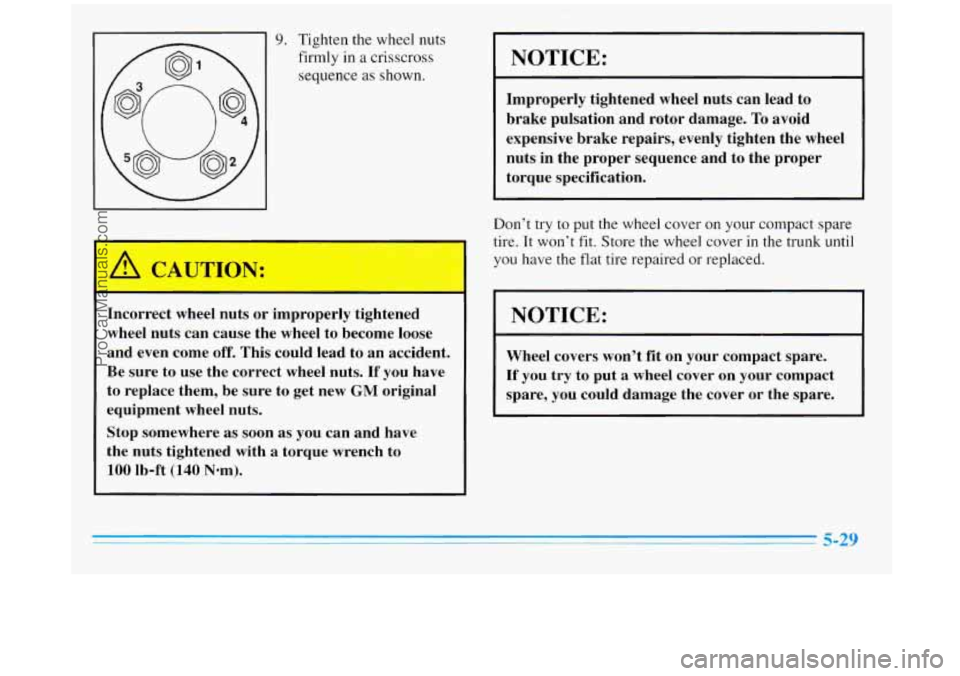
9. Tighten the wheel nuts
firmly in a crisscross
sequence as shown.
I
Incorrect wheel nuts or improperly tightened
wheel nuts can cause the wheel to become loose
and even come
off. This could lead to an accident.
Be sure to use the correct wheel nuts.
If you have
to replace them, be sure to get new
GM original
equipment wheel nuts.
Stop somewhere
as soon as you can and have
the nuts tightened with a torque wrench to
100 lb-ft (140 Nom).
NOTICE:
Improperly tightened wheel nuts can lead to
brake pulsation and rotor damage. To avoid
expensive brake repairs, evenly tighten the wheel nuts in the proper sequence and to the proper
torque specification.
Don‘t try
to put the wheel cover on your compact spare
tire. It won’t
fit. Store the wheel cover in the trunk until
you have the flat tire repaired or replaced.
NOTICE:
~
~~
Wheel covers won’t fit on your compact spare.
If you try to put a wheel cover on your compact
spare, you could damage the cover
or the spare.
ProCarManuals.com
Page 218 of 356
Storing the Flat Tire and Tools
~~
F< .&.ye ~ __
Storing a jack, a tire or other equipment in the
passenger compartment
of the vehicle could
cause injury. In a sudden stop or collision, loose
equipment could strike someone. Store all these
in the proper place.
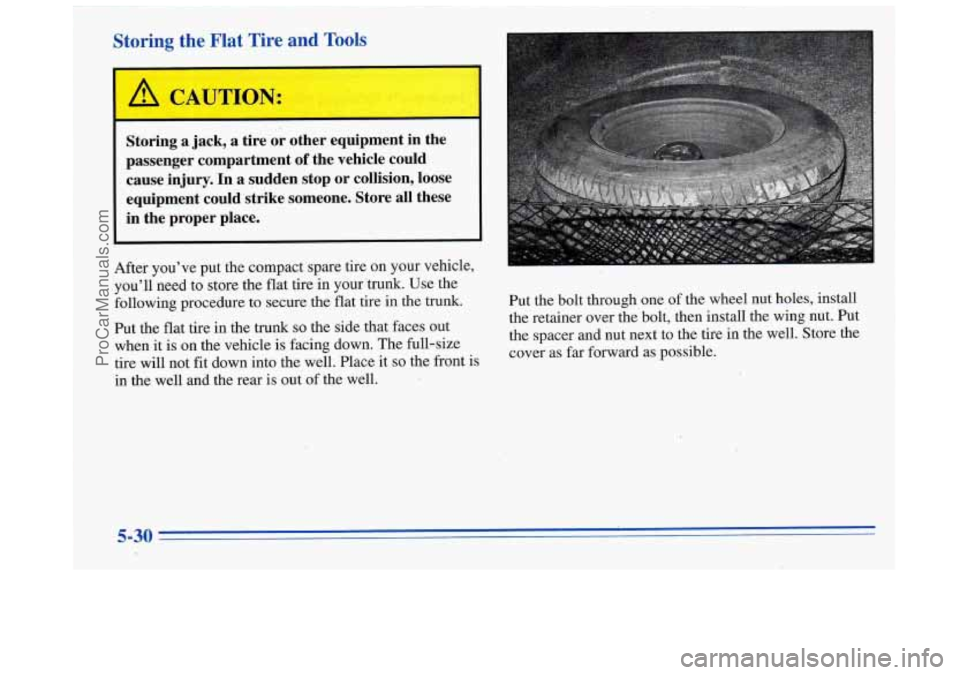
After you’ve put the compact spare tire on your vehicle,
you’ll need to store the flat tire in your trunk. Use the
following procedure
to secure the flat tire in the trunk.
Put the flat tire in the trunk
so the side that faces out
when it is on the vehicle is facing down. The full-size
tire will not fit down into the well. Place it
so the front is
in the well and the rear is out of the well. Put the bolt through
one of the wheel nut holes, install
the retainer over the’bolt, then install the wing nut. Put
the spacer and nut next to the tire in the well. Store the
cover as far forward as possible.
5-30
ProCarManuals.com
Page 219 of 356
Storing the Spare Tire and Tools
Storing a jack, a tire or other equipment in the
passenger compartment
of the vehicle could
cause injury. In a sudden stop or collision, loose
equipment could strike someone. Store all these
in the proper place.
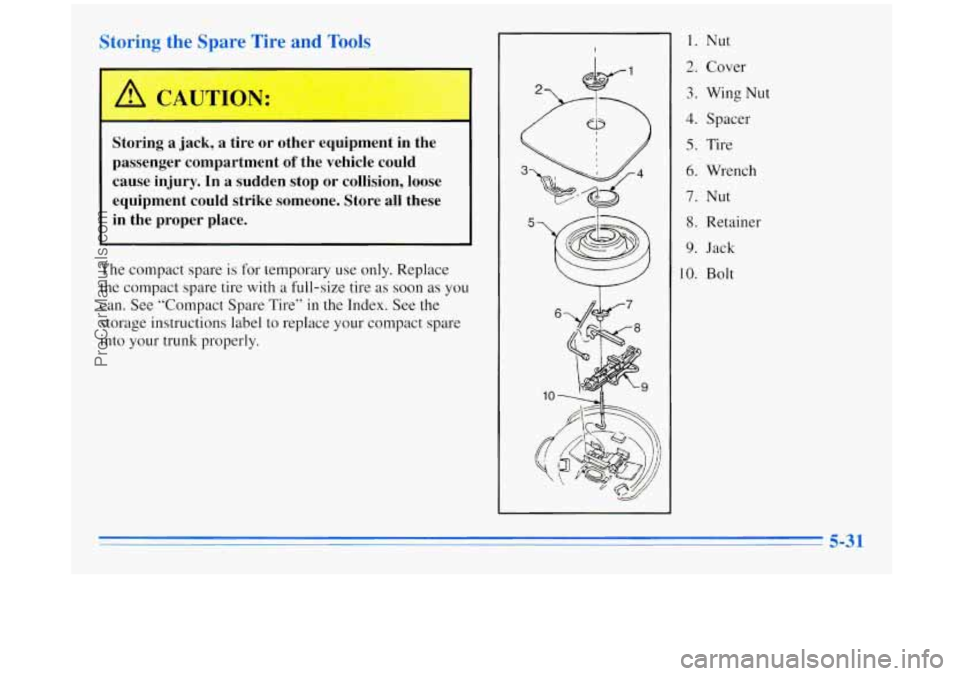
The compact spare is for temporary use only. Replace
the compact spare tire with
a full-size tire as soon as you
can. See “Compact Spare Tire” in
the Index. See the
storage instructions label to replace your compact spare
into your trunk properly.
I
21 +’
5
1. Nut
2. Cover
3. Wing Nut
4. Spacer
5. Tire
6. Wrench
7. Nut
8. Retainer
9. Jack
10. Bolt
5-31
ProCarManuals.com
Page 254 of 356
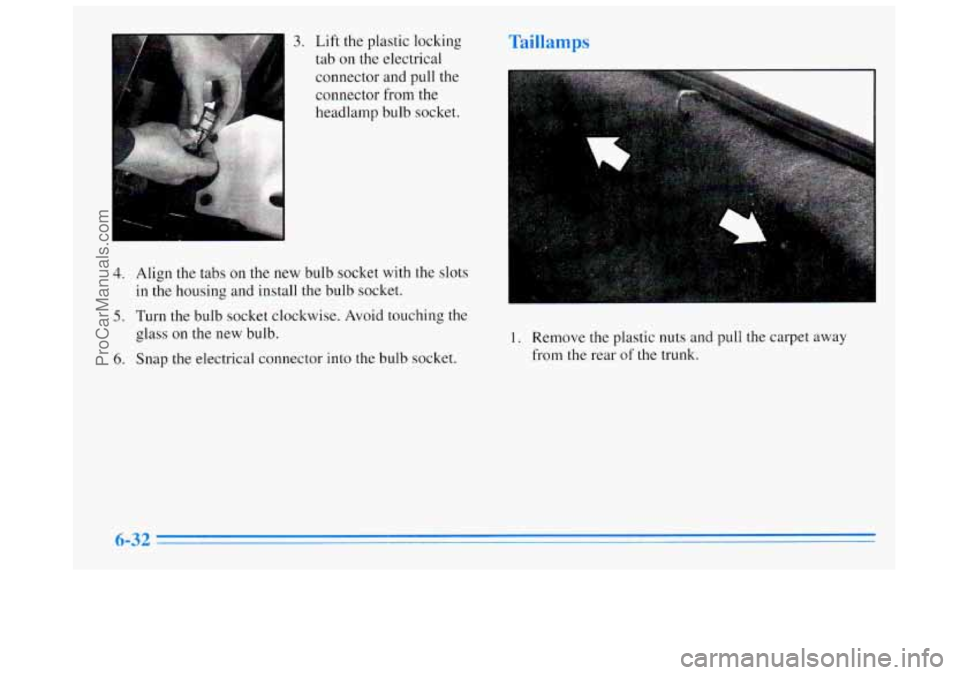
3. Lift the plastic locking
tab on the electrical
connector and pull the
connector from the
headlamp bulb socket.
4. Align the tabs on the new bulb socket with the slots
5. Turn the bulb socket clockwise. Avoid touching the
in the housing and install the bulb socket.
glass
on the new bulb.
6. Snap the electrical connector into the bulb socket.
1. Remove the plastic nuts and pull the carpet away
from the rear of the trunk.
ProCarManuals.com
Page 257 of 356
CAUTION: (Conunut
0
0
0
Underinflated tires pose the Sme danger as
overloaded tires. The resulting accident
could cause serious injury. Check all tires
frequently to maintain the recommended pressure. Tire pressure should be checked
when your tires are cold.
Overinflated tires are more likely to be
cut, punctured
or broken by a sudden
impact
-- such as when you hit a pothole.
Keep tires at the recommended pressure.
Worn, old tires can cause accidents.
If your
tread is badly worn, or if your tires have
been damaged, replace them.
Inflation - Tire Pressure
The Tire-Loading Information label which is inside the
trunk lid shows the correct inflation pressures for your
tires when they’re cold. “Cold” means your vehicle has
been sitting for at least three
hours or driven no more
than a mile.
NOTICE:
Don’t let anyone tell you that underinflation or
overinflation is all right. It’s not.
If your tires
don’t have enough air (underinflation), you can
get the following:
Too much flexing
Too much heat
Tire overloading
Bad wear
0 Bad handling
Bad fuel economy.
NOTICE: (Continued)
6-35
ProCarManuals.com
Page 277 of 356
Fuse
15
16
19
21
23
24
28
Description
HVAC #1 -- Air Temperature
Valve Motor: Trip Computer,
Daytime Running Lamps Module
(DRL), HVAC Control Assembly,
Multifunction Lever Cruise
Control Switch
Control Assembly Rear Window
Defogger Switch
POWER ACCESSORY
#1 -- Antenna Relay, Power
Mirror Switch, Door Lock
Switches,
Door Handle Switches,
Trunk Courtesy Lamp
AIR BAG SYSTEM
STOPLAMPS
-- TCC/Brake
Switch
CRUISE CONTROL
CTSY LAMPS -- Vanity Mirrors,
T/P Courtesy Lamps, I/P
Compartment Lamp, Header
Courtesy and Reading Lamp,
I/S
Lighted Rearview Mirror, Dome
and Reading Lamps, Quarter
Courtesy Lamps
REAR
DEFOG
-- HVAC
Fuse
29
30
32
37
38
39
Description
WIPER -- Wiper Switch
TURN SIGNAL
-- Turn
Signal Flasher
POWER LOCKS
-- Door
Lock Relay
AUXILIARY POWER
RADIO
-- Radio, Steering Wheel
Radio Switches
I/P ELECTRONICS IGNITION
FEED
-- Headlamp Switch,
Cruise Control Cut-Out Switch,
Air Bag System, TCC/Brake
Switch, Instrument Cluster, Chime
Module, Second-Gear Start
Switch, Daytime Running Lamps
Module (DRL)
6-55
ProCarManuals.com