1996 BUICK PARK AVENUE window
[x] Cancel search: windowPage 147 of 388

Heating
If you have the electronic touch system, on cold days,
use HTR with the TEMPERATURE lever toward
WARM. If you have the dual automatic comfortemp
system, press
AUTO and adjust the temperature by
pressing the TEMP up or down arrow. You may also
adjust the dual automatic comfortemp system manually
by pressing the AIR FLOW button until FLOOR
appears. Again, adjust the temperature by pressing the
TEMP up or down arrow.
With each system, outside air will be brought in and sent
through the floor outlets. The heater works best if you
keep your windows closed.
Ventilation System
For mild outside temperatures when little heating or
cooling is needed, use
VENT (on the electronic touch
system or manual operation of the dual automatic
cornfortemp system) to direct outside air through
your
vehicle. Air will flow through the middle instrument
panel outlets.
Your vehicle’s flow-through ventilation system supplies
outside air into the vehicle when it’s moving. When the
vehicle is not moving, you can get outside air to flow
through by selecting any air choice (except the rear
window defogger) and any fan speed.
3-7
ProCarManuals.com
Page 149 of 388

Ventilation Tips
0
0
0
0
Keep the hood and front air inlet free of ice, snow or
any other obstruction such as leaves. The heater and
defroster will work better, reducing the chance of
fogging your windows.
When you enter a vehicle with the electronic touch
system in cold weather, select HTR to supply air
through the floor outlets. Then move the FAN lever
to HIGH for a few moments before driving away.
This will blow moist air from the intake outlets
toward the floor, not the windshield. It reduces the
chance of fogging your windows. If you have the
dual automatic comfortemp system, the AUTO
setting will do this for you. Manual operation of the
automatic comfortemp system in the
FLOOR mode
will also supply air through the floor outlets.
Keep the air path under the front seats clear of objects.
This helps air to circulate throughout your vehicle.
When the engine idles for a long time, the exterior
temperature sensor may cause the system
to blow air
that is too cool. Once the vehicle is moving again,
the system will try to maintain the set temperature
inside your vehicle.
0 When you start your vehicle and the EXT display
flashes (dual automatic comfortemp system only) for
some time, the system may need repair. See your
Buick dealer.
Defogging and Defrosting
On cool but humid days, use FRONT to keep the
windshield and side windows clear and to quickly
remove fog, frost or ice from the windshield.
If you have the the electronic touch system, adjust the
TEMPERATURE lever toward
WARM and the FAN
lever toward HIGH.
If you have the dual automatic cornfortemp system,
while in the AUTO mode, the fan speed will vary.
If a
manual fan speed setting
is selected, the fan speed will
remain at that selection until the engine is turned
off or
another selection has been made. To turn off FRONT,
press
AUTO or AIR FLOW.
3-9
ProCarManuals.com
Page 150 of 388

Rear Window Defogger (Option)
E The lines you see on the
rear window warm the
glass. Press this button to
start warming your window.
After
10 minutes it will turn off by itse lf, or
by press ing
the button during the heating cycle will turn it off. If you
need additional warming time, push the button again.
The system will then operate for five minutes before
going
off by itself.
Do not attach a temporary vehicle license, tape or decals
across the defogger grid on the rear window.
I NOTICE:
Don’t use a razor blade or something else sharp
on the inside
of the rear window. If you do, you
could cut or damage the warming grid, and the
repairs wouldn’t be covered by your warranty.
3-10
ProCarManuals.com
Page 195 of 388
The exit speed is usually posted.
Reduce your speed according to your speedometer, not
to your sense of motion. After driving for any distance
at higher speeds, you may tend to think you are going
slower than you actually are.
Before Leaving on a Long Trip
Make sure you’re ready. Try to be well rested. If you
must start when you’re not fresh
-- such as after a day’s
work
-- don’t plan to make too many miles that first part
of the journey. Wear comfortable clothing and shoes you
can easily drive
in.
Is your vehicle ready for a long trip? If you keep it
serviced and maintained, it’s ready to go.
If it needs
service, have
it done before starting out. Of course,
you’ll find experienced and able service experts in
Buick dealerships all across
North America. They’ll be
ready and willing
to help if you need it. Here
are some things
you can check before a trip:
0
0
0
0
0
0
0
Windshield Washer Fluid: Is the reservoir full? Are
all windows clean inside and outside?
Wiper Blades: Are they in good shape?
Fuel, Engine Oil, Other Fluids: Have you checked
all levels?
Lamps: Are they all working? Are the lenses clean?
Tires: They are vitally important to a safe,
trouble-free trip.
Is the tread good enough for
long-distance driving? Are the tires all inflated to the
recommended pressure?
Weather Forecasts: What’s the weather outlook
along your route? Should you delay your trip a short
time to avoid a major storm system?
Maps: Do you have up-to-date maps?
ProCarManuals.com
Page 201 of 388
Tie a red cloth to your vehicle to alert police that
you’ve been stopped by the snow.
Put on extra clothing or wrap a blanket around you.
If you have no blankets
or extra clothing, make body
ins‘ulators from newspapers, burlap bags, rags, floor
mats
-- anything you can wrap around yourself or
tuck under your clothing to keep warm.
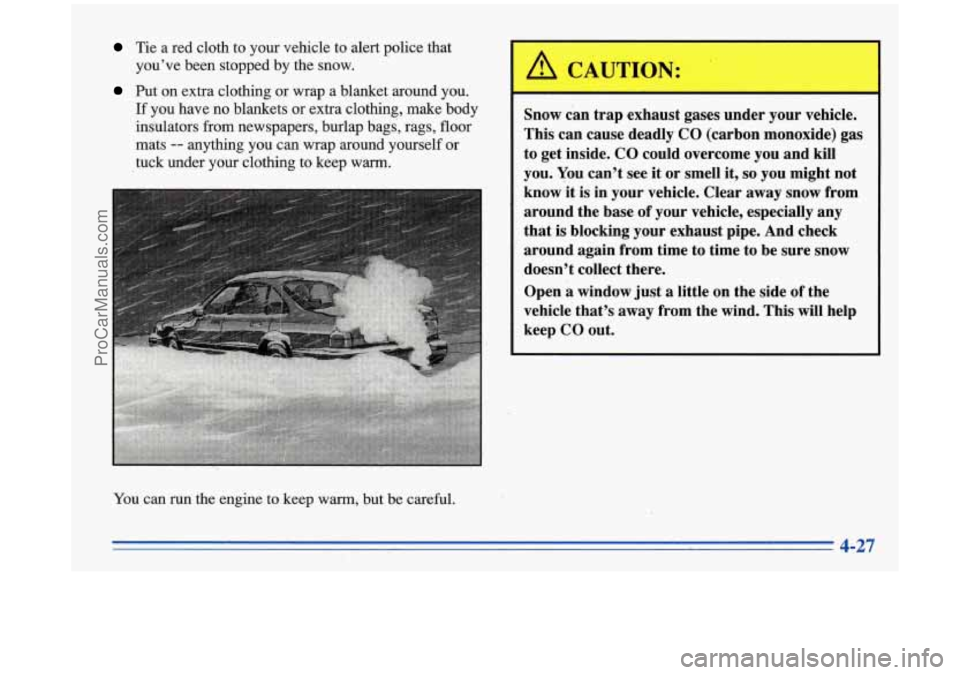
You can run the engine to keep wm, but be careful. Snow can trap exhaust
gases under your vehicle:
This can cause deadly
CO (carbon monoxide) gas
to get inside.
CO could overcome you and kill
you.
You can’t see it or smell it, so you might not
know
it is in your vehicle. Clear away snow from
around the base
of your vehicle, especially any
that is blocking your exhaust pipe. And check
around again from time to time to be sure snow
doesn’t collect there.
Open
a window just a little on the side of the
vehicle
that’s away from the wind. This will help
keep
CO out.
4-27
ProCarManuals.com
Page 202 of 388
Run your engine only as long as you must. This saves
fuel. When you run the engine, make it go a little faster
than just idle. That is, push the accelerator slightly. This
uses less fuel for the heat that you get and it keeps the
battery charged. You will need a well-charged battery to
restart the vehicle, and possibly for signaling later on
with your headlamps. Let the heater run for awhile.
Then, shut the engine off and close the window almost
all the way to preserve the heat. Start the engine again
and repeat this only when you feel really uncomfortable
from the cold. But do it as little as possible. Preserve the
fuel as long as you can. To help keep warm, you can get
out of the vehicle and do some fairly vigorous exercises
every half hour or
so until help comes.
Loading Your Vehicle
ym OCCUPANTS
VEHICLE CAP. WT.
TIRE-LOADING INFORMATION
7
FRT. CTR. RR. TOTAL LBS. KG
MAX. LOADING & GVWR
SAME AS VEHICLE
CAPACITY WEIGHT XXX COLD TIRE
TIRE
SIZE SPEED PRESSURE
RTG PSI/KPa
FRT.
RR.
SPA.
IF TIRES ARE HOT, ADD 4PSIi28KPa
SEE OWNER'S MANUAL FOR ADDITIONAL
INFORMATION
- ~ ~ __
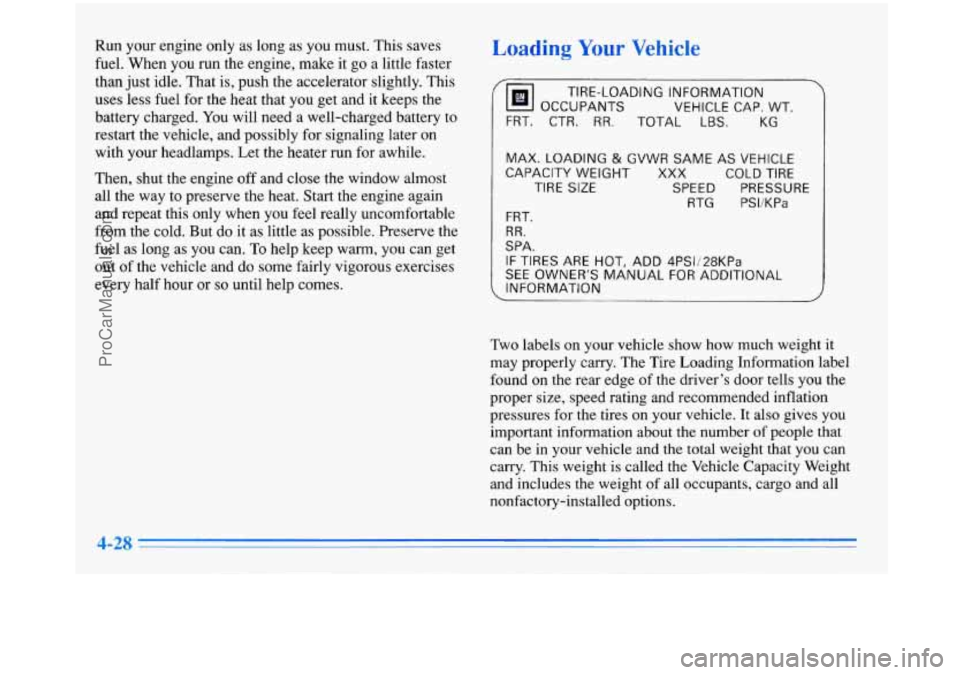
Two labels on your vehicle show how much weight it
may properly carry. The Tire Loading Information label
found on the rear edge
of the driver's door tells you the
proper size, speed rating and recommended inflation
pressures for the tires on your vehicle. It also gives you
important information about the number
of people that
can be in your vehicle and the total weight that you can
carry. This weight is called the Vehicle Capacity Weight
and includes the weight of all occupants, cargo and all
nonfactory-installed options.
4-28
ProCarManuals.com
Page 225 of 388
If No Steam Is Coming From Your Engine
If you get the overheat warning but see or hear no
steam, the problem may not be too serious. Sometimes
the engine can get a little
too hot when you:
0 Climb a long hill on a hot day.
Stop after high-speed driving.
Idle for long periods in traffic.
@ Tow a trailer.
If you get the overheat warning with no sign of steam,
try this for a minute or
so:
1. Turn off your air conditioner.
2. Turn on your heater to full hot at the highest fan
speed and open
the window as necessary.
3. If you’re in a traffic jam, shift to NEUTRAL (N);
otherwise, shift to the highest gear while
driving
-- AUTOMATIC OVERDRIVE (a)
or THIRD (3).
If you no longer have the overheat warning, you
can drive. Just to be safe, drive slower for about
10 minutes. If the warning doesn’t come back on,
you can drive normally.
If the warning continues, pull over, stop, and park your
vehicle right away.
If there’s still no sign of steam, you can idle the engine
for two or three minutes while you’re parked, to see if
the warning stops. But then, if you still have the
warning,
turn off the engine and get evejyone out of the
vehicle
until it cools down.
You may decide not to lift the hood but to get service
help right away.
ProCarManuals.com
Page 295 of 388

Appearance Care
Remember, cleaning products can be hazardous. Some
are toxic. Others can burst into flame if you strike a
match
or get them on a hot part of the vehicle. Some are
dangerous if you breathe their fumes in a closed space.
When you use anything from a container to clean your
Buick, be sure to follow the manufacturer’s warnings
and instructions. And always open your doors or
windows when you’re cleaning the inside.
Never use these to clean your vehicle:
Gasoline
Benzene
0 Naphtha
Carbon Tetrachloride
Acetone
Paint Thinner
Turpentine
Lacquer Thinner
Nail Polish Remover
They can all be hazardous
-- some more than
others
-- and they can all damage your vehicle, too.
Don’t use any of these unless this manual says you can.
In many uses, these will damage your vehicle:
0 Alcohol
0 Laundry Soap
0 Bleach
Reducing Agents
Cleaning the Inside of Your Buick
Use a vacuum cleaner often to get rid of dust and loose
dirt. Wipe vinyl or leather with a clean, damp cloth.
Your Buick dealer has two
GM cleaners, a solvent-type
spot lifter and a foam-type powdered cleaner. They will
clean normal spots and stains very well.
Do not use
them on vinyl or leather.
Here are some cleaning tips:
0 Always read the instructions on the cleaner label.
Clean up stains as soon as you can -- before they set.
Use a clean cloth or sponge, and change to a clean area
often. A soft brush may be used if
stains are stubborn.
Use solvent-type cleaners in a well-ventilated area
only.
If you use them, don’t saturate the stained area.
If a ring forms after spot cleaning, clean the entire
area immediately or
it will set.
ProCarManuals.com