Page 268 of 388
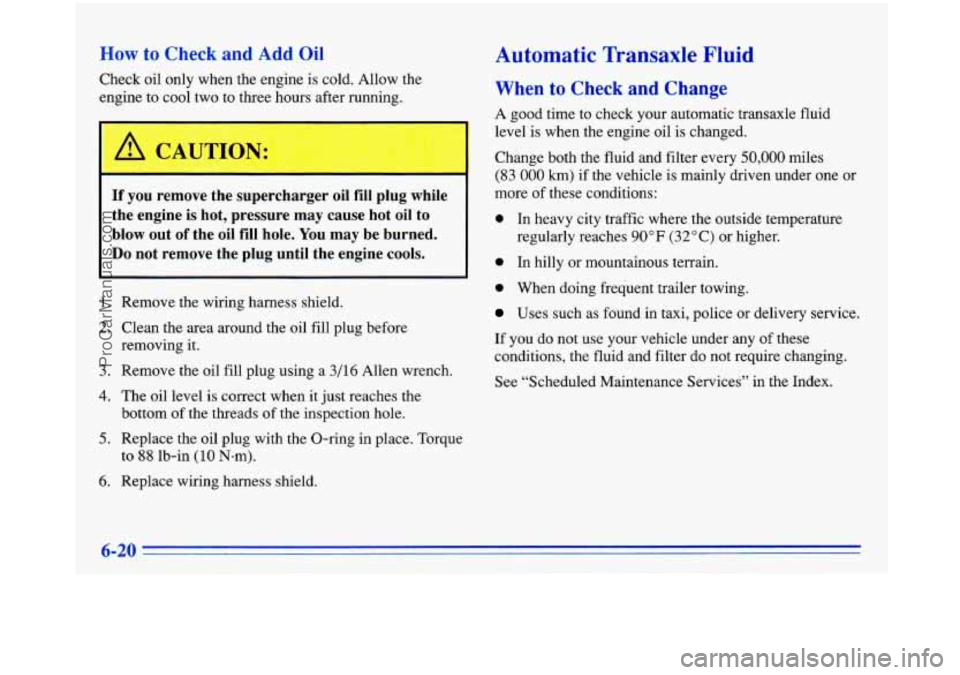
How to Check and Add Oil
Check oil only when the engine is cold. Allow the
engine to cool two to three hours after running.
r
I
If you remove the supercharger oil fill plug while
the engine is hot, pressure may cause hot oil to
blow out of the oil fill hole. You may be burned.
Do not remove the plug until the engine cools.
1. Remove the wiring harness shield.
2. Clean the area around the oil fill plug before
removing
it.
3. Remove the oil fill plug using a 3/16 Allen wrench.
4. The oil level is correct when it just reaches the
bottom
of the threads of the inspection hole.
5. Replace the oil plug with the O-ring in place. Torque
to
88 lb-in (10 N-m).
6. Replace wiring harness shield.
Automatic Transaxle Fluid
When to Check and Change
A good time to check your automatic transaxle fluid
level is when the engine oil is changed.
Change both the fluid and filter every
50,000 miles
(83 000 km) if the vehicle is mainly driven under one or
more
of these conditions:
0 In heavy city traffic where the outside temperature
regularly reaches
90 OF (32 O C) or higher.
0 In hilly or mountainous terrain.
0 When doing frequent trailer towing.
Uses such as found in taxi, police or delivery service.
If you do not use your vehicle under any of these
conditions, the fluid and filter do not require changing.
See “Scheduled Maintenance Services” in the
Index.
ProCarManuals.com
Page 271 of 388
How to Add Fluid
Refer to the Maintenance Schedule to determine what
kind of transaxle fluid to use. See “Recommended
Fluids and Lubricants” in the Index.
If the fluid level is low, add only enough
of the proper
fluid to bring the level into the cross-hatched area on
the dipstick.
1. Pull out the dipstick.
2. Using a long-neck funnel, add enough fluid at the
It doesn’t take much fluid, generally less than a pint
(0.5 L). Don’t ovel-fill. We recommend you use only
fluid labeled DEXRON@-111, because fluid with that
label is made especially for your automatic transaxle.
Damage caused by fluid other than DEXRON-I11 is
not covered by your new vehicle warranty.
dipstick hole to
bring it to the proper level.
After adding fluid, recheck the fluid level as
described under “How to Check.”
0 When the correct fluid level is obtained, push the
dipstick back in all the way.
Engine Coolant
The cooling system in your vehicle is filled with new
DEX-COOL
TM (orange-colored, silicate-free) engine
coolant. This coolant is designed to remain in your
vehicle for
5 years or 100,000 miles (166 000 km),
whichever occurs first.
The following explains your cooling system and how
to add coolant when
it is low. If you have a problem
with engine overheating, see “Engine Overheating” in
the Index.
A 50/50 mixture of water and the proper coolant for
your Buick will:
Give freezing protection down to -34°F (-37°C).
9 Give boiling protection up to 265 OF ( 129 O C).
Protect against rust and corrosion.
Help keep the proper engine temperature.
0 Let the warning lights and gages work as they should.
ProCarManuals.com
Page 276 of 388
Power Steering Fluid
When to Check Power Steering Fluid
It is not necessary to regularly check power steering fluid
unless you suspect there
is a leak in the system or you hear
an unusual noise. A fluid loss in this system could indicate
a problem. Have the system inspected and repaired. The
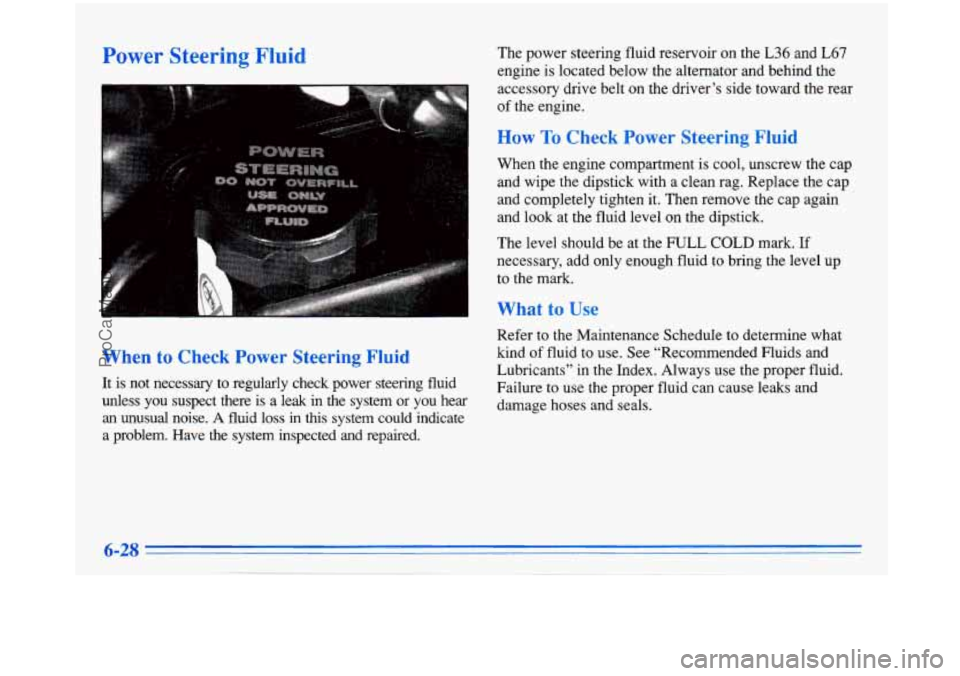
power steering fluid reservoir on the L36 and L67
engine is located below the alternator and behind the
accessory drive belt on the driver’s side toward the rear
of the engine.
How To Check Power Steering Fluid
When the engine compartment is cool, unscrew the cap
and wipe the dipstick with a clean rag. Replace the cap
and completely tighten
it. Then remove the cap again
and look at the fluid level on the dipstick.
The level should be at the FULL COLD mark.
If
necessary, add only enough fluid to bring the level up
to the mark.
What to Use
Refer to the Maintenance Schedule to determine what
kind of fluid
to use. See “Recommended Fluids and
Lubricants” in the Index. Always use the proper fluid.
Failure to use the proper fluid can cause leaks and
damage hoses and seals.
ProCarManuals.com
Page 289 of 388
Tire Inspection and Rotation ,
Tires should be inspected every 6,000 to 8,000 miles
(10 000 to 13 000 km) for any signs of unusual wear.
If unusual wear is present, rotate yourtires as soon as
possible and check wheel alignment.
Also check for
damaged tires or wheels. See “When It’s The for New
Tires” and “Wheel Replacement” later in this section for
more information. When
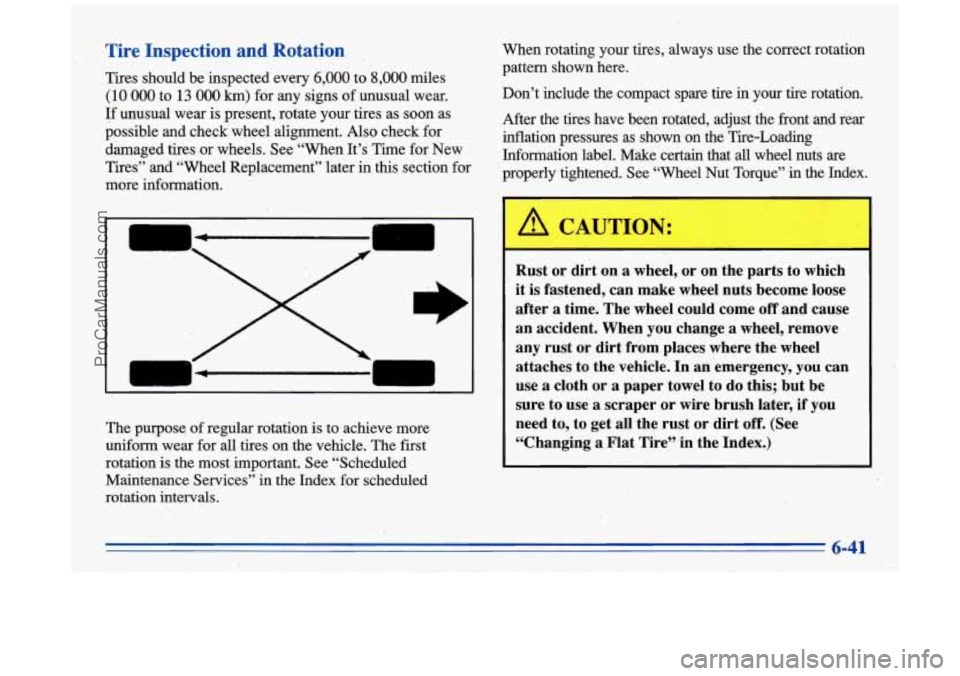
rotating your tires, always use the correct rotation
pattern shown here.
Don’t include the compact spare tire in your tire rotation.
After the tires have been rotated, adjust the front and rear
inflation pressures as shown on the Tire-Loading
Information label. Make certain that
all wheel nuts are
properly tightened. See “Wheel Nut Torque”
in the Index.
I I
The purpose of regular rotation is to achieve more
uniform wear for
all tires on the vehicle. The first
rotation is the most important. See “Scheduled
Maintenance Services”
in the Index for scheduled
rotation intervals.
A CAUTION:
I
Rust or dirt on a wheel, or on the parts to which
it
is fastened, can make wheel nuts become loose
after
a time. The wheel could come off and cause
an accident. When
you change a wheel, remove
any rust or dirt from places where the wheel
attaches
to the vehicle. In an emergency, you can
use
a cloth or a paper towel to do this; but be
sure to use a scraper or wire brush later, if you
need to, to get all the rust
or dirt off. (See
“Changing
a Flat Tire” in the Index.)
6-41
ProCarManuals.com
Page 302 of 388
Finish Damage
Any stone chips, fractures or deep scratches in the finish
should be repaired right away. Bare metal will corrode
quickly and may develop into a major repair expense.
Minor chips and scratches can be repaired with touch-up
materials available from your dealer or other service
outlets. Larger areas
of finish damage can be corrected
in your dealer’s body and paint shop.
Underbody Maintenance
Chemicals used for ice and snow removal and dust control
can collect on the underbody.
If these are not removed,
accelerated corrosion (rust) can occur on
the underbody
parts such as fuel lines, frame, floor pan and exhaust system even though they have corrosion protection.
At least every spring, flush these materials from the
underbody with plain water. Clean any areas where
mud
and other debris can collect. Dirt packed in closed areas
of the frame should be loosened before being flushed.
Your dealer or an underbody car washing system can do
this
for you.
Chemical Paint Spotting
Some weather and atmospheric conditions can create a
chemical fallout. Airborne pollutants can fall upon and
attack painted surfaces on your vehicle.
This damage
can take two forms: blotchy, ringlet-shaped
discolorations, and small irregular dark spots etched into
the paint surface.
Although no defect in the paint job causes this, Buick
will repair, at no charge
to the owner, the surfaces of
new vehicles damaged by this fallout condition within
12 months or 12,000 miles (20 000 km) of purchase,
whichever occurs first.
ProCarManuals.com
Page 314 of 388
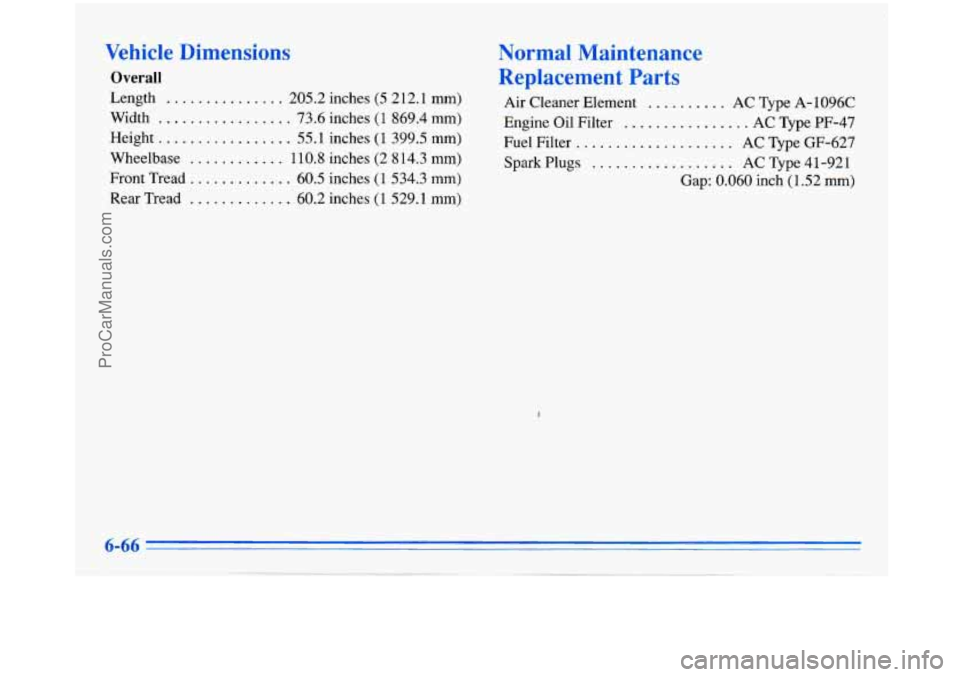
Vehicle Dimensions
Overall
Length ............... 205.2 inches (5 2 12.1 mm)
Width
................. 73.6 inches (1 869.4 mm)
Height
................. 55.1 inches (1 399.5 mm)
Wheelbase
............ 110.8 inches (2 8 14.3 mm)
Front Tread
............. 60.5 inches (1 534.3 mm)
Rear Tread
............. 60.2 inches (1 529.1 mm)
Normal Maintenance
Replacement Parts
Air Cleaner Element .......... AC Type A- 1096C
Engine Oil Filter
................ AC Type PF-47
Fuel Filter
.................... AC Type GF-627
Spark Plugs
.................. AC Type 41-921
Gap:
0.060 inch (1.52 mm)
6-66
ProCarManuals.com
Page 315 of 388
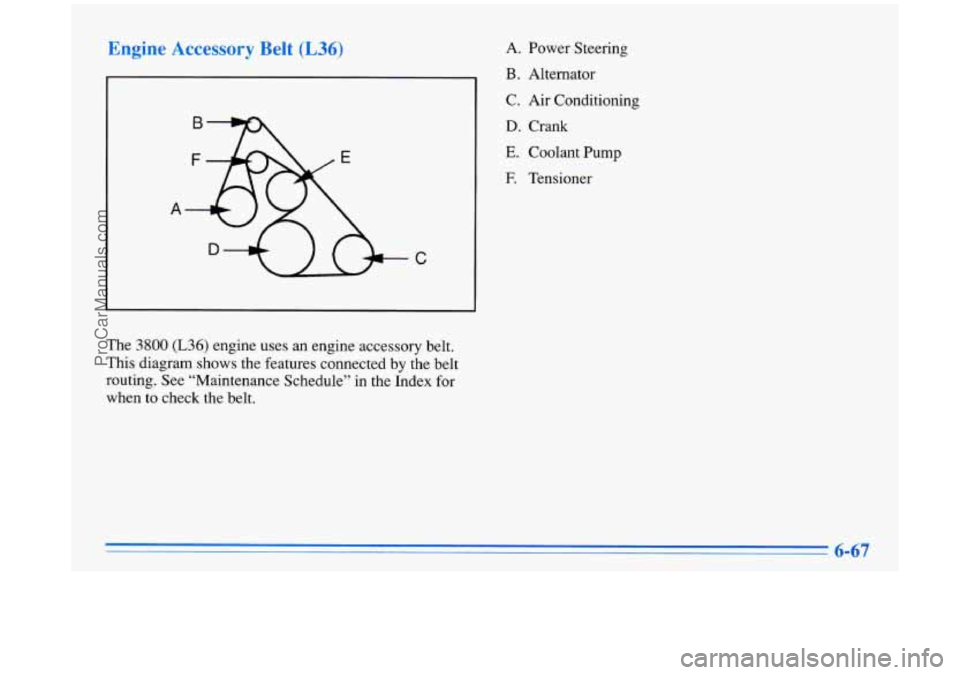
Engine Accessory Belt (L36)
C
I
A. Power Steering
B. Alternator
C. Air Conditioning
D. Crank
E. Coolant Pump
E Tensioner
The
3800 (L36) engine uses an engine accessory belt.
This diagram shows the features connected by the belt
routing. See “Maintenance Schedule” in the Index for
when
to check the belt.
ProCarManuals.com
Page 316 of 388
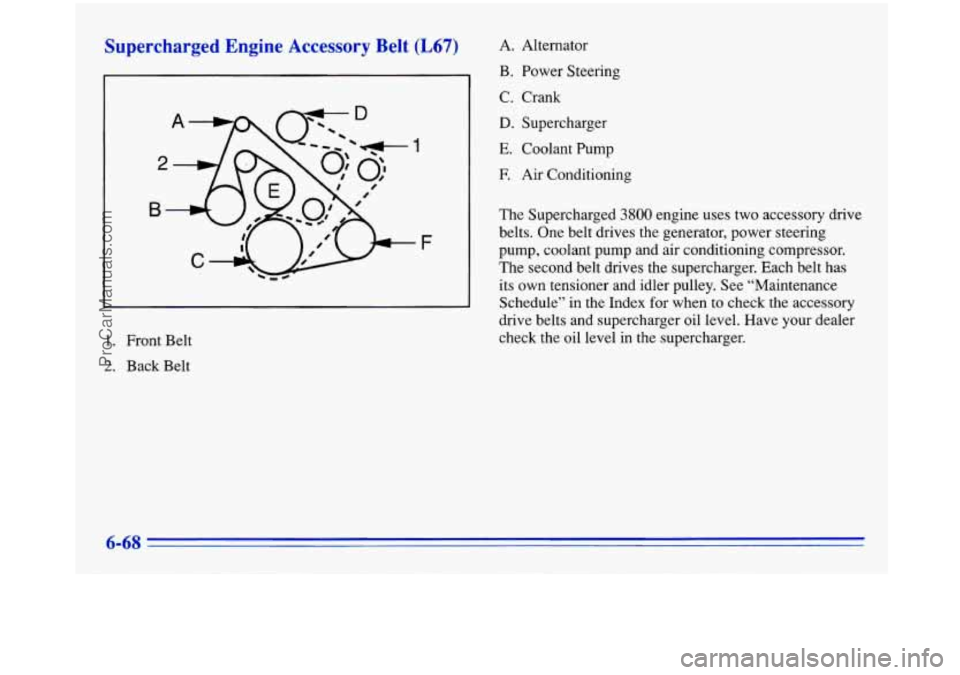
mharged Engine Accessory Belt (L67)
F
1. Front Belt
2. Back Belt A.
B.
C.
D.
E.
E
Alternator
Power Steering
Crank
Supercharger
Coolant Pump
Air Conditioning
The Supercharged
3800 engine uses two accessory drive
belts. One belt drives the generator, power steering
pump, coolant pump and air conditioning compressor.
The second belt drives the supercharger. Each belt has
its own tensioner and idler pulley. See “Maintenance
Schedule” in the Index for when
to check the accessory
drive belts and supercharger oil level. Have your dealer
check the
oil level in the supercharger.
6-68
ProCarManuals.com