1996 BUICK CENTURY ignition
[x] Cancel search: ignitionPage 113 of 340

This system is called OBD I1 (On-Board
Diagnostics-Second Generation) and is intended to assure
that emissions are at acceptable levels for the life
of the
vehicle, helping to produce a cleaner environment. (In
Canada, OBD I1 is replaced by Enhanced Diagnostics.)
The SERVICE ENGINE SOON light comes on to
indicate that there is a problem and service is required.
Malfunctions often will be indicated by the system
before any problem
is apparent, which may prevent more
serious damage
to your vehicle. This system is also
designed to assist your service technician in correctly
diagnosing any malfunction.
NOTICE:
If you keep driving your vehicle with this light
on, after a while, your emission controls may not
work as well, your fuel economy may not be as
good and your engine may not run as smoothly.
This could lead to costly repairs that may not be
covered by your warranty.
This light should come on, as a check to show you it is
working, when the ignition is on and the engine is
not
running. If the light doesn’t come on, have it repaired.
This light will also come on during a malfunction in one
of two ways:
0
0 Light Flashing -- A misfire condition has been
detected.
A misfire increases vehicle emissions and
may damage the emission control system on your vehicle. Dealer or qualified service center diagnosis
and service is required.
Light On Steady -- An emission control system
malfunction has been detected on your vehicle.
Dealer or qualified service center diagnosis and service may be required.
2-55
ProCarManuals.com
Page 116 of 340

The oil light could also come on in three other situations:
When the ignition is on but the engine is not running,
the light will come
on as a test to show you it is
working, but the light will go out when
you turn the
ignition to START. If it doesn’t come on with the
ignition, you may have
a problem with the fuse or a
bulb. Have
it fixed right away.
Sometimes when the engine is idling at a stop, the
If you make a hard stop, the light may come on for a
light
may blink on and off. This
is normal.
moment. This
is normal.
A CAUTION:
Don’t keep driving if the oil pressure is low. If
you do, your engine can become so hot that it
catches fire.
You or others could be burned.
Check your oil
as soon as possible and have your
vehicle serviced.
I NOTICE:
Damage to your engine from neglected oil
problems can be costly and
is not covered by
your warranty.
Liftgate Ajar Warning Light (Wagon)
The TAILGATE AJAR
reminder light on your instrument panel will come
on if your liftgate is not
TAILGATE
AJAR
2-58
ProCarManuals.com
Page 117 of 340
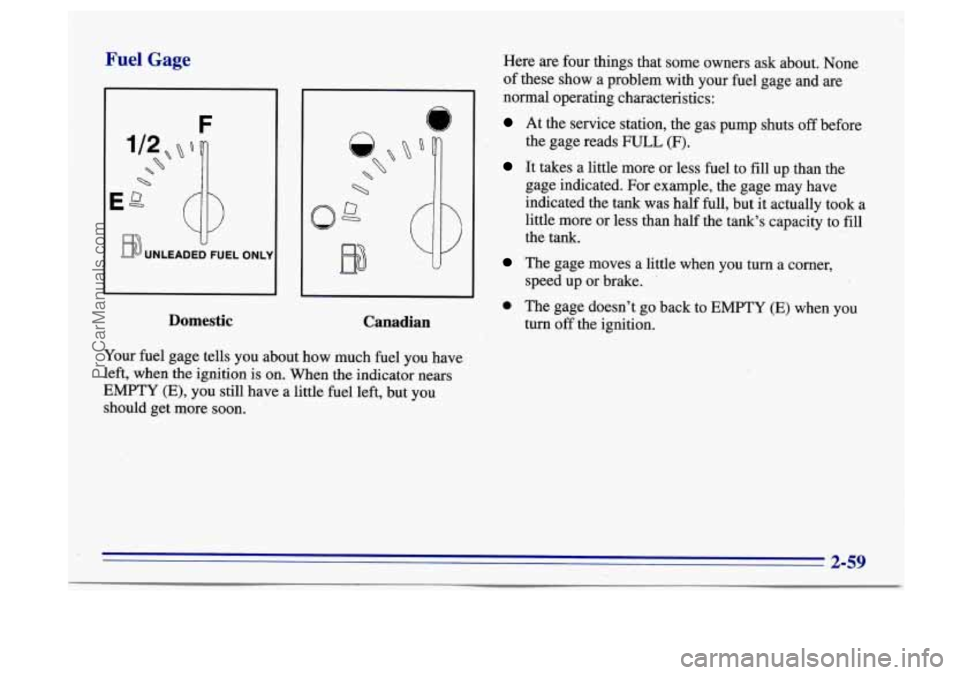
Fuel Gage
Eg 0
BUNLEADED FUEL ONLY
II
Domestic Canadian
Your fuel gage tells you about how much fuel you have
left, when the ignition is on. When the indicator nears
EMPTY (E), you still have a little fuel left, but you
should get more soon. Here are four
things that some owners ask about. None
of these show a problem with your fuel gage and
are
normal operating characteristics:
At the service station, the gas pump shuts off before
the gage reads FULL (F).
It takes a little more or less fuel to fill up than the
gage indicated. For example, the gage may have
indicated the tank was half full, but it actually took
a
little more or less than half the tank's capacity to fill
the tank.
The gage moves a little when you turn a corner,
0 The gage doesn't go back to EMPTY (E) when you
speed
up or brake.
turn
off the ignition.
I
2-59
ProCarManuals.com
Page 121 of 340

Rear Window Defogger
REAR
!
The rear window defogger
uses
a warming grid to
remove fog from the rear
window. In winter, it can
also keep ice from forming
on the rear window.
Press the
ON portion of the switch. The indicator light
will glow. The rear window defogger
will turn off
automatically after about 10 minutes of use. You can
also
turn it off by turning off the ignition or pressing the
OFF portion of the switch.
I NOTICE:
Don’t use a razor blade or something else sharp
on the inside
of the rear window. If you do, you
could cut or damage the warming grid, and the
repairs wouldn’t be covered by your warranty.
Ventilation System
Your Buick’s flow-through ventilation system supplies
outside air into the vehicle when
it is moving. Outside
air
will also enter the vehicle when the heater or the air
conditioning fan is running.
For mild outside temperatures, when
little heating or
cooling is needed, slide the upper lever to VENT.
Airflow is through the instrument panel outlets. Rotate
the control next to the outlets to turn on, adjust or turn
off the airflow. Adjust the lower lever
on the control
panel
to the temperature desired.
3-3
ProCarManuals.com
Page 123 of 340

AM-FM Stereo
Playing the Radio
VOL: Turn the upper knob to turn the radio on and off
and to control the volume.
RECALL: When the ignition is off, press the upper
knob
to display the time.
Finding a Station
AM-FM: Press the lower knob to select AM or FM.
TUNE: Turn the lower knob to choose radio stations.
SEEK: Press this button to go to the next higher station
and stay there.
SCAN: Press this button to hear each station for a few
seconds. The radio will go to
a station, stop for a few
seconds, then go on to the next station. SCAN appears
on the display. Press SCAN again to stop scanning.
PUSHBUTTONS: The four numbered pushbuttons let
you return to your favorite stations. You can set up to
14 stations (seven AM and seven FM).
1. Find the station you want by using TUNE.
2.
Press SET. (The SET indicator will appear briefly on
the display.)
3. Press one of the four pushbuttons, within five
seconds. Whenever you press that numbered button,
the station you set will return.
4. Repeat the steps for each pushbutton.
3-5
ProCarManuals.com
Page 124 of 340

In addition to the four stations set as above, up to three
additional stations may be preset on each band by
pressing two adjoining buttons at the same time. Just:
1. Tune in the desired station.
2. Press SET. (The SET indicator will appear on
3. Press any two adjoining pushbuttons at the same
the
display.)
time (within five seconds).
4. Whenever you press the same buttons, the station
you
set will return.
Setting the Tone
BASS:
Slide this lever up to increase bass and down to
decrease it.
TREBLE: Slide this lever up to increase treble and
down to decrease it. If a station is weak or noisy, slide
the lever down
to reduce the noise.
Adjusting the Speakers
BAL:
This control behind the upper knob adjusts the
sound between the right and
left speakers.
FADE: This control behind the lower knob adjusts the
sound between your front and rear speakers.
AM-FM Stereo with Cassette Tape Player
(Option)
Playing the Radio
VOL: Turn the upper knob to turn the radio on and off
and control the volume. When the ignition is
off, press
the knob to display the time.
Finding a Station
AM-FM: Press the lower knob to select AM or FM.
TUNE: Turn the lower knob to choose radio stations.
SEEK: Press this button to go to the next higher station
and stay there.
3-6
ProCarManuals.com
Page 128 of 340
Fixed Mast Antenna
The fixed mast antenna can withstand most car washes
without being damaged. If the mast should ever become
slightly bent, you can straighten it out by hand.
If the
mast is badly bent, as it might be by vandals,
you should
replace it.
Check every once in a while to be sure the mast is still
tightened to the fender.
Power Antenna Mast Care
Your power antenna will look its best and work
well
if it’s cleaned from time to time. To clean the
antenna mast:
1.
2.
3.
4.
5.
6.
Turn on the ignition and radio to raise the antenna.
Dampen
a clean cloth with mineral spirits or
equivalent solvent.
Wipe the cloth over the mast sections, removing
any dirt.
Wipe dry with a clean cloth.
Make the antenna
go up and down by turning the
radio
or ignition off and on.
Repeat if necessary.
I NOTICE:
Don’t lubricate the power antenna. Lubrication
could damage it.
NOTICE:
Before entering an automatic car wash, turn off
your radio to make the power antenna go down.
This will prevent the mast from possibly getting
damaged.
If the antenna does not go down when
i you turn the radio off, it may be damaged or
need to be cleaned. In either case, lower the
antenna by hand by carefully pressing the
antenna down.
If the mast portion of your antenna is damaged, you can
easily replace it. See your dealer for a replacement kit
and follow
the instructions in the kit.
3-10
ProCarManuals.com
Page 153 of 340

If you drive regularly in steep country, or if you’re
planning
to visit there, here are some tips that can make
your trips safer and more enjoyable.
0 Keep your vehicle in good shape. Check all fluid
levels and also the brakes, tires, cooling system
and transaxle. These parts can work hard on
mountain roads.
Know how to go down hills. The most important
thing to know is this:
let your engine do some of the
slowing down. Shift to a lower gear when you go
down a steep or long hill.
If you don’t shift down, your brakes could get
so hot that they wouldn’t work well. You would
then have poor braking or even none going
down
a hill. You could crash. Shift down to let
your engine assist your brakes on
a steep
downhill slope.
A CAUTION:
Coasting downhill in NEUTRAL (N) or with the
ignition
off is dangerous. Your brakes will have to
do all the work
of slowing down. They could get so
hot that they wouldn’t work well. You would then
have poor braking or even none going down
a hill.
You could crash. Always have your engine running
and your vehicle in gear when you
go downhill.
I
Know how to go uphill. You may want to shift down
to a lower gear.
The lower gears help cool your engine
and transaxle, and you can climb the hill better.
Stay in your own lane when driving on two-lane
roads
in hills or mountains. Don’t swing wide or cut
across
the center of the road. Drive at speeds that let
you stay in your own lane.
As you go over the top of a hill, be alert. There could be
something
in your lane, like a stalled car or an accident.
You may see highway signs on mountains that warn
of special problems. Examples are long grades,
passing or no-passing zones,
a falling rocks area
or winding roads. Be alert to these and take
appropriate action.
4-23
ProCarManuals.com