Page 69 of 340

OFF (C): Unlocks the steering wheel, ignition, and
transaxle, but does not send electrical power
to any
accessories. Use this position if your vehicle must be
pushed
or towed, but never try to push-start your
vehicle.
A warning chime will sound if you open the
driver’s door when the ignition is off and the key is in
the ignition.
RUN (D): Position to which the switch returns after you
start your engine and release the switch. The switch
stays in the RUN position when the engine is running.
But even when the engine is not running, you can
use
RUN to operate your electrical power accessories, and
to display some instrument panel warning lights.
START (E): Starts the engine. When the engine starts,
release the key. The ignition switch will return
to RUN
for normal driving.
NOTICE:
If your key seems stuck in LOCK and you can’t
turn it, be sure it is all the way in.
If it is, then
turn the steering wheel left and right while you
turn the key hard. But turn the key only with
your hand. Using a tool to force it could break
the key or the ignition switch.
If none of this
works, then your vehicle needs service.
2-11
ProCarManuals.com
Page 70 of 340
Starting Your Engine
Move your shift lever to PARK (P) or NEUTRAL (N).
Your engine won’t start in any other position -- that’s a
safety feature.
To restart when you’re already moving,
use NEUTRAL
(N) only.
I NOTICE:
Don’t try to shift to PARK (P) if your Buick is
moving.
If you do, you could damage the
transaxle. Shift to PARK
(P) only when your
vehicle is stopped.
Starting Your 2.2 Liter Engine
1. Without pushing the accelerator pedal, turn your
ignition key to START. When the engine starts,
let
go of the key. The idle speed will go down as your
engine gets warm.
NOTICE:
Holding your key in START for longer than
15 seconds at a time will cause your battery to be
drained much sooner. And the excessive heat can
damage your starter motor.
2. If your engine still won’t start (or starts but then
stops), it could be flooded with
too much gasoline.
Try pushing your accelerator pedal all the way
to the
floor and holding it there
as you hold the key in
START for about three seconds. If the car starts
briefly but then stops again,
do the same thing, but
this time keep the pedal down for five or six seconds.
This clears the extra gasoline from the engine.
2-12
ProCarManuals.com
Page 71 of 340

NOTICE:
Your engine is designed to work with the
electronics
in your vehicle. If you add electrical
parts or accessories, you could change the way
the engine operates. Before adding electrical
equipment, check with your dealer.
If you don’t,
your engine might not perform properly.
If you ever have to have your vehicle towed, see
the part of this manual that tells how to do it
without damaging your vehicle. See “Towing
Your Vehicle” in the Index.
Starting Your 3.1 Liter Engine
1. Without pushing the accelerator pedal, turn your
ignition key to START. When the engine starts, let
go of the key. The idle speed will go down as your
engine gets warm.
NOTICE:
Holding your key in START for longer than
15 seconds at a time will cause your battery to be
drained much sooner. And the excessive heat can
damage your starter motor.
2. If your engine won’t start (or starts but then stops), it
could be flooded with too much gasoline. Try
pushing your accelerator pedal all the way
to the
floor and holding
it there as you hold the key in
START for up
to 15 seconds. This clears the extra
gasoline from the engine.
2-13
ProCarManuals.com
Page 77 of 340
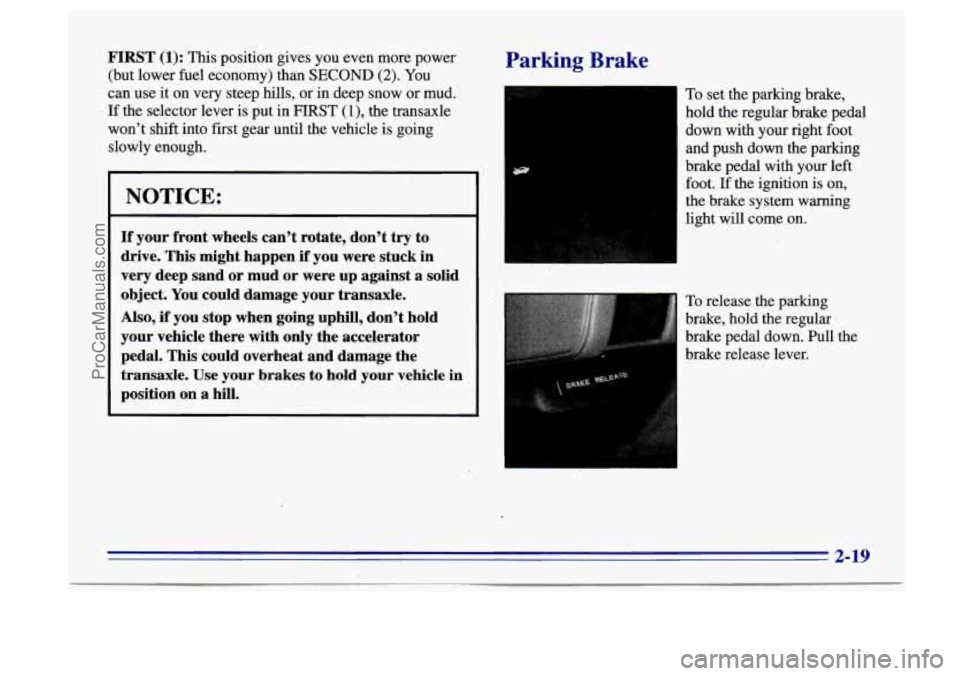
FIRST (1): This position gives you even more power
(but lower fuel economy) than
SECOND (2). You
can use it on very steep hills, or in deep snow or mud.
If the selector lever is put in FIRST (I), the transaxle
won’t shift into first gear until the vehicle is going
slowly enough.
NOTICE:
If your front wheels can’t rotate, don’t try to
drive. This might happen if you were stuck in
very deep sand or mud or were up against a solid
object.
You could damage your transaxle.
Also,
if you stop when going uphill, don’t hold
your vehicle there with only the accelerator
pedal. This could overheat and damage the
transaxle. Use your brakes to hold your vehicle in
position on a hill.
Parking Brake
To set the parking brake,
hold the regular brake pedal
down with your right foot
and push down the parking
brake pedal with your left
.foot. If the ignition is on,
the.brake system warning
light will come on.
To release the parking
brake, hold the regular
brake pedal down. Pull the
brake release lever.
2-19
ProCarManuals.com
Page 79 of 340
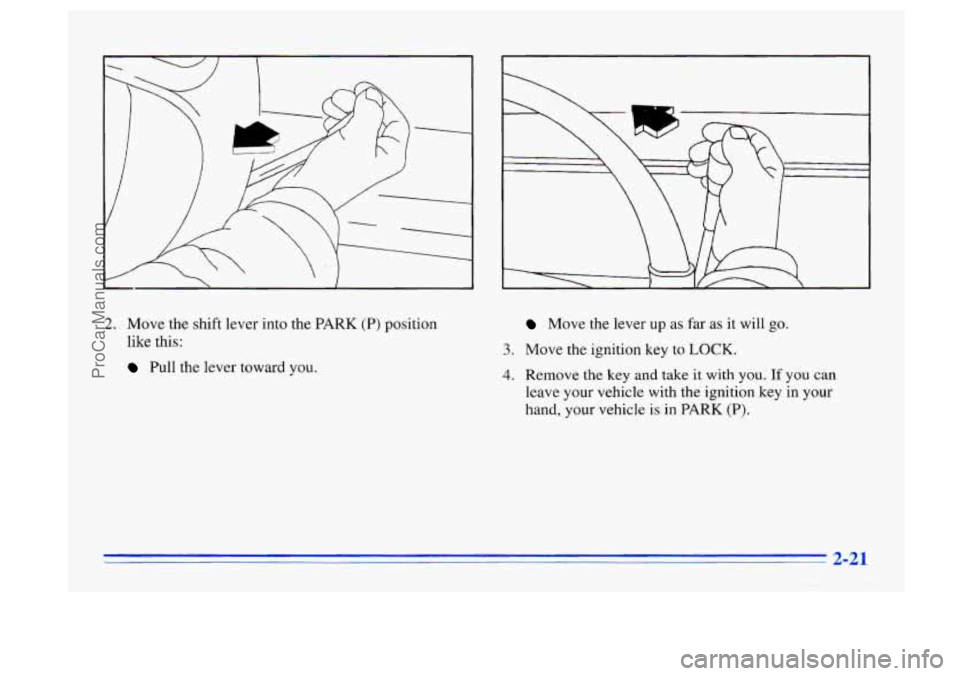
2. Move the shift lever into the PARK (P) position
like this:
Pull the lever toward you.
Move the lever up as far as it will go.
3. Move the ignition key to LOCK.
4. Remove the key and take it with you. If you can
leave your vehicle with the ignition key in your
hand, your vehicle is in
PARK (P).
2-21
ProCarManuals.com
Page 81 of 340
Shifting Out of PARK (P)
Your Buick has a brake-transaxle shift interlock. You
have to
fully apply your regular brake to shift from
PARK (P) when
the ignition is in the RUN position.
See “Automatic Transaxle Operation” in
the Index.
If you cannot shift out of PARK (P), ease pressure on
the shift lever -- push the shift lever all the way into
PARK
(P) as you maintain brake application. Then
move the shift lever into the gear
you want. If you ever
hold the brake pedal down but still can’t shift out
of
PARK (P), try this:
1.
2.
3.
4.
5.
Turn the key to OFF.
Apply and hold the brake until the end of Step 4.
Shift to NEUTRAL (N).
Start the vehicle and then shift to the drive gear
you want.
Have the vehicle fixed as soon
as you can.
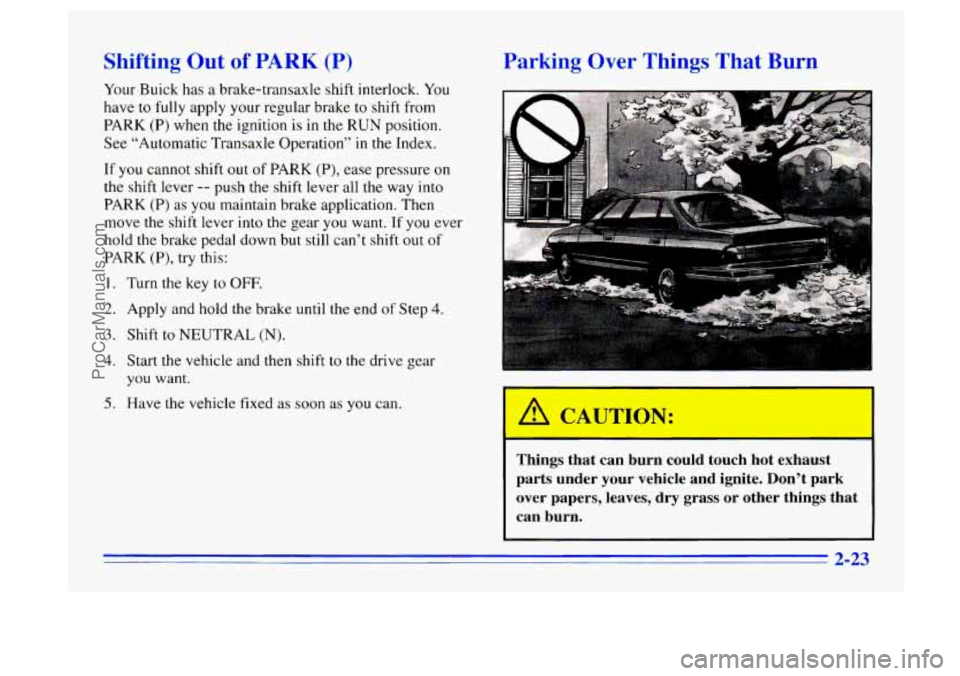
Parking Over Things That Burn
A-
I
CAUTION:
Things that can burn could touch hot exhaust
parts under your vehicle and ignite. Don’t park over papers, leaves, dry grass or other things that
can burn.
2-23
ProCarManuals.com
Page 83 of 340
-
A CAUTION:
It can be dangerous to get out of your vehicle if
the shift lever is not fully in PARK (P) with the
parking brake firmly set. Your vehicle can roll.
Don’t leave your vehicle when the engine
is
running unless you have to. If you’ve left the
engine running, the vehicle can move suddenly.
You or others could be injured.
To be sure your
vehicle won’t move, even when you’re on
fairly
level ground, always set your parking brake and
move the shift lever to PARK
(P).
Follow the proper steps to be sure your vehicle won’t
move. See “Shifting Into
PARK (P)” in the Index.
If you are parking on
a hill and if you’re pulling a
trailer, also see “Towing a Trailer” in the Index.
Windows
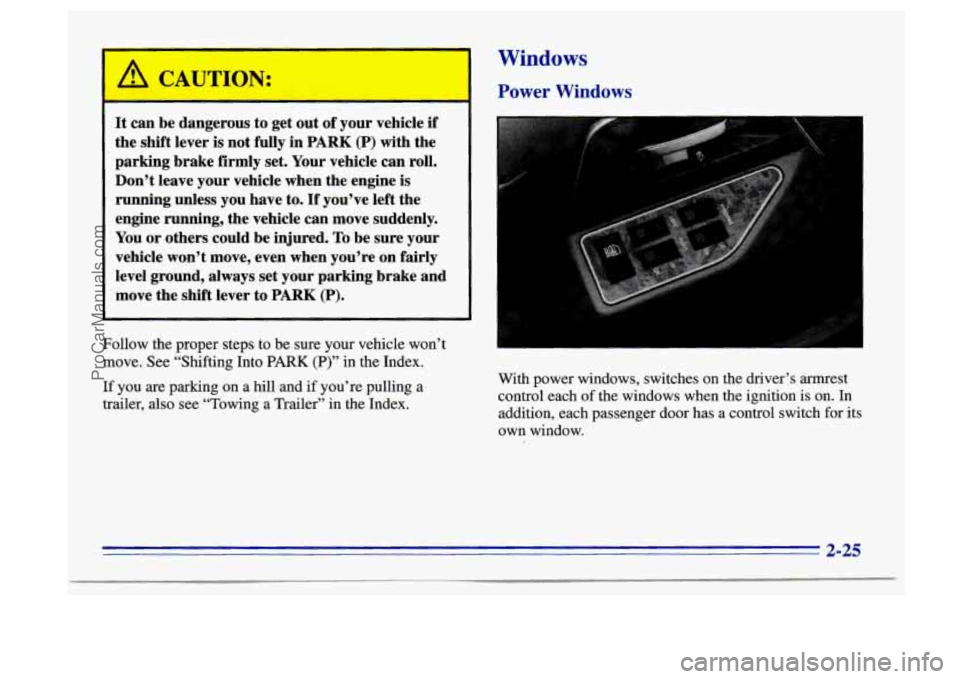
Power Windows
With power windows, switches on the driver’s armrest
control each of the windows when the ignition is on. In
addition, each passenger door has a control switch for its
own window.
2-25
ProCarManuals.com
Page 91 of 340

Passing Another Vehicle While Using Cruise Control
Use the accelerator pedal to increase your speed. When
you take your foot off the pedal, your vehicle will slow
down
to the cruise control speed you set earlier.
Using Cruise Control on Hills
How well your cruise control will work on hills depends
upon your speed, load and the steepness
of the hills.
When going up steep hills, you may have to step
on the
accelerator pedal to maintain your speed. When going
downhill, you may have to brake or shift
to a lower gear
to keep your speed down. Of course, applying the brake
takes you out
of cruise control. Many drivers find this to
be
too much trouble and don’t use cruise control on
steep hills.
Ending Cruise Control
There are two ways to turn off the cruise control:
Step lightly on the brake pedal; or
Move the cruise switch to OFF.
Erasing Cruise Speed Memory
When you turn off the cruise control or the ignition,
your cruise control set speed memory is erased.
Lamps
..
li
LtOWtS
0 Headlamps
0 Parking Lamps
0 Sidemarker Lamps
Taillamps
0 License Plate Lamps
0 Instrument Panel Lights
To turn on the headlamps, press the switch with the
lamp symbol.
Press
the switch marked P to turn on the parking lamps.
Press
OFF to turn off all lamps.
2-33
ProCarManuals.com