Page 178 of 354
Driving OR Grades
Reduce speed and shift to a lower gear before you start
down a long
or steep downgrade. If you don’t shift
down,
you might have to use your brakes so much that
they would get hot and no longer work well.
On a long uphill grade, shift down and reduce your
speed to around
45 mph (70 km/h) to reduce the
possibility
of engine and transaxle overheating.
If you have Overdrive,
you may want to drive in
THIRD (3), instead of DRIVE (D).
But if you ever have to park your rig on a hill, here’s
how to
do it:
1. Apply your regular brakes, but don’t shift into
PARK (P) yet.
2. Have someone place chocks under the trailer wheels.
3. When the wheel chocks are in place, release the
regular brakes until the chocks absorb the load.
4. Reapply the regular brakes. Then apply your parking
brake, and then shift to PARK (P).
5. Release the regular brakes.
Parking on Hills
You really should not park your vehicle, with a trailer
attached, on a hill.
If something goes wrong, your rig
could start to move. People can be injured, and both
your vehicle
and the trailer can be damaged.
ProCarManuals.com
Page 179 of 354
When You Are Ready to Leave After
Parking on a Hill
1. Apply your regular brakes and hold the pedal down
while you:
Start your engine;
0 Shift into a gear; and
0 Release the parking brake.
2. Let up on the brake pedal.
3. Drive slowly until the trailer is clear of the chocks.
4. Stop and have someone pick up and store the chocks.
Maintenance When Trailer Towing
Your vehicle will need service more often when you’re
pulling
a trailer. See the Maintenance Schedule for more
on this. Things that are especially important in trailer
operation are automatic transaxle fluid (don’t overfill),
engine oil, belt, cooling system, and brake adjustment.
Each
of these is covered in this manual, and the Index
will help you find them quickly.
If you’re trailering, it’s
a good idea to review these sections before
you start
your trip.
Check periodically to see that all hitch nuts and bolts are
tight.
ProCarManuals.com
Page 182 of 354

2.
3.
Get the vehicles cbse enough so the jumper cables
can reach, but be sure the vehicles aren’t touching
each other.
If they are, it could cause a ground
connection you don’t want. You wouldn’t be able to
start your Pontiac, and the bad grounding could
damage the electrical systems.
You could be injured
if the vehicles roll. Set the
parking brake firmly on each vehicle. Put an
automatic transaxle
in PARK (P) or a manual
transaxle in NEUTRAL
(N).
Turn off the ignition on both vehicles. Turn off all
lamps that aren’t needed, and radios. This will avoid
sparks and help save both batteries. And it could
save your radio!
NOTICE:
If you leave your radio on, it could be badly
damaged.
The repairs wouldn’t be covered by
your warranty.
4.. Open the hoods and locate the batteries.
5. Find the positive (+) and negative (-) terminals on
each battery. Your Pontiac has a remote positive
(+)
jump starting terminal. The terminal is on the same
side
of the engine compartment as your battery. You
should always use the remote positive (+) terminal
instead
of the positive (+) terminal on your battery.
To uncover the remote positive (+) terminal, lift the
red plastic cap.
5-3
ProCarManuals.com
Page 187 of 354
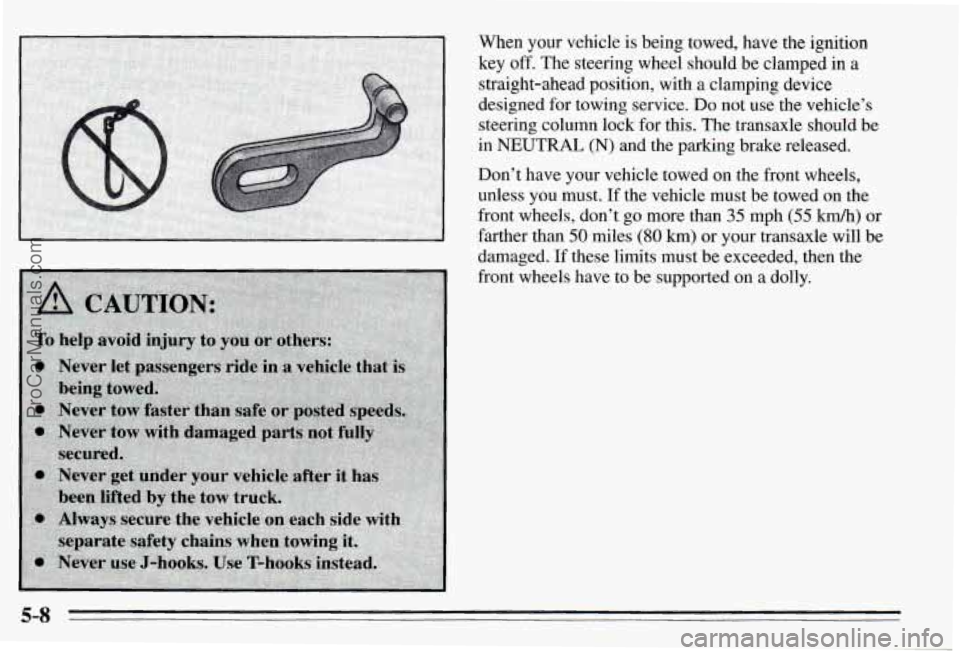
When your vehicle is being towed, have the ignition
key
off. The steering wheel should be clamped in a
straight-ahead position, with
a clamping device
designed for towing service. Do not use the vehicle’s
steering column lock for this. The transaxle should be
in
NEUTRAL (N) and the parking brake released.
Don’t have your vehicle towed
on the front wheels,
unless you must.
If the vehicle must be towed on the
front wheels, don’t
go more than 35 mph (55 km/h) or
farther than
50 miles (80 km) or your transaxle will be
damaged.
If these limits must be exceeded, then the
front wheels have to be supported on a dolly.
5-8
ProCarManuals.com
Page 230 of 354
Wait at least 30 minutes before checking the transaxle
fluid level
if you have been driving:
0 When outside temperatures are above 90°F (32°C).
At high speed for quite a while.
In heavy traffic -- especially in hot weather.
While pulling a trailer.
To get the right reading, the fluid should be at normal
operating temperature, which is 180°F to 200°F
(82°C to 93°C).
Get
the vehicle warmed up by driving about 15 miles (24 km)
when outside temperatures are above 50°F (10°C). If it's
colder
than 50°F ( 1O"C), you may have to drive longer.
To check the fluid level
Park your vehicle on a level place. Keep the engine
With the parking brake applied, place the shift lever
With your foot on the brake pedal, move the shift
running.
in
PARK (P).
lever through each gear range, pausing for about
three seconds in each range. Then, position the shift
lever in PARK
(P).
Let the engine run at idle for three to five minutes. Then, without shutting
off the engine, follow these
steps:
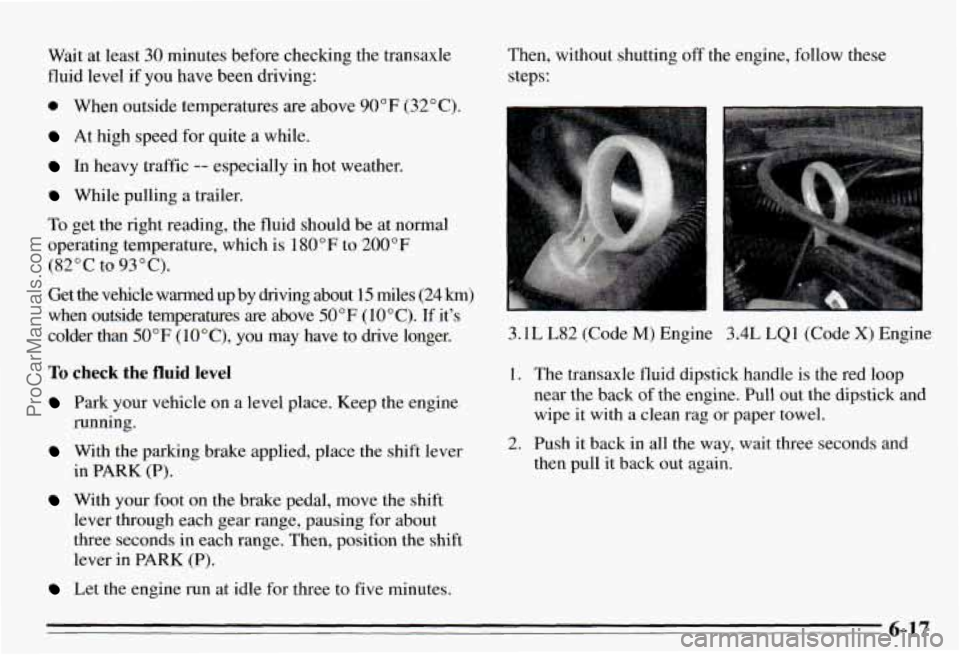
3.1L
L82 (Code M) Engine 3.4L LQl (Code X) Engine
1. The transaxle fluid dipstick handle is the red loop
near the back of the engine. Pull out the dipstick and
wipe
it with a clean rag or paper towel.
2. Push it back in all the way, wait three seconds and
then pull it back out again.
6-17
ProCarManuals.com
Page 294 of 354
I Maintenance Schedule I I
6,000 Miles (10 000 km)
Change engine oil and filter (or every
3 months, whichever occurs first).
An Emission Control Service.
0 Lubricate the shift linkage, parking brake
cable guides, underbody contact points and
linkage
(or every 6 months, whichever
occurs first).
CI Rotate tires. See “Tire Inspection and
Rotation” in the Index
for proper rotation
pattern and additional information.
€
ACTUAL MILEAGE SERVICED BY:
9,000 Miles (15 000 km)
0 Change engine oil and filter (or every
3 months, whichever occurs first).
An Emission Control Sewice.
DATE
SERVICED BY: ACTUAL MILEAGE
-.- - ._ = ~ - . x.-..
7-7
ProCarManuals.com
Page 295 of 354
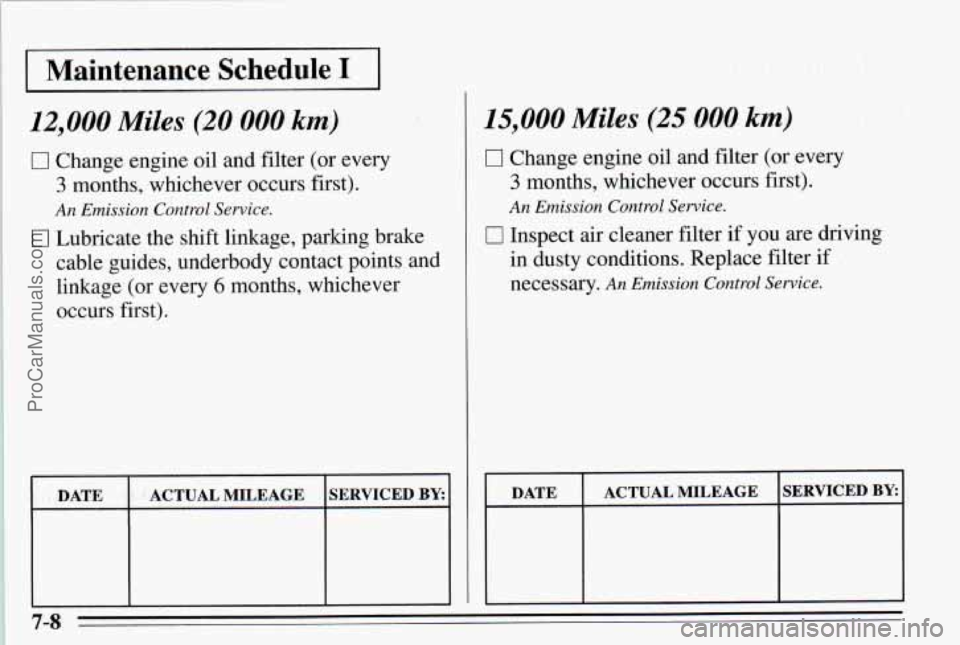
I Maintenance Schedule I I
12,000 Miles (20 000 km)
0 Change engine oil and filter (or every
3 months, whichever occurs first).
An Emission Control Service.
[7 Lubricate the shift linkage, parking brake
cable guides, underbody contact points and
linkage (or every
6 months, whichever
occurs first).
DATE ACTUAL MILEAGE SERVICED BY:
15,000 Miles (25 000 km)
0 Change engine oil and filter (or even
3 months, whichever occurs first).
An Emission Control Service.
0 Inspect air cleaner filter if you are driving
in dusty conditions. Replace filter
if
necessary. An Emission Control Service.
I I i
DATE ACTUAL MILEAGE SERVICED BY:
7-8
ProCarManuals.com
Page 296 of 354
I Maintenance Schedule I I
18,000 Miles (30 000 km)
c] Change engine oil and filter (or every
3 months, whichever occurs first).
An Emission Control Sewice.
0 Lubricate the shift linkage, parking brake
cable guides, underbody contact points and
linkage
(or every 6 months, whichever
occurs first).
0 Rotate tires. See “Tire Inspection and
Rotation” in the Index for proper rotation
pattern and additional information.
DATE
SERVICED BY: ACTUAL MILEAGE
21,000 Miles (35 000 km)
0 Change engine oil and filter (or every
3 months, whichever occurs first).
An Emission Control Sewice.
DATE SERVICED BY: ACTUAL MILEAGE
7-9 ProCarManuals.com

![PONTIAC PONTIAC 1995 Owners Manual I Maintenance Schedule I I
18,000 Miles (30 000 km)
c] Change engine oil and filter (or every
3 months, whichever occurs first).
An Emission Control Sewice.
0 Lubricate the shift linkage, pa](/manual-img/50/58392/w960_58392-295.png "PONTIAC PONTIAC 1995 Owners Manual I Maintenance Schedule I I
18,000 Miles (30 000 km)
c] Change engine oil and filter (or every
3 months, whichever occurs first).
An Emission Control Sewice.
0 Lubricate the shift linkage, pa")