Page 170 of 354
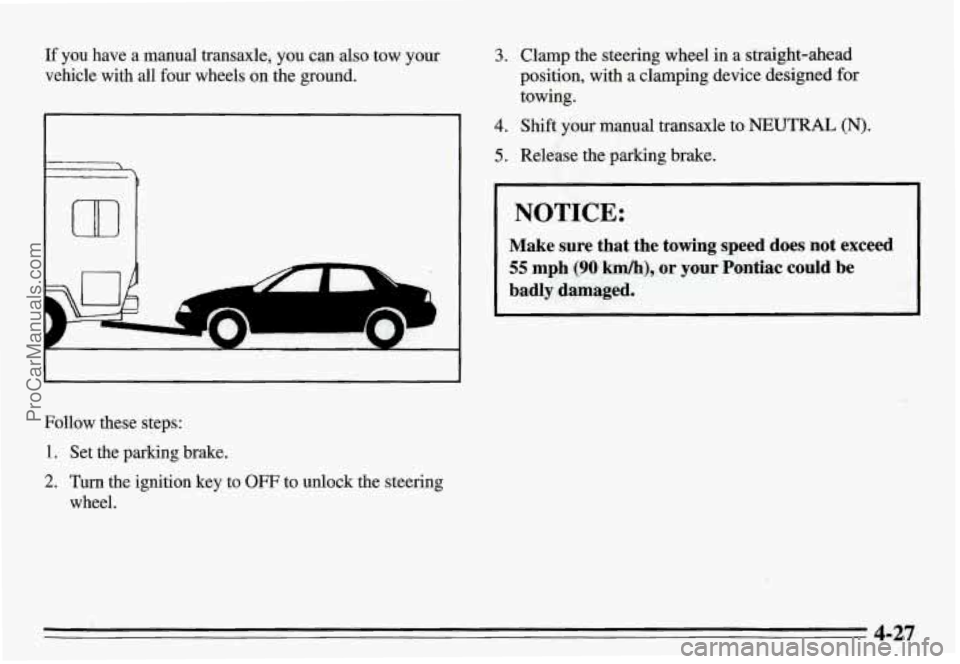
If you have a manual transaxle, you can also tow your
vehicle with all four wheels on the ground.
I
Follow these steps:
1. Set the parking brake.
2. Turn the ignition key to OFF to unlock the steering
wheel.
3. Clamp the steering wheel in a straight-ahead
position, with a clamping device designed
for
towing.
4. Shift your manual transaxle to NEUTRAL IN).
5. Release the parking brake.
NOTICE:
Make sure that the towing speed does not exceed
55 mph (90 km/h), or your Pontiac could be
badly damaged.
4-27
ProCarManuals.com
Page 178 of 354

Following Distance
Stay at least twice as far behind the vehicle ahead as you
would when driving your vehicle without a trailer. This
can help you avoid situations that require heavy braking
and sudden
turns.
Passing
You’ll need more passing distance up ahead when
you’re towing a trailer. And, because you’re
a good deal
longer, you’ll need to go much farther beyond the
passed vehicle before you can return to your lane.
Backing Up
Hold the bottom of the. steering wheel with one hand.
Then, to move the trailer to the left, just move that hand
to
the left. To move the trailer to the right, move your
hand to the right. Always back up slowly and, if
possible, have someone guide
you.
Making ’Ihrns
I
I NOTICE:
Making very sharp turns while trailering could
cause the trailer to come in contact with the
vehicle. Your vehicle could be damaged. Avoid
making very sharp turns while trailering.
I ..
When you’re turning with a trailer, make wider turns than
normal.
Do this so your trailer won’t strike soft shoulders,
curbs, road signs, trees, or other objects. Avoid jerky or
sudden maneuvers. Signal well
in advance.
’Ihrn Signals When Towing a Trailer
When you tow a trailer, your vehicle has to have a
different turn signal flasher and extra wiring. The green
arrows on your instrument panel will flash whenever
you signal a
turn or lane change. Properly hooked up,
the trailer lamps will
also flash, telling other drivers
you’re about
to turn, change lanes or stop.
4-35
ProCarManuals.com
Page 189 of 354
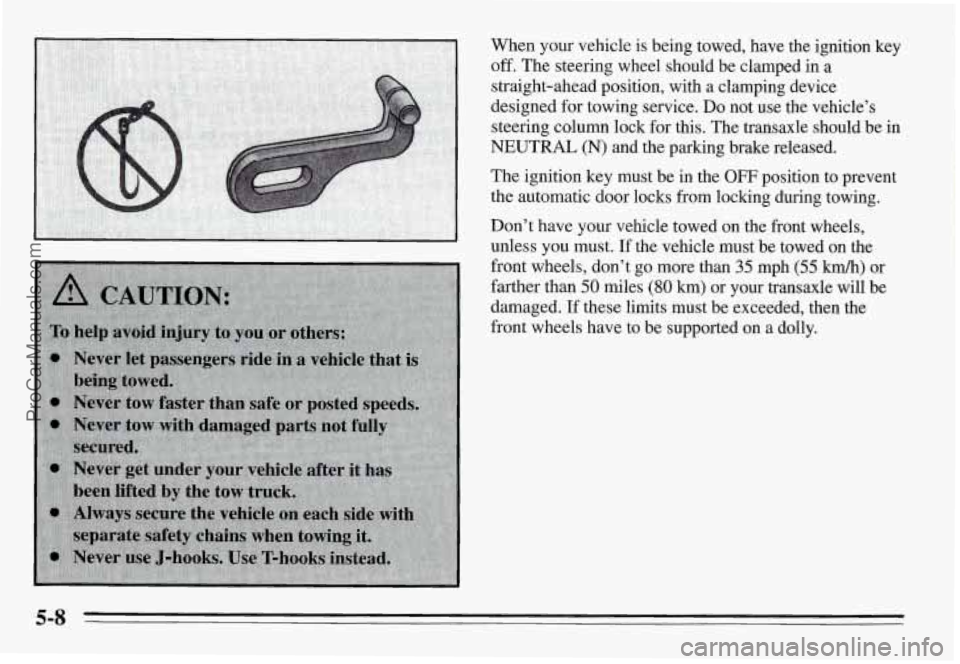
When your vehicle is being towed, have the ignition key
off. The steering wheel should be clamped in a
straight-ahead position, with a clamping device
designed for towing service. Do not use the vehicle’s
steering column lock for this. The transaxle should be in
NEUTRAL (N) and the parking brake released.
The ignition key must be in the OFF position to prevent
the automatic door locks from locking during towing.
Don’t have your vehicle towed on the front wheels,
unless you must.
If the vehicle must be towed on the
front wheels, don’t go more than
35 mph (55 km/h) or
farther than
50 miles (80 km) or your transaxle will be
damaged.
If these limits must be exceeded, then the
front wheels have to be supported on
a dolly.
ProCarManuals.com
Page 202 of 354

If a Tire Goes Flat
It’s unusual for a tire to “blow out’’ while you’re driving,
especially if you maintain your tires properly. If air goes
out of a tire, it’s much more likely to leak out slowly.
But if you should ever have a “blowout,” here
are a few
tips about what to expect and what to do:
If a front tire fails, the flat tire will create a drag that
pulls the vehicle toward that side. Take your foot off the
accelerator pedal and grip the steering wheel firmly.
Steer to maintain lane position, then gently brake to a
stop well out
of the traffic lane.
A rear blowout, particularly on a curve, acts much like a
skid and may require the same correction you’d use in a
skid. In any rear blowout, remove your foot from the
accelerator pedal. Get the vehicle under control by
steering the way you want the vehicle to go.
It may be
very bumpy and noisy, but you can still steer. Gently
brake to a stop, well off the road
if possible.
If a tire goes flat, the next part shows how to use your
jacking equipment to change
a flat tire safely.
Changing a Flat Tire
If a tire goes flat, avoid further tire and wheel damage
by driving slowly to a level place. Turn on your hazard
warning flashers.
5-21
ProCarManuals.com
Page 210 of 354
If You’re Stuck: In Sand, Mud, Ice or
Snow
What you don’t want to do when your vehicle is stuck is
to spin your wheels too fast. The method known as
“rocking” can help you get out when you’re stuck, but
you must use caution.
For information about using tire chains on your vehicle,
see “Tire Chains” in the Index.
I NOTICE: I
Spinning your wheels can destroy parts of your
vehicle
as well as the tires. If you spin the wheels
too fast while shifting your transaxle back and
forth, you can destroy your transaxle.
Rocking your vehicle to get it out
First, turn your steering wheel left and right. That will
clear the area around your front wheels. Then shift back
and forth between REVERSE
(R) and a forward gear
(or with a manual transaxle, between F’IRST
(1) or
SECOND
(2) gear and REVERSE (R)), spinning the
wheels as little as possible. Release the accelerator pedal
while
you shift, and press lightly on the accelerator
pedal when the transaxle is in gear.
If that doesn’t get
you out after a few tries, you
may need to be towed out.
If you do need to be towed out, see “Towing Your
Vehicle” in the Index.
5-29
ProCarManuals.com
Page 220 of 354
2.3L Quad 4 Engine (CODE D)
PO ??
When you open the hood, you'll see:
1.
2.
3.
4.
5.
6.
7.
8.
9.
Engine Oil Dipstick
Automatic Transaxle Dipstick (if equipped)
Brake Fluid Reservoir
Air Cleaner
,? I, 4
Hydraulic Clutch Fluid Reservoir (if so equipped)
Battery
Windshield Washer Huid Reservoir
Power Steering Fluid Reservoir
Engine Oil
Fill Cap
'il.
10. Engine Coolant Surge Tank
6-9
ProCarManuals.com
Page 221 of 354
3.1L V6 Engine (CODE M)
P 9p P
When you open the hood, you’ll see:
1.
2.
3.
4.
5.
6.
7.
8.
9.
Power Steering Fluid Reservoir
Automatic Transaxle Fluid Dipstick
Brake Fluid Reservoir
Air Cleaner
Battery
Windshield Washer Fluid Reservoir
Engine Oil Dipstick
Engine Oil
Fill Cap
Engine Coolant Surge Tank
6-10
ProCarManuals.com
Page 237 of 354
Power Steering Fluid
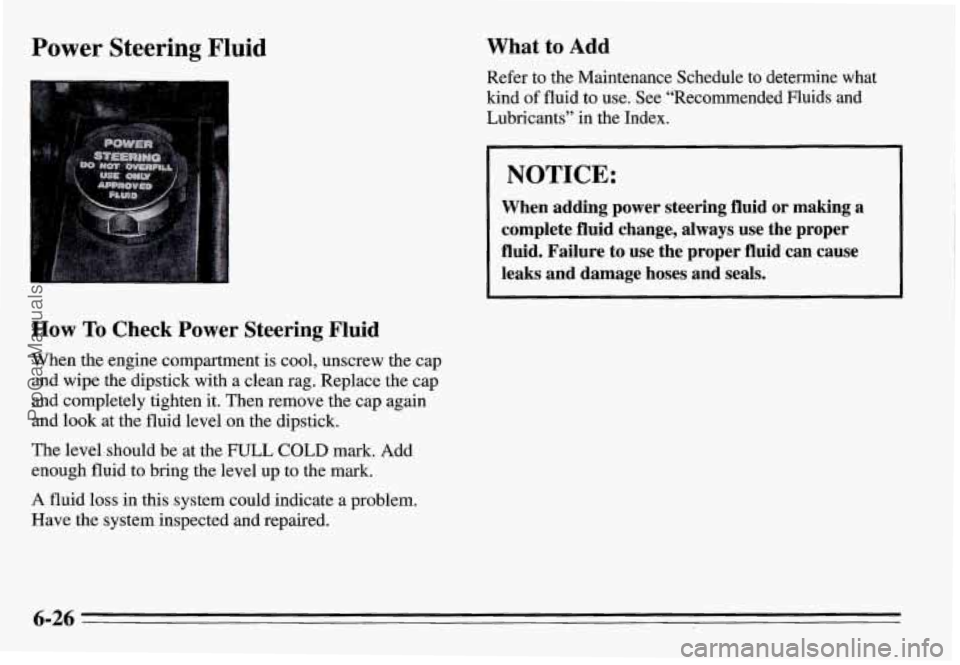
How To Check Power Steering Fluid
When the engine compartment is cool, unscrew the cap
and wipe the dipstick with a clean rag. Replace the cap
and completely tighten it. Then remove the cap again
and look at the fluid level on the dipstick.
The level should be at the FULL COLD mark. Add
enough fluid to bring the level up to the mark.
A fluid loss in this system could indicate a problem.
Have the system inspected and repaired.
What to Add
Refer to the Maintenance Schedule to determine what
kind of fluid to use. See “Recommended Fluids and
Lubricants” in
the Index.
I I
NOTICE:
When adding power steering fluid or making a
complete fluid change, always use the proper
fluid. Failure to use the proper fluid can cause
leaks and damage hoses and seals.
6-26
ProCarManuals.com