Page 6 of 338
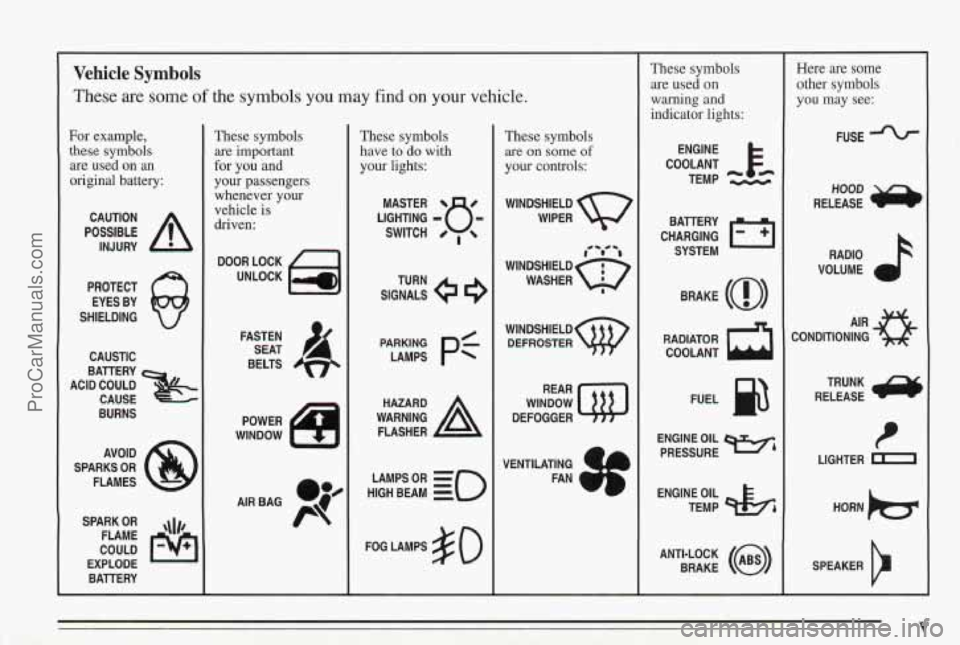
Vehicle Symbols
These are some of the symbols you may find on your vehicle.
For example,
these symbols
are used on
an
original battery:
POSSIBLE A
CAUTION
INJURY
PROTECT EYES BY
SHIELDING
CAUSTIC
ACID COULD BATTERY
CAUSE
BURNS
AVOID
SPARKS
OR
FLAMES
SPARK
OR ,\I/,
COULD FLAME
EXPLODE BAllERY
These symbols are
important
for you and
your passengers
whenever your
vehicle
is
driven:
DOOR LOCK
UNLOCK
FASTEN SEAT
4
BELTS
POWER
WINDNOW
These symbols
have
to do with
your lights:
SIGNALS 9
TURN
HIGH
LAMPSoR BEAM = =o
FOG LAMPS $0
These symbols
are on some of
your controls:
WIPER w
WINDsHIELDw DEFROSTER
WINDOW
DEFOGGER
VENTILATING
4 1
FAN CI
These symbols are used on
warning
and
indicator lights:
COOLANT Fe
TEMP --
ENGINE
CHARGING
I-1
BATTERY SYSTEM
BRAKE
(0)
RADIATOR COOLANT
a
FUEL @
ENGINE OIL
PRESSURE Wb
TEMP OIL 45
ANTI-LOCK (@)
BRAKE
Here are some
other symbols
you may see:
FUSE
RADIO
VOLUME
CONDITIONING
AIR 43
TRUNK
RELEASE
t
LIGHTER n
SPEAKER
V ProCarManuals.com
Page 62 of 338
;ystem tu its higlxevt speed with
>n ECON or VENT. That will
air into
your vehicle. See Vornfo
New Vehicle “Break-In”
NOTICE:
Your modern Pontiac doesn’t need an elaborate
“break-in.” But it will perform better in the long
run if you follow these guidelines:
Don’t drive at any one speed -- fast or slow
-- for the first 500 miles (804 km). Don’t
make full-throttle starts.
Avoid making hard stops for the first 200
miles (322 km) or so. During this time your
new brake linings aren’t yet broken in.
Hard stops with new linings can mean
premature wear and earlier replacement.
Follow this “breaking-in” guideline every
time you get new brake linings.
Don’t tow a trailer during “break-in.” See
“Towing a Trailer’’ in the Index
for more
information.
2-13
ProCarManuals.com
Page 68 of 338
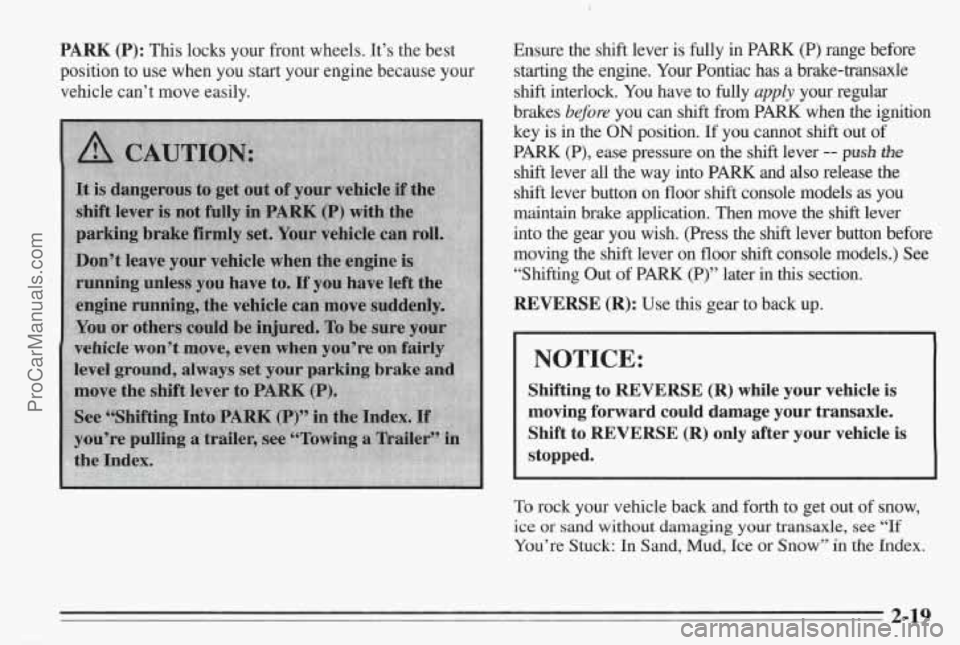
PARK (P): This locks your front wheels. It’s the best
position to use when
you start your engine because your
vehicle can’t move easily. Ensure the shift lever is fully in
PARK (P) range before
starting the engine. Your Pontiac has a brake-transaxle
shift interlock.
You have to fully apply your regular
brakes before you can shift from PARK when the ignition
key is in the
ON position. If you cannot shift out of
PARK (P), ease pressure
on the shift lever -- push t2ze
shift lever all the way into PARK and also release the
shift lever button on floor
shift console models as you
maintain brake application. Then move the shift lever
into the gear you wish. (Press the shift lever button before \
moving the shift lever on floor shift console models.) See
“Shifting Out of PARK (P)” later
in this section.
REVERSE (R): Use this gear to back up.
NOTICE:
Shifting to REVERSE (R) while your vehicle is
moving forward could damage your transaxle.
Shift to REVERSE
(R) only after your vehicle is
stopped.
To rock your vehicle back and forth to get out of snow,
ice or sand without damaging your transaxle, see “If
You’re Stuck: In Sand, Mud, Ice or Snow” in the Index.
2-19
ProCarManuals.com
Page 70 of 338
DRIVE (D): This is like @, but you never go into
OVERDRIVE.
Here are some times you might choose DRIVE (D)
instead of
a:
- When driving on hilly, winding roads
- When towing a trailer, so there is less shifting
between gears
- When going down a steep hill
SECOND (2): This position gives you more power but
lower fuel economy. You can
use SECOND (2) on hills.
It can help control your speed as you go down steep
mountain roads, but then you would also want to use
your brakes off and on.
NOTICE:
Don’t drive in SECOND (2) for more than 5
miles (8 km), or at speeds over 55 mph (88 km/h),
or you can damage your transaxle. Use
@ or
DRIVE (D) as much as possible.
Don’t shift into SECOND
(2) unless you are going
slower than
65 mph (105 kd), or you can
damage your engine. FIRST
(1): This
position gives you even more power
(but lower fuel economy) than SECOND
(2). You can
use it on very steep hills, or in deep snow or mud.
If the
selector lever is put in FIRST (l), the transaxle won’t
shift into first gear until
the vehicle is going slowly
enough.
NOTICE:
If your front wheels can’t rotate, don’t try to
drive. This might happen
if you were stuck in
very deep sand or mud or were up against
a solid
object. You could damage your transaxle.
Also,
if you stop when going uphill, don’t hold
your vehicle there with only the accelerator
pedal. This could overheat and damage the
transaxle. Use your brakes or shift into PARK (P)
to hold your vehicle in position on a hill.
2-21
ProCarManuals.com
Page 72 of 338
Parking Brake
A
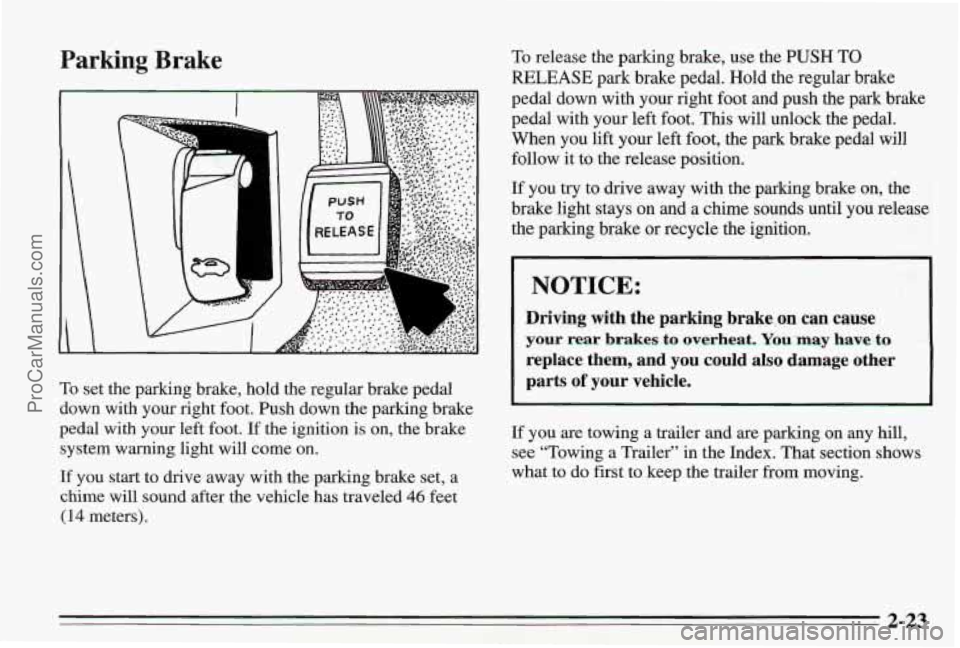
To set the parking brake, hold the regular brake pedal
down with your right foot. Push down the parking brake
pedal with your left foot.
If the ignition is on, the brake
system warning light will come on.
If you start to drive away with the parking brake set, a
chime
will sound after the vehicle has traveled 46 feet
(14 meters). To
release the parking brake, use the
PUSH TO
RELEASE park brake pedal. Hold the regular brake
pedal down with your right foot and push
the park brake
pedal with your left foot. This will unlock the pedal.
When you lift your left foot, the park brake pedal
will
follow it to the release position.
If you try to drive away with the parking brake on, the
brake light stays on and a chime sounds until you
release
the parking brake or recycle the ignition.
I NOTICE:
Driving with the parking brake,on can cause
your rear brakes to overheat. You may have to
replace them, and you could also damage other
parts
of your vehicle.
If you are towing a trailer and are parking. on any hill,
see “Towing a Trailer” in the Index. That section shows
what to do first to keep the trailer
from moving.
2-23
ProCarManuals.com
Page 73 of 338
Shifting Into PARK (P)
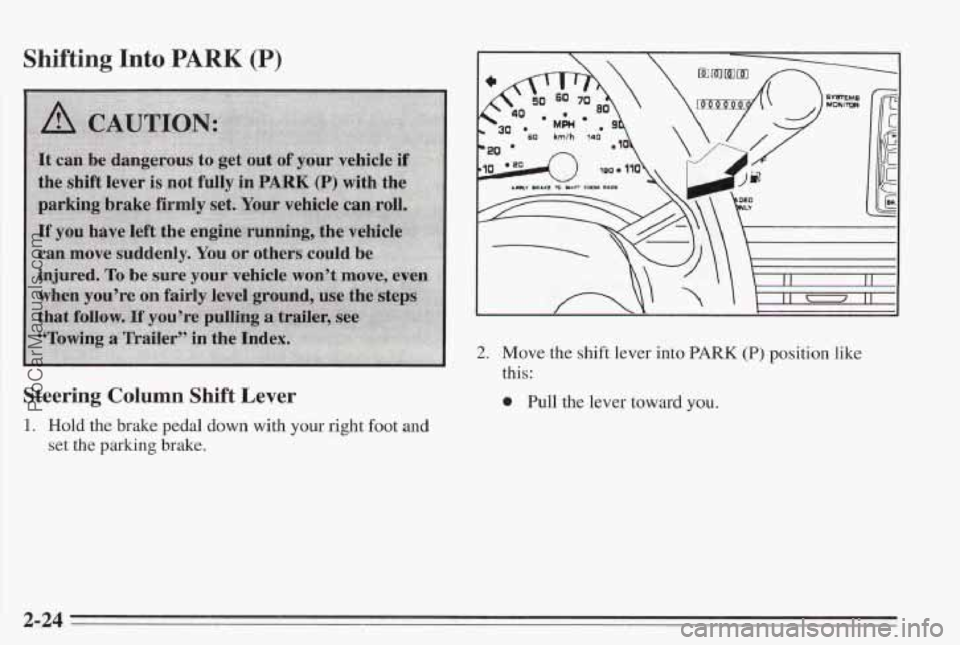
Steering Column Shift Lever
1. Hold the brake pedal down with your right foot and
set the parking brake.
3a '60 km/h 140
II I I1
2. Move the shift lever into PARK (P) position like
this:
0 Pull the lever toward you.
2-24
ProCarManuals.com
Page 74 of 338
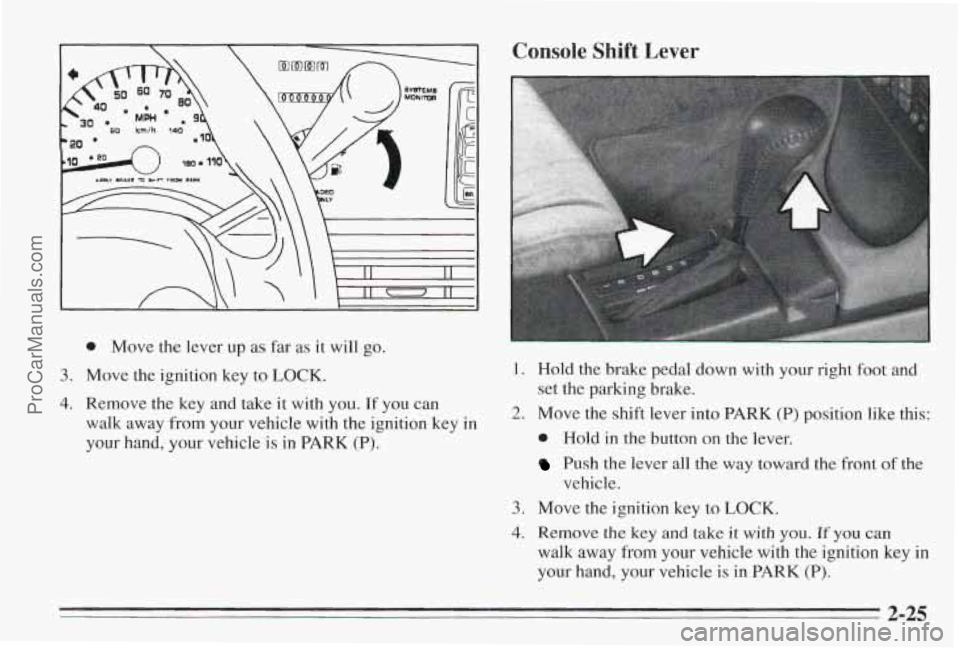
0 Move the lever up as far as it will go.
3. Move the ignition key to LOCK.
4. Remove the key and take it with you. If you can
walk away from your vehicle with the ignition key in
your hand, your vehicle
is in PARK (P).
Console Shift Lever
1. Hold the brake pedal down with your right foot and
2. Move the shift lever into PARK (P) position like this:
set the parking brake.
0 Hold
in the button on the lever.
Push the lever all the way toward the front of the
vehicle.
3. Move the ignition key to LOCK.
4. Remove the key and take it with you. If you can
walk away from your vehicle with the ignition key in
your hand, your vehicle is in PARK (P).
2-25
ProCarManuals.com
Page 75 of 338
Leaving Your Vehicle With the Engine
Running
If yon have to leave your vehicle with the engine
running,
be sure your vehicle is in PARK (P) and your
parking bralae is fdy set before you leave it. After
you’ve moved the shift lever into the PARK (I?)
position, hold the regular brake pedal down. Then, see if
you can muve the shift lever away from PARK (P)
without first pulling it tow& you (or, if you have the
console shift lever, without first pushing.the button). If
yuu c-an, it mema that the shift lever- w&snB t fully locked
into PARK (P).
Torque Lock
If you are parking on a hill and you don’t shift your
transaxle into
PARK (P) properly, the weight of the
vehicle may put too much force on the
parking pawl in
the transaxle. You may find it difficult to pull the shift
lever out
of PARK (P). This is called “torque lock.” To
prevent torque lock, set the parking brake and then shift
into
PARK (P) properly before you leave the driver’s
seat.
To find out how, see “Shifting Into PARK (P)” in
the Index.
When
you are ready to drive, move the shift lever out of
PARK
(P) before you release the parking brake.
If “torque lock” does occur, you may need to have
another vehicle
push yours a little uphill to take some of
the pressure from the transaxle. so you can pull the shift
lever out of PARK (P).
2-26
ProCarManuals.com