Page 152 of 390
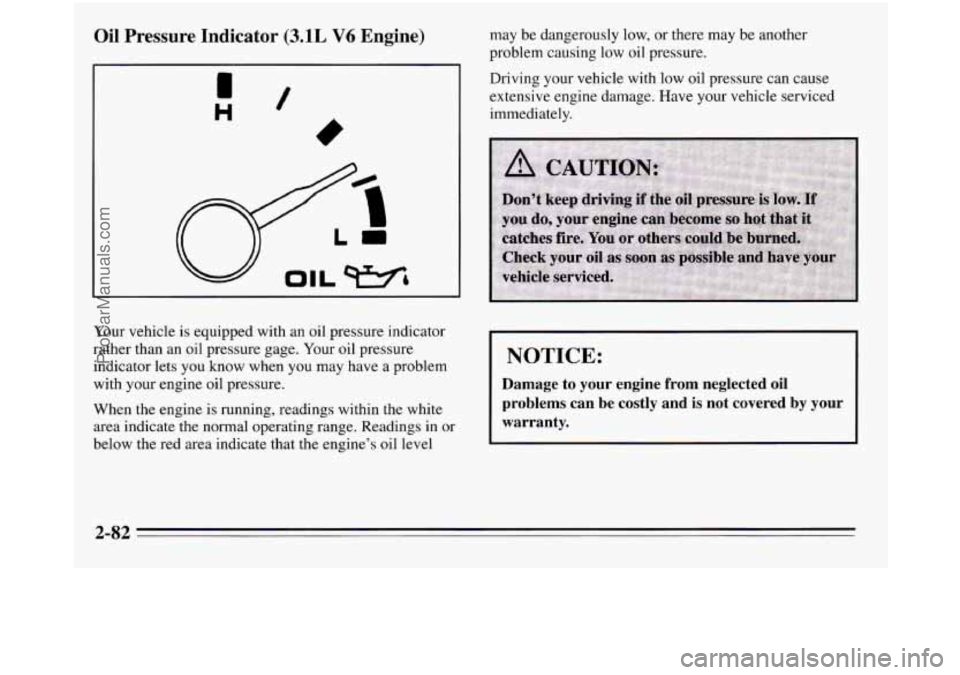
Oil Pressure Indicator (3.1L V6 Engine)
H /
Your vehicle is equipped with an oil pressure indicator
rather than an oil pressure gage. Your oil pressure
indicator lets you know when
you may have a problem
with your engine oil pressure.
When the engine is running, readings within the white
area indicate the normal operating range. Readings
in or
below the red area indicate that the engine’s oil level may
be dangerously low, or there may be another
problem causing low oil pressure.
Driving your vehicle with low oil pressure can cause
extensive engine damage. Have your vehicle serviced
immediately.
I NOTICE:
Damage to your engine from neglected oil
problems can be costly and is not covered by your
warranty.
2-82
ProCarManuals.com
Page 153 of 390
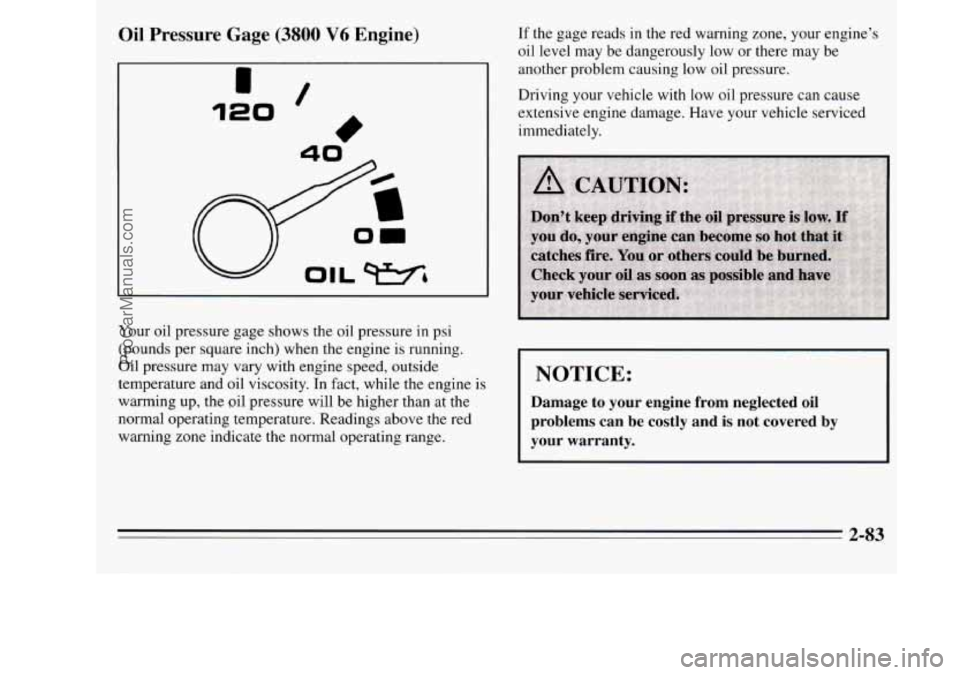
Oil Pressure Gage (3800 V6 Engine)
120 '/
40-
If the gage reads in the red warning zone, your engine's
oil level may be dangerously low or there may be
another problem causing low oil pressure.
Driving your vehicle with low
oil pressure can cause
extensive engine damage. Have your vehicle serviced
immediately.
Your oil pressure gage shows the oil pressure in psi
(pounds per square inch) when the engine is running.
Oil pressure may vary with engine speed, outside
temperature and oil viscosity. In fact, while the engine is
warming up, the oil pressure will be higher than at the
normal operating temperature. Readings above the red
warning zone indicate the normal operating range.
I
I NOTICE:
Damage to your engine from neglected oil
problems can be costly and is not covered by
your warranty.
2-83
ProCarManuals.com
Page 155 of 390
If you manually slam the power sliding door shut when
the ignition is on, the power sliding door warning light
may come on and stay on.
To turn the light off, reopen
and close the
door using either power door switch, or
manually open and close the door again more slowly.
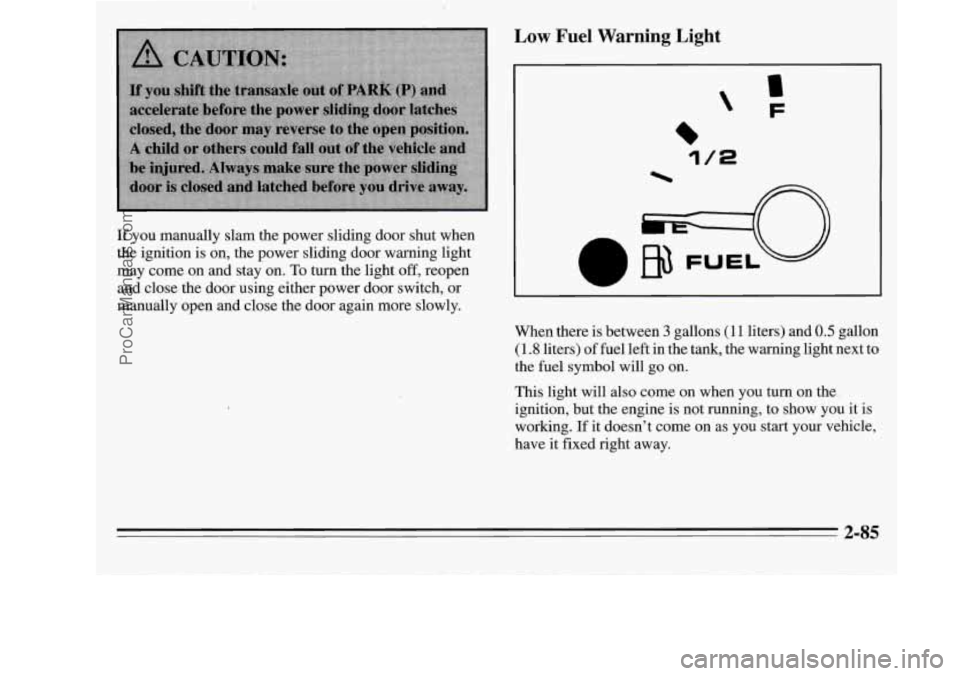
Low Fuel Warning Light
L
F
When there is between 3 gallons (1 1 liters) and 0.5 gallon
(1.8 liters) of fuel left in the tank, the warning light next to
the fuel symbol will go on.
This light will also come on when you turn on the,
ignition, but the engine is not running, to show you
it is
working. If it doesn’t come on as you start your vehicle,
have it fixed right away.
2-85
ProCarManuals.com
Page 159 of 390
Section 3 Comfort Controls and Audio Systems
Q
~
In this section you’ll find out how to operate the comfort
control systems and audio systems offered with your
Oldsmobile. Be sure to read about the particular system
supplied with your vehicle.
Zllimate Control System
COOL /st /--- I WARM --
Your vehicle’s heater and air conditioner work best if
you keep your windows closed. Your vehicle also has
flow-through ventilation, described later in this section,
to bring outside air into your vehicle.
If you have the optional coolant heater and use it during
cold weather,
0°F (- 1 8 “C) or lower, your heating
system will provide heat more quickly because the
engine coolant is already warmed. See “Engine Coolant
Heater”
in the Index.
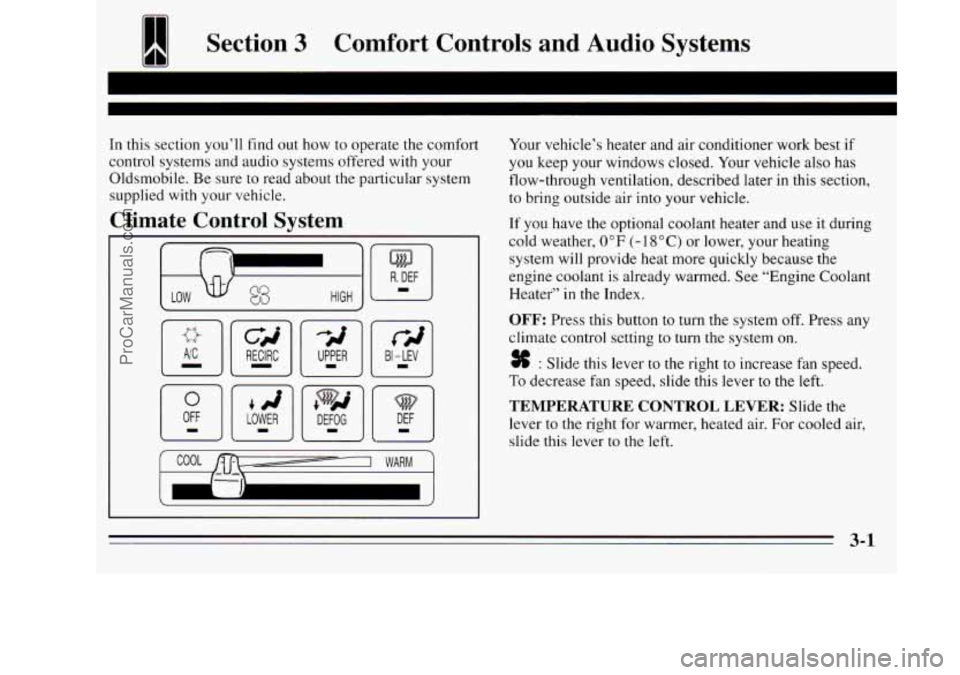
OFF: Press this button to turn the system off. Press any
climate control setting to turn the system on.
* : Slide this lever to the right to increase fan speed.
To decrease fan speed, slide this lever to the left.
TEMPERATURE CONTROL LEVER: Slide the
lever to the right for warmer, heated air. For cooled air,
slide this lever
to the left.
ProCarManuals.com
Page 160 of 390
Air Conditioner
When the temperature outside is above freezing, the air
conditioner compressor will automatically condition the air when you press RECIRC (the A/C indicator light will glow),
DEFOG or DEF (the A/C indicator light will not glow).
Press A/C (the
A/C indicator light will glow) to condition
the air when you press UPPER, BI-LEV or
LOWER. To
turn off the air conditioner compressor
in these settings,
press A/C again (the indicator light will go off).
Each time
you turn on the ignition, the air conditioner
will default
to the setting you had selected before last
turning off the ignition.
When the air conditioner compressor is
on, you may
sometimes notice slight changes in your vehicle’s engine
performance and power. This
is normal. The system is
designed to help fuel economy while
it maintains the
desired cooling level.
The air conditioner removes moisture from the air,
so
you may sometimes notice water dripping from under
your vehicle when it is idling or after it has been turned
off. This is normal.
On very hot days,
your vehicle will cool down more
quickly and economically if you open the windows long
enough
to let hot, inside air escape. For all settings, adjust
the temperature control lever and fan speed as desired.
Directional Controls
RECIRC: Press to get maximum cooling or quick
cool-down
on very hot days. This setting recirculates
much of the air inside your vehicle. It should not be
used for long periods
of time because the air may
become too cold and dry.
Slide the temperature control lever down to the coolest
setting and adjust the fan speed as desired.
UPPER: For normal cooling on hot days, press A/C
along with UPPER. This setting cools outside air and
directs it through the instrument panel outlets. Adjust
the temperature of the air with the temperature control
lever.
BI-LEV: This setting is designed for use on sunny days
when the air is only moderately warm or cool. On days
like these, the sun may adequately warm your upper
body, but your lower body may
not be warm enough.
The BI-LEV setting directs outside air into your vehicle
in two ways. Cooler air is directed toward your upper
body through the front instrument panel outlets, while
warmed air is directed through the heater ducts at your
feet. At times this temperature difference may be more
apparent than others. For best results, slide the
temperature control lever to the middle position, and
then adjust for comfort.
3-2
ProCarManuals.com
Page 179 of 390
adjusting the volume control on your radio to a safe
sound level before your hearing adapts to
it.
To help avoid hearing loss or damage:
1. Adjust the volume control
to the lowest setting.
2. Increase the volume slowly until you can hear
comfortably and clearly.
I NOTICE:
Before you add any sound equipment to your
vehicle
-- like a tape player, CB radio, mobile
telephone or two-way radio
-- be sure you can
add what you want.
If you can, it’s very
important to do it properly. Added sound equipment may interfere with the operation of
your vehicle’s engine, Delco@ radio
or other
systems, and even damage them. And, your
vehicle’s systems may interfere with the
operation
of sound equipment that has been
added improperly.
Before adding sound equipment, check with your retailer and be sure to check Federal rules
covering mobile radio and telephone units.
Understanding Radio Reception
FM Stereo
FM stereo will give you the best sound, but FM signals
will reach
only about 10 to 40 miles ( 16 to 65 km). Tall
buildings or hills can interfere with
FM signals, causing
the sound
to come and go.
AM The range for most AM stations is greater than for
FM,
especially at night. The longer range, however, can
cause stations to interfere with each other. AM can
also
pick up noise from things like storms and power lines.
To lower this noise, try reducing the treble level.
AM Stereo
Your Delco@ system may be able
to receive C-Quam@
stereo broadcasts. Many AM stations around the country
use C-Quam@
to produce stereo, though some do not.
C-Quam@ is a registered trademark of Motorola, Inc. If
your Delco@ system can get C-Quam@ signals, your
stereo indicator light will come on when
you are
receiving
it.
3-21
ProCarManuals.com
Page 188 of 390
Avoid needless heavy braking. Some people drive in
spurts
-- heavy acceleration followed by heavy
braking
-- rather than keeping pace with traffic. This is a
mistake. Your brakes may not have time to cool between
hard stops. Your brakes will wear out much faster if you
do a lot
of heavy braking. If you keep pace with the
traffic and allow realistic following distances, you will
eliminate
a lot of unnecessary braking. That means
better braking and longer brake life.
If your engine ever stops while you're driving, brake
normally but don't pump your brakes.
If you do, the
pedal may get harder to push down. If your engine
stops, you will
still have some power brake assist. But
you will use it when you brake. Once the power assist is
used up, it may take longer to stop and the brake pedal
will be harder to push.
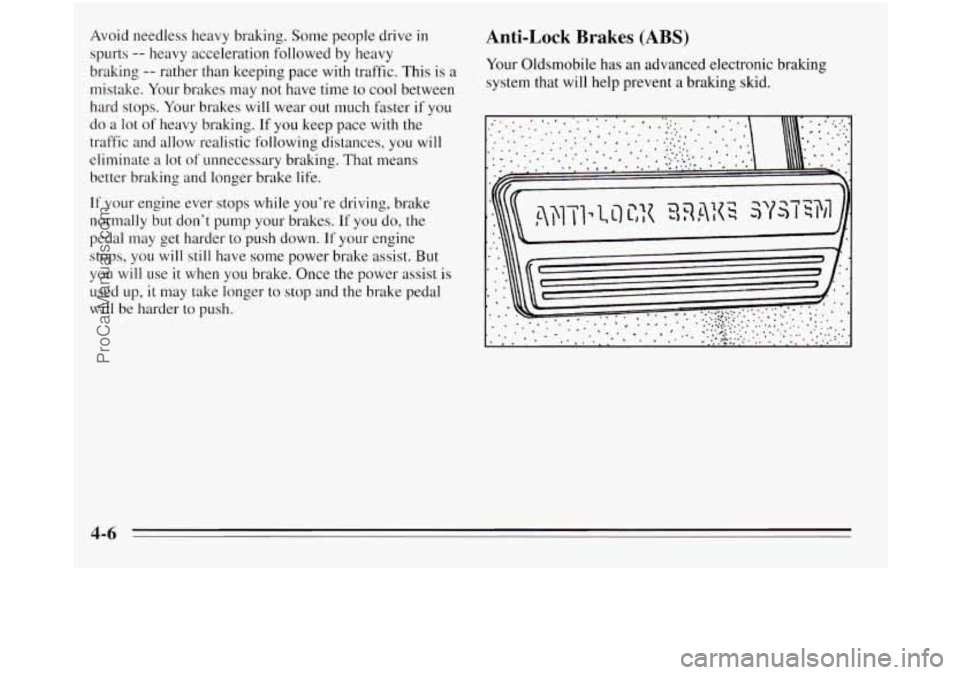
Anti-Lock Brakes (ABS)
Your Oldsmobile has an advanced electronic bralung
system that will help prevent a braking skid.
' * \\\
4-6
ProCarManuals.com
Page 191 of 390
Traction Control System
(Option:
3800 V6 Engine)
Your vehicle may have a traction control system that
limits wheel spin. This is especially useful in slippery
road conditions. The system operates only if it senses
that one or both of the front wheels are spinning or
beginning to lose traction.
When this happens, the system works the front brakes
and reduces engine power to limit wheel spin.
The LOW TRACTION light will come on when your
traction control system is limiting wheel spin. See
“Low Traction Light” in the Index. You may feel the
system working, or you may notice some noise, but this
is normal.
If your vehicle is in cruise control when the traction
control system begins to limit wheel spin, the cruise
control will automatically disengage. When road
conditions allow you
to safely use it again, you may
re-engage the cruise control. (See “Cruise Control” in
the Index.)
TCS
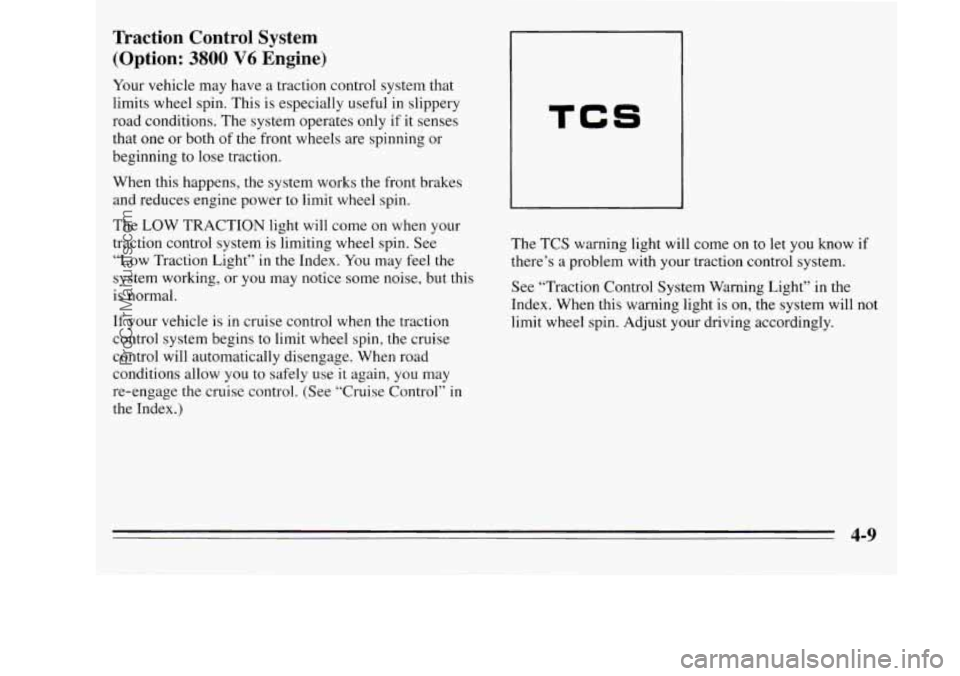
The TCS warning light will come on to let you know if
there’s a problem with your traction control system.
See “Traction Control System Warning Light’’ in the
Index. When this warning light is on, the system will not
limit wheel spin. Adjust your driving accordingly.
4-9
ProCarManuals.com