1995 Oldsmobile Cutlass Supreme key
[x] Cancel search: keyPage 105 of 340
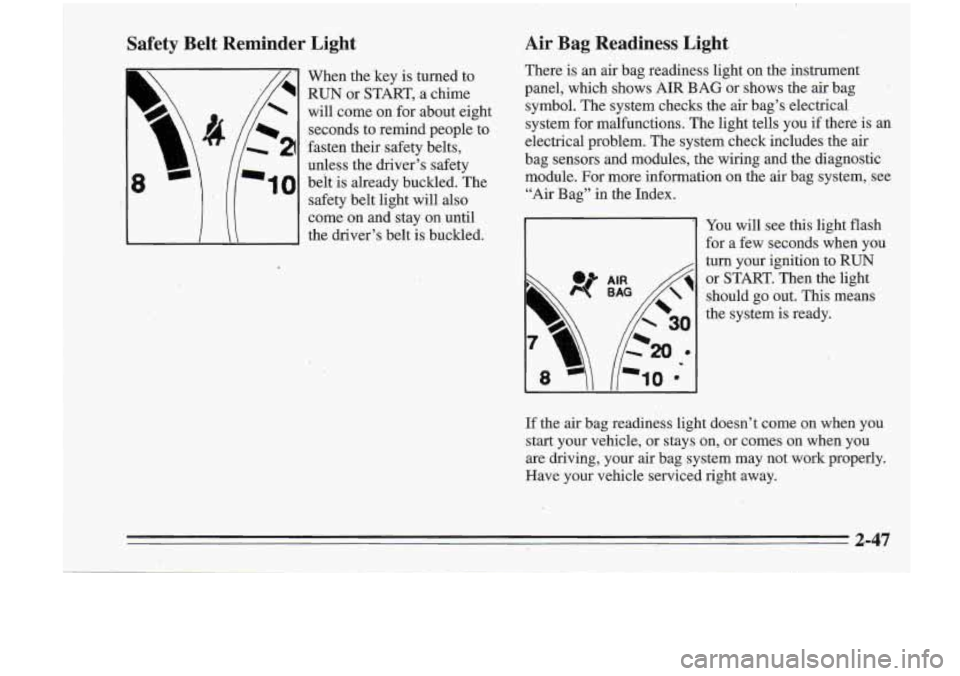
Safety Belt Reminder Light
8 -10
When the’key is turned to
RUN or START, a chime
will come on for about eight
seconds to remind people to
fasten their safety belts,
unless the driver’s safety
belt is already buckled. The
safety belt light Will also
come on and stay on until
the driver’s belt is buckled.
Air Bag Readiness Light
There is an air bag readiness light on the instrument
panel, which shows
i?lIR BAG or shows the air bag
symbol. The system checks the air bag’s electrical
system for malfunctions. The light ‘tells you if there is an
electrical problem. The system check includes the air
bag sensors and modules, the wiring and the diagnostic
module. For more information on the air bag system, ,see
“Air Bag” in the Index.
’ You will see this light flash
for a few seconds when you
turn your ignition to RUN
or START. Then the light
should go out. This means
the system is ready.
If the air bag readiness light doesn’t come on when you
start your vehicle, or stays on, or comes on when you
are driving, your air bag system may not work properly.,
Have your vehicle serviced right away.
2-47
Page 112 of 340
.(I
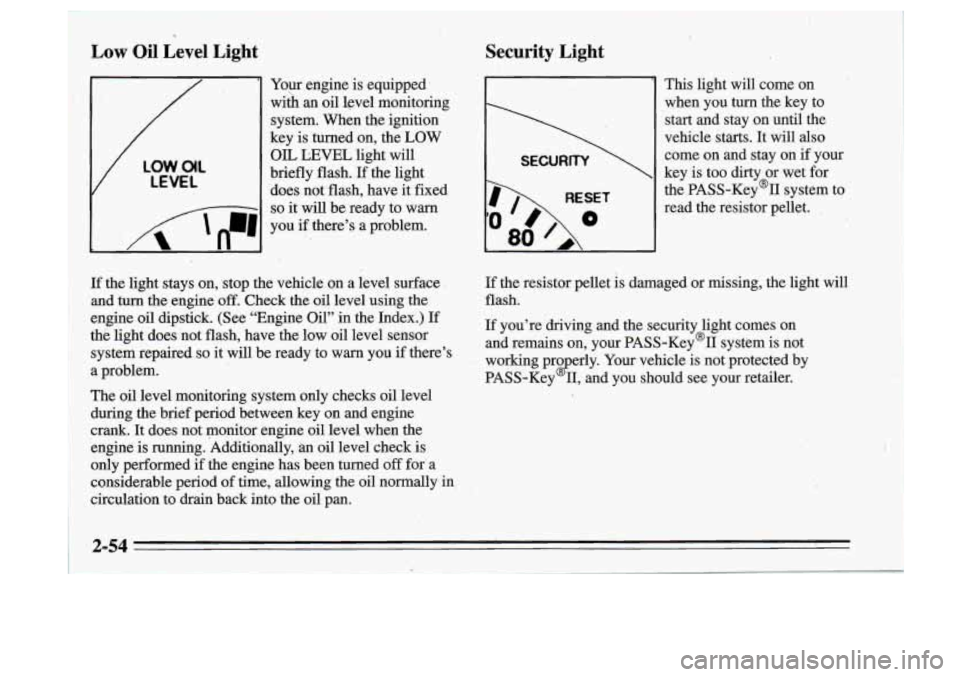
Low Oil Level Light
Your engine is equipped’
wiih
an oil level monitoring
system. When the ignition
key is turned on, the
LOW
V
LOW.O(L
LEVEL
OIL LEVEL light will
briefly flash.
If the light
‘does not flash, have it fixed
I 8 - -1 so it will be ready to warn
I n
I ‘A ‘n-1 , .
you if there’s a problem.
- ..
Security Light
I
RESET
80
This light will come on
when you
turn the key to
start and stay on until the
vehicle starts.
It will also
come on and stay on if your
key is too dirty or wet for
the PASS-Key% system to
read the resistor pellet.
,
If the light stays on,, stop the vehicle on a level surface
and turn the engine
off. Check the oil level using the
engine oil dipstick. (See “Engine Oil” in the Index.) If
thti light does not flash, have
the low oil level sensor
system repaired
so it will be ready to warn you if there’s
a problem.
The
oil level monitoring system only checks oil level
during the brief period between key on and engine
crank. It does not monitor engine oil level when the
engine is running. Additionally,
an oil level check.is
only performed if the engine has been turned
off for- a
considerable period
of time, allowing the oil normally in
circulation to drkn back into the oil pan.
If the resistor pellet is damaged or missing, the light will
flash.
If you’re driving and the security light comes on
and remains on, your PASS-Key’II system is not
working pro erly. Your vehicle is not protected by
PASS-Key
2 11, and you should see your retailer.
2-54
t
Page 113 of 340

Head-Up ,Display (Option)
If you have the Head-Up Display (HUD), you can see
the speedometer reading, in English or metric units,
displayed “through” the windshield.
The HUD
also shows these lights when they are lit on
the instrument panel:
0 Turn Signal Indicators
0 High-Beam Indicator Symbol
Low Fuel Symbol
Oil Warning Symbol
0 Coolant Temperature.Symbo1
Charging System Symbol
I
When you sit straight in your seat, the HUD image will
appear slightly to the right.
When the ignition key is turned to RUN, all possible
HUD images will come on. Then the Head-Up Display
will operate normally.
NOTICE: 1.
Although the HXJD image appears to be near the
front of the vehicle, do not use it as a parking aid. The
.HUD was not designed for that purpose. If
you try to use it that way,-such as in,a parking
lot, you may misjudge distance and run into
something.
J
2-55
. ..
Page 140 of 340
~ ’ Drunken Driving
Death and injury associated with
dnnking and driving is
I a national tragedy.. It’s the number one contributor to the
1 highway death toll, claiming ,thousands of victims every
year.
Alcohol affects four thmgs that anyone needs to drive
a
~ veEcle:
~
Judgment
0 Muscular Coordination
0 Vision
Attentiveness
Police records show-that almost half of all motor
vehicle-related’deaths involve ‘alcohol.
In most cases,
these deaths are the result of someone who was drinking
, ’ and driving. In recent years; some 18,000 annual motor
vehicle-related deaths have been associated with
the use
of alcohol, with more- than
300,000 people injured.
1 Many adults -- by some estimates, nearly half the adult
‘population
-- choose never to drink alcohol, so they
never drive after drinking. For persons under 21, it’s
-against the law in every
U.S. state to drink alcohol.
developmentd reasons for these laws.
i There are good medical, psychological and
,.
The obvious way to solve this highway safety problem
is for people never to drink alcohol and then drive. But
what if people do? How much is “too much” if the
driver plans to drive? It’s a lot less than many might
think. Although it depends on each person and situation,
here is some general information.on the problem.
The Blood Alcohol Concentration (BAC) of someone
who is drinking depends upon four things:
How much alcohol consumed
The drinker’s body weight
0 The amount of food that is consumed before and
during drinking
The length of time it has taken the drinker to
consume the alcohol
According to the American Medical Association, a 180-pound
(82 kg) person who drinks three 12-ounce
(355 ml) bottles of beer in an hour will end up with a
BAC of about
0.06 percent. The,person would reach the
same BAC by drinking three 4-ounce (120 ,ml) glasses
of wine or three mixed drinks if each had 1-1/2 ounces
(45 ml) of a liquor like whiskey, gin or vodka.
, 4-2
Page 173 of 340
I Section 5 Problems on the Road
Here you’ll find what to do about some problems that Your
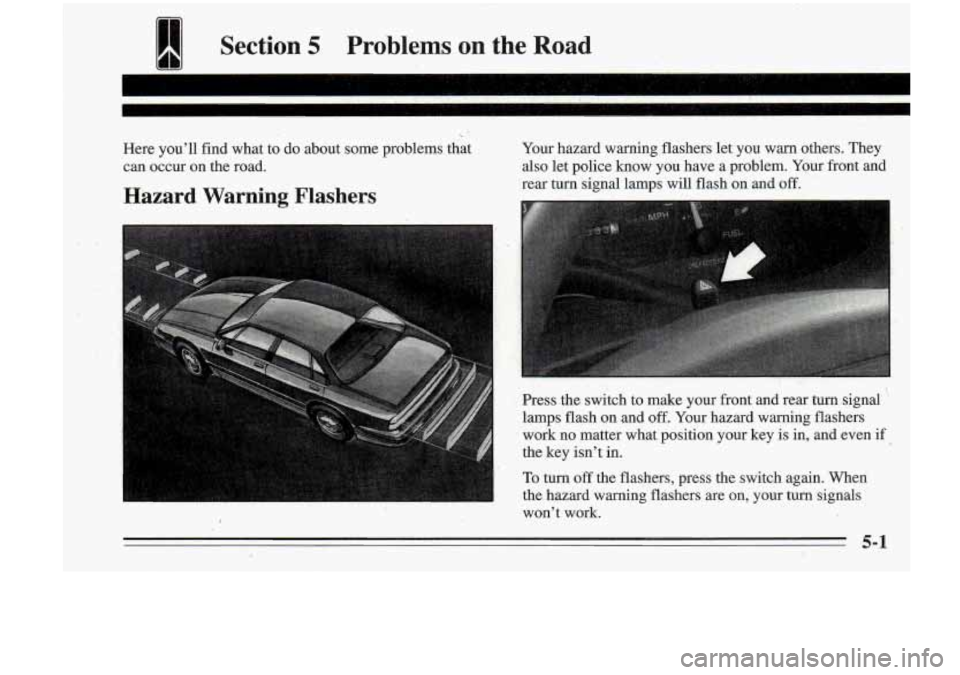
hazard warning flashers let you warn others. They
can occur on the road.
also let police know you have a problem. Your front and
rear turn signal lamps will flash on and
off.
Hazard Warning Flashers
Press the switch to make your front and rear turn si,gnal
lamps flash on and
off. Your hazard warning flashers
work no matter what position your key is in, and even if
the key isn’t in.
To turn
off the flashers, press the switch again. When
the hazard warning flashers are on, your turn signals
I ’won’t work.
5-1 /
Page 180 of 340
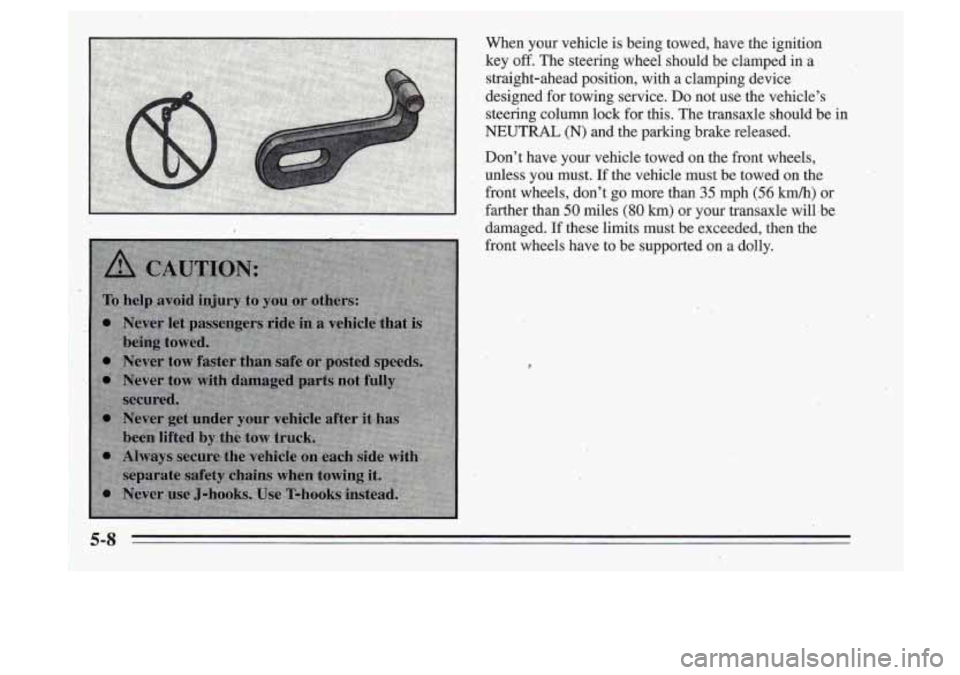
r. ..
When your vehicle is being towed, have the ignition
key
off. The steering wheel should be clamped in a
straight-ahead position, with a clamping device
designed for towing service.
DQ not use the vehicle’s
steering column lock for this. The transaxle should be’in
NEUTRAL (N) and the parking brake released.
Don’,t have your vehicle towed on the front wheels,
unless you must.. If the vehicle ‘must be towed
on the
front wheels, don’t go more
than 35 mph (56 km/h) or
farther than
50 miles (80 km) or your transaxle wilLbe
damaged. If these limits must be exceeded, then the
front wheels have
to be supported on a dolly.
Page 311 of 340
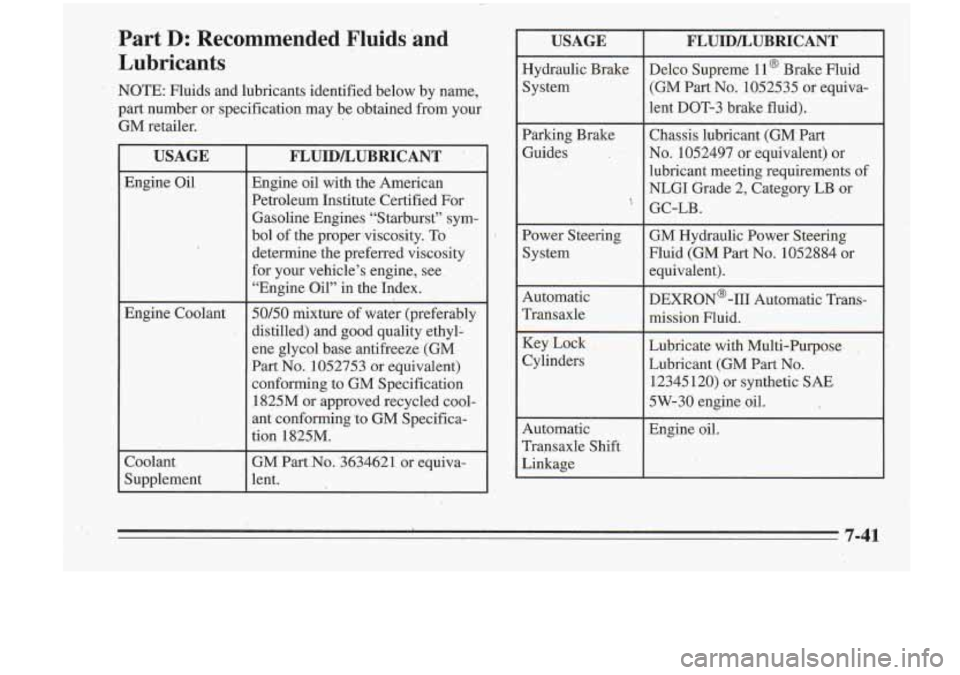
Part D: Recommended Fluids and
Lubricants
NOTE: Fluids and lubricants identified below by name,
part number or specification may be obtained from your
GM retailer.
USAGE
Engine Oil
Engine Coolant
Coolant
Supplement
FLUIDLUBRICANT ’ .
Engine oil with the American
Petroleum Institute Certified For
Gasoline Engines “Starburst” sym-
bol of the proper viscosity.
To
determine the preferred viscosity
for your vehicle’s engine, see
“Engine Oil” in the Index.
50/50 mixture of water (preferably
distilled) and good quality ethyl-
ene glycol base antifreeze (GM
Part No. 1052753 or equivalent)
conforming to GM Specification
I825M or approved recycled cool-
ant conforming
‘to GM Specifica-
tion 1825M.
GM
PartNo. 3634621 or equiva-
lent.
USAGE
Hydraulic Brake
System
Parking Brake Guides
I
Power Steering System
Automatic
Transaxle Key Lock
Cylinders
Automatic
Transaxle Shift
Linkage
FLUIDLUBRICANT
Delco Supreme 11 Brake Fluid
(GM PartNo. 1052535 or equiva-
lent DOT-3 brake fluid).
Chassis lubricant (GM-Part
N.o. 1052497 or equivalent) or
lubricant meeting requirements
of
NLGI Grade 2, Category LB or
GC-LB.
GM Hydraulic Power Steering
Fluid (GM Part
No. 1052884 or
equivalent).
DEXRON’-III Automatic Trans-
mission Fluid.
Lubricate with Multi-Purpose.
,
Lubricant (GM Part No.
1,2345 120) or synthetic SAE
5W-30 engine oil.
Engine oil.
7-41
Page 331 of 340
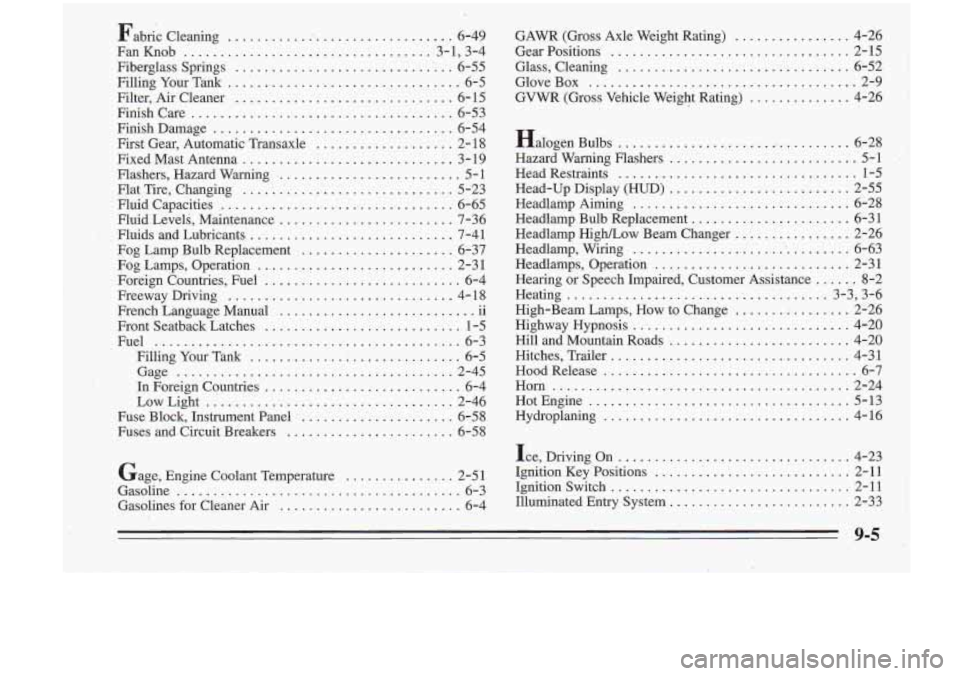
Fib& Cleaning ............................... 6-49
FanKnob
.................................. 3.1. 3.4
Fiberglass Springs
............................... 6-55
Filling Your Tank
... ............................ 6-5
Filter. Air Cleaner
.............................. 6- 15
Finishcare
.................................... 6-53
Finish Damage
................................. 6-54
First Gear. Automatic Transaxle
................... 2-18
FixedMastAntenna
............................. 3-19
Flashers. Hazard Warning
......................... 5-1
Flat Tire. Changing
............................. 5-23
Fluid Capacities
................................ 6-65
Fluid Levels. Maintenance
........................ 7-36
Fluids
and Lubricants ............................ 7-41
Fog Lamp Bulb Replacement
....................... 6-37
Fog -Lamps. Operation
........................... 2-3 1
Foreign Countries. Fuel ....... ................... 6-4
Freeway Driving
............................... 4- 18
French Language Manual
11
Front Seatback Latches ........................... 1-5
Fuel
.......................................... 6-3
Filling Your Tank
............. : ............... 6-5
Gage
...................................... 2-45
In Foreign Countries ........................... 6-4
Fuse Block, Instrument Panel
..................... 6-58
Fuses and-Circuit Breakers
................. ....... 6-58
.. ...........................
LowLight ................................... 2-46 GAWR
(Gross Axle Weight Rating)
................. 4-26
Gear Positions
................................. 2-15
Glass. Cleaning
................................ 6-52
Glove Box
...................................... 2-9
GVWR
(Gross Vehicle Weight Rating) .............. 4-26
Halogen Bulbs
................................. 6-28
Hazard Warning Flashers
.......................... 5-1 .
Head Restraints ................................. 1-3
Head-Up Display
(HUD) ......................... 2-55
Headlamp Aiming
.............................. 6-28
Headlamp Bulb Replacement
...................... 6-31
Headlamp HighLow Beam Changer
................ 2-26
Headlamp. Wiring
............................... 6-63
Headlamps. Operation
........................... 2-31
Hearing or Speech Impaired. Customer Assistance
...... 8-2
Heating
....................................... 3-3., 3-6
High-Beam Lamps. How to Change
....... .. ........ 2-26
Highway Hypnosis
............................... 4-20
Hill and Mountain Roads
......................... 4-20
Hitches, Trailer
................................. 4-31
Hood Release
................................... 6-7
Horn ......................................... 2-24
HotEngine
.................................... 5-13
Hydroplaning
.................................. 4-16
Ice. Driving On
................................ 4-23
Gasoline
....................................... 6-3 Ignition Switch 2-11
Gasolines for Cleaner
Air ......................... 6-4 Illuminated Entry System 2-33
Gage.
Engine Coolant Temperature
............... 2-51 Ignition Key Positions ........................... 2-11
.................................
.........................
9-5
'I