Page 1 of 28

SECTION 1 – 6
47
INSTRUMENTS AND CONTROLS
Comfort adjustment
Front seats48 . . . . . . . . . . . . . . . . . . . . . . . . . . . . . . . . . . . . . . . . . . . . . . .
Trunk storage extension50 . . . . . . . . . . . . . . . . . . . . . . . . . . . . . . . . . . .
Headrests51 . . . . . . . . . . . . . . . . . . . . . . . . . . . . . . . . . . . . . . . . . . . . . . .
Tilt steering wheel51 . . . . . . . . . . . . . . . . . . . . . . . . . . . . . . . . . . . . . . . . .
Outside rear view mirrors52 . . . . . . . . . . . . . . . . . . . . . . . . . . . . . . . . . .
Inside rear view mirror53 . . . . . . . . . . . . . . . . . . . . . . . . . . . . . . . . . . . . .
Seat belts54 . . . . . . . . . . . . . . . . . . . . . . . . . . . . . . . . . . . . . . . . . . . . . . . .
SRS airbags60 . . . . . . . . . . . . . . . . . . . . . . . . . . . . . . . . . . . . . . . . . . . . .
Child restraint66 . . . . . . . . . . . . . . . . . . . . . . . . . . . . . . . . . . . . . . . . . . . .
Page 14 of 28
COMFORT ADJUSTMENT
60
SRS AIRBAGS
The SRS (Supplemental Restraint System) airbags are
designed to provide further protection to the driver and
front passenger when added to the primary protection
provided by the seat belts.
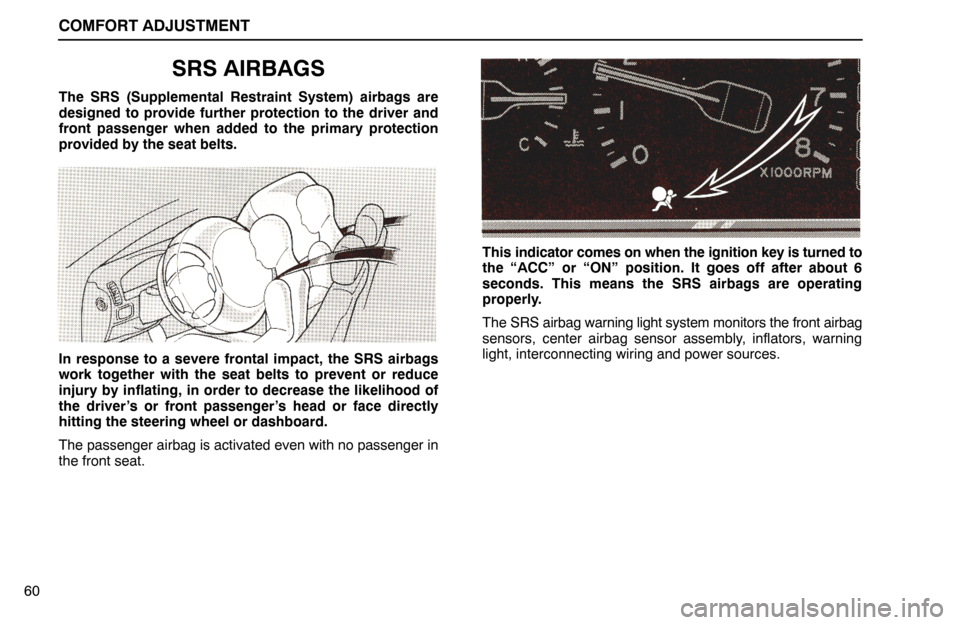
In response to a severe frontal impact, the SRS airbags
work together with the seat belts to prevent or reduce
injury by inflating, in order to decrease the likelihood of
the driver’s or front passenger’s head or face directly
hitting the steering wheel or dashboard.
The passenger airbag is activated even with no passenger in
the front seat.
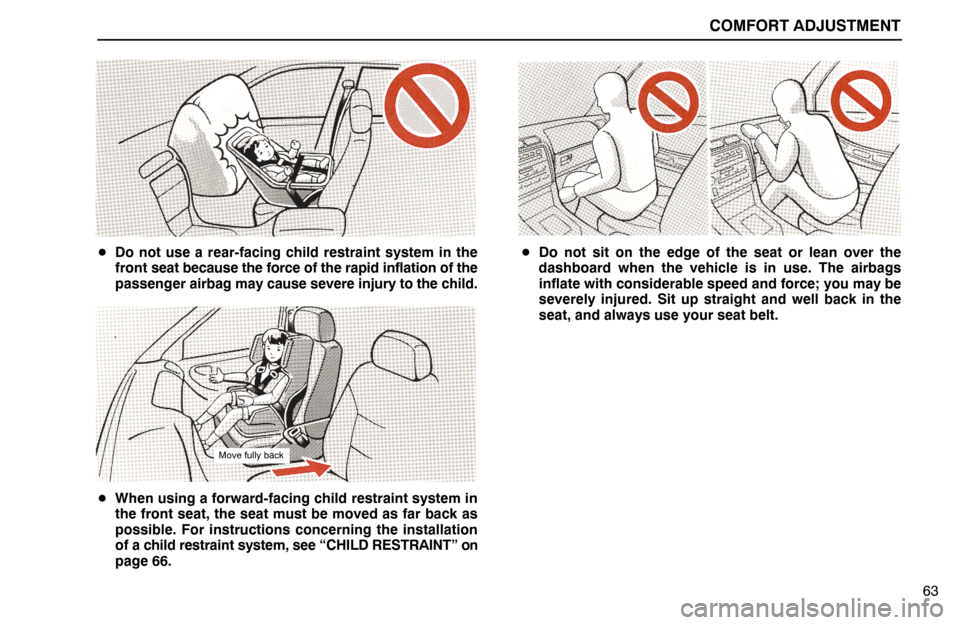
This indicator comes on when the ignition key is turned to
the “ACC” or “ON” position. It goes off after about 6
seconds. This means the SRS airbags are operating
properly.
The SRS airbag warning light system monitors the front airbag
sensors, center airbag sensor assembly, inflators, warning
light, interconnecting wiring and power sources.
Page 15 of 28
COMFORT ADJUSTMENT
61
The SRS airbag system is designed to activate in
response to a severe frontal impact within the shaded area
between the arrows in the illustration.
The SRS airbags will deploy if the severity of the impact is
above the designed threshold level, comparable to an
approximate 20 km / h (14 mph) collision when impacting
straight into a fixed barrier that does not move or deform.
If the severity of the impact is below the above threshold level,
the SRS airbags may not deploy.
However, this threshold velocity will be considerably higher if
the vehicle strikes an object, such as a parked vehicle or sign
pole, which can move or deform on impact, or if it is involved
in an underride collision (a collision in which the nose of the
vehicle “underrides”, or goes under, the bed of a truck).
It is possible with collision severity at the marginal level of
airbag sensor detection and activation that only one of your
vehicle’s two airbags will deploy.
For your safety, be sure to always wear your seat belts.
Collision from the rear
Vehicle roll-overCollision from the side
The SRS airbags are not designed to inflate if the vehicle
is subjected to a side or rear impact, if it rolls over, or if it
is involved in a low-speed frontal collision.
Page 16 of 28
COMFORT ADJUSTMENT
62
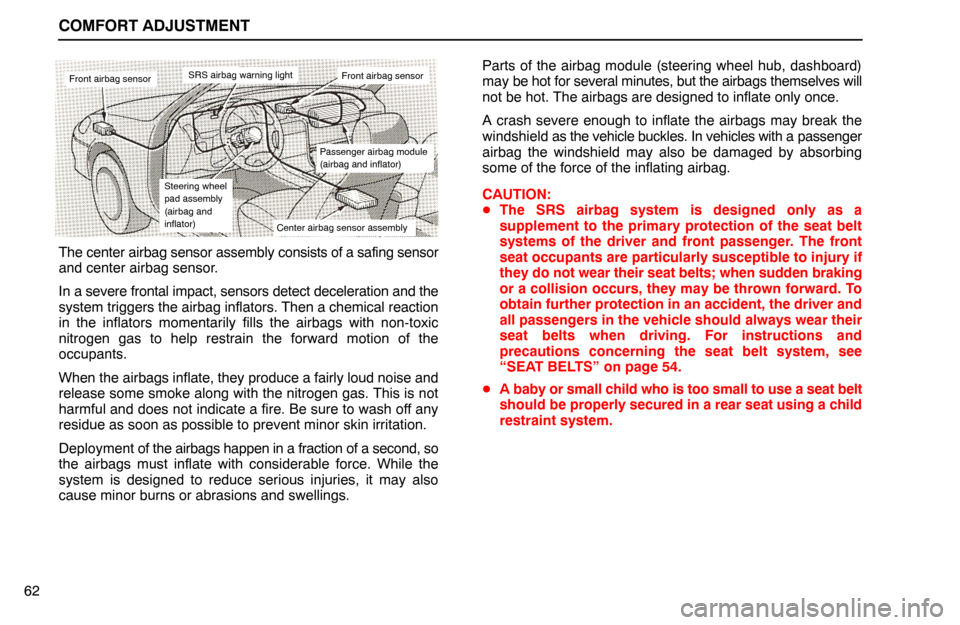
Front airbag sensor
Steering wheel
pad assembly
(airbag and
inflator)
SRS airbag warning light
Passenger airbag module
(airbag and inflator)
Center airbag sensor assembly
Front airbag sensor
The center airbag sensor assembly consists of a safing sensor
and center airbag sensor.
In a severe frontal impact, sensors detect deceleration and the
system triggers the airbag inflators. Then a chemical reaction
in the inflators momentarily fills the airbags with non-toxic
nitrogen gas to help restrain the forward motion of the
occupants.
When the airbags inflate, they produce a fairly loud noise and
release some smoke along with the nitrogen gas. This is not
harmful and does not indicate a fire. Be sure to wash off any
residue as soon as possible to prevent minor skin irritation.
Deployment of the airbags happen in a fraction of a second, so
the airbags must inflate with considerable force. While the
system is designed to reduce serious injuries, it may also
cause minor burns or abrasions and swellings.Parts of the airbag module (steering wheel hub, dashboard)
may be hot for several minutes, but the airbags themselves will
not be hot. The airbags are designed to inflate only once.
A crash severe enough to inflate the airbags may break the
windshield as the vehicle buckles. In vehicles with a passenger
airbag the windshield may also be damaged by absorbing
some of the force of the inflating airbag.
CAUTION:
�The SRS airbag system is designed only as a
supplement to the primary protection of the seat belt
systems of the driver and front passenger. The front
seat occupants are particularly susceptible to injury if
they do not wear their seat belts; when sudden braking
or a collision occurs, they may be thrown forward. To
obtain further protection in an accident, the driver and
all passengers in the vehicle should always wear their
seat belts when driving. For instructions and
precautions concerning the seat belt system, see
“SEAT BELTS” on page 54.
�A baby or small child who is too small to use a seat belt
should be properly secured in a rear seat using a child
restraint system.
Page 17 of 28
COMFORT ADJUSTMENT
63
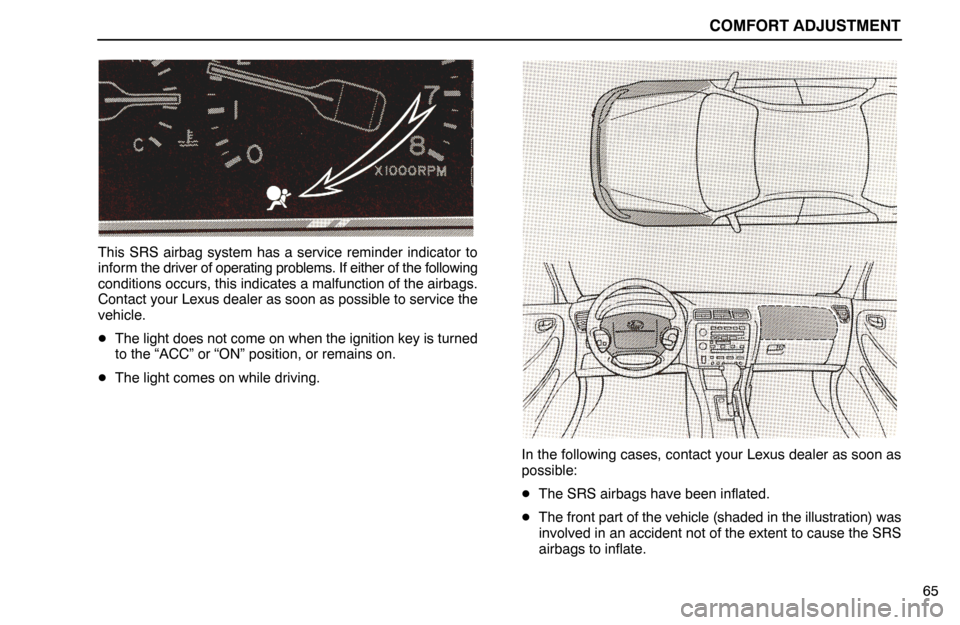
�Do not use a rear-facing child restraint system in the
front seat because the force of the rapid inflation of the
passenger airbag may cause severe injury to the child.
Move fully back
�When using a forward-facing child restraint system in
the front seat, the seat must be moved as far back as
possible. For instructions concerning the installation
of a child restraint system, see “CHILD RESTRAINT” on
page 66.
�Do not sit on the edge of the seat or lean over the
dashboard when the vehicle is in use. The airbags
inflate with considerable speed and force; you may be
severely injured. Sit up straight and well back in the
seat, and always use your seat belt.
Page 18 of 28
COMFORT ADJUSTMENT
64
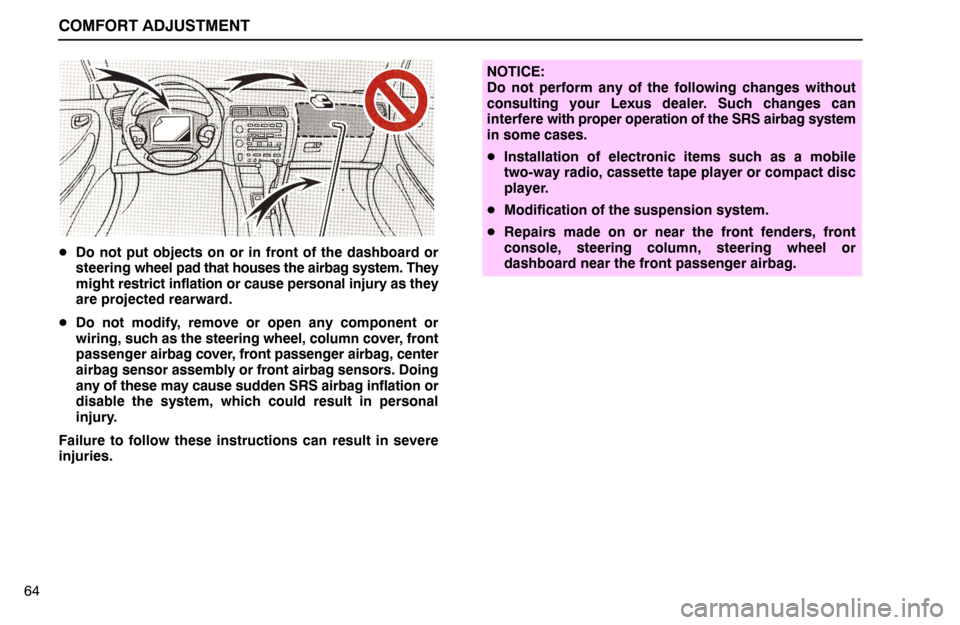
�Do not put objects on or in front of the dashboard or
steering wheel pad that houses the airbag system. They
might restrict inflation or cause personal injury as they
are projected rearward.
�Do not modify, remove or open any component or
wiring, such as the steering wheel, column cover, front
passenger airbag cover, front passenger airbag, center
airbag sensor assembly or front airbag sensors. Doing
any of these may cause sudden SRS airbag inflation or
disable the system, which could result in personal
injury.
Failure to follow these instructions can result in severe
injuries.
NOTICE:
Do not perform any of the following changes without
consulting your Lexus dealer. Such changes can
interfere with proper operation of the SRS airbag system
in some cases.
�Installation of electronic items such as a mobile
two-way radio, cassette tape player or compact disc
player.
�Modification of the suspension system.
�Repairs made on or near the front fenders, front
console, steering column, steering wheel or
dashboard near the front passenger airbag.
Page 19 of 28
COMFORT ADJUSTMENT
65
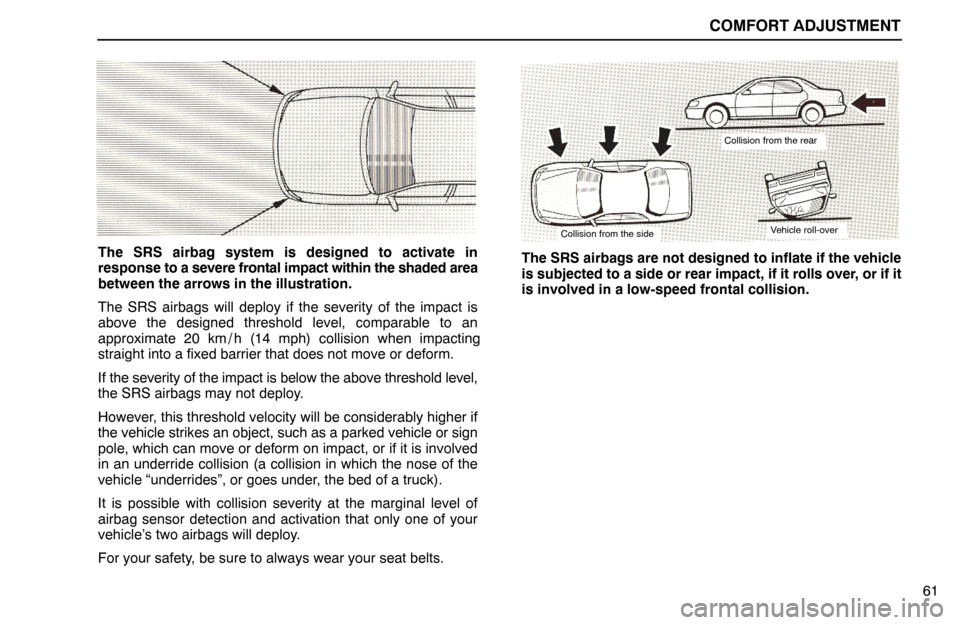
This SRS airbag system has a service reminder indicator to
inform the driver of operating problems. If either of the following
conditions occurs, this indicates a malfunction of the airbags.
Contact your Lexus dealer as soon as possible to service the
vehicle.
�The light does not come on when the ignition key is turned
to the “ACC” or “ON” position, or remains on.
�The light comes on while driving.
In the following cases, contact your Lexus dealer as soon as
possible:
�The SRS airbags have been inflated.
�The front part of the vehicle (shaded in the illustration) was
involved in an accident not of the extent to cause the SRS
airbags to inflate.
Page 20 of 28

COMFORT ADJUSTMENT
66�The pad section of the steering wheel or front passenger
airbag cover (shaded in the illustration) is scratched,
cracked, or otherwise damaged.
CHILD RESTRAINT
Child restraint precautions
Lexus strongly urges the use of child restraint system for
children small enough to use it.
The laws of all fifty states in the U.S.A. and Canada now
require the use of a child restraint system.
CAUTION:
For effective protection in automobile accidents and
sudden stops, children must be properly restrained.
Holding a child in your arms is not a substitute for a child
restraint system. In an accident, the child can be crushed
against the windshield, or between you and the vehicle’s
interior if you are unrestrained.
Child restraint system
A child restraint system for a small child or baby must
itself be restrained on the seat with either the lap belt or
the lap portion of the lap / shoulder belt.
The child restraint system should conform to the size of the
child and properly fit the vehicle seat. For greater safety, the
child restraint system should be installed in the rear seat.
According to accident statistics, children are safer when
properly restrained in the rear seat than in the front seat.
When installing a child restraint system, refer to the
instructions provided by its manufacturer and follow the
directions under the following illustrations.
CAUTION:
After installing the child restraint system, make sure it is
secured in place. If it is not restrained securely, it may
cause injury to the child in the event of a sudden stop or
accident.
When not using the child restraint system, keep it secured with
the seat belt or place it in the trunk or somewhere other than
in the passenger compartment. This will prevent it injuring
passengers in the event of a sudden stop or accident.