1995 HONDA ODYSSEY air condition
[x] Cancel search: air conditionPage 167 of 240
Air Conditioning
Your car's air conditioning is a sealed system. Any major maintenance,
such as recharging, should be done
by
a qualified technician. There are a
couple of things you can do to make sure the air conditioning works
efficiently.
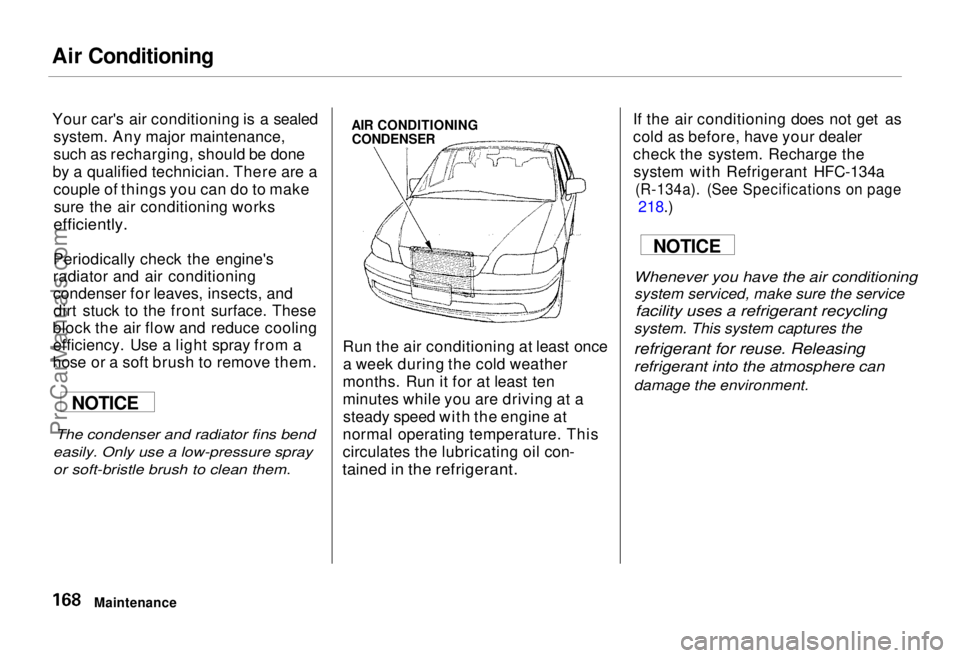
Periodically check the engine's
radiator and air conditioning
condenser for leaves, insects
, and
dirt stuck to the front surface.
These
block the air flow and reduce cooling efficiency. Use a light spray from a
hose or
a soft brush to remove them. Run the air conditioning at least once
a week during the cold weather
months
. Run it for at least ten
minutes while you are driving at a steady speed with the engin
e at
normal operating temperature. This
circulates
the lubricating oil con-
tained in the refrigerant.
If th
e air conditioning does not get as
cold
as before, have your dealer
chec
k the system. Recharge the
syste
m with Refrigerant HFC-134a
(R-134a). (See Specifications on page
218.)
Whenever you have the air conditioning
system. This system captures the
refrigerant for reuse. Releasing
refrigerant into the atmosphere can
damage the environment.
Maintenance
AIR CONDITIONING
CONDENSER
The condenser and radiator fins bend
easily. Only use a low-pressure spray
or soft-bristle brush to clean them.
NOTICE NOTICE
system serviced, make sure the service
facility uses a refrigerant recycling
ProCarManuals.comMain Menu Table of Contents s t
Page 168 of 240
Drive Belts, Tires
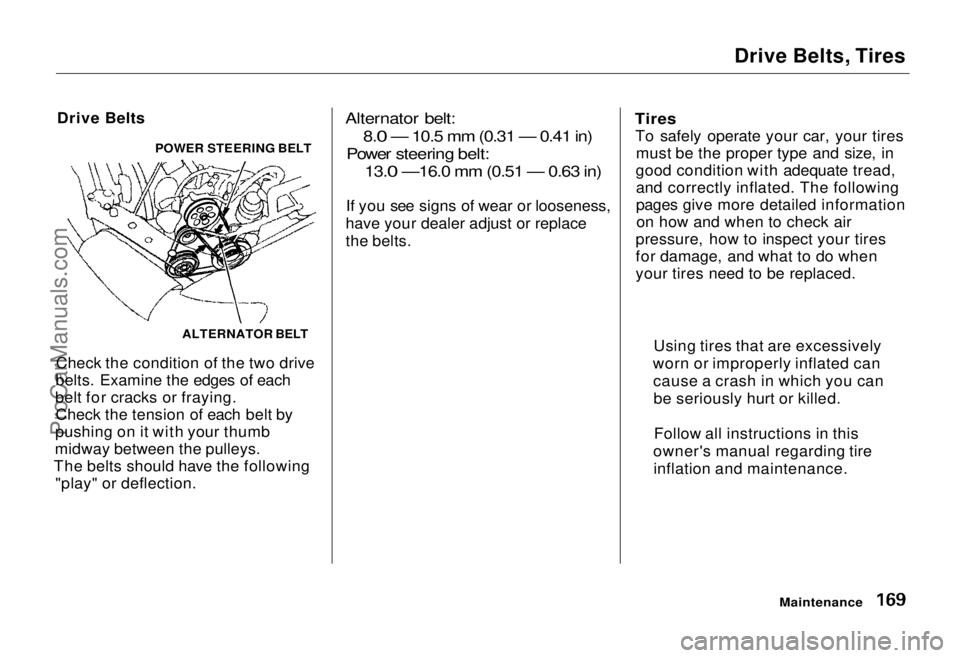
Drive Belts POWER STEERING BELT
Check the condition of the two drive
belts. Examine the edges of each
belt for cracks or fraying. Check the tension of each belt by
pushing on it with your thumb
midway between the pulleys.
The belts should have the following "play" or deflection.
Alternator belt:
8.0 — 10.5 mm (0.31 — 0.41 in)
Power steering belt:
13.0 —16.0 mm (0.51 — 0.63 in)
If you see signs of wear or looseness,
have your dealer adjust or replace
the belts.
Tires
To safely operate your car, your tires must be the proper type and size, in
good condition with adequate tread, and correctly inflated. The following
pages give more detailed informationon how and when to check air
pressure, how to inspect your tires
for damage, and what to do when
your tires need to be replaced.
Maintenance
ALTERNATOR BELT
Using tires that are excessively
worn or improperly inflated can cause a crash in which you canbe seriously hurt or killed.
Follow all instructions in this
owner's manual regarding tire inflation and maintenance.
ProCarManuals.comMain Menu Table of Contents s t
Page 169 of 240
Tires
Inflation
Keeping the tires properly inflated
provides the best combination of
handling, tread life and riding comfort. Underinflated tires wear
unevenly, adversely affect handling
and fuel economy, and are more
likely to fail from being overheated. Overinflated tires can make your car
ride more harshly, are more prone to damage from road hazards, and wear
unevenly.
We recommend that you visually check your tires every clay and use a
gauge to measure the air pressure at
least once a month. If you think a tire
might be low, check it immediately.Remember to check the spare tire at
the same time you check all the
other tires.
Check the pressure in the tires when
they are cold. This means the car
has been parked for at least three
hours. If you have to drive the car
before checking the tire pressure,
the tires can still be considered
"cold" if you drive less than 1.6 km
(1 mile).
If you check the pressure when the
tires are hot (the car has been driven several miles), you will see readings
28 to 41 kPa (0.3 to 0.4 kg/cm2, 4 to
6 psi) higher than the cold reading.
This is normal. Do not let air out to match the specified cold pressure.
The tire will be underinflated.
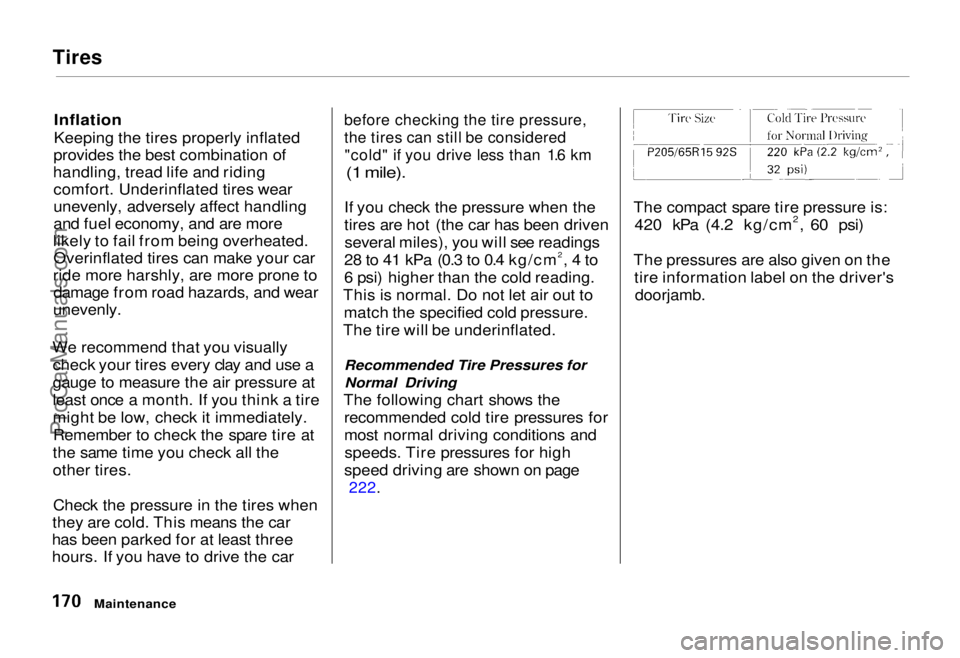
Recommended Tire Pressures forNormal Driving
The following chart shows the recommended cold tire pressures for
most normal driving conditions andspeeds. Tire pressures for high
speed driving are shown on page
222.
The compact spare tire pressure is:
420 kPa (4.2 kg/cm2, 60 psi)
The pressure
s
are also given on the
tire information label on the driver's
doorjamb.
MaintenanceProCarManuals.comMain Menu Table of Contents s t
Page 172 of 240
Tires
It is best to replace all four tires at
the same time. If that is not possible
or necessary, then replace the two
front tires or the two rear tires as a
pair. Replacing just one tire can seriously affect your car's handling.
The ABS works by comparing the speed of the wheels. When replacing
tires, use the same size originally supplied with the car. Tire size and
construction can affect wheel speed
and may cause the system to work in-
consistently. If you ever need to replace a wheel,
make sure the wheel's specifications
match those of the original wheel
that came on your car. Replacement
wheels are available at your Honda
dealer.
Wheels and Tires Wheel:15 x 6JJ
Tire:
P205/65R15 92S
See Tire Information on page 221 for
additional information about tire and
wheel size designations. See page 222 for information about DOT Tire
Quality Grading.
Winter Driving
Tires that are marked "M + S" or
"All Season" on the sidewall have an
all-weather tread design. Theyshould be suitable for most winter
driving conditions. Tires without
these markings are designed for optimum traction in dry conditions.
They may not provide adequate performance in winter driving.
For the best performance in snowyor icy conditions, you should install
snow tires or tire chains. They may
be required by local laws under
certain conditions.
CONTINUED
Maintenance
installing improper tires on your
car can affect handling and
stability. This can cause a crash in which you can be seriously
hurt or killed.
Always use the size and type of
tires recommended in this owner's manual.
ProCarManuals.comMain Menu Table of Contents s t
Page 222 of 240
Emission Controls
The burning of gasoline in your car's engine produces several byproducts.
Some of these are carbon monoxide (CO), oxides of nitrogen (NOx) and
hydrocarbons (HC). Gasoline
evaporating from the tank also
produces hydrocarbons. Controlling
the production of NOx, CO, and HC is important to the environment.
Under certain conditions of sunlight
and climate, NOx and HC react to
form photochemical "smog." Carbon
monoxide does not contribute to smog creation, but it is a poisonous
gas.
The Clean Air Act
The United States Clean Air Act* sets standards for automobile
emissions. It also requires that automobile manufacturers explain to
owners how their emission controls
work and what to do to maintain them. This section summarizes how
the emission controls work.
Scheduled maintenance is on page
140.
* In Canada, Honda vehicles comply
with the Canadian Motor Vehicle Safety Standards (CMVSS) for
Emissions valid at the time they are
manufactured. Crankcase Emission Control
System
Your car has a Positive Crankcase Ventilation System. This keepsgasses that build up in the engine'scrankcase from going into the
atmosphere. The Positive Crankcase
Ventilation valve routes them from the crankcase back to the intakemanifold. They are then drawn into
the engine and burned.
Evaporative Emission Control
System
As gasoline evaporates in the fuel tank, an evaporative emission control
canister filled with charcoal adsorbs
the vapor. It is stored in this canister
while the engine is off. After the engine is started and warmed up, the
vapor is drawn into the engine and burned during driving.
Technical InformationProCarManuals.comMain Menu Table of Contents s t
Page 223 of 240

Emission Controls
Exhaust Emission Controls
The exhaust emission controls include four systems: PGM-FI,
Ignition Timing Control, ExhaustGas Recirculation and Three Way
Catalytic Converter. These four
systems work together to control the
engine's combustion and minimize
the amount of HC, CO, and NOx that comes out the tailpipe. The exhaust
emission control systems are
separate from the crankcase and
evaporative emission control
systems.
PGM-FI System
The PGM-FI System uses sequential multiport fuel injection.
It has three subsystems: Air Intake,
Engine Control, and Fuel Control.
The Engine Control Module (ECM) uses various sensors to determine
how much air is going into theengine. It then controls how much
fuel to inject under all operating conditions. Ignition Timing Control System
This system constantly adjusts the ignition timing, reducing the amountof HC, CO and NOx produced.
Exhaust Gas Recirculation (EGR)
System
The Exhaust Gas Recirculation (EGR) system takes some of the
exhaust gas and routes it back into
the intake manifold. Adding exhaust
gas to the air/fuel mixture reduces
the amount of NOx produced when
the fuel is burned.
Three Way Catalytic Converter
The three way catalytic converter is in the exhaust system. Through
chemical reactions, it converts HC,CO, and NOx in the engine's exhaust
to carbon dioxide (CO 2), dinitrogen
(N 2), and water vapor. Replacement Parts
The emission control systems are designed and certified to work to-
gether in reducing emissions to
levels that comply with the Clean Air
Act. To make sure the emissions remain low, you should use only new
genuine Honda replacement parts or
their equivalent for repairs. Using
lower quality parts may increase theemissions from your car.
The emissions control systems are covered by warranties separate from
the rest of your car. Read your warranty manual for more informa-
tion.
Technical InformationProCarManuals.comMain Menu Table of Contents s t
Page 232 of 240
Index
Accessories
Installation.................................. 115
ACCESSORY (Ignition Key
Position)....................................... 52
Adding Automatic Transmission
Fluid........................................ 155
Brake Fluid................................. 156
Engine Coolant........................... 150
Engine Oil................................... 146
Power Steering Fluid................. 157
Windshield Washer Fluid......... 154
Additional Safety Information........ 18 Door Locks................................... 19
Driving with Pets......................... 19
Head Restraint Position.............. 18
Seat-back Position........................ 18
Storing Cargo Safely................... 19
Additives, Engine Oil..................... 148
Adjustments
Mirrors.......................................... 67
Head Restraints........................... 58
Seats.............................................. 56
Steering Wheel............................ 46
Airbag (SRS) .................................... 12
Air Cleaner..................................... 157
Air Conditioning............................... 76
Maintenance............................... 168
Usage............................................. 78
Air Outlets (Vents).......................... 76
Air Pressure, Tires........................ 170
Alcohol and Drugs........................... 28
Alcohol in Gasoline........................ 109
Antifreeze....................................... 150
Anti-lock Brakes (ABS)
Description................................. 220
Indicator Light..................... 37, 125
Operation.................................... 125
Anti-theft Steering Column Lock .. 52
Appearance Care........................... 183
Ashtray.............................................. 72
Audio System................................... 84
Automatic Speed Control................ 48
Automatic Transmission............... 120
Capacity, Fluid........................... 218
Checking Fluid Level................ 155
Shifting........................................ 120
Shift Lever Positions................. 120
Shift Lock Release..................... 123
Battery
Charging System Light............... 36
Jump Starting............................. 200 Maintenance............................... 162
Specifications............................. 219
Before Driving............................... 107
Belts, Seat........................................... 5
Beverage Holder.............................. 69
Body Repair.................................... 190
Brakes
Anti-lock System (ABS)............ 125Break-in, New Linings .............. 108
Fluid............................................ 156
Light, Burned-out...................... 179
Parking.......................................... 68
System Indicator.......................... 36
Wear Indicators......................... 124
Brakes, ABS Description................................. 220
Operation.................................... 125
System Indicator................. 37, 125
Braking System.............................. 124
CONTINUEDProCarManuals.comMain Menu s t Main Menu s t
Page 233 of 240
Index
Break-in, New Car......................... 108
Brightness Control, Instruments... 43
Brights, Headlights......................... 42
Bulb Replacement
Back-up Lights........................... 179
Brake Lights............................... 179
Ceiling Light............................... 181
Front Parking Lights................. 178
Front Side Marker Lights......... 178
Headlights.................................. 177
License Plate Lights.................. 180
Specifications............................. 219
Turn Signal Lights..................... 178
Bulbs, Halogen............................... 177
Cables, Jump Starting With.......... 200
Capacities Chart............................. 218
Carbon Monoxide Hazard.............. 29
Cargo, Loading............................... 116
Cassette Player Care............................................. 105
Operation................................ 89, 98
CAUTION, Explanation of............... ii
CD Player........................................101 Center Pocket.................................. 71
Certification Label......................... 216
Chains............................................. 174
Change Oil
How to......................................... 148
When to....................................... 140
Changing a Flat Tire ..................... 193 Changing Engine Coolant............. 152
Charging System Indicator .... 36, 205
Check Engine Light........................ 37
Checking Automatic Transmission
Fluid........................................ 155
Battery Condition...................... 162 Brake Fluid................................. 156
Drive Belts.................................. 169
Engine Coolant........................... 150
Engine Oil................................... 146
Fuses........................................... 209
Power Steering Fluid................. 157
Checklist, Before Driving............. 118
Child Safety...................................... 20
Childproof Door Locks................... 54
Cigarette Lighter............................. 72
Cleaner, Air.................................... 158
Cleaning
Aluminum Wheels..................... 185
Carpeting.................................... 187
Exterior....................................... 184
Fabric.......................................... 187
Interior........................................ 187
Seat Belts....................................188
Vinyl............................................ 187
Window....................................... 188
CLEAN Light................................. 105
Clock, Setting the ............................ 68
Coin Box........................................... 71
CO in the Exhaust......................... 224 Cold Weather, Starting in............. 119
Compact Spare............................... 192
Consumer Information.................. 227
Controls, Instruments and.............. 33
Coolant
Adding......................................... 151
Checking..................................... 150
Proper Solution.......................... 150
Temperature Gauge.................... 40
Corrosion Protection..................... 189
Crankcase Emission Control System......................................... 224
Cruise Control Operation ............... 48ProCarManuals.comMain Menu s t Main Menu s t