1995 HONDA ODYSSEY hood open
[x] Cancel search: hood openPage 202 of 240
If Your Engine Overheats
4. If the temperature gauge stays at the red mark, turn off the engine.
5. Wait until you see no more signs of steam or spray, then open the
hood.
6. Look for any obvious coolant leaks, such as a split radiator hose.
Everything is still extremely hot, so use caution. If you find a leak, it
must be repaired before you
continue driving (see Towing on
page 213).
7. If you don't find an obvious leak, check the coolant level in the
radiator reserve tank (see page 150). If the level is below the
MIN mark, add coolant to half-way
between the MIN and MAX marks.
8. If there was no coolant in the reserve tank, you may also have to
add coolant to the radiator. Let the
engine cool down until the pointer reaches the middle of the tempera-
ture gauge, or lower, before check-
ing the radiator.
9. Using gloves or a large heavy cloth, turn the radiator cap
counterclockwise, without pushing
down, to the first stop. This
releases any remaining pressure in
the cooling system. After the
pressure releases, push down on
the cap and turn it until it comes
off.
10.Start the engine and set the
temperature control lever to
maximum. Add coolant to the
radiator up to the base of the filler
neck. If you do not have the proper coolant mixture available,
you can add plain water. Remember to have the coolingsystem drained and refilled with
the proper mixture as soon as you
can.
11. Put the radiator cap back on tightly. Run the engine and watch
the temperature gauge. If it goes
back to the red mark, the engine needs repair. (See Towing on
page 213.)
12.If the temperature stays normal, check the coolant level in the
radiator reserve tank. If it has
gone down, add coolant to the MAX mark. Put the cap back on
tightly.
Taking Care of the Unexpected
Removing the radiator cap
while the engine is hot can cause the coolant to spray out,
seriously scalding you.
Always let the engine and radiator cool down before
removing the radiator cap.ProCarManuals.comMain Menu Table of Contents s t
Page 203 of 240
Low Oil Pressure
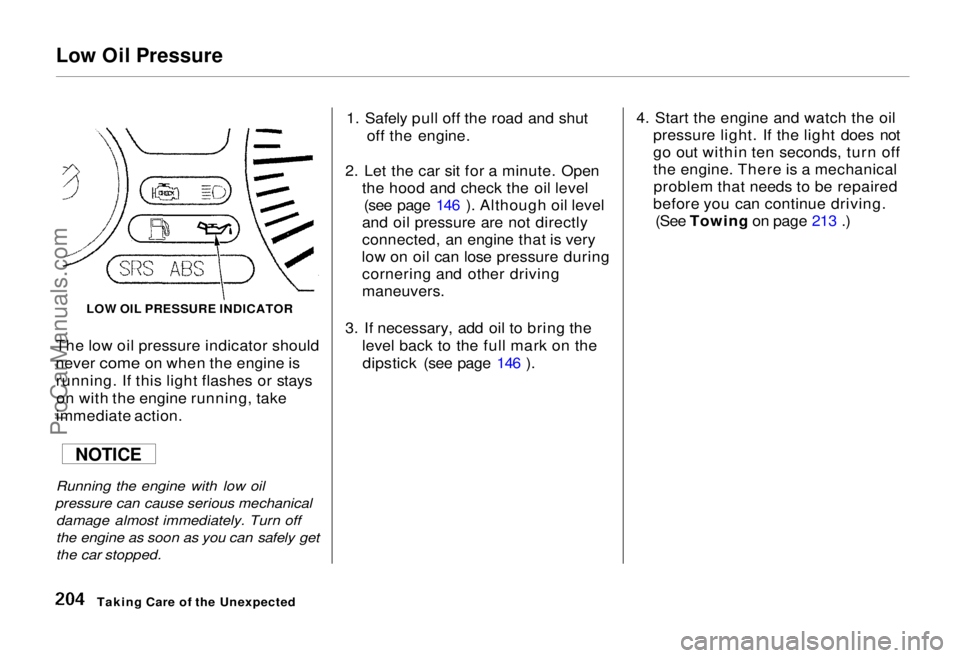
The low oil pressure indicator should
never come on when the engine is
running. If
this light flashes or stays
on with the engine running, take
immediate action.
Running the engine with low oil
pressure can cause serious mechanical
damage almost immediately. Turn off
the engine as soon as you can safely get
the car stopped.
1. Safely pull off the road and shut
off the engine.
2. Let the car sit for a minute. Open the hood and check the oil level(see page 146 ). Although oil level
and oil pressure are not directly
connected, an engine that is very
low on oil can lose pressure during cornering and other driving
maneuvers.
3. If necessary, add oil to bring the level back to the full mark on thedipstick (see page 146 ). 4. Start the engine and watch the oil
pressure light. If the light does not
go out within ten seconds, turn off
the engine. There is a mechanicalproblem that needs to be repaired
before you can continue driving. (See Towing on page 213 .)
Taking Care of the Unexpected
LOW OIL PRESSURE INDICATOR
NOTICEProCarManuals.comMain Menu Table of Contents s t
Page 207 of 240
Fuses
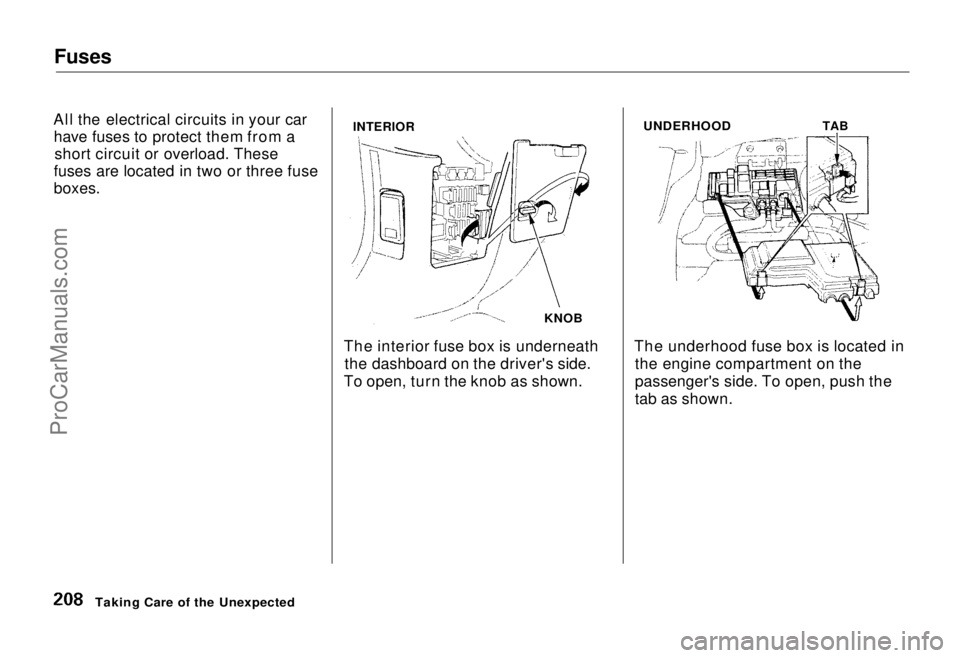
All the electrical circuits in your car have fuses to protect them from a short circuit or overload. These
fuses are located in two or three fuse
boxes.
The interior fuse box is underneaththe dashboard on the driver's side.
To open, turn the knob as shown. The underhood fuse box is located in
the engine compartment on the
passenger's side. To open, push the
tab as shown.
Taking Care of the Unexpected
INTERIOR
KNOB
UNDERHOOD
TABProCarManuals.comMain Menu Table of Contents s t
Page 235 of 240
Index
Flashers, Hazard Warning.............. 45
Flat Tire, Changing a.................... 193
Fluids Automatic Transmission........... 155
Brake........................................... 156
Power Steering........................... 157
Windshield Washer................... 154
FM Stereo Radio Reception...................................... 87
Folding the Second Seats ............... 60
Folding the Third Seats.................. 62
Foreign Countries, Driving in...... 109
Four-way Flashers........................... 45
Front End, Towing by Emergency Wrecker................. 213
Fuel.................................................. 108
Fill Door and Cap....................... 110
Gauge............................................ 40Octane Requirement................. 108
Oxygenated................................ 108
Tank, Filling the......................... 110
Fuses, Checking the...................... 209 Gas Mileage, Improving................ 114
Gasohol........................................... 108
Gasoline.......................................... 108
Gauge............................................ 40
Octane Requirement................. 108
Tank, Filling the......................... 110
Gas Station Procedures................. 110
Gauges
Engine Coolant Temperature .... 40
Fuel................................................ 40
Gearshift Lever Positions............. 120
Glass Cleaning............................... 188
Glove Box......................................... 55
Halogen Headlight Bulbs.............. 177
Hazard Warning Flashers............... 45
Headlights......................................... 42 Aiming......................................... 175
Daytime Running Lights............. 42
High Beam Indicator................... 38
High Beams, Turning on............ 42
Low Beams, Turning on ............. 42
Reminder Chime.......................... 42
Replacing Halogen Bulbs ......... 177
Turning on.................................... 42
Head Restraints............................... 58
Heating and Cooling........................ 76
High Altitude, Starting at.............. 119
High-Low Beam Switch .................. 42
Hood, Opening the ........................ 111
Horn.................................................. 51
Hot Coolant, Warning about........ 151
Hydroplaning.................................. 127
Identification Number, Vehicle.... 216
If Your Car Has to be Towed....... 213
Ignition
Keys............................................... 51
Switch............................................ 52
Timing Control System............. 225
Indicator Lights, Instrument
Panel.............................................. 35
Infant Restraint................................ 22
Inflation, Proper Tire .................... 170
Inside Mirror.................................... 66
Inspection, Tire.............................. 171ProCarManuals.comMain Menu s t Main Menu s t
Page 237 of 240
Index
Oil
Selecting Proper Viscosity Chart....................................... 148
ON (Ignition Key Position)............ 52
Opening the Hood ......................... 111
Operation in Foreign Countries... 109
Outside Mirrors............................... 66 Overheating, Engine..................... 202
Panel Brightness Control............... 43
Park Gear Position......................... 121
Parking Brake.................................. 68
Parking Lights.................................. 42
Parking Over Things that Burn... 226
PGM-FI System.............................. 225
Polishing and Waxing................... 185
Power
Door Locks................................... 53
Mirrors.......................................... 67
Steering....................................... 157
Windows....................................... 64
Pregnancy, Using Seat Belts.......... 10
Proper Seat Belt Usage..................... 7
Radiator Overheating.................... 202
Radio/Cassette Sound System....... 84
Rear End Towing........................... 213
Rear Lights, Bulb Replacement... 179 Rear View Mirror............................. 66
Rear Window Defogger.................. 45
Rear Window Wiper and Washer.. 45
Reclining the Seat Backs................ 57
Redining the Second Seats............. 61
Reminder Lights.............................. 35
Remote Transmitter........................ 54
Removing the Second Seats........... 59
Replacement Information Air Cleaner................................. 158
Coolant........................................ 152
Engine Oil and Filter................. 148
Fuses........................................... 209
Light Bulbs................................. 177
Schedule..................................... 138
Spark Plugs................................. 160
Tires............................................ 172 Wiper Blades.............................. 165
Replacing Seat Belts After a
Crash............................................. 11
Reserve Tank, Coolant.................. 150
Restraint, Child................................ 20
Reverse Gear Position................... 121
Rotation, Tire................................. 172
Safely Belts......................................... 5
Safety Defects, Reporting............... 30
Safety Labels, Location of.............. 31
Safety Messages................................ ii
Seat Belts............................................ 5 Advice for Pregnant Women...... 10Cleaning...................................... 188
Frayed or Torn............................. 11
Maintenance................................. 11
Reminder Light and Beeper....... 36
Replacement................................. 11
System Components...................... 6
Tether Attachment Points.......... 26 Use During Pregnancy................ 10
Wearing a Lap/Shoulder Belt...... 7
Wearing the Lap Belt.................... 9
Seats.................................................. 56
Adjustments................................. 56ProCarManuals.comMain Menu s t