1995 GMC SIERRA key
[x] Cancel search: keyPage 133 of 488

Safety Belt Reminder Light
When the key is turned to RUN or START, a tone will come on for about
eight seconds to remind people to fasten their safety belts, u\
nless the
driver’s safety belt is already buckled. The safety belt light will also come
on and stay on for about 20 seconds, then it will flash for about 55 seconds.
If the driver’s belt is already buckled, neither the tone nor \
the light will
come on.
Air Bag Readiness Light
There is an air bag readiness light on the instrument panel, which shows
AIR BAG. The system checks the air bag’s electrical system for
malfunctions. The light tells you if there is an electrical problem. The
system check includes the air bag sensors and module, the wiri\
ng and the
diagnostic module.
For more information on the air bag system, see “Air
Bag” in the Index.
2-71
ProCarManuals.com
Page 177 of 488
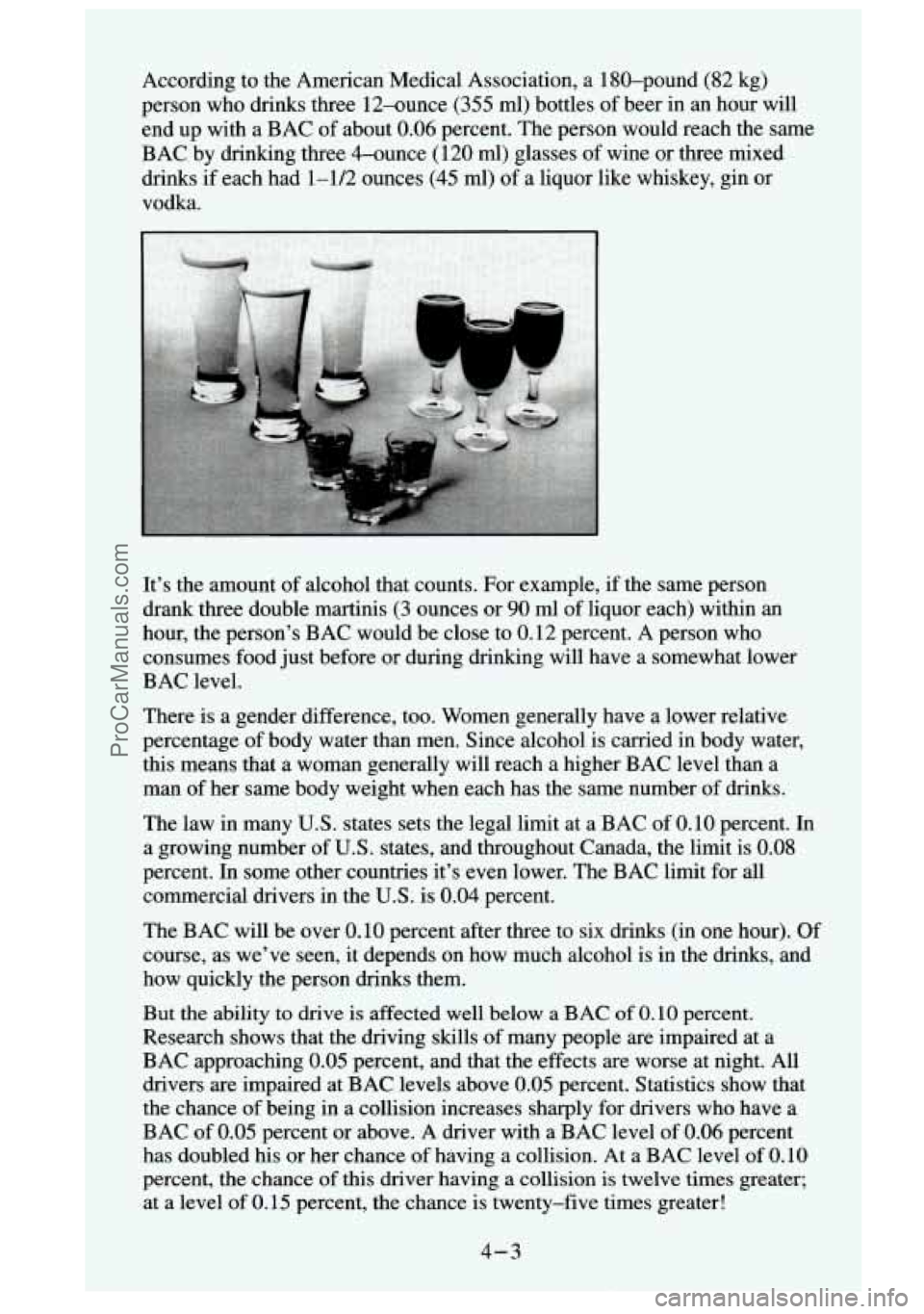
According to the American Medical Association, a 180-pound (82 kg)
person who drinks three 12-ounce (355 ml) bottles of beer in an hour will
end up with a BAC of about
0.06 percent. The person would reach the same
BAC, by drinking three 4-ounce (120
ml) glasses of wine or three mixed
drinks if each had 1-1/2 ounces (45 ml)
of a liquor like whiskey, gin or
vodka.
It’s the amount
of alcohol that counts. For example, if the same person
drank three double martinis
(3 ounces or 90 ml of liquor each) within an
hour, the person’s BAC would be close to 0.12 percent. A person who
consumes food just before or during drinking will have a somewhat lower
BAC level.
There is a gender difference, too. Women generally have a lower relative
percentage of body water than men. Since alcohol is carried in body water,
this means that a woman generally will reach a higher BAC level than a
man of her same body weight when each has the same number
of drinks.
The law in many
U.S. states sets the legal limit at a BAC of 0.10 percent. In
a growing number
of U.S. states, and throughout Canada, the limit is 0.08
percent. In some other countries it’s even lower. The BAC limit for all
commercial drivers in the
U.S. is 0.04 percent.
The BAC will be over 0.10 percent after three to six drinks (in one hour). Of
course, as we’ve seen, it depends on how much alcohol is in the drinks, and
how quickly the person
drinks them.
But the ability to drive
is affected well below a BAC of 0.10 percent.
Research shows that the driving skills
of many people are impaired at a
BAC approaching 0.05 percent, and that the effects are worse at night. All
drivers are impaired at BAC levels above 0.05 percent. Statisti\
cs show that
the chance of being in a collision increases sharply for drivers who have a
BAC of 0.05 percent or above. A driver with a BAC level
of 0.06 percent
has doubled his or her chance of having a collision. At a BAC level of 0.10
percent, the chance
of this driver having a collision is twelve times greater;
at a level
of 0.15 percent, the chance is twenty-five times greater!
4-3
ProCarManuals.com
Page 188 of 488
Controlling your vehicle is the key to successful off-road driving. One of
the best ways
to control your vehicle is to control your speed. Here are some
things
to keep in mind. At higher speeds:
you approach things faster and you have less time to scan the terrain for
obstacles.
0 you have less time to react.
0 you have more vehicle bounce when you drive over obstacles.
0 you’ll need more distance for braking, especially since you’re on an
unpaved surface.
A CAUTION:
When you’re driving off road, bouncing and quick changes in
direction can easily throw you out of position. This could cau\
se
you to lose control and crash.
So, whether you’re driving on or
off the road, you and your passengers should wear safety belts.
Scanning the Terrain
Off-road driving can take you over many different kinds of terrain. You
need to be familiar with the terrain and its many different features. Here are
some things to consider.
Stttface Conditions. Off-roading can take you over hard-packed dirt,
gravel, rocks, grass, sand, mud, snow or ice. Each of these surfaces affects
the steering, acceleration, and braking of your vehicle in different ways.
Depending upon the kind
of surface you are on, you may experience
slipping, sliding, wheel spinning, delayed acceleration, poor traction, and
longer braking distances.
Surjace Obstacles . Unseen or hidden obstacles can be hazardous. A rock,
log, hole,
rut, or bump can startle you if you’re not prepared for them. Often
these obstacles are hidden by grass, bushes, snow or even the rise and fall of
the terrain itself. Here are some things to consider:
Is the path ahead clear?
Will the surface texture change abruptly up ahead‘?
Does the travel take you uphill or downhill? (There’s more discussion
of these subjects later.)
0 Will you have to stop suddenly or change direction quickly?
When
you drive over obstacles or rough terrain, keep a firm grip on the
steering wheel. Ruts, troughs, or other surface features can jerk the wheel
out
of your hands if you’re not prepared.
4- 14
ProCarManuals.com
Page 226 of 488
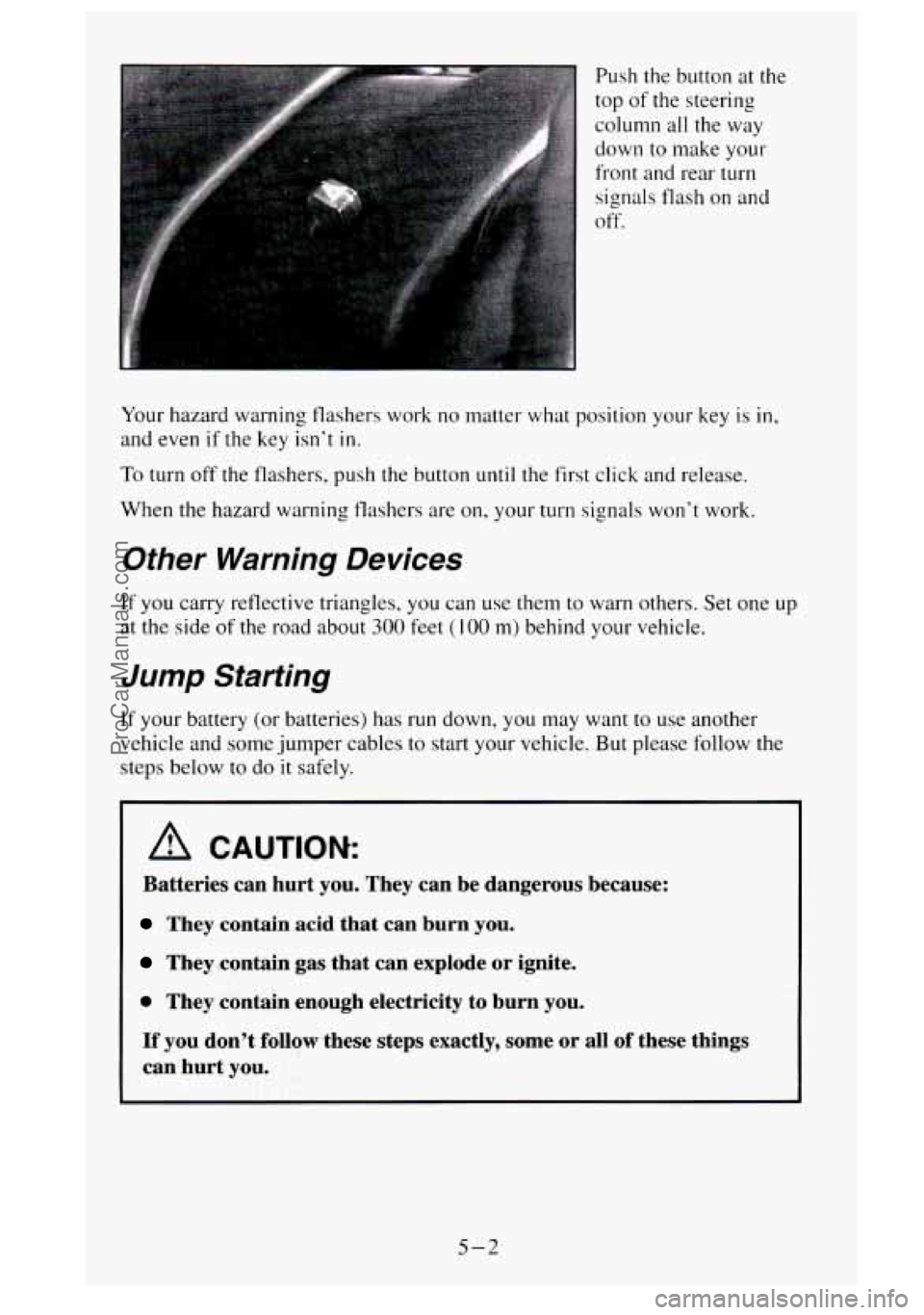
Push the button at the
top of the steering
column all the way
down to make
your
front and rear turn
signals flash on and
off.
Your hazard warning flashers work no matter what position your key is in,
and even if the key isn’t in.
To turn off the flashers, push the button until the first click and release.
When the hazard warning flashers are on, your turn signals won’t work.
Other Warning Devices
If you carry reflective triangles, you can use them to warn others. Set one up
at the side of the road about
300 feet (100 m) behind your vehicle.
Jump Starting
If your battery (or batteries) has run down, you may want to use another
vehicle and some jumper cables
to start your vehicle. But please follow the
steps below to do it safely.
A CAUTION:
Batteries can hurt you. They can be dangerous because:
They contain acid that can burn you.
They contain gas that can explode or ignite.
0 They contain enough electricity to burn you.
If you don’t follow these steps exactly, some or all of these things
can hurt you.
5-2
ProCarManuals.com
Page 231 of 488
To wing Your Vehicle
Try to have your GM dealer or a professional towing service tow your
vehicle. They can provide the right equipment and know how to tow
it
without damage.
If your vehicle has been changed since
it was factory-new. by adding such
things like fog lamps, aero skirting,
or special tires and wheels, these things
could be damaged during towing.
Before you do anything,
turn on the hazard warning flashers.
When you call, tell the towing service:
0 That your vehicle has rear-wheel drive, or that it has the four-wheel
drive option.
The make, model, and year of your vehicle.
0 Whether you can move the shift lever for the transmission and transfer
case,
if you have one.
If there was an accident. what was damaged.
A CAUTION:
To help avoid injury to you or others:
Never let passengers ride in a vehicle that is being towed.
0 Never tow faster than safe or posted speeds.
0 Never tow with damaged parts not fuIly secured.
0 Never get under your vehicle after it has been lifted by the
tow truck.
0 Always use separate safety chains on each side when towing a
vehicle.
0 For pickups (except cab chassis models), use T-hooks on front
. of vehicle, J-hooks on rear.
For cab chassis models, use J-hooks on front and rear of
vehicle.
When your vehicle is being towed, have the ignition key off. The steering
wheel should be clamped
in a straight-ahead position, with a clamping
device designed for towing, service.
Do not use the vehicle’s steering
column lock for this. The transmission and transfer case, if
you have one,
should be
in NEUTRAL (N) and the parking brake released.
5-7
ProCarManuals.com
Page 274 of 488
NOTICE:
If there is water in your diesel fuel and the weather is warm or
humid, fungus and bacteria can grow in the fuel. They can
damage your fuel system. You'll need a diesel fuel biocide to
sterilize your fuel system. Your dealer can advise
you if you ever
need this.
If your fuel tank needs to be purged to remove water, see your
dealer or a qualified technician. Improper purging can damage
your fuel system.
Running Out of Fuel (Diesel Engines)
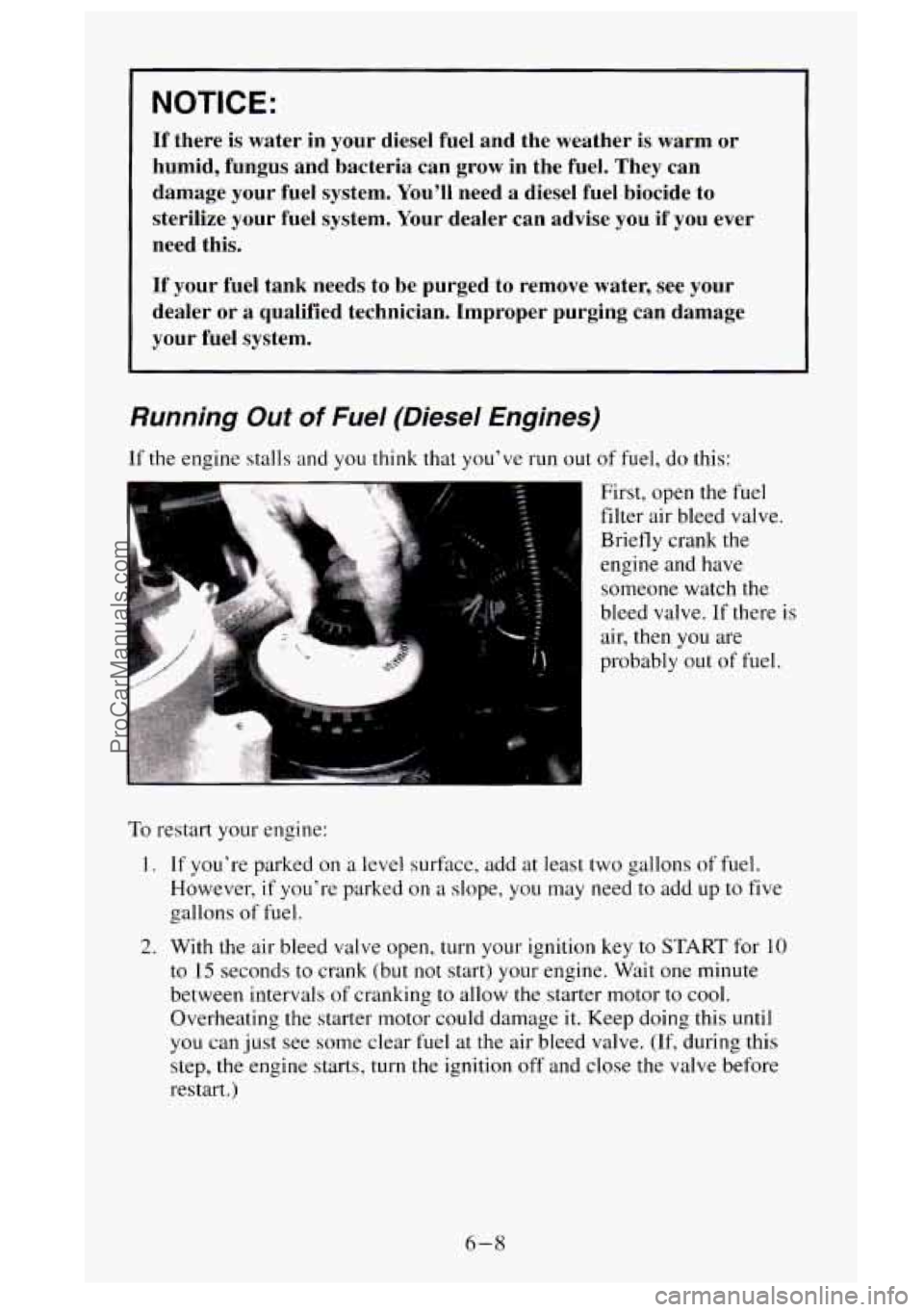
If the engine stalls and you think that you've run out of fuel, do this:
First, open the fuel filter air bleed valve.
Briefly crank the
engine and have
someone watch the
bleed valve. If there is
air, then you are
probably
out of fuel.
To restart your engine:
I. If you're parked on a level surface, add at least two gallons of fuel.
However, if you're parked
on a slope, you may need to add up to five
gallons of fuel.
2. With the air bleed valve open, turn your ignition key to START for 10
to
15 seconds to crank (but not start) your engine. Wait one minute
between intervals
of cranking to allow the starter motor to cool.
Overheating the starter motor could damage it. Keep doing this until
you can just see some clear fuel at the air bleed valve. (If, during this
step, the engine starts, turn the ignition off and close the valve before
restart.)
6-8
ProCarManuals.com
Page 275 of 488
A CAUTION:
Diesel fuel is flammable. It could start a fire if it gets on hot
engine parts. You could be burned. Don't let too much fuel flow
from the air bleed
valve, and wipe up any spilled fuel with a
cloth.
3. Close the air bleed valve.
4. Turn the ignition key to START for 10 to 15 seconds at a time until
your engine starts.
Fuel Filter Replacement (Diesel Engines)
If you want to change the fuel filter yourself, here's how to do it:
A CAUTION:
Diesel fuel is flammable. It could start a fire if something ignites
it, and you could be burned. Don't let it get on hot engine parts,
and keep matches or other ignition sources away.
First. drain any water from the filter following the procedure for draining
water listed previously.
Your vehicle's engine should be off until the end
of the following procedure.
1. Apply the parking brake.
2. Take off the fuel tank cap. This releases vacuum in the tank.
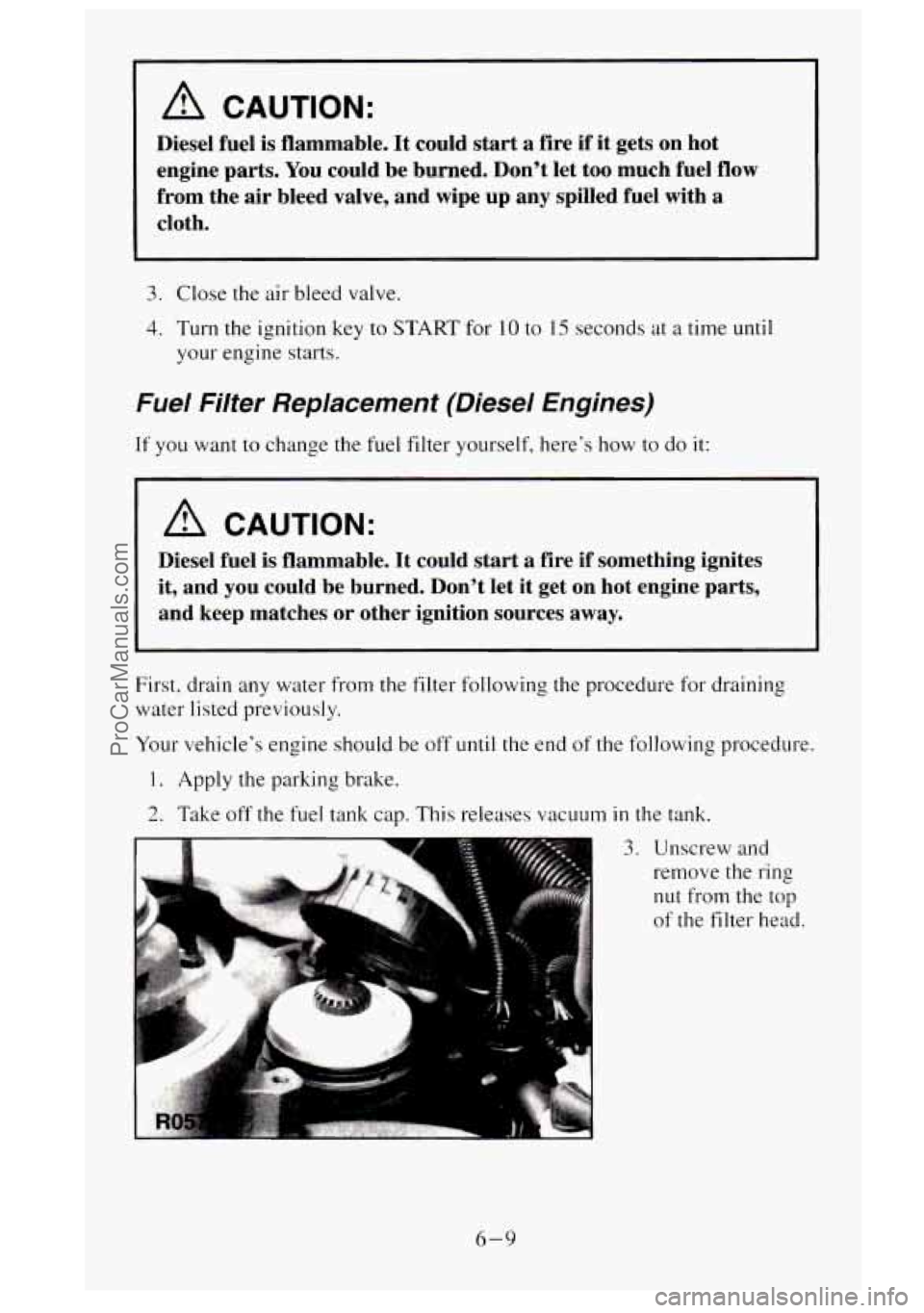
3. Unscrew and
remove the ring
nut from the top
of the
filter head.
6-9
ProCarManuals.com
Page 276 of 488
7.
8.
9.
10.
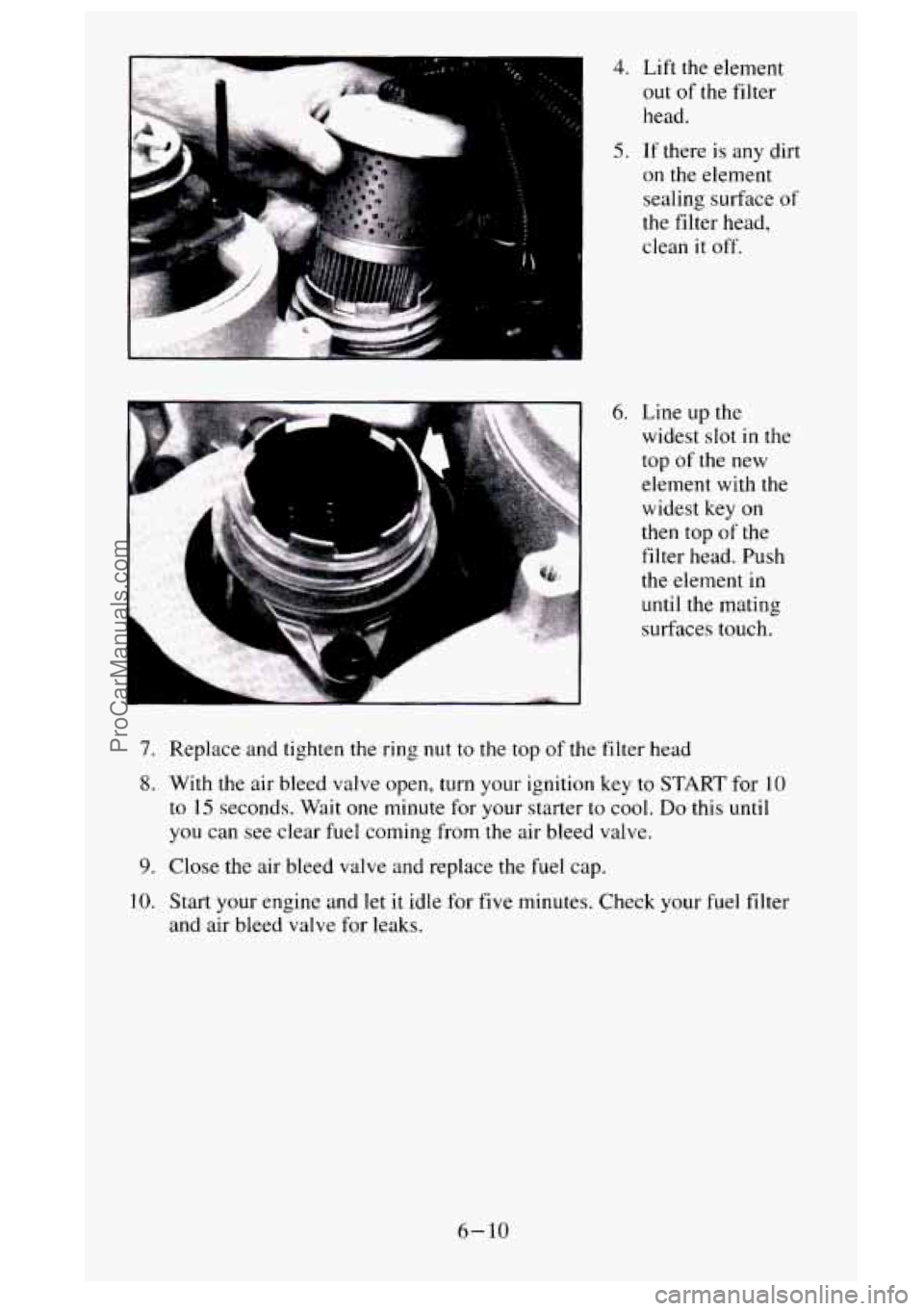
4. Lift the element
out
of the filter
head.
5. If there is any dirt
on the element
sealing surface
of
the filter head,
clean
it off.
6. Line up the
widest slot in the
top of the new
element with
the
widest key on
then top of the
filter head. Push
the element in
until the mating
surfaces touch.
Replace and tighten the ring
nut to the top of the filter head
With
the air bleed valve open, turn your ignition key to START for 10
to 15 seconds. Wait one minute for your starter to cool. Do this until
you can see clear fuel coming from the air bleed valve.
Close the air bleed valve and replace the fuel cap.
Start your engine and let it idle for five minutes. Check your
fuel filter
and air bleed valve for leaks.
6- 10
ProCarManuals.com