Page 306 of 488
NOTICE:
Your surge tank pressure cap is a unique 15 psi (105 kPa)
pressure-type cap for use with surge tank cooling systems only.
It must be tightly installed to prevent coolant loss and possible
engine damage from overheating. Be sure the arrows on the cap
line up with the top tube of the coolant surge tank.
Thermostat
Engine coolant temperature is controlled by a thermostat in the engine
coolant system. The thermostat stops the flow
of coolant through the
radiator until the coolant reaches a preset temperature.
When you replace your thermostat, an AC@ thermostat is recommended.
Power Steering Fluid
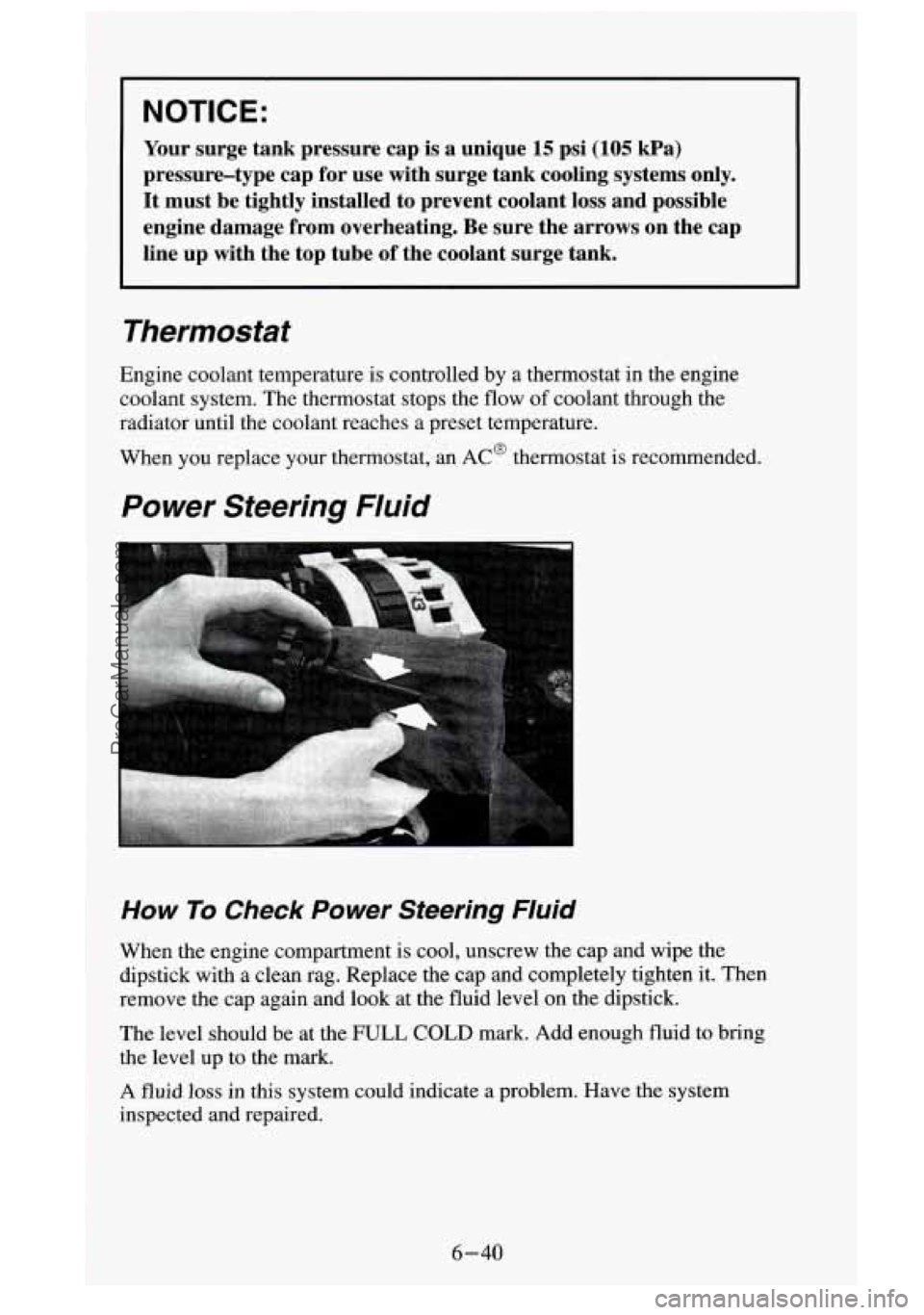
How To Check Power Steering Fluid
When the engine compartment is cool, unscrew the cap and wipe \
the
dipstick with a clean rag. Replace the cap and completely tighten it. Then
remove the cap again and look at the fluid level on the dips\
tick.
The level should be at the
FULL COLD mark. Add enough fluid to bring
the level
up to the mark.
A fluid loss in this system could indicate a problem. Have the system
inspected and repaired.
6-40
ProCarManuals.com
Page 309 of 488
(or remove) brake fluid, as necessary, only when work is done on the brake
hydraulic system.
A CAUTION:
If you have too much brake fluid, it can spill on the engine. The
fluid will burn
if the engine is hot enough. You or others could
be burned, and your vehicle could be damaged. Add brake fluid
only when work is done on the brake hydraulic system.
Refer to the Maintenance Schedule to determine when to check your brake
fluid. See “Periodic Maintenance Inspections”
in the Index.
To Check Brake Fluid
You can check the brake fluid without taking off the cap. Just look at the
windows on the brake fluid reservoir. The fluid levels should be above MIN.
If they aren’t, have your brake system checked to see if there is a leak.
After work
is done on the brake hydraulic system, make sure the levels are
above MIN and below the top
of each window.
What to Add
When you do need brake fluid, use only DOT-3 brake fluid - such as
Delco Supreme 11
@ (GM Part No. 1052535). Use new brake fluid from a
sealed container only, and always clean the brake fluid reservoir cap before
removing it.
NOTICE:
Don’t let someone put in the wrong kind of fluid. For
example, just
a few drops of mineral-based oil, such as engine
oil, in your brake system can damage brake system parts
so
badly that they’ll have to be replaced.
Brake fluid can damage paint, so be careful not to spill brake
fluid on your vehicle.
If you do, wash it off immediately. See
“Appearance Care” in the Index.
6-43
ProCarManuals.com
Page 313 of 488
Battery
Every new GM vehicle has a Delco Freedom@ battery. You never have to
add water to one of these. When it’s time for a new battery, we recommend
a Delco Freedom@ battery. Get one that has the replacement number shown
on the original battery’s label.
Vehicle Storage
If you’re not going to drive your vehicle for 25 days or more. take off the
black, negative (-) cable from the battery. This will help keep your battery
from running down.
A CAUTION:
Batteries have acid that can burn you and gas that can explod\
e.
You can be badly hurt if you aren’t careful. See “Jump Start\
ing’’
in the Index for tips on working around a battery without
getting hurt.
Contact your dealer to learn how to prepare your vehicle for longer storage
periods.
Bulb Replacement
Before you replace any bulbs. be sure that all the lamps are off and the
engine isn’t running.
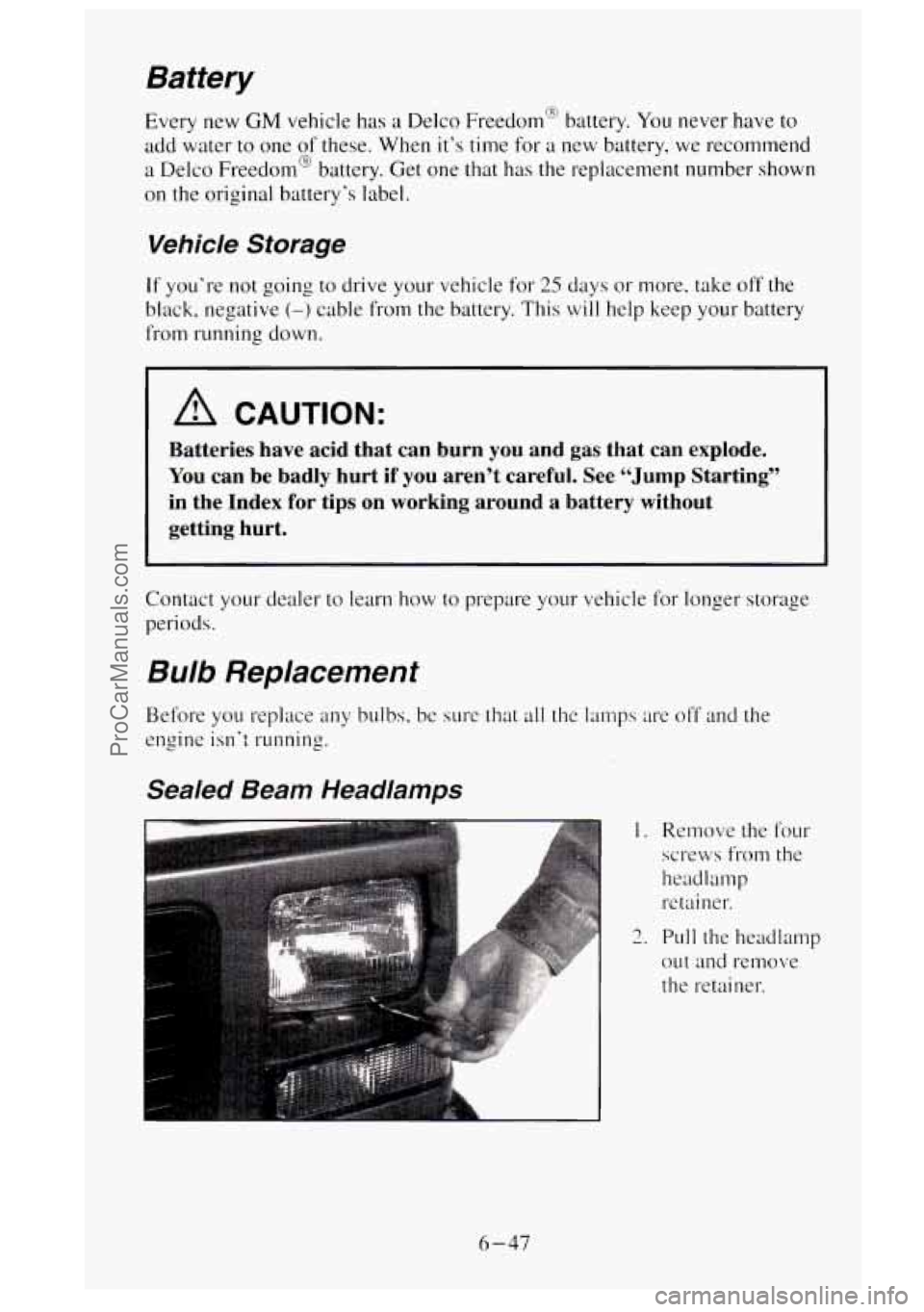
Sealed Beam Headlamps
I. Remove the four
screws from the
headlamp retainer.
2. Pull the headlamp
out and remove
the retainer.
6-47
ProCarManuals.com
Page 322 of 488
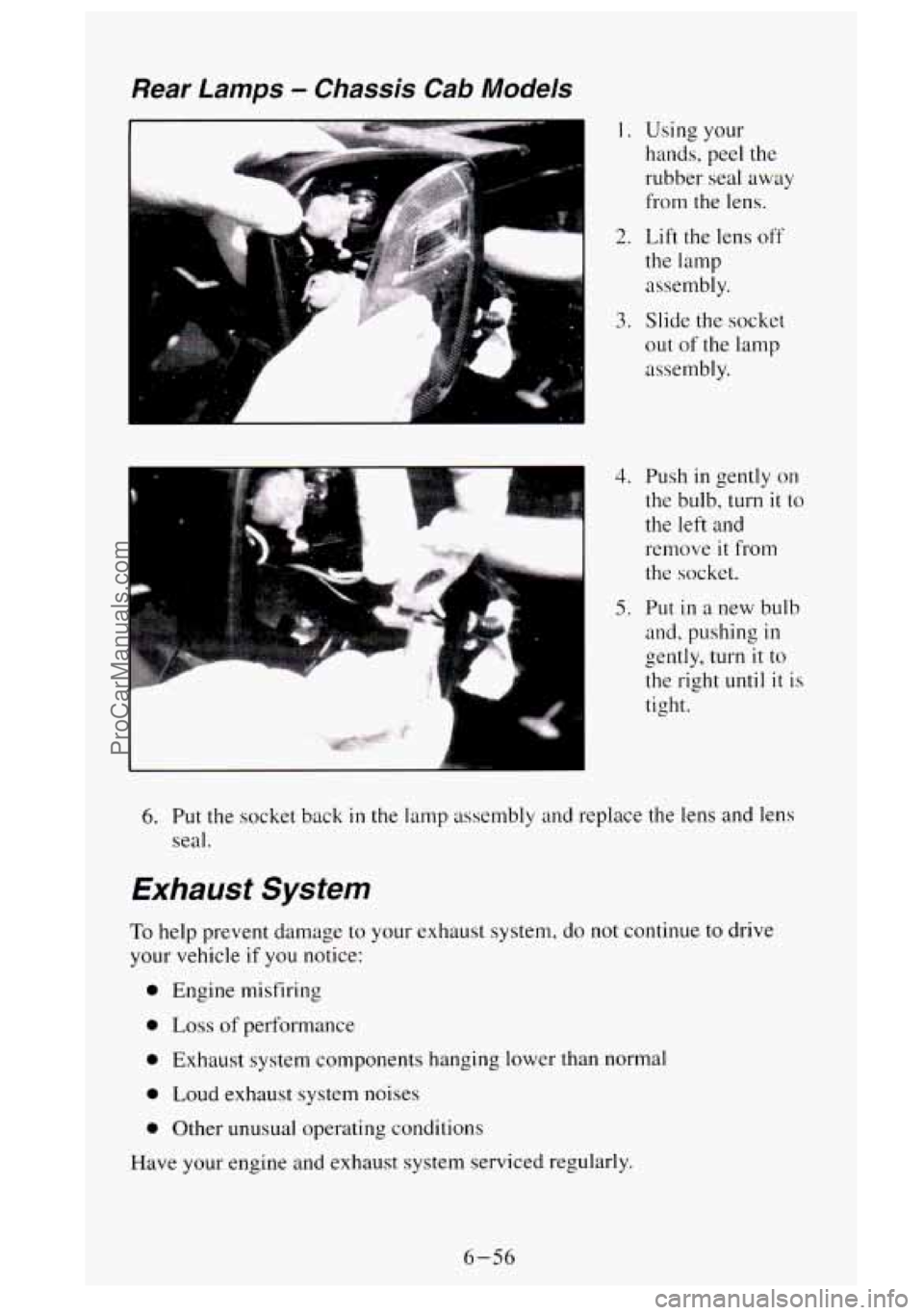
Rear Lamps - Chassis Cab Models
d
1. Using your
hands, peel the
rubber seal away
from the lens.
2. Lift the lens off
the lamp
assembly.
3. Slide the socket
out
of the lamp
assembly.
4. Push in gently on
the bulb, turn it to
the left and remove
it from
the socket.
5. Put in a new bulb
and, pushing
in
gently, turn it to
the right
until it is
tight.
6. Put the socket back in the lamp assembly and replace the lens and lens
seal.
Exhaust System
To help prevent damage to your exhaust system, do not continue to drive
your vehicle
if you notice:
0 Engine misfiring
0 Loss of performance
0 Exhaust system components hanging lower than normal
0 Loud exhaust system noises
0 Other unusual operating conditions
Have
your engine and exhaust system serviced regularly.
6-56
ProCarManuals.com
Page 323 of 488

Three- Way Catalytic Converter (Gasoline Engines)
Your vehicle’s three-way catalytic converter is designed to reduce the
pollutants
in your vehicle‘s exhaust. Use only unleaded fuel in your vehicle.
If you use leaded fuel, you could damage your three-way catalytic converter
and other engine components.
Oxidation Catalytic Converter (Diesel Engines)
Your vehicle’s oxidation catalytic converter is designed to reduce the
particulates
in your vehicle‘s exhaust. If your vehicle’s oxidation catalytic
converter ever needs to be replaced,
it must be replaced with an oxidation
converter intended for use
with diesel engines only.
Engine Control Module System
Gasoline Engines
This system has an oxygen sensor (OS) that helps keep your engine’s
air-fuel mixture at a proper level. Use only unleaded fuel in your vehicle. If
you use leaded fuel, you could damage your oxygen sensor
(OS) and
three-way catalytic converter.
Diesel Vehicles Below 8,500 (3 850 Kg) G VWR
This system monitors engine speed and throttle position. It adjusts exhaust
gas recirculation to limit emissions.
Malfunction Indicator (SERVICE ENGINE SOON)
Light
The Malfunction Indicator (SERVICE ENGINE SOON) Light on your
instrument panel lets you know when your emission system needs service.
The light will come on briefly when you start your engine to
let you know
that the system is working. If
it does not come on when you start your
engine, or
if it comes on and stays on while you’re driving, your system
may need service. Your vehicle should still be driveable, but you should
have your system serviced right away.
Secondary Air Injection Reaction (AIR) System
(Gasoline Engines)
You may have this system. It has a control valve that will direct air to where
it is needed. If the AIR system needs service, your Malfunction Indicator
(SERVICE ENGINE
SOON) Lamp on your instrument panel will come on.
6-57
ProCarManuals.com
Page 342 of 488
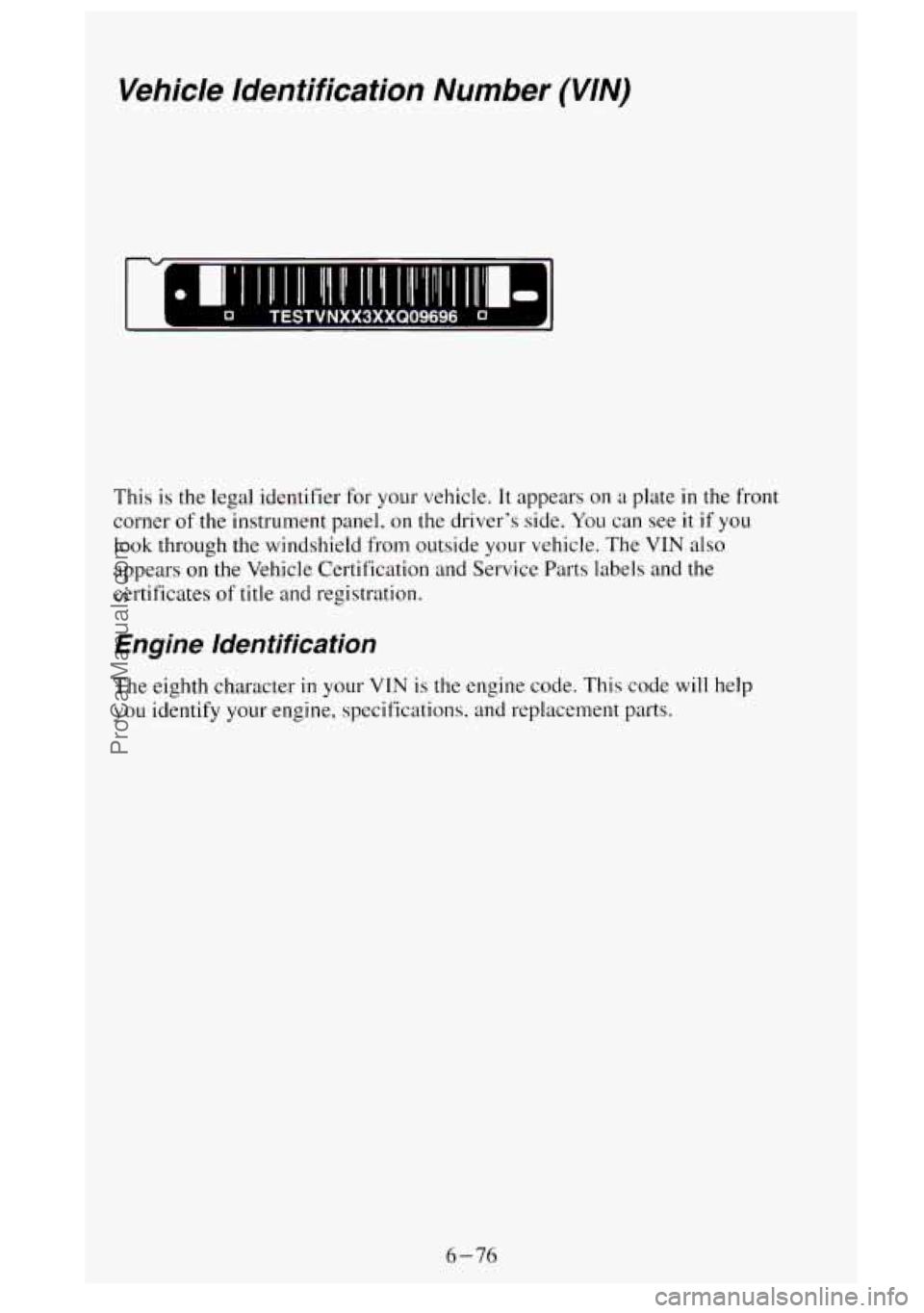
Vehicle Identification Number (VIN)
0 TESTVNXX3XXQ09696 G
This is the legal identifier for your vehicle. It appears on a plate in the front
corner
of the instrument panel, on the driver’s side. You can see it if you
look through the windshield from outside your vehicle. The
VIN also
appears
on the Vehicle Certification and Service Parts labels and the
certificates of title and registration.
Engine ldentificafion
The eighth character in your VIN is the engine code. This code will help
you identify your engine, specifications. and replacement parts.
6-76
ProCarManuals.com
Page 347 of 488
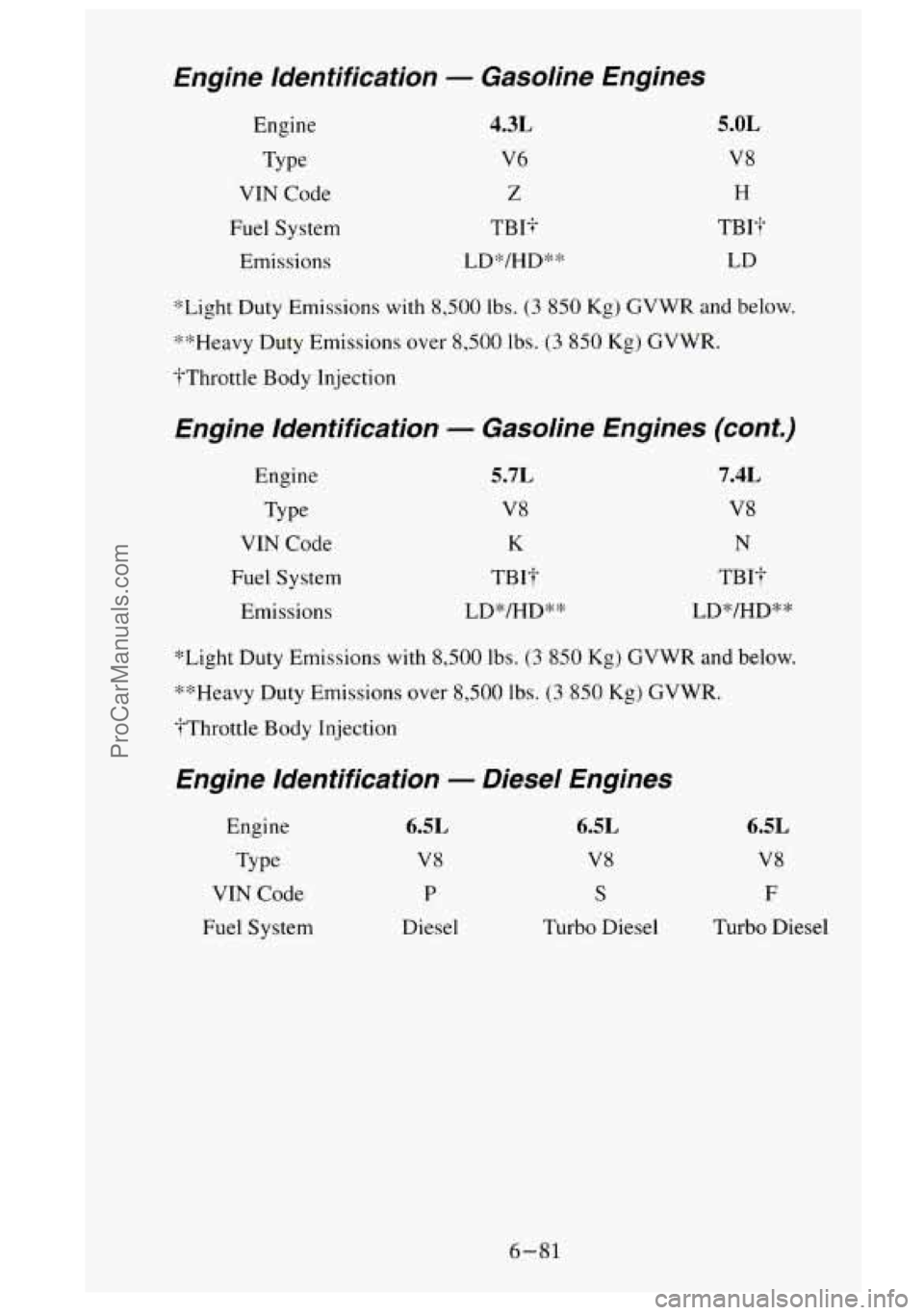
Engine Identification - Gasoline Engines
Engine
Type
VIN Code
Fuel System
Emissions
5.0L
V8
H
TBI? LD
"Light Duty Emissions with
8,500 lbs. (3 850 Kg) GVWR and below.
**Heavy Duty Emissions over 8,500 lbs. (3 850 Kg) GVWR.
?Throttle Body Injection
Engine Identification - Gasoline Engines (cont.)
Engine
Type
VIN Code
Fuel System
Emissions 7.4L
V8
N
TBI?
LD*/HD**
"Light Duty Emissions with 8,500 lbs. (3 850 Kg) GVWR and below.
""Heavy Duty Emissions over
8,500 lbs. (3 850 Kg) GVWR.
?Throttle Body Injection
Engine Identification - Diesel Engines
Engine
Type
VIN Code
Fuel System
6.5L
V8
P
Diesel
6.5L
V8 S
Turbo Diesel
6.5L
V8
F
Turbo Diesel
6-81
ProCarManuals.com
Page 348 of 488
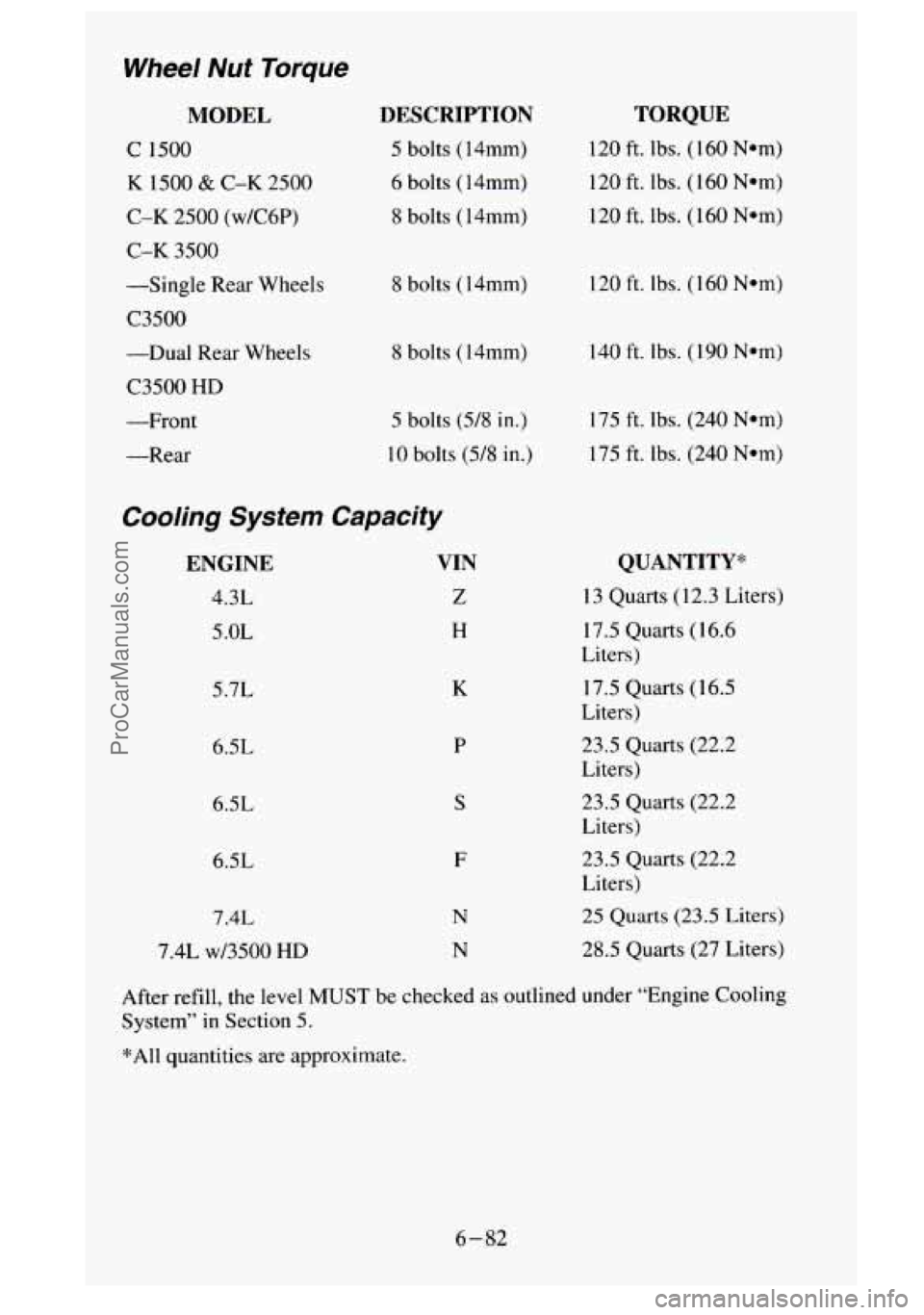
Wheel Nut Torque
MODEL
C 1500
K 1500 & C-K 2500
C-K 2500
(w/CGP)
C-K 3500
-Single Rear Wheels
C3500
-Dual Rear Wheels
C3500 HD
-Front
-Rear
DESCRIPTION
5 bolts ( 14mm)
6 bolts (14mm)
8 bolts ( 14mm)
8 bolts ( 14mm)
8 bolts (14rnm)
5 bolts (518 in.)
10 bolts (5/8 in.)
Cooling System Capacity
ENGINE
4.3L
5 .OL
5.7L
6.5L
6.5L
6.5L
7.4L
7.4L w/3500
HD
VIN
Z
H
K
P
S
F
N
N
TORQUE
120 ft. lbs. (1 60 Nmm)
120 ft. lbs. (160 Nmm)
120 ft. lbs. (160 Nom)
120
ft. lbs. (1 60 Nom)
140 ft. lbs. ( 190 Nmm)
175 ft. lbs. (240 Nom)
175 ft. lbs. (240 Nom)
QUANTITY*
13 Quarts (12.3 Liters)
17.5 Quarts (16.6
Liters)
17.5 Quarts (16.5
Liters)
23.5 Quarts (22.2
Liters)
23.5 Quarts (22.2
Liters)
23.5 Quarts (22.2
Liters)
25
Quarts (23.5 Liters)
28.5
Quarts (27 Liters)
After refill, the level
MUST be checked as outlined under “Engine Cooling
System”
in Section 5.
*All quantities are approximate.
6-82
ProCarManuals.com