Page 220 of 354
When you open the hood, you’ll see the following on
the 8-valve engine:
1. Battery
2. Automatic Transmission Dipstick (if equipped)
3. Oil Fill Cap
4. Brake Fluid Reservoir
5. Air Cleaner
6. Engine Coolant Reservoir
7. Power Steering Reservoir
8. Radiator Pressure Cap
9. Electric Engine Fan
10. Engine Oil Dipstick
1 1. Windshield Washer Reservoir
12. Main Fuse Box Before
closing the hood, be sure all the filler caps are
on.
6-9
ProCarManuals.com
Page 222 of 354
When you open the hood, you’ll see the following on
the 16-valve engine:
1. Battery
2. Automatic Transmission Dipstick (if equipped)
3. Oil Fill Cap
4. Brake muid Reservoir
5. Air Cleaner
6. Engine Coolant Reservoir
7. Power Steering Reservoir
8. Radiator Pressure Cap
9. Electric Engine Fan
10. Windshield Washer Reservoir
11. Main Fuse Box Before
closing the hood, be sure all the filler caps are
on.
Then lift the hood to relieve pressure on the hood prop.
Remove the hood prop from the slot in the hood and
return the prop to its retainer. Then just let the hood
down and close it firmly.
6-11 ProCarManuals.com
Page 223 of 354
Engine Oil
It’s a good idea to check your engine oil level every time
you get fuel. In order to get an accurate reading, the oil
must be warm and the vehicle must be
on level ground.
Turn
off the engine and give
the oil a few minutes to
drain back into the oil pan.
If
you don’t, the oil dipstick
might not
show the actual
level.
To Check Engine Oil
Pull out the dipstick and clean it with a paper towel or a
cloth, then push it back in all the way. Remove it again,
keeping the tip down.
t
ProCarManuals.com
Page 224 of 354
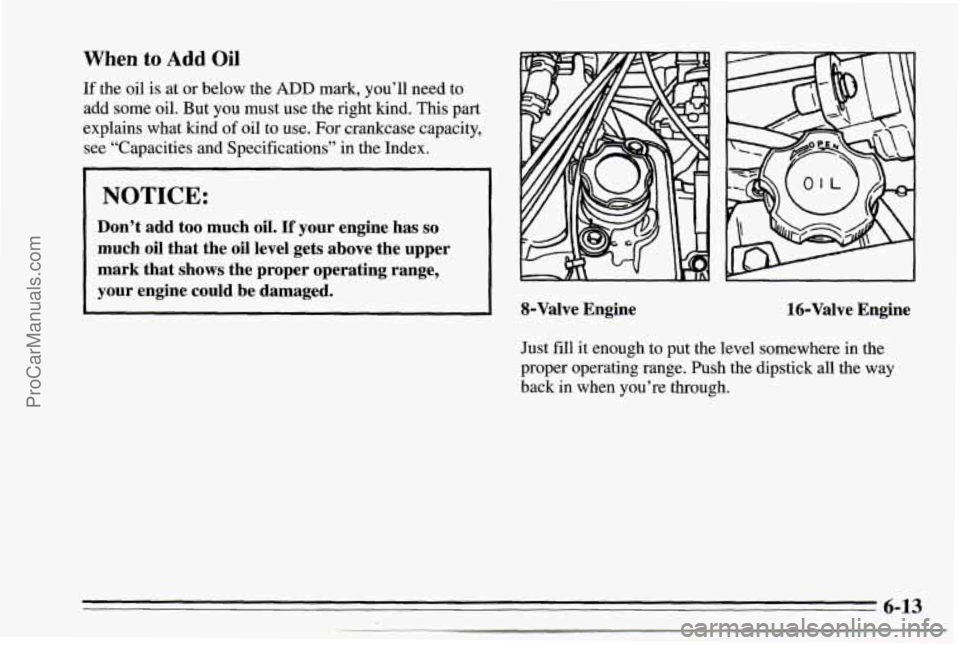
When to Add Oil
If the oil is at or below the ADD mark, you’ll need to
add some oil. But you must use the right kind. This part
explains what kind
of oil to use. For crankcase capacity,
see “Capacities and Specifications” in the Index.
Don’t add too much oil. If your engine has so
much oil that the oil level gets above the upper
mark that
shows the proper operating range,
your engine could be damaged. 8-Valve Engine 16-Valve Engine
Just fill it enough to put the level somewhere in the
proper operating range. Push the dipstick all the way
back in when you’re through.
6-13
ProCarManuals.com
Page 230 of 354

Automatic Transmission Fluid
When to Check and Change
A good time to check your automatic transmission fluid
level is when the engine oil is changed. Refer to the
Maintenance Schedule to determine
when to change
your fluid. See “Scheduled Maintenance Services”
in the
Index.
How to Check
Because this operation can be a little difficult, you may
choose to have this done at your Chevrolet/Geo dealer
Service Department.
If you do it yourself, be sure to follow all the
instructions here, or you could get a false reading on the
dipstick.
NOTICE:
Too much or too little fluid can damage your
transmission.
Too much can mean that some of
the fluid could come out and fall on hot engine
parts or exhaust system parts, starting a fire. Be sure to get an accurate reading if you check your
transmission fluid.
Wait at least 30 minutes before checking the
transmission fluid level if you have been driving:
0 When outside temperatures are above 90°F (32°C).
At high speed for quite a while.
0 In heavy traffic -- especially in hot weather.
0 While pulling a trailer.
To get the right reading, the fluid should be at normal
operating temperature, which is
180” F to 200” F
(82°C to 93°C).
ProCarManuals.com
Page 233 of 354
How to Add Fluid Manual Transmission Fluid
Refer to the Maintenance Schedule to determine what
kind
of transmission fluid to use. See “Recommended
Fluids and Lubricants” in the Index.
Add fluid only after checking the transmission fluid
HOT. (A COLD check is used only as a reference.) If
the fluid level is low, add only enough of the proper
fluid to bring the level up to the
HOT area for a hot
check. It doesn’t take much fluid, generally less than a
pint.
Don ’t ove$ZZ. We recommend you use only fluid
labeled DEXRON@-111, because fluid with that label is
made especially for your automatic transmission.
Damage caused by fluid other than DEXRON@-I11 is
not covered by your new vehicle warranty.
After adding fluid, recheck the fluid level as
described under “How to Check.’’
When the correct fluid level is obtained, push the
dipstick back in all the way.
When to Check and Change
A good time to have it checked is when the engine oil is
changed. Refer to the Maintenance Schedule to
determine when to change
your transmission fluid. See
“Scheduled Maintenance Services” in the Index.
How to Check
Because this operation can be a little difficult, you may
choose
to have this done at your Chevrolet/Geo dealer
Service Department.
If you do it yourself, be sure to follow all the
instructions here, or you could get
a false reading.
ProCarManuals.com