Page 162 of 354
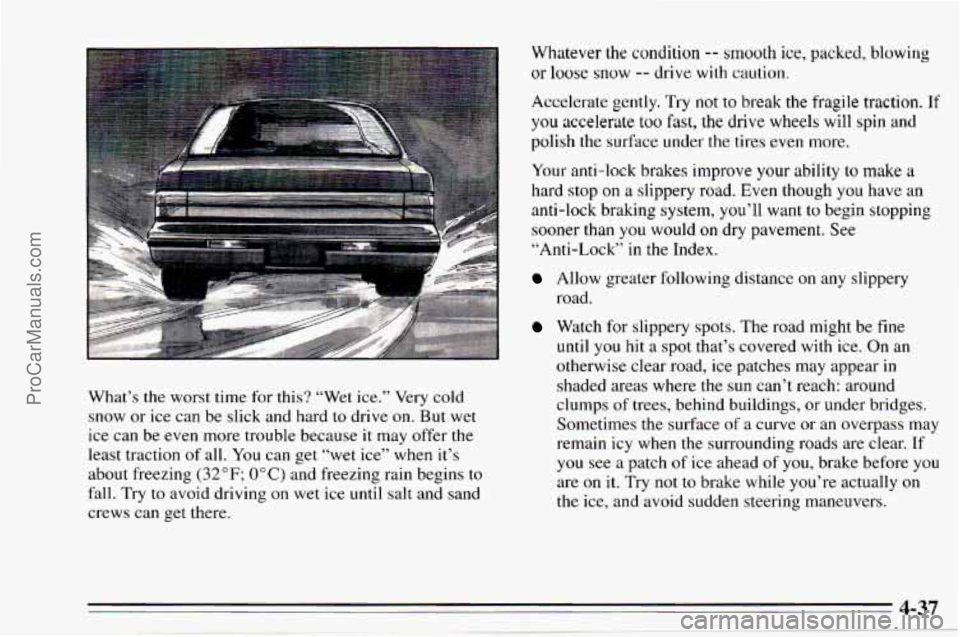
What’s the worst time for this? “Wet ice.” Very cold
snow or ice can be slick and hard
to drive on. But wet
ice can be even more trouble because it may offer
the
least traction of all. You can get “wet ice” when it’s
about freezing (32” F; 0°C) and freezing rain begins to
fall. Try
to avoid driving on wet ice until salt and sand
crews can get there. Whatever
the condition
-- smooth ice, packed, blowing
or loose snow
-- drive with caution.
Accelerate gently. Try not
to break the fragile traction. If
you accelerate too fast, the drive wheels will spin and
polish the surface under the tires even more.
Your anti-lock brakes improve
your ability to make a
hard stop on a slippery road. Even though you have an
anti-lock braking system, you’ll want
to begin stopping
sooner than you would on dry pavement. See
“Anti-Lock”
in the Index.
Allow greater following distance on any slippery
road.
Watch for slippery spots. The road might be fine
until
you hit a spot that’s covered with ice. On an
otherwise clear road, ice patches may appear in
shaded areas where the sun can’t reach: around
clumps of trees, behind buildings,
or under bridges.
Sometimes the surface
of a curve or an overpass may
remain icy when
the surrounding roads are clear. If
you see a patch of ice ahead of you, brake before you
are
on it. Try not to brake while you’re actually on
the ice, and avoid sudden steering maneuvers,
ProCarManuals.com
Page 165 of 354
Recreational Vehicle Towing
There may be times when you want to tow your Geo
behind another vehicle for use at your destination. Be
sure to use the proper towing equipment designed for
recreational towing. Follow the instructions for the
towing equipment.
Towing Your Geo from the Rear
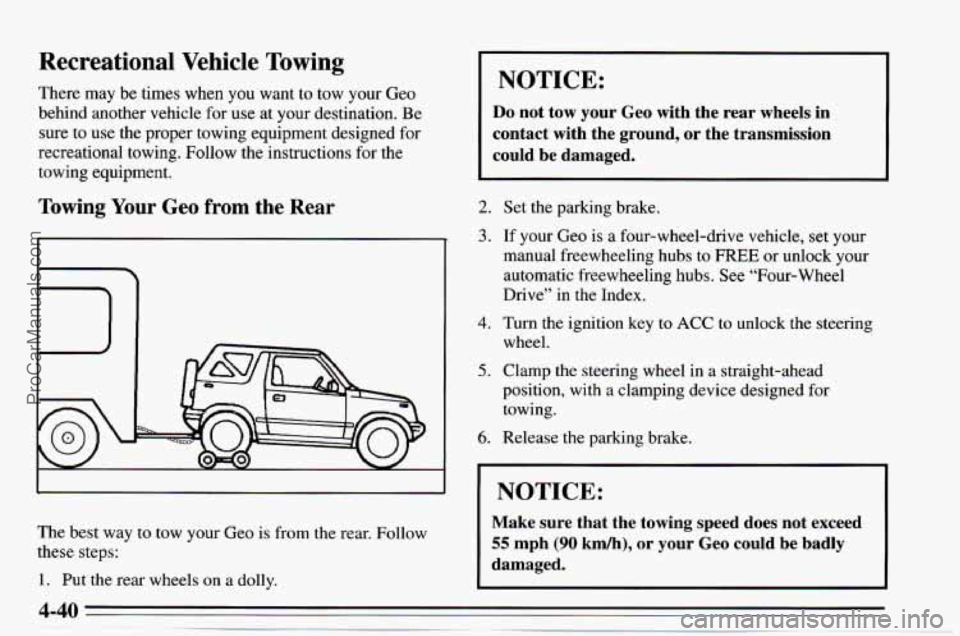
The best way to cow your Geo is from the rear. Follow
these steps:
1. Put the rear wheels on a dolly.
I NOTICE:
Do not tow your Geo with the rear wheels in
contact with the ground,
or the transmission
could be damaged.
2. Set the parking brake.
3. If your Geo is a four-wheel-drive vehicle, set your
manual freewheeling hubs
to FREE or unlock your
automatic freewheeling hubs. See “Four-wheel
Drive” in the Index.
4. Turn the ignition key to ACC to unlock the steering
5. Clamp the steering wheel in a straight-ahead
wheel.
position, with a clamping device designed for
towing.
6. Release the parking brake.
NOTICE:
Make sure that the towing speed does not exceed
55 mph
(90 km/h), or your Geo could be badly
damaged.
ProCarManuals.com
Page 166 of 354

Towing Your Geo from the Front
I NOTICE:
If your vehicle has automatic freewheeling hubs
or two-wheel drive, do not tow it on all four
wheels. If you do, your transmission could be
damaged.
If you have a four-wheel-drive vehicle with manual
freewheeling hubs, it can be towed from the front with
all four wheels on the ground. Follow these steps:
1. Set the parking brake.
2. Turn the ignition key to ACC to unlock the steering
wheel.
3. Shift your automatic transmission into PARK (P), or
your manual transmission into SECOND
(2).
4. Shift the transfer case to NEUTRAL (N).
5. Set the hubs to FREE. See “Four-wheel Drive” in
the Index.
6. Release the parking brake.
Stop towing every
200 miles (300 km) and start
the engine. Leave the transfer
case shift lever in
NEUTRAL (N). Shift your automatic transmission
to
DRIVE (D); leave a manual transmission in
SECOND
(2) with the clutch engaged. Run the engine
at medium speed for
one minute to circulate the oil in
the transfer case. Turn the ignition key to ACC. Now,
you can continue towing your Geo.
ProCarManuals.com
Page 167 of 354
I
NOTICE:
The front wheels transmit shocks during towing.
The steering column may not be strong enough to
withstand the shocks. Always unlock the steering
wheel before towing.
Loading Your Vehicle
I NOTICE:
Make sure that the towing speed does not exceed
damaged.
I 50 mph (SO kmh), or your Geo could be badly
f
TIRE PLACARD
GhR GWVR FRT GAWR RR
WKg
TIRES
RIMS
INFLATION PRESSURE COLD PSVkPa
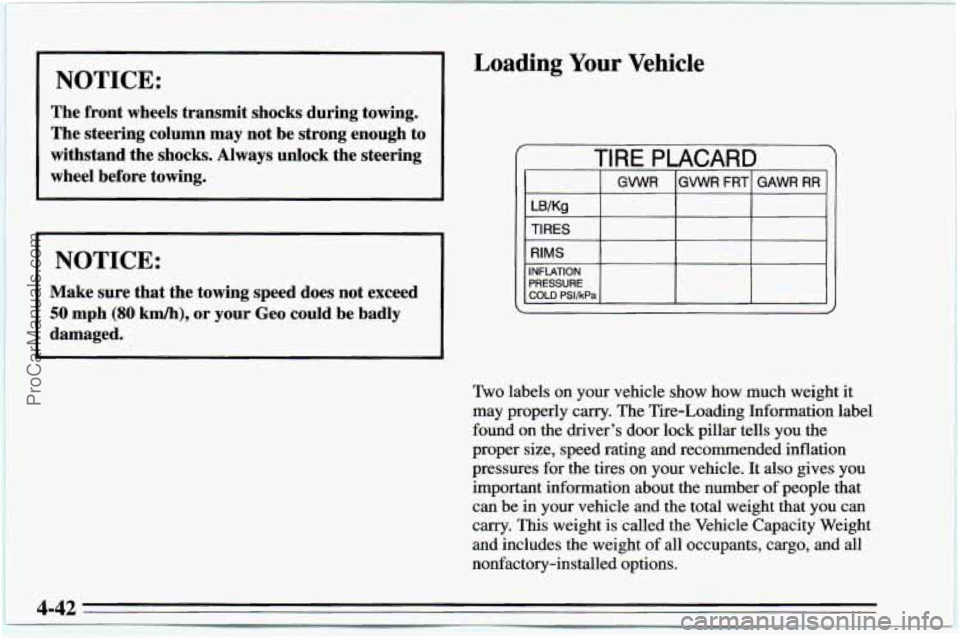
Two labels on your vehicle show how much weight it
may properly carry. The Tire-Loading Information label
found on the driver’s door lock pillar tells you the
proper size, speed rating and recommended inflation
pressures for the tires on your vehicle. It also gives you
important information about the number of people that
can be in your vehicle and the total weight that
you can
carry.
This weight is called the Vehicle Capacity Weight
and includes the weight of all occupants, cargo, and all
nonfactory-installed options.
4-42
ProCarManuals.com
Page 168 of 354
f :[:BY CAM1 AUTOMOTIVE CANADA GVWR GAWR FRT GAWR RR
The
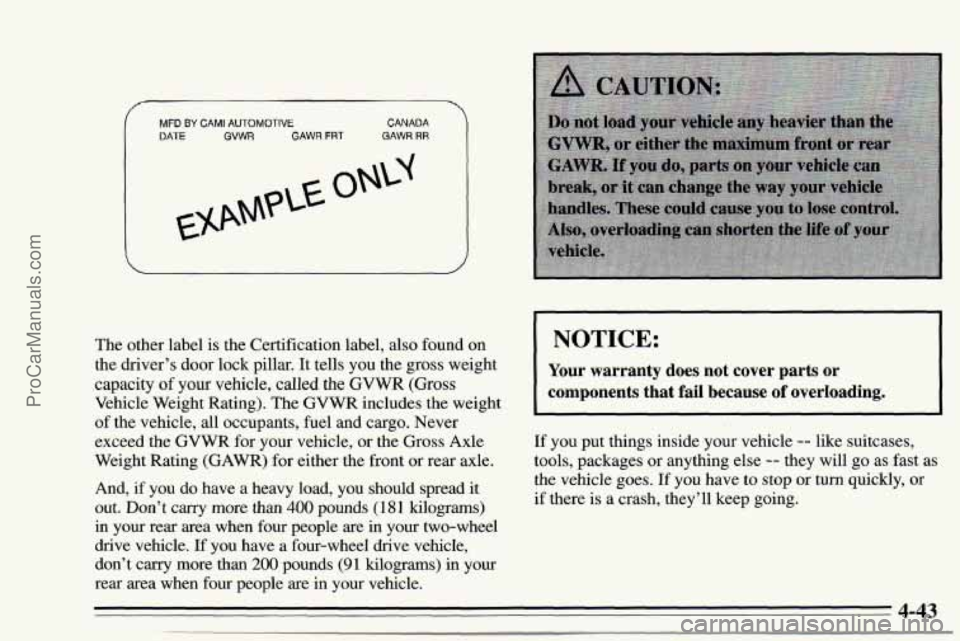
other label is the Certification label, also found on
the driver’s door lock pillar. It tells you the gross weight
capacity of your vehicle, called
the GVWR (Gross
Vehicle Weight Rating). The GVWR includes the weight
of the vehicle,
all occupants, fuel and cargo. Never
exceed the GVWR for your vehicle, or the Gross Axle
Weight Rating
(GAWR) for either the front or rear axle.
And,
if you do have a heavy load, you should spread it
out. Don’t
carry more than 400 pounds (181 kilograms)
in your rear area when four people are in your two-wheel
drive vehicle.
If you have a four-wheel drive vehicle,
don’t carry more than
200 pounds (9 1 kilograms) in your
rear area when four people are in your vehicle.
NOTICE:
Your warranty does not cover parts or
components that fail because
of overloading.
If you put things inside your vehicle -- like suitcases,
tools, packages or anything else
-- they will go as fast as
the vehicle goes. If
you have to stop or turn quickly, or
if there is a crash, they’ll keep going.
4-43
ProCarManuals.com
Page 184 of 354
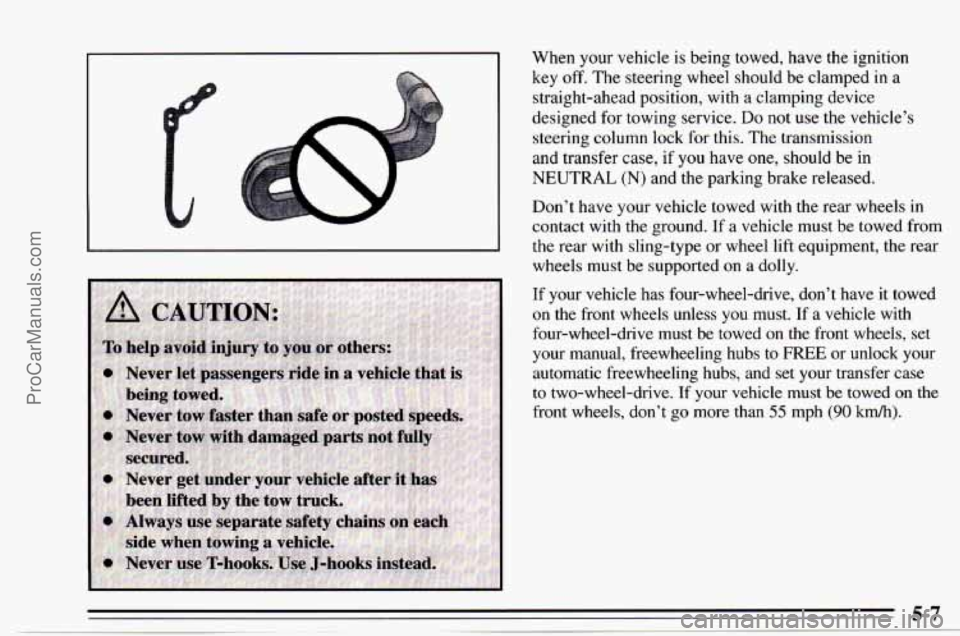
When your vehicle is being towed, have the ignition
key
off. The steering wheel should be clamped in a
straight-ahead position, with a clamping device
designed for towing service.
Do not use the vehicle’s
steering column lock
for this. The transmission
and transfer
case, if you have one, should be in
NEUTRAL (N) and the parking brake released.
Don’t have your vehicle towed with the rear wheels in
contact with the ground. If a vehicle must be towed from
the rear with sling-type or wheel lift equipment, the rear
wheels must be supported on a dolly.
If your vehicle has four-wheel-drive, don’t have it towed on
the front wheels unless you must. If a vehicle with
four-wheel-drive must be towed
on the front wheels, set
your manual, freewheeling hubs to FREE or unlock your
automatic freewheeling hubs, and set your transfer case
to two-wheel-drive. If
your vehicle must be towed on the
front wheels, don’t
go more than 55 mph (90 km/h).
5-7
ProCarManuals.com
Page 201 of 354
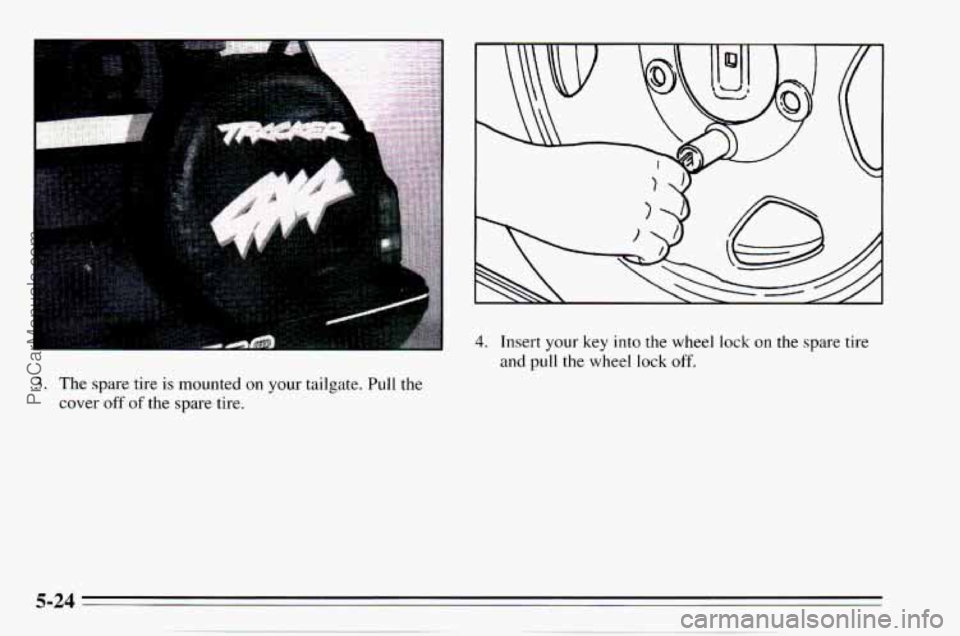
3. The spare tire is mounted on your tailgate. Pull the
cover off of the spare tire.
4. Insert your key into the wheel lock on the spare tire
and pull
the wheel lock off.
ProCarManuals.com
Page 202 of 354
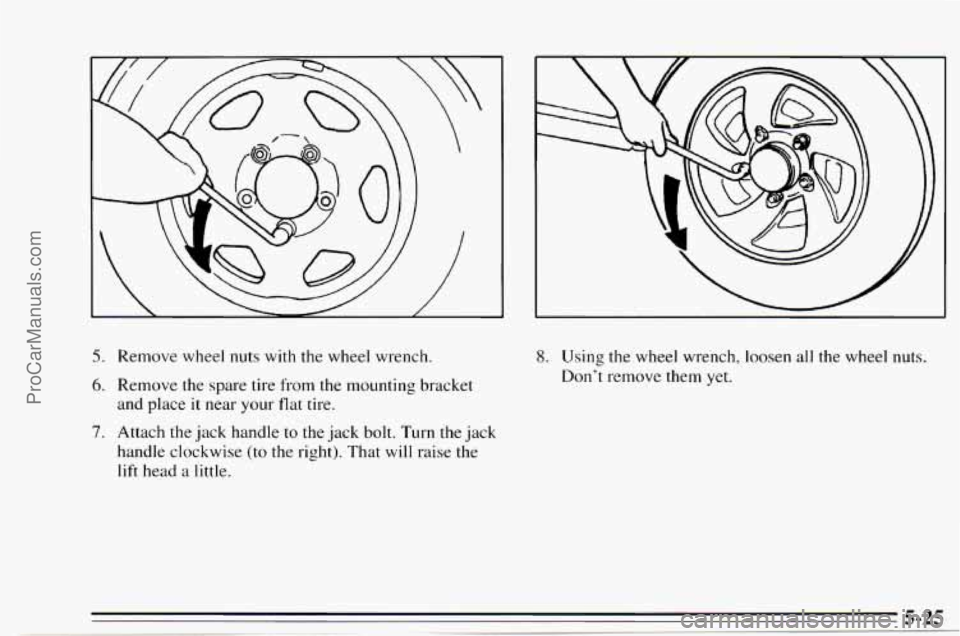
5. Remove wheel nuts with the wheel wrench.
6. Remove the spare tire from the mounting bracket
and place
it near your flat tire.
7. Attach the jack handle to the jack bolt. Turn the jack
handle clockwise
(to the right). That will raise the
lift head a little.
8. Using the wheel wrench, loosen all the wheel nuts.
Don’t remove them
yet.
5-25 - ProCarManuals.com