1995 CHEVROLET TRACKER tow
[x] Cancel search: towPage 73 of 354

Lamps On Reminder Windshield Wipermasher Lever
If you turn the ignition off, remove the key, open the
door and leave the lamps on, a chime will remind you to
turn
off your lamps.
Headlamp High/Low Beam
First, you must have the
headlamps on. For high
beams, push the turn signal
lever away from you. When
the high beams are
on, a
blue light on the instrument
panel also will be on.
It will
go
off when you switch to
low beam.
To switch back to low beams, pull the lever toward you.
Passing Signal
With the lever in the low beam position, pull the lever
toward you to momentarily switch to high beam (to
~ signal that you are going to pass). When you release the
lever, the headlamps will return to low beam operation. The lever
on the right side
of the steering column
controls the windshield wipers
and washers.
Move the wiper switch to the position you want:
OFF: The wipers are off.
INT: Intermittent wiper operation. In light rain or snow,
you might want
to use this position rather than
continuous wiping.
LO: The wipers will run continuously at low speed.
2-30
ProCarManuals.com
Page 74 of 354

HI: The wipers will run continuously at high speed.
For a single wiping cycle, push the lever to MIST. Hold
it there until the wipers start, then let go. The wipers will
stop after one cycle.
If you want more cycles, hold the
lever on MIST longer.
Washers
Pull the wipedwasher lever toward you to spray washer
fluid on the windshield. The spray will continue until
you release the lever. This will also turn on the low
speed wipers.
Be sure to clear ice and snow from the wiper blades
before using them. If they’re frozen to the windshield,
carefully loosen or thaw them.
If your blades do become
damaged, get new blades or blade inserts.
Heavy snow or ice can overload your wipers.
A circuit
breaker will stop them until the motor cools. Clear away
snow or ice to prevent an overload.
When using concentrated washer fluid,
follow the manufacturer’s instructions for
adding water.
Don’t mix water with ready-to-use washer
fluid. Water can cause the solution to freeze
and damage your washer fluid tank and
other parts
of the washer system. Also,
water doesn’t clean as well as washer fluid.
Fill your washer fluid tank only
3/4 full
when it’s very cold.
This allows for
expansion, which could damage the tank
if
it is completely full.
Don’t
use radiator antifteeze in your
windshield washer.
It can damage your paint.
2-31
ProCarManuals.com
Page 88 of 354

Brake System Warning Light
BRAKE
United States Canada
Your Geo’s
hydraulic brake system is divided into two
parts. If one part isn’t working, the other part can still
work and stop you. For good braking, though, you need
both
parts working well.
Your vehicle also has rear-wheel anti-lock brakes. If the
warning light comes on, there could be a brake problem
with either your regular or rear-wheel anti-lock brakes,
or both. Have your brake system inspected right away.
This light should come on briefly as you start the
vehicle.
If it doesn’t come on then, have it fixed so it
will be ready to warn you if there’s a problem. If
the light comes on while you are driving, pull
off the
road and stop carefully.
You may notice that the pedal is
harder to push. Or, the pedal may
go closer to the floor.
It may take longer to stop.
If the light is still on, have the
vehicle towed
for service. (See “Towing Your Vehicle”
in the Index.)
The brake system warning light will also come on when
you set your parking brake, and it will stay on if your
parking brake doesn’t release fully. If it stays on after
your parking brake is fully released, it means you have
a
brake problem.
~ ..
2-45
ProCarManuals.com
Page 106 of 354
Gem Section 3 Comfort Controls and Audio Systems
In this section you’ll find out how to operate the comfort
control systems and audio systems offered
with your
Geo. Be sure to read about the particular system
supplied with your vehicle.
Comfort Controls
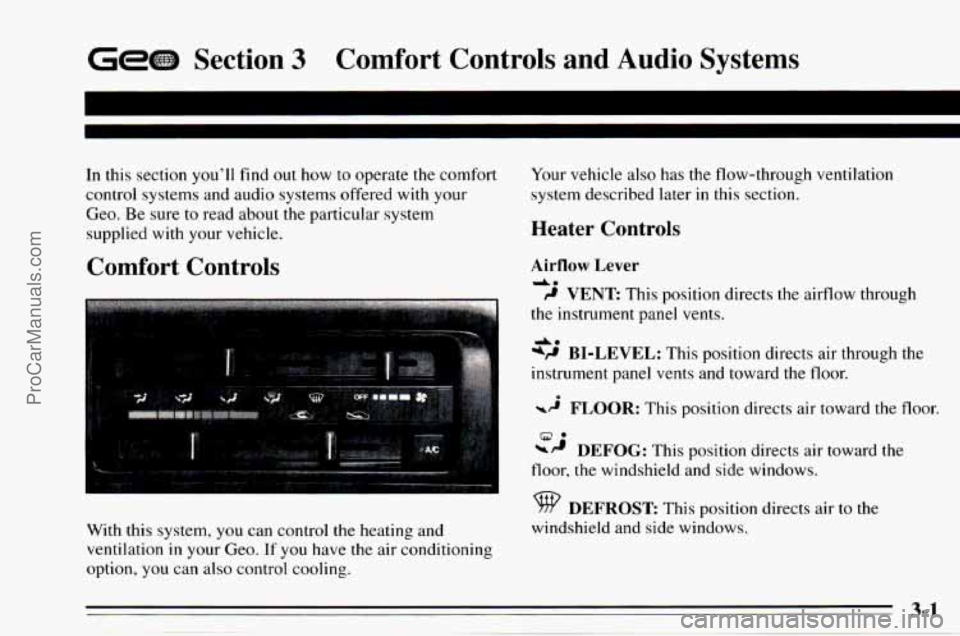
With this system, you can control the heating and
ventilation
in your Geo. If you have the air conditioning
option, you can
also control cooling. Your
vehicle also has the flow-through ventilation
system described later
in this section.
Heater Controls
Airflow Lever
da
9 VENT This position directs the airflow through
the instrument panel vents.
*P BI-LEVEL: This position directs air through the
instrument panel vents and toward
the floor.
-2 FLOOR: This position directs air toward the floor.
DEFOG: This position directs air toward the
A*
9.
floor, the windshield and side windows.
DEFROST This position directs air to the
windshield and side windows.
ProCarManuals.com
Page 107 of 354
Fan Control Lever Bi-Level
Slide the lever away from OFF to turn the heating
system on. Move the lever toward FAN
to increase the
fan’s speed.
Temperature Control Lever
Slide the lever to change the temperature of the air
flowing from the system. Move it to the right for warmer
air and
to the left for cooler air. The air temperature can’t
be less than the outside air temperature.
Air Intake Lever
RECIRCULATE:
Choose this position to
recirculate the inside air through
the comfort control
system.
outside air through the comfort control system.
CIRCULATE: Choose this position to circulate
Heating
For the quickest results, move the air intake lever to
RECIRCULATE. Move the airflow lever to FLOOR, the
temperature control lever toward the right for warmer
air and the fan control lever toward FAN.
You should
switch
to CIRCULATE once in a while to avoid stale air
and cloudy windows.
You may want to use bi-level on cool, but sunny days.
This setting directs outside air toward your body and
warmer air toward your feet.
Move the air intake lever to CIRCULATE and the
airflow lever to
BI-LEVEL. Move the temperature
control lever to the center and the fan control lever
toward FAN.
Ventilation
For mild outside temperatures, when little heating or
cooling is needed, you can still direct outside air through
your vehicle.
Move the air intake lever to CIRCULATE and
the
airflow lever to BI-LEVEL. Adjust the temperature
control lever to a comfortable setting and move the fan
control lever to FAN.
Defogging and Defrosting Windows
Slide the air intake lever to CIRCULATE and the
airflow lever to DEFROST
to direct air to the
windshield vents. Then slide the temperature control
lever toward the right and the fan control lever to FAN.
When the windshield is clear, turn down the fan speed.
ProCarManuals.com
Page 108 of 354
Air Conditioner Controls (Option)
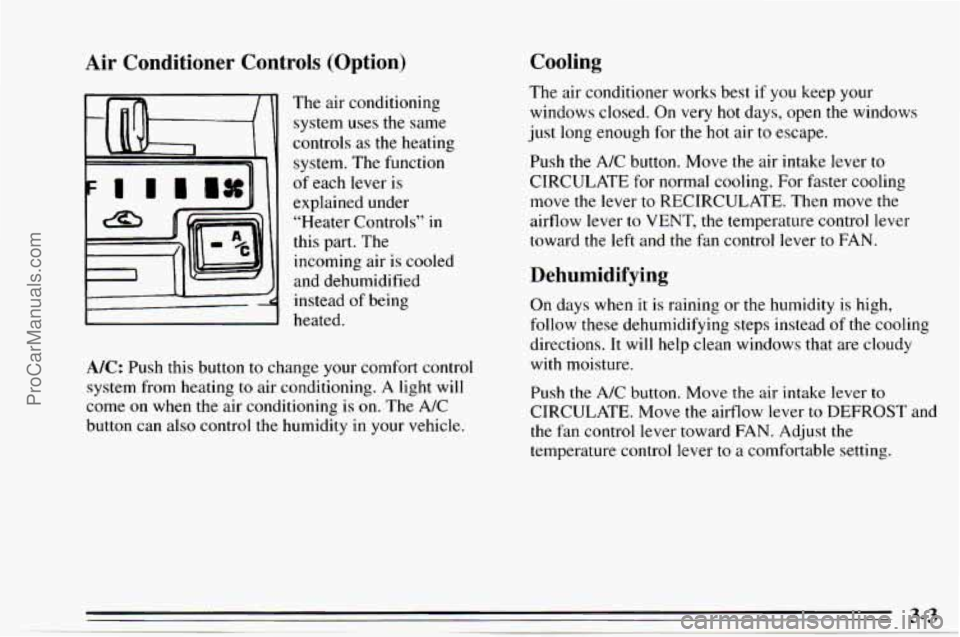
The air conditioning
system uses
the same
controls
as the heating
system. The function
of each lever is
explained under
“Heater Controls”
in
this part. The
incoming air
is cooled
and dehumidified
instead of being
heated.
A/C: Push this button to change your comfort control
system from heating
to air conditioning. A light will
come on when the air conditioning is on. The A/C
button can also control the humidity in your vehicle.
Cooling
The air conditioner works best if you keep your
windows closed. On very hot days, open the windows
just
long enough for the hot air to escape.
Push the
A/C button. Move the air intake lever to
CIRCULATE for normal cooling. For faster cooling
move the lever to RECIRCULATE, Then move the
airflow lever to VENT, the temperature control lever
toward the left and the
fan control lever to FAN.
Dehumidifying
On days when it is raining or the humidity is high,
follow these dehumidifying steps instead
of the cooling
directions.
It will help clean windows that are cloudy
with moisture.
Push
the A/C button. Move the air intake lever to
CIRCULATE. Move the airflow lever to DEFROST and
the
fan control lever toward FAN. Adjust the
temperature control lever to a comfortable setting.
ProCarManuals.com
Page 109 of 354
Rear Window Defogger
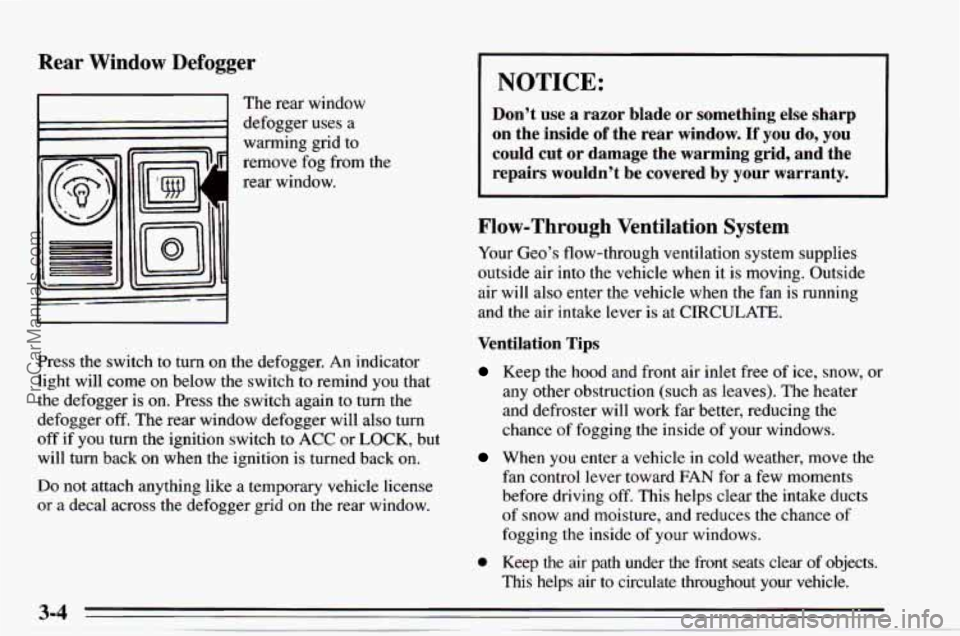
I I The rear window
1 defogger uses a
warming grid
to
remove fog from the
rear window.
Press the switch
to turn on the defogger. An indicator
light will come on below the switch to remind you that
the defogger is
on. Press the switch again to turn the
defogger
off. The rear window defogger will also turn
off if you turn the ignition switch to ACC or LOCK, but
will turn back on when the ignition
is turned back on.
Do not attach anything like a temporary vehicle license
or a decal across the defogger grid on the rear window.
I NOTICE:
Don’t use a razor blade or something else sharp
on the inside
of the rear window. If you do, you
could cut or damage the warming grid, and the
repairs wouldn’t be covered by
your warranty.
Flow-Through Ventilation System
Your Geo’s flow-through ventilation system supplies
outside air into the vehicle when it is moving. Outside
air will also enter the vehicle when the fan
is running
and the air intake lever is at CIRCULATE.
Ventilation Tips
Keep the hood and front air inlet free of ice, snow, or
any other obstruction (such as leaves). The heater
and defroster will work far better, reducing the
chance of fogging the inside of your windows.
When you enter a vehicle in cold weather, move the
fan control lever toward FAN for a few moments
before driving
off. This helps clear the intake ducts
of snow and moisture, and reduces the chance of
fogging the inside of your windows.
0 Keep the air path under the front seats clear of objects.
This helps air to circulate throughout your vehicle.
ProCarManuals.com
Page 165 of 354
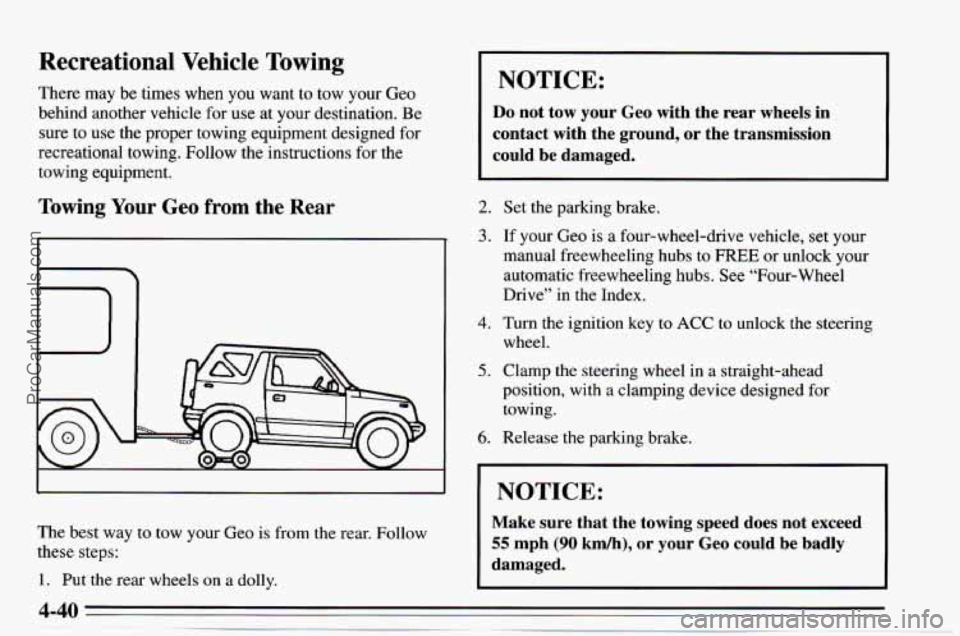
Recreational Vehicle Towing
There may be times when you want to tow your Geo
behind another vehicle for use at your destination. Be
sure to use the proper towing equipment designed for
recreational towing. Follow the instructions for the
towing equipment.
Towing Your Geo from the Rear
The best way to cow your Geo is from the rear. Follow
these steps:
1. Put the rear wheels on a dolly.
I NOTICE:
Do not tow your Geo with the rear wheels in
contact with the ground,
or the transmission
could be damaged.
2. Set the parking brake.
3. If your Geo is a four-wheel-drive vehicle, set your
manual freewheeling hubs
to FREE or unlock your
automatic freewheeling hubs. See “Four-wheel
Drive” in the Index.
4. Turn the ignition key to ACC to unlock the steering
5. Clamp the steering wheel in a straight-ahead
wheel.
position, with a clamping device designed for
towing.
6. Release the parking brake.
NOTICE:
Make sure that the towing speed does not exceed
55 mph
(90 km/h), or your Geo could be badly
damaged.
ProCarManuals.com