Page 59 of 354
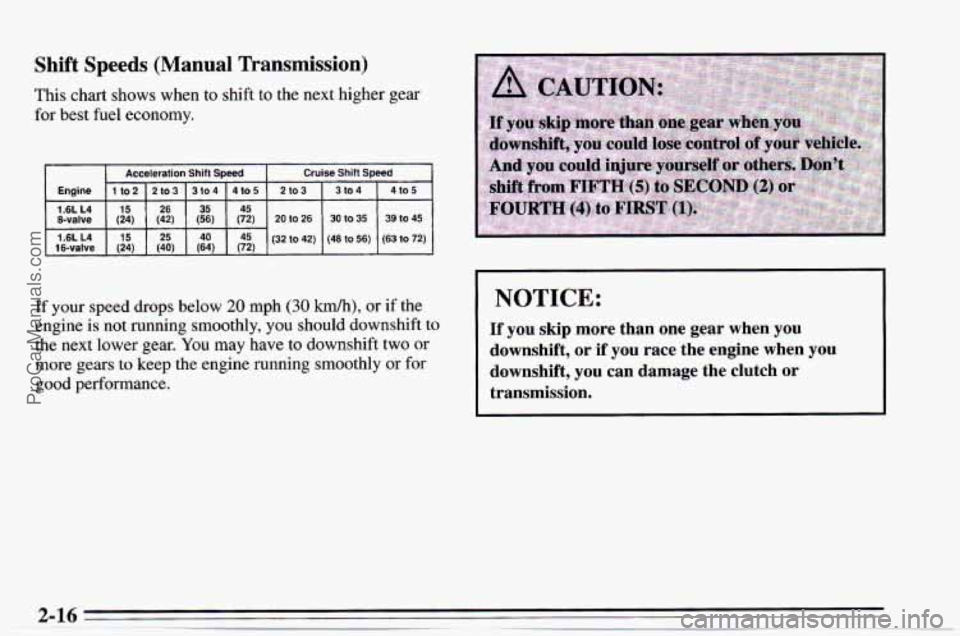
Shift Speeds (Manual Transmission)
This chart shows when to shift to the next higher gear
for best fuel economy.
Acceleration Shift Speed Cruise Shift Speed
1t02 I2to3 I3to4 f4to5 2to3 I 3to4 I 4to5 1 1.6L L4 15 26 35 45
&valve (24) (42) (56) (72) 20 to 26 30 to 35 39 to 45
16-valve (24)
(40) (64) (72)
1.6L L4 15 25
40 45 (32 to 42) (48 to 56) (63 to 72)
If your speed drops below 20 mph (30 km/h), or if the
engine is not running smoothly,
you should downshift to
the next lower gear. You may have to downshift two or
more gears to keep the engine running smoothly or for
good performance.
I NOTICE:
If you skip more than one gear when you
downshift, or if you race the engine when you
downshift,
you can damage the clutch or
transmission.
ProCarManuals.com
Page 61 of 354
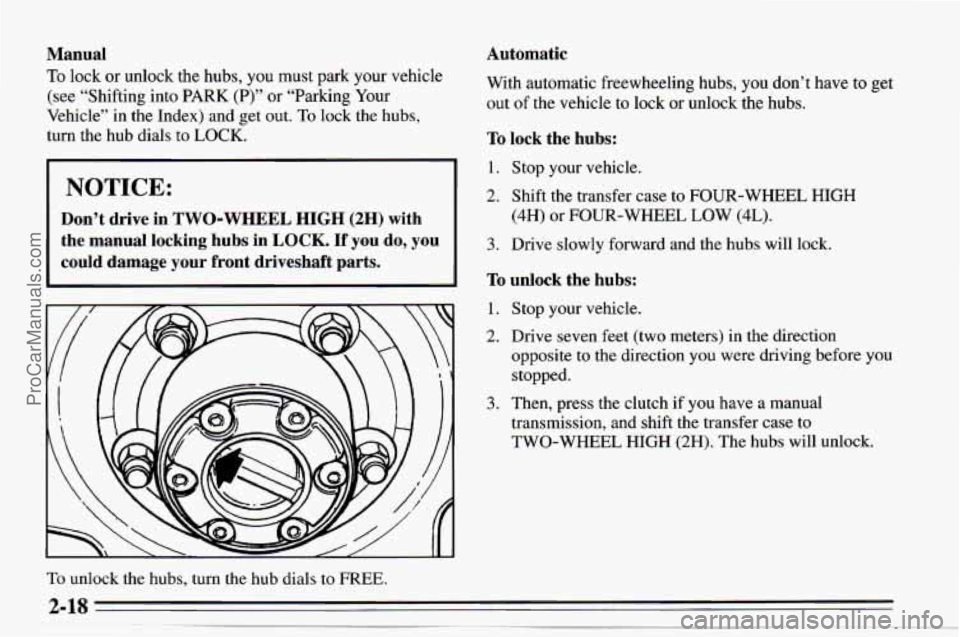
Manual
To lock or unlock the hubs, you must park your vehicle
(see “Shifting into
PARK (P)” or “Parking Your
Vehicle” in the Index) and get out.
To lock the hubs,
turn the hub dials
to LOCK.
NOTICE:
Don’t drive in TWO-WHEEL HIGH (2H) with
the manual locking hubs in
LOCK. If you do, you
could damage your front driveshaft parts.
To unlock the hubs, turn the hub dials to FREE.
Automatic
With automatic freewheeling hubs, you don’t have to get
out of the vehicle to lock or unlock the hubs.
To lock the hubs:
1. Stop your vehicle.
2. Shift the transfer case to FOUR-WHEEL HIGH
(4H)
or FOUR-WHEEL LOW (4L).
3. Drive slowly forward and the hubs will lock.
To unlock the hubs:
1. Stop your vehicle.
2. Drive seven feet (two meters) in the direction
opposite to the direction you were driving before you
stopped.
transmission, and shift the transfer case to
TWO-WHEEL HIGH (2H). The hubs will unlock.
3. Then, press the clutch if you have a manual
ProCarManuals.com
Page 63 of 354
You can shift from TWO-WHEEL HIGH (2H) to
FOUR-WHEEL HIGH (4H) or from FOUR-WHEEL
HIGH
(4H) to TWO-WHEEL HIGH (2H) at any speed
if your hubs are locked and your wheels are straight
ahead. Your front axle will engage faster if
you take
your foot
off the accelerator pedal for a few seconds as
you shift.
To shift into or out of FOUR-WHEEL LOW (4L):
1. Stop your vehicle and shift your transmission to
2. Shift the
transfer case in one continuous motion.
NEUTRAL (N).
Don’t pause in NEUTRAL (N) as you shift into
FOUR-WHEEL HIGH (4H), or your gears could clash.
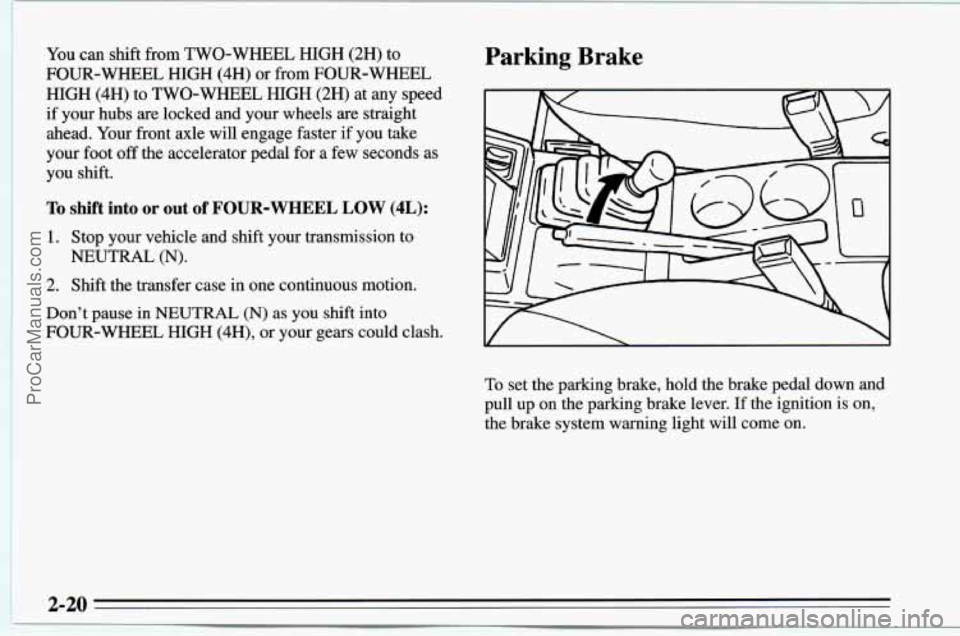
Parking Brake
To set the parking brake, hold the brake pedal down and
pull up on the parking brake lever. If the ignition is on,
the brake system warning light will come
on.
2-20
ProCarManuals.com
Page 64 of 354
Shifting Into PARK (P) (Automatic
Transmission
Models Only)
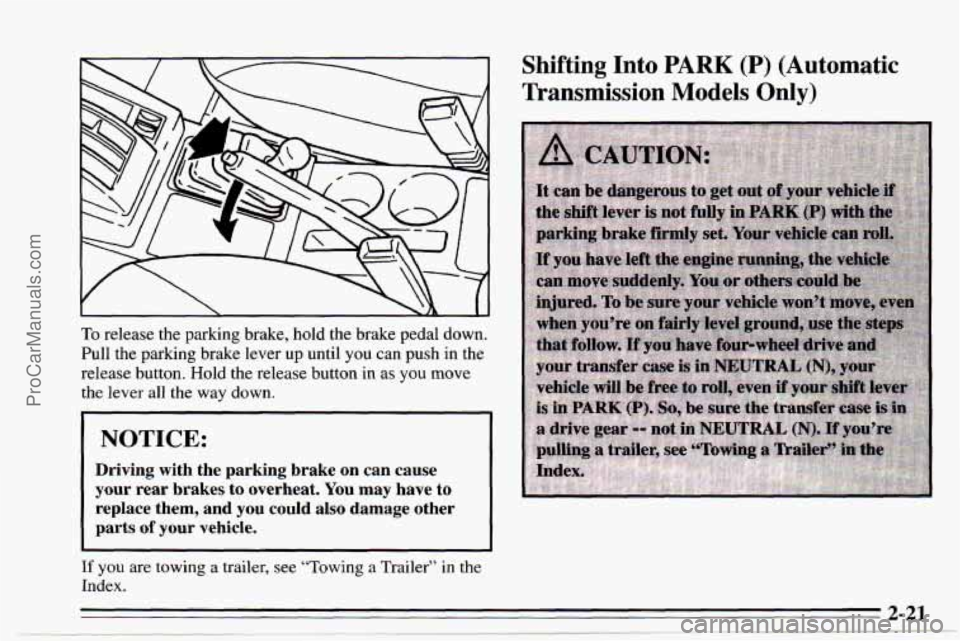
To release the parking brake, hold the brake pedal down.
Pull the parking brake lever up until you can push in the
release button. Hold the release button
in as you move
the lever all the way down.
I 1
I NOTICE: I
Driving with the parking brake on can cause
your rear brakes
to overheat. You may have to
replace them, and you could also damage other
parts
of your vehicle.
If you are towing a trailer, see “Towing a Trailer” in the
Index.
2-21
ProCarManuals.com
Page 65 of 354
1.
2.
3.
4.
5.
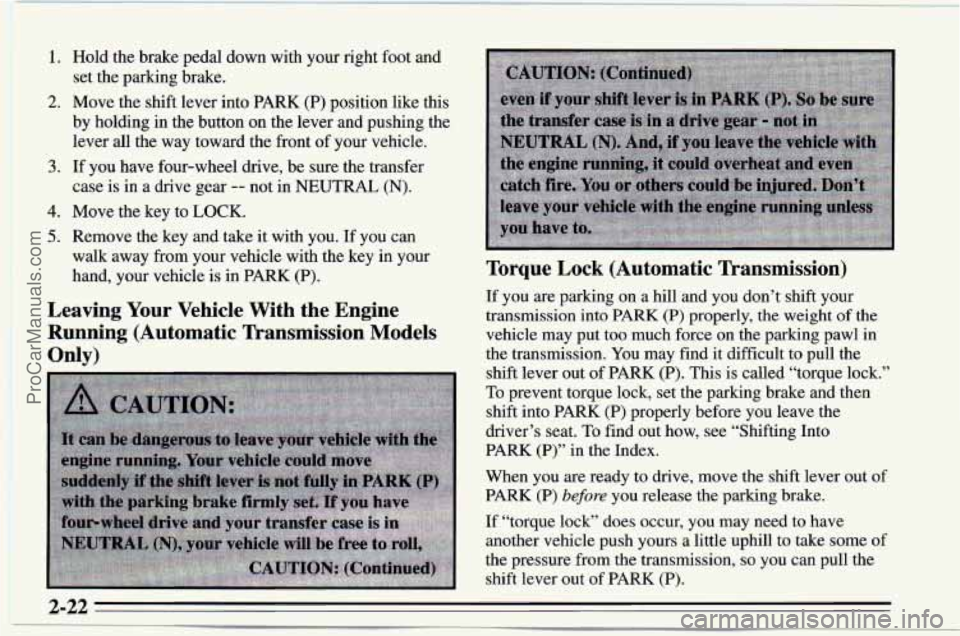
Hold the brake pedal down with your right foot and
set the parking brake.
Move the shift lever into PARK
(P) position like this
by holding
in the button on the lever and pushing the
lever all the way toward the front of your vehicle.
If you have four-wheel drive, be sure the transfer
case is in a drive gear
-- not in NEUTRAL (N).
Move the key to LOCK.
Remove the key and take it with you. If you can
walk away
from your vehicle with the key in your
hand, your vehicle is in PARK (P).
Leaving Your Vehicle With the Engine
Running (Automatic Transmission Models
Only) Torque Lock (Automatic Transmission)
If you
are parking on a hill and you don’t shift your
transmission
into PARK (P) properly, the weight of the
vehicle may put too much force
on the parking pawl in
the transmission. You may find it difficult to pull the
shift lever out
of PARK (P). This is called “torque lock.”
To prevent torque lock, set the parking brake and then
shift into PARK (P) properly before you leave the
driver’s seat. To find out how, see “Shifting Into
PARK (P)” in the Index.
When you are ready to drive, move the shift lever out of
PARK (P)
before you release the parking brake.
If “torque lock” does occur, you may need to have
another vehicle push yours a little uphill to take some of
the pressure from the transmission,
so you can pull the
shift lever out of PARK
(P).
2-22
ProCarManuals.com
Page 66 of 354
Shifting Out of PARK (P)
(Automatic Transmission)
Your Geo has a brake-transmission shift interlock. You
have to fully
apply your regular brakes before you can
shift from PARK
(P) when the ignition is in the ON
position. See “Automatic Transmission” in the Index.
If you cannot shift out of
PARK (P), ease pressure on
the shift lever -- push the shift lever all the way into
PARK
(P) and release the shift lever button as you
maintain brake application. Then press the shift lever
button and move the shift lever into the gear you wish. If
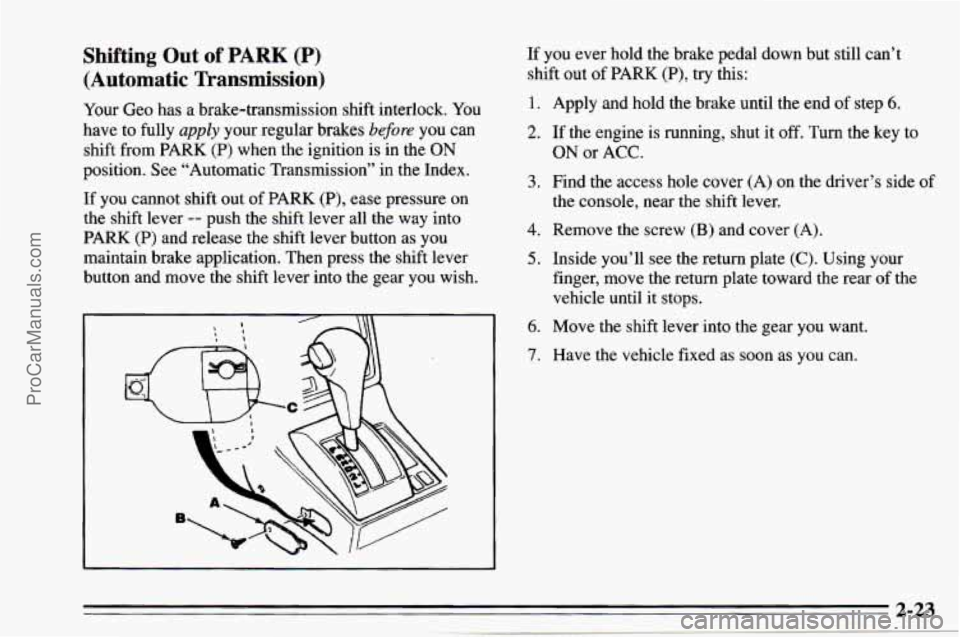
you ever hold the brake pedal down but still can’t
shift out of
PARK (P), try this:
1. Apply and hold the brake until the end of step 6.
2. If the engine is running, shut it off. Turn the key to
3. Find the access hole cover (A) on the driver’s side of
4. Remove the screw (B) and cover (A).
5. Inside you’ll see the return plate (C). Using your
ON or ACC.
the console, near the shift lever.
finger, move the return plate toward the rear of the
vehicle until it stops.
6. Move the shift lever into the gear you want.
7. Have the vehicle fixed as soon as you can.
2-23
ProCarManuals.com
Page 67 of 354
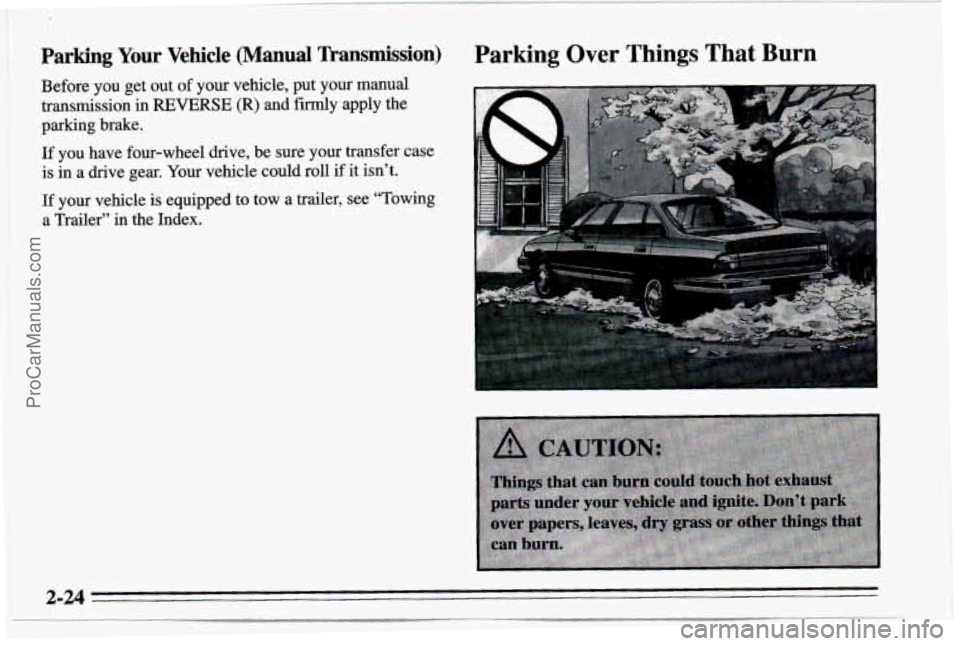
Parking Your Vehicle (Manual mansmission)
Before you get out of your vehicle, put your manual
transmission in
REVERSE (R) and firmly apply the
parking brake.
If you have four-wheel drive, be sure your transfer case
is in a drive gear. Your vehicle could roll
if it isn’t.
If your vehicle is equipped to tow a trailer, see “Towing
a Trailer” in the Index.
Parking Over Things That Burn
2-24
ProCarManuals.com
Page 68 of 354
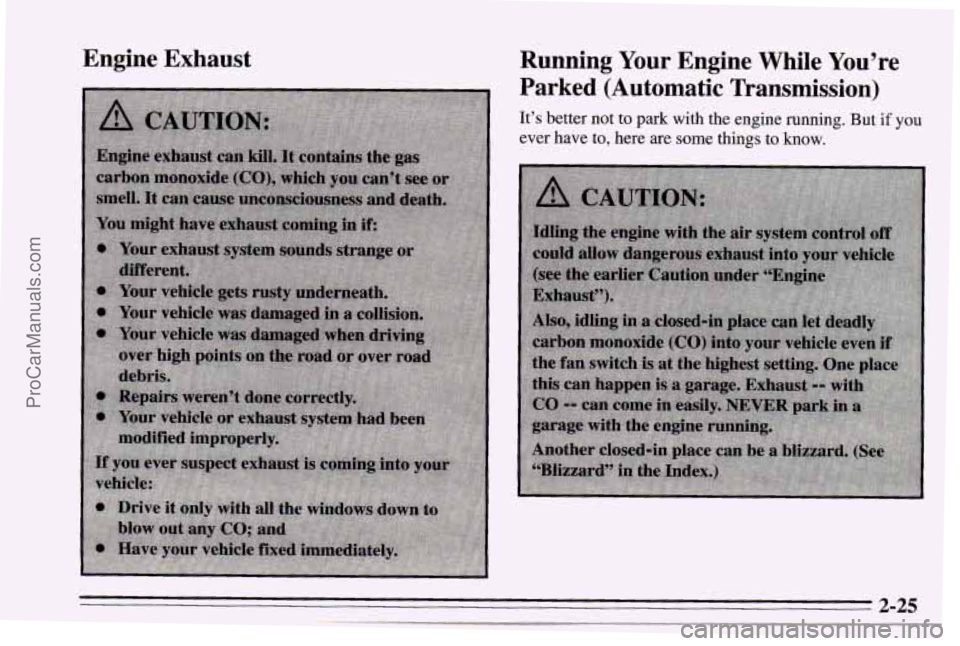
Engine Exhaust Running Your Engine While You’re
Parked (Automatic Transmission)
It’s better not to park with the engine running. But if vou
ever have to, here are some things to know.
2-25
ProCarManuals.com