Page 84 of 354
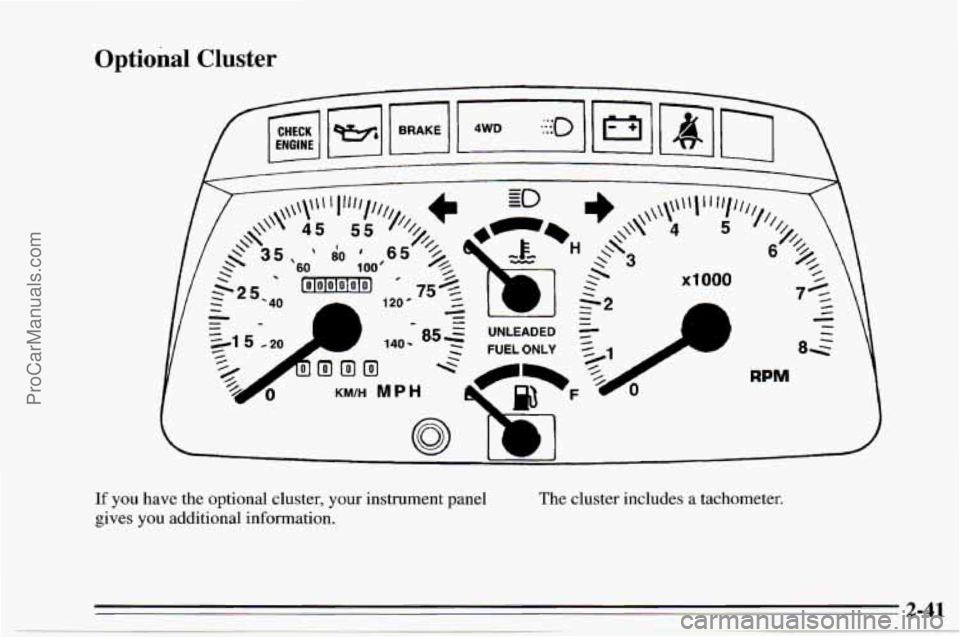
Optional Cluster
x1 000
If you have the optional cluster, your instrument panel
gives you additional information. The
cluster includes a tachometer.
ProCarManuals.com
Page 92 of 354
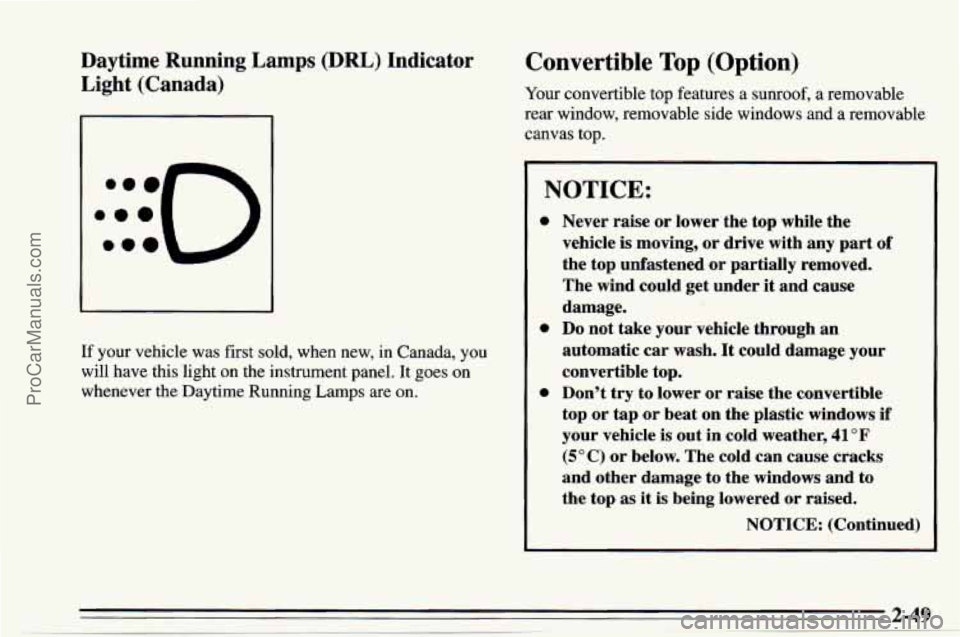
Daytime Running Lamps (DRL) Indicator
Light (Canada)
If your vehicle was first sold, when new, in Canada, you
will have this light on the instrument panel. It goes on
whenever the Daytime Running Lamps are
on.
Convertible Top (Option)
Your convertible top features a sunroof, a removable
rear window, removable side windows and a removable
canvas top.
NOTICE:
0
0
0 Never raise or lower the top while the
vehicle is moving, or drive with any part of
the top unfastened or partially removed.
The wind could get under it and cause
damage.
Do not take your vehicle through an
automatic car wash.
It could damage your
convertible top.
Don’t
try to lower or raise the convertible
top or tap or beat on the plastic windows if
your vehicle is out in cold weather,
41°F
(5OC) or below. The cold can cause cracks
and other damage to the windows and to
the top as it is being lowered or raised.
NOTICE: (Continued)
ProCarManuals.com
Page 106 of 354
Gem Section 3 Comfort Controls and Audio Systems
In this section you’ll find out how to operate the comfort
control systems and audio systems offered
with your
Geo. Be sure to read about the particular system
supplied with your vehicle.
Comfort Controls
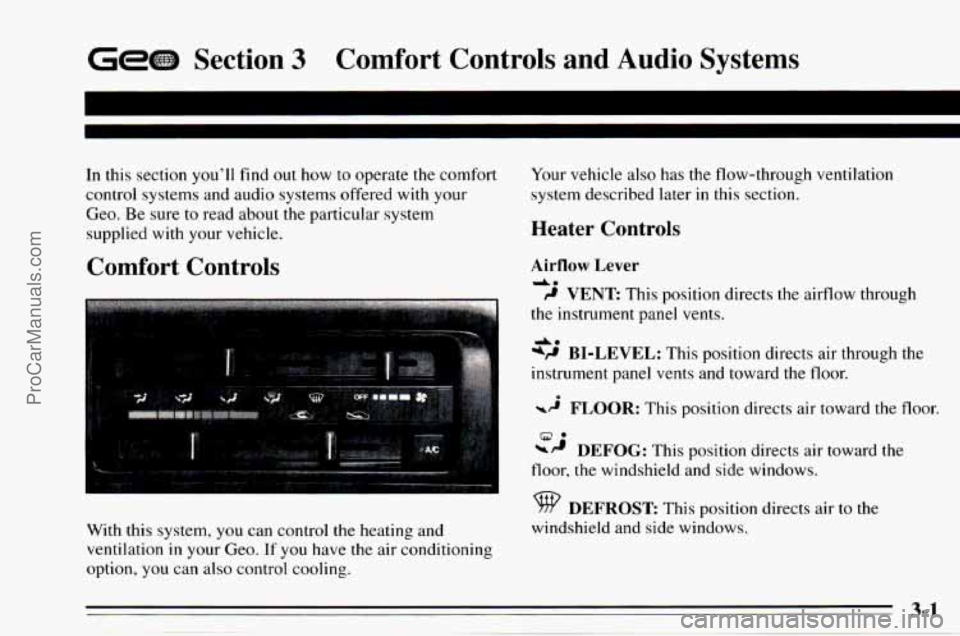
With this system, you can control the heating and
ventilation
in your Geo. If you have the air conditioning
option, you can
also control cooling. Your
vehicle also has the flow-through ventilation
system described later
in this section.
Heater Controls
Airflow Lever
da
9 VENT This position directs the airflow through
the instrument panel vents.
*P BI-LEVEL: This position directs air through the
instrument panel vents and toward
the floor.
-2 FLOOR: This position directs air toward the floor.
DEFOG: This position directs air toward the
A*
9.
floor, the windshield and side windows.
DEFROST This position directs air to the
windshield and side windows.
ProCarManuals.com
Page 174 of 354
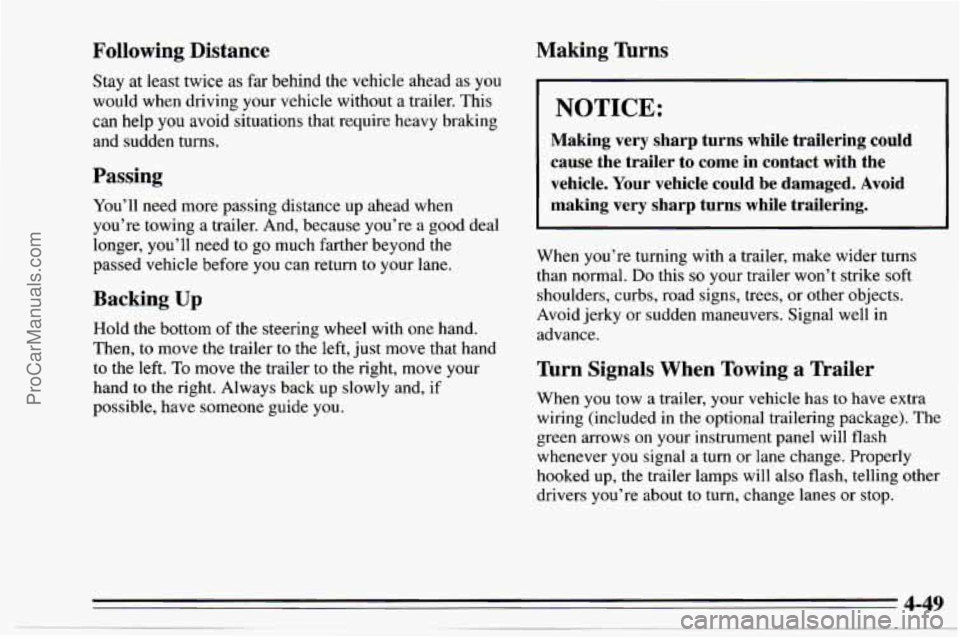
Following Distance
Stay at least twice as far behind the vehicle ahead as you
would when driving your vehicle without a trailer. This
can help you avoid situations that require heavy braking
and sudden turns.
Making lhrns
Passing
You’ll need more passing distance up ahead when
you’re towing a trailer. And, because you’re a good deal
longer, you’ll need to go much farther beyond the
passed vehicle before you can return to your lane.
Backing Up
Hold the bottom of the steering wheel with one hand.
Then, to move the trailer to the left, just move that hand
to the left.
To move the trailer to the right, move your
hand to the right. Always back up slowly and, if
possible, have someone guide you.
I NOTICE:
Making very sharp turns while trailering could
cause the trailer to come in contact with the
vehicle.
Your vehicle could be damaged. Avoid
making very
sharp turns while trailering.
When you’re turning with a trailer, make wider turns
than normal.
Do this so your trailer won’t strike soft
shoulders, curbs, road signs, trees, or other objects.
Avoid jerky or sudden maneuvers. Signal well in
advance.
Turn Signals When Towing a Trailer
When you tow a trailer, your vehicle has to have extra
wiring (included in the optional trailering package). The
green arrows on your instrument panel will flash
whenever you signal a turn or lane change. Properly
hooked up, the trailer lamps will also flash, telling other
drivers you’re about to turn, change lanes or stop.
ProCarManuals.com
Page 175 of 354

When towing a trailer, the green arrows on your
instrument panel will flash for turns even if the bulbs on
the trailer are burned out. Thus, you may think drivers
behind you are seeing your signal when
they are not. It’s
important to check occasionally to be sure the trailer
bulbs are still working.
Driving On Grades
Reduce speed and shift to a lower gear before you start
down a long or steep downgrade.
If you don’t shift
down, you might have to
use your brakes so much that
they would get hot and no longer work well.
On a long uphill grade, shift down and reduce your
speed
to around 45 mph (70 km/h) to reduce the
possibility of engine and transmission overheating.
If you are towing a trailer and you have a manual
transmission with fifth gear, you may prefer not to use
fifth gear. Just drive in fourth gear (or,
as you need to, a
lower gear).
Parking on Hills
You really should not park your vehicle, with a trailer
attached,
on a hill. If something goes wrong, your rig
could start
to move. People can be injured, and both
your vehicle and the trailer can be damaged.
But if you ever have to park your rig on a hill, here’s
how to do it:
1. Apply your regular brakes, but don’t shift into
PARK
(P) yet, or into gear for a manual
transmission.
2. Have someone place chocks under the trailer wheels.
3. When the wheel chocks are in place, release the
regular brakes until the chocks absorb the load.
4. Reapply the regular brakes. Then apply your parking
brake, and then shift to PARK
(P), or REVERSE (R)
for a manual transmission.
5. If you have a four-wheel drive vehicle, be sure
the transfer case is
in a drive gear -- not in
NEUTRAL
(N).
6. Release the regular brakes.
ProCarManuals.com
Page 188 of 354
c
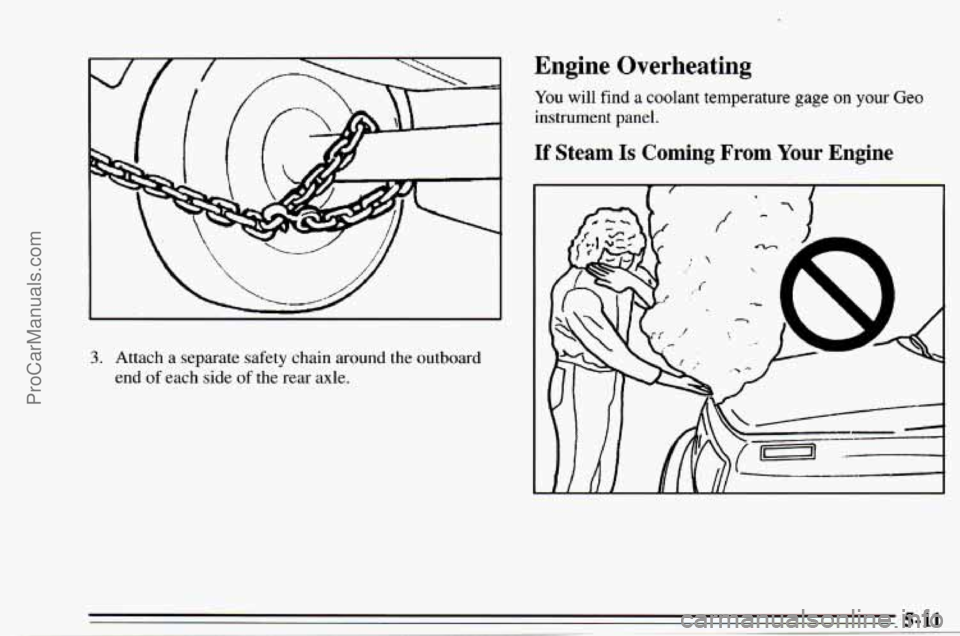
3. Attach a separate safety chain around the outboard
end
of each side of the rear axle.
Engine Overheating
You will find a coolant temperature gage on your Geo
instrument panel.
If Steam Is Coming From Your Engine
ProCarManuals.com
Page 263 of 354
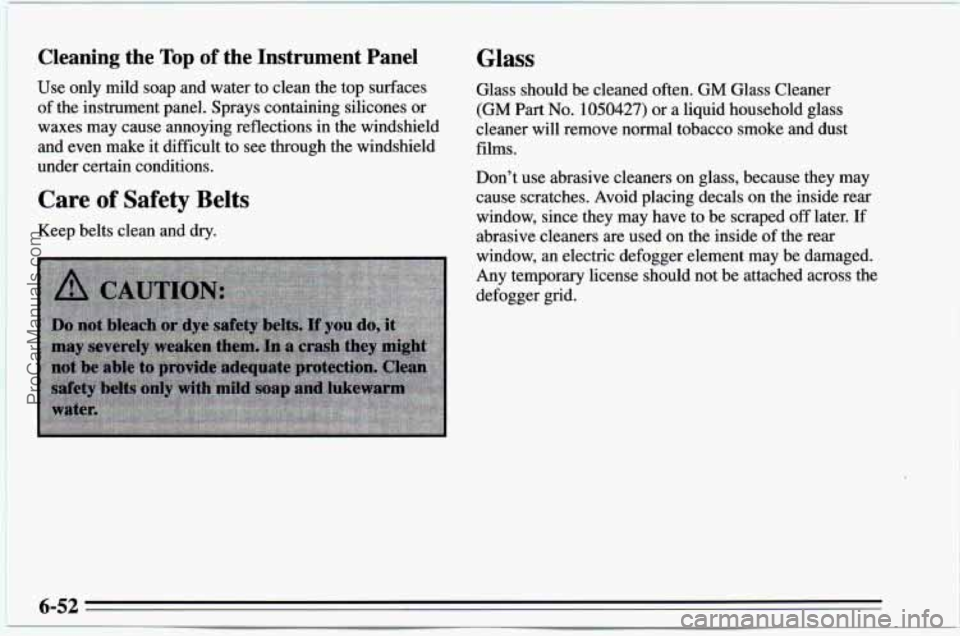
Cleaning the Top of the Instrument Panel
Use only mild soap and water to clean the top surfaces
of the instrument panel. Sprays containing silicones or
waxes may cause annoying reflections in the windshield
and even make it difficult to see through the windshield
under certain conditions.
Care of Safety Belts
Keep belts clean and dry.
Glass
Glass should be cleaned often. GM Glass Cleaner
(GM Part No. 1050427) or a liquid household glass
cleaner will remove normal tobacco smoke and dust
films.
Don’t use abrasive cleaners on glass, because they may
cause scratches. Avoid placing decals on the inside rear
window, since they may have to be scraped
off later. If
abrasive cleaners are used on the inside of the rear
window, an electric defogger element may be damaged.
Any temporary license should not be attached across the
defogger grid.
ProCarManuals.com
Page 270 of 354
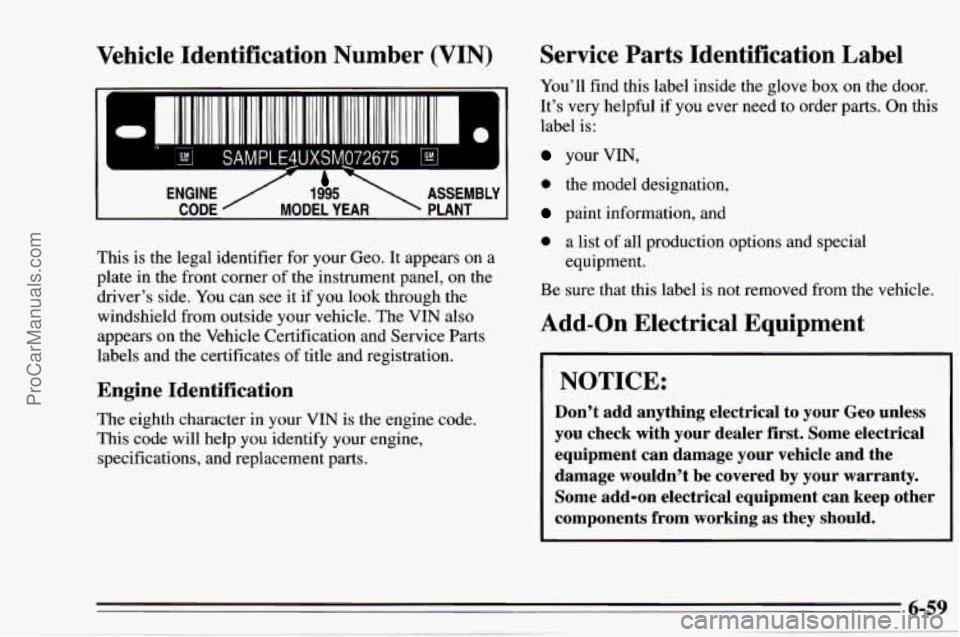
Vehicle Identification Number (VIN)
lli Iiilll Ill1 iilllllilll
1
I
SAMPLE4UXSMJ72675 45s- 1
(. CODE MODEL YEAR PLANT
ENGINE
/ 1995 ASSEMBLY I
Service Parts Identification Label
You’ll
find this label inside the glove box on the door.
It’s
very helpful if you ever need to order parts. On this
label is:
your VIN,
This is the legal identifier for your Geo. It appears on
a
plate in the front corner of the instrument panel, on the
driver’s side. You can see it if you look through the
windshield from outside your vehicle. The VIN also
appears
on the Vehicle Certification and Service Parts
labels and the certificates of title and registration.
Engine Identification
The eighth character in your VIN is the engine code.
This code will help you identify your engine,
specifications, and replacement parts.
0 the model designation,
paint information, and
0 a list of all production options and special
equipment.
Be sure that this label
is not removed from the vehicle.
Add-on Electrical Equipment
NOTICE:
Don’t add anything electrical to your Geo unless
you check with your dealer first. Some electrical equipment can damage your vehicle and the
damage wouldn’t be covered by your warranty. Some add-on electrical equipment can keep other
components from working as they should.
ProCarManuals.com