Page 193 of 354
I NOTICE:
In cold weather, water can freeze and crack the
engine, radiator, heater core and other parts. Use
the recommended coolant.
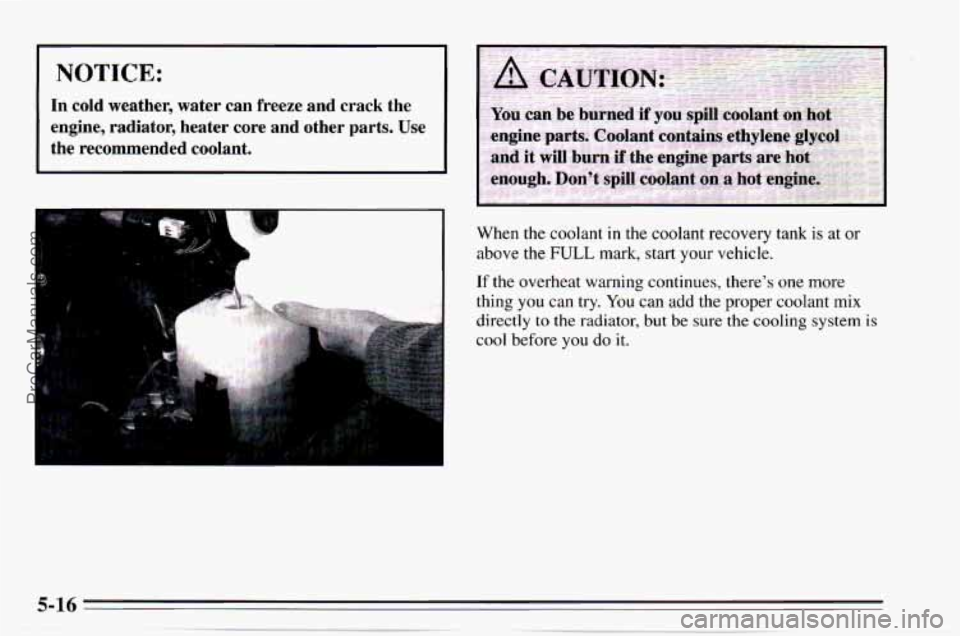
When the coolant in the coolant recovery tank is at or
above the
FULL mark, start your vehicle.
If the overheat warning continues, there's one more
thing
you can try. You can add the proper coolant mix
directly to the radiator, but be sure the cooling system is
cool before you do it.
ProCarManuals.com
Page 195 of 354
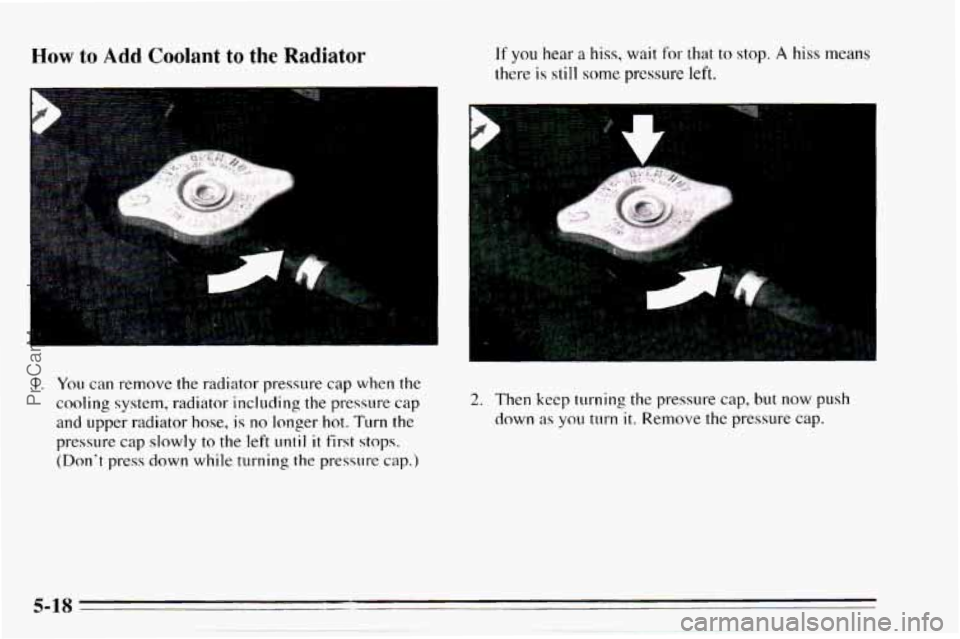
How to Add Coolant to the Radiator If you hear a hiss, wait for that to stop. A hiss means
there
is still some pressure left.
1. You can remove the radiator pressure cap when the
cooling system, radiator including
the pressure cap
and upper radiator hose,
is no longer hot. Turn the
pressure cap slowly to the left until it first stops.
(Don’t press down while turning the pressure cap.)
2. Then keep turning the pressure cap, but now push
down
as you turn it. Remove the pressure cap.
5-18 .
ProCarManuals.com
Page 196 of 354
.. ... ., . ,.
... . .. ..
I I
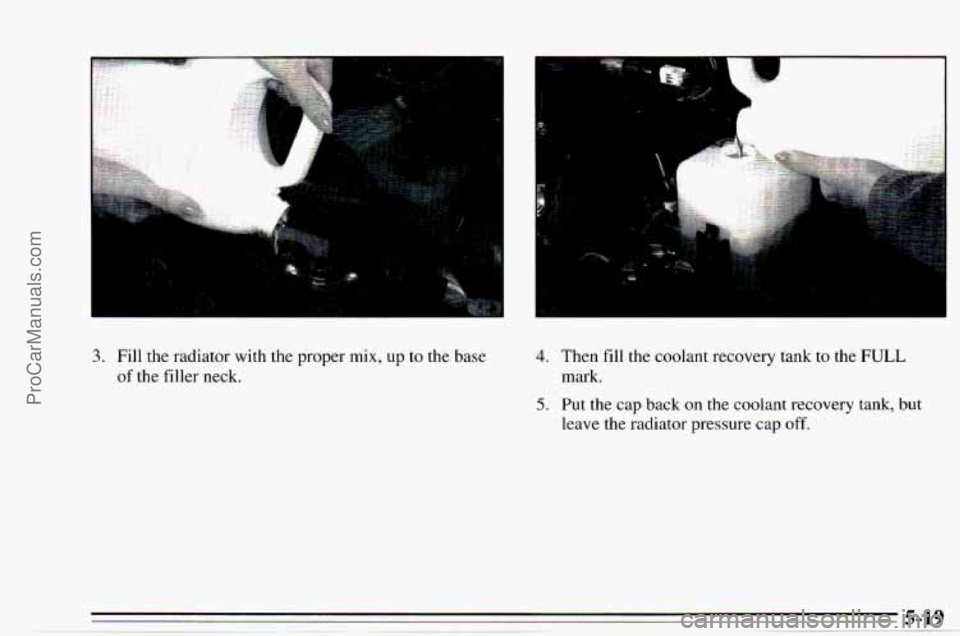
3. Fill the radiator with the proper mix, up to the base
of the filler neck.
1
4. Then fill the coolant recovery tank to the FULL
mark.
5. Put the cap back on the coolant recovery tank, but
leave the radiator pressure
cap off.
ProCarManuals.com
Page 197 of 354
6. Start the engine and let it run until you can feel the
upper radiator hose getting hot. Watch out for the
engine fan.
7. By this time the coolant level inside the radiator
filler neck may be lower.
If the level is lower, add
more
of the proper mix through the filler neck until
the level reaches the base of the filler neck.
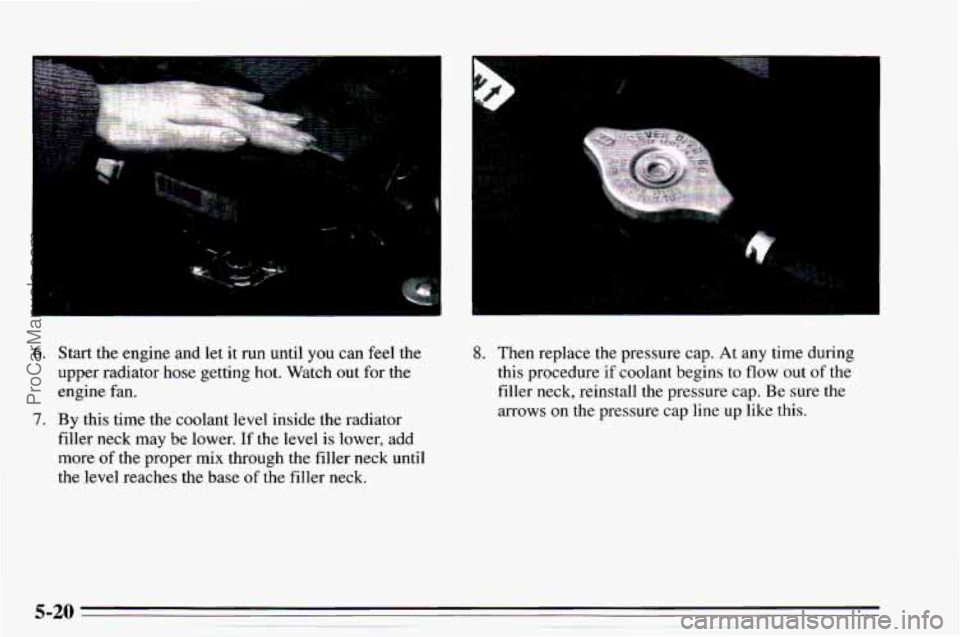
8. Then replace the pressure cap. At any time during
this procedure
if coolant begins to flow out of the
filler neck, reinstall the pressure cap. Be sure the
arrows on the pressure cap line up like this.
5-20 ~ - . . I .. - -- . . .,.^. . . .. ProCarManuals.com
Page 220 of 354
When you open the hood, you’ll see the following on
the 8-valve engine:
1. Battery
2. Automatic Transmission Dipstick (if equipped)
3. Oil Fill Cap
4. Brake Fluid Reservoir
5. Air Cleaner
6. Engine Coolant Reservoir
7. Power Steering Reservoir
8. Radiator Pressure Cap
9. Electric Engine Fan
10. Engine Oil Dipstick
1 1. Windshield Washer Reservoir
12. Main Fuse Box Before
closing the hood, be sure all the filler caps are
on.
6-9
ProCarManuals.com
Page 222 of 354
When you open the hood, you’ll see the following on
the 16-valve engine:
1. Battery
2. Automatic Transmission Dipstick (if equipped)
3. Oil Fill Cap
4. Brake muid Reservoir
5. Air Cleaner
6. Engine Coolant Reservoir
7. Power Steering Reservoir
8. Radiator Pressure Cap
9. Electric Engine Fan
10. Windshield Washer Reservoir
11. Main Fuse Box Before
closing the hood, be sure all the filler caps are
on.
Then lift the hood to relieve pressure on the hood prop.
Remove the hood prop from the slot in the hood and
return the prop to its retainer. Then just let the hood
down and close it firmly.
6-11 ProCarManuals.com
Page 236 of 354

Front Axle Engine Coolant
When to Check and Change Lubricant
Refer to the Maintenance Schedule to determine how
often to check the lubricant and when to change it. See
“Periodic Maintenance Inspections” and “Scheduled
Maintenance Services” in the Index.
How to Check Lubricant
If the level is below the bottom of the filler plug hole,
you’ll need to add some lubricant.
If the differential is at operating temperature (warm),
add enough lubricant to raise the level to the bottom of
the filler plug hole.
If the differential is cold, add enough lubricant to raise
the level to 1/2 inch (12 mm) below the filler plug hole.
What to Use
Refer to the Maintenance Schedule to determine what
kind of lubricant to use. See “Recommended Fluids and
Lubricants” in the Index. The following explains
your cooling
system and how to
add coolant when it is low. If you have a problem with
engine overheating, see “Engine Overheating’’ in the
Index.
The proper coolant for your Geo will:
0 Give freezing protection down to -33°F (-36°C).
Give boiling protection up to 258°F (125°C).
Protect against rust and corrosion.
Help keep the proper engine temperature.
Let the warning lights work as they should.
What to Use
Use a mixture of one-half clean water (preferably
distilled) and one-half antifreeze that meets
“GM
Specification 1825M,” which won’t damage aluminum
parts. You can also use a recycled coolant conforming to
GM Specification 1825M with a complete coolant flush
and refill. If you use this mixture, you don’t need to add
anything else.
ProCarManuals.com
Page 237 of 354
I NOTICE:
If you use an improper coolant mix, your engine
could overheat and be badly damaged. The
repair cost wouldn’t be covered by your
warranty.
Too much water in the mix can freeze
and crack the engine, radiator, heater core and
other parts.
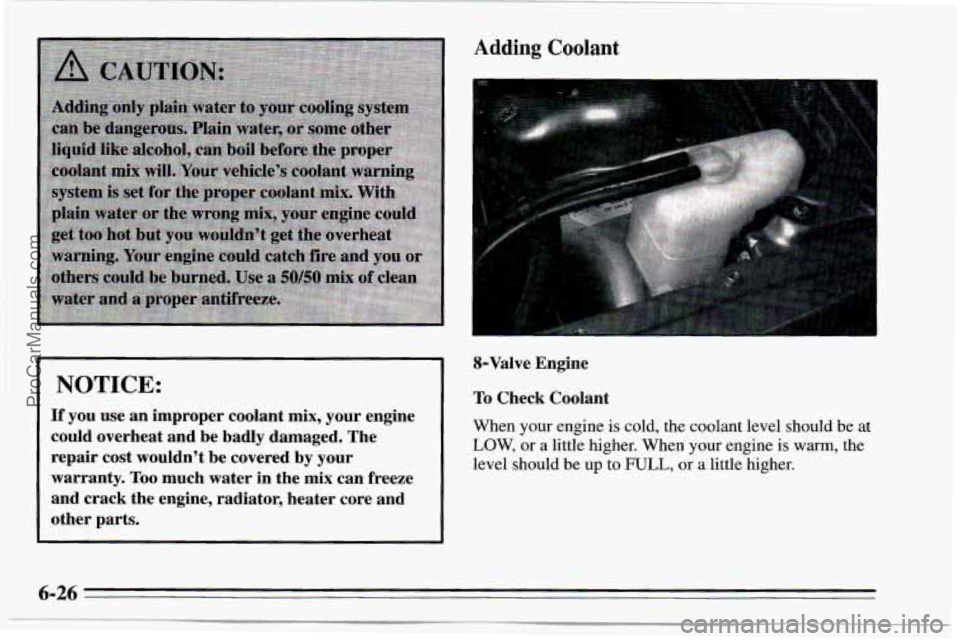
Adding Coolant
8-Valve Engine
To Check Coolant
When your engine is cold, the coolant level should be at
LOW, or
a little higher. When your engine is warm, the
level should be
up to FULL, or a little higher.
6-26
ProCarManuals.com