Page 174 of 354
Following Distance
Stay at least twice as far behind the vehicle ahead as you
would when driving your vehicle without a trailer. This
can help you avoid situations that require heavy braking
and sudden turns.
Making lhrns
Passing
You’ll need more passing distance up ahead when
you’re towing a trailer. And, because you’re a good deal
longer, you’ll need to go much farther beyond the
passed vehicle before you can return to your lane.
Backing Up
Hold the bottom of the steering wheel with one hand.
Then, to move the trailer to the left, just move that hand
to the left.
To move the trailer to the right, move your
hand to the right. Always back up slowly and, if
possible, have someone guide you.
I NOTICE:
Making very sharp turns while trailering could
cause the trailer to come in contact with the
vehicle.
Your vehicle could be damaged. Avoid
making very
sharp turns while trailering.
When you’re turning with a trailer, make wider turns
than normal.
Do this so your trailer won’t strike soft
shoulders, curbs, road signs, trees, or other objects.
Avoid jerky or sudden maneuvers. Signal well in
advance.
Turn Signals When Towing a Trailer
When you tow a trailer, your vehicle has to have extra
wiring (included in the optional trailering package). The
green arrows on your instrument panel will flash
whenever you signal a turn or lane change. Properly
hooked up, the trailer lamps will also flash, telling other
drivers you’re about to turn, change lanes or stop.
ProCarManuals.com
Page 183 of 354
Towing Your Vehicle
I
I
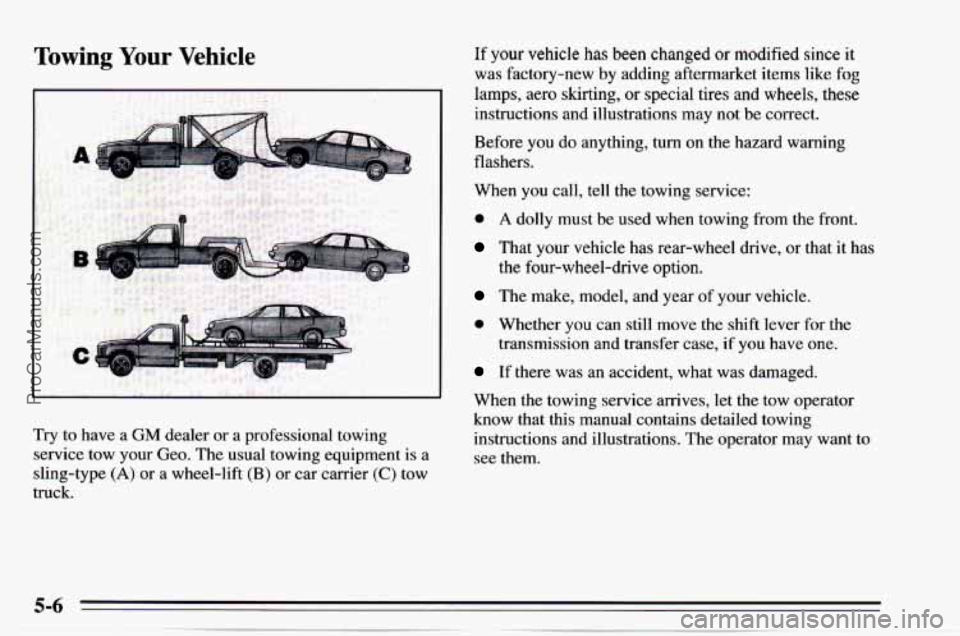
Try to have a GM dealer or a professional towing
service tow your Geo. The usual towing equipment is
a
sling-type (A) or a wheel-lift (B) or car carrier (C) tow
truck.
If your vehicle has been changed or modified since it
was factory-new by adding aftermarket items
like fog
lamps, aero skirting, or special tires and wheels, these
instructions and illustrations may not be correct.
Before you do anything, turn on the hazard warning
flashers.
When
you call, tell the towing service:
0 A dolly must be used when towing from the front.
That your vehicle has rear-wheel drive, or that it has
The make, model, and year of your vehicle.
0 Whether you can still move the shift lever for the
transmission and transfer case, if you have
one.
the four-wheel-drive option.
If there was an accident, what was damaged.
When the towing service arrives, let the tow operator
know that this manual contains detailed towing
instructions and illustrations. The operator may want
to
see them.
ProCarManuals.com
Page 198 of 354
If a Tire Goes Flat
It’s unusual for a tire to “blow out’‘ while you’re driving,
especially if you maintain your
tires properly. If air goes
out of
a tire, it’s much more likely to leak out slowly.
But if you should ever have a “blowout,” here are a few
tips about what to expect and what
to do:
If a front tire fails, the flat tire will create a drag that
pulls
the vehicle toward that side. Take your foot off the
accelerator pedal and grip
the steering wheel firmly.
Steer
to maintain lane position, then gently brake to a
stop well out of the traffic lane.
A rear blowout, particularly on a curve, acts much like a
skid and may require the same correction you’d use in a
skid. In any rear blowout, remove your foot from the
accelerator pedal. Get the vehicle under control by
steering the way you want the vehicle to
go. It may be
very bumpy and noisy, but you can still steer. Gently
brake
to a stop, well off the road if possible.
If a tire goes flat, the next part shows how to use your
jacking equipment to change a flat tire safely.
Changing a Flat Tire
If a tire goes flat, avoid further tire and wheel damage
by driving slowly
to a level place. Turn on your hazard
warning flashers.
5-21
ProCarManuals.com
Page 199 of 354
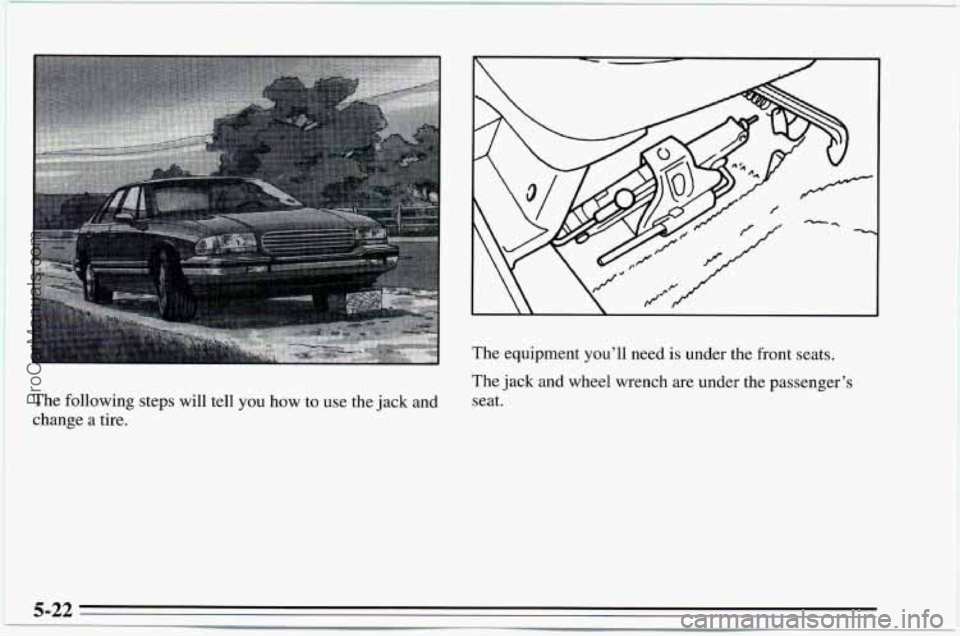
The following steps will tell you how to use the jack and
change a tire. The
equipment you’ll need is under the front seats.
The jack and wheel wrench are under the passenger’s
seat.
5-22 I ProCarManuals.com
Page 235 of 354
Rear Axle Four- Wheel Drive
When to Check and Change Lubricant
Refer to the
Maintenance Schedule to determine how
often to check the lubricant and when to change it. See
“Periodic Maintenance Inspections” and “Scheduled
Maintenance Services” in the Index.
How to Check Lubricant
If the level is below the bottom of the filler plug hole,
you’ll need to add some lubricant. Add enough lubricant
to raise the level to the bottom
of the filler plug hole.
What to Use
Refer to the Maintenance Schedule to determine what
kind
of lubricant to use. See “Recommended Fluids and
Lubricants” in the Index. Most
lubricant checks in this section also apply to
four-wheel-drive vehicles. However, they have
two
additional systems that need lubrication.
Transfer Case
When to Check and Change Lubricant
Refer to the Maintenance Schedule to determine how
often to check the lubricant and when
to change it. See
“Scheduled Maintenance Services” in the Index.
How to Check Lubricant
If the level is below the bottom of the filler plug hole,
you’ll need to add some lubricant. Add enough lubricant
to raise the level
to the bottom of the filler plug hole.
What to Use
Refer to the Maintenance Schedule to determine what
kind
of lubricant to use. See “Recommended Fluids and
Lubricants” in the Index.
ProCarManuals.com
Page 281 of 354

Maintenance Schedule
I Schedule I Definition
Follow Maintenance Schedule I if any one of these is
true for your vehicle:
Most trips are less than 5 to 10 miles (8 to 16 km).
This is particularly important when outside
temperatures are below freezing.
driving
in stop-and-go traffic).
Most trips include extensive idling (such as frequent
0 You frequently tow a trailer or use a carrier on top of
your vehicle.
Schedule
I should also be followed if the vehicle is used
for delivery service, police, taxi, or other commercial
application.
Schedule I Intervals
Every 3,000 Miles (5 000 km) or 3 Months,
Whichever Occurs First
Engine Oil and Filter Change
Free-Wheeling Hubs Inspection (If Equipped)
Every 6,000 Miles (10 000 km) or 6 Months,
Whichever Occurs First
Tire Rotation
Every 15,000 Miles (25 000 km)
Air Cleaner Filter Inspection, if driving in dusty
Front Wheel Bearing Repack (or at each brake
Manual Transmission Fluid Change (or every
Engine Idle Speed Check
Valve Lash (Clearance) Adjustment
Propeller Shafts and U-Joints Inspection (or every conditions
relining, whichever occurs first)
15 months, whichever occurs first)
15 months, whichever occurs first)
ProCarManuals.com
Page 283 of 354
Maintenance Schedule
Schedule I1 Definition 'I
Follow Schedule I1 only if none of the conditions from
Schedule
I is true.
Schedule I1 Intervals
Every 7,500 Miles (12 500 km)
whichever occurs first)
every
3 months, whichever occurs first)
Engine
Oil and Filter Change (or every
7.5 months,
Free-Wheeling
Hubs Inspection (If Equipped) (or
Tire Rotation
Every 15,000 Miles (25 000 km)
Front Wheel Bearing Repack (or at each brake
relining)
Engine Idle Speed Check
Valve Lash (Clearance) Adjustment
Propeller Shafts and U-Joints Inspec :ti
15 months, whichever occurs first)
on (or every
7-6
I- ProCarManuals.com
Page 287 of 354
I *
I Maintenance Schedule I I
12,000 Miles (20 000 km)
0 Change engine oil and filter (or every
3 months, whichever occurs first).
An Emission Control Service.
0 Rotate tires. See “Tire Inspection and
Rotation” in the Index for proper rotation
pattern and additional information.
0 Inspect the locking front hubs (if equipped)
for correct operation (or every
3 months,
whichever occurs first). Repair or replace
if
necessary.
I I I 1
DATE ACTUAL MILEAGE SERVICED BY:
15,000 Miles (25 000 km)
0 Change engine oil and filter (or every
3 months, whichever occurs first).
An Emission Control Service.
0 Inspect air cleaner filter if you are driving
in dusty conditions. Replace filter
if
necessary. An Emission Control Sewice.
(or at each brake relining, whichever occurs
first).
0 Change manual transmission fluid (or every
15 months, whichever occurs first).
0 Inspect the valve lash and adjust if
necessary. An Emission Control Service.
Check engine idle speed and adjust it to
underhood label specifications. An Emission
Control Service.
0 Clean and repack the front wheel bearings
7-10
ProCarManuals.com