1995 CHEVROLET TRACKER ESP
[x] Cancel search: ESPPage 140 of 354
Traveling to Remote Areas
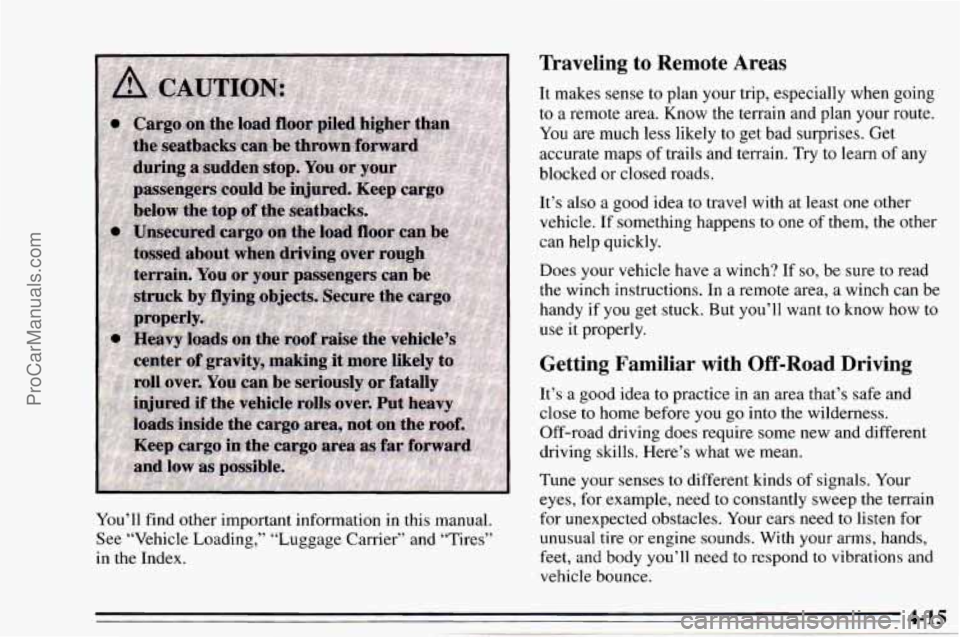
You’ll find other important information in this manual.
See “Vehicle Loading,” “Luggage Carrier” and “Tires”
in the Index. It
makes
sense to plan your trip, especially when going
to
a remote area. Know the terrain and plan your route.
You are much less likely to get bad surprises. Get
accurate maps
of trails and terrain. Try to learn of any
blocked or closed roads.
It’s also a good idea to travel with at least one other
vehicle.
If something happens to one of them, the other
can help quickly.
Does your vehicle have
a winch? If so, be sure to read
the winch instructions.
In a remote area, a winch can be
handy
if you get stuck. But you’ll want to know how to
use it properly.
Getting Familiar with Off-Road Driving
It’s a good idea to practice in an area that’s safe and
close to home before you go into the wilderness.
Off-road driving does require some new and different
driving skills. Here’s what we mean.
Tune your senses to different kinds of signals. Your
eyes, for example, need to constantly
sweep the terrain
for unexpected obstacles. Your ears need to listen for
unusual tire or engine sounds. With your anns, hands,
feet, and body you’ll need
to respond to vibrations and
vehicle bounce.
ProCarManuals.com
Page 141 of 354

Controlling your vehicle is the key to successful
off-road driving. One of the best ways to control your
vehicle is to control your speed.
Here are some things to
keep in mind. At higher speeds:
you approach things faster and you have less time to
scan the terrain for obstacles.
you have less time to react.
you have more vehicle bounce when you drive over
obstacles.
you’ll need more distance for braking, especially
since you’re on an unpaved surface.
Scanning the Terrain
Off-road driving can take you over many different kinds
of terrain. You need
to be familiar with the terrain and
its many different features. Here are some things to
consider.
Sugace Conditions. Off-roading can take you over
hard-packed dirt, gravel, rocks, grass, sand, mud, snow or
ice. Each
of these surfaces affects the steering,
acceleration, and braking of your vehicle in different ways.
Depending upon the kind of surface
you are on, you may
experience slipping, sliding, wheel spinning, delayed
acceleration, poor traction, and longer braking distances.
Surjke Obstacles. Unseen or hidden obstacles can be
hazardous. A rock, log,
hole, rut, or bump can startle
you if you’re not prepared for them. Often these
obstacles are hidden by grass, bushes, snow or even the
rise and fall of the terrain itself. Here are some things to
consider:
Is the path ahead clear?
Will the surface texture change abruptly up ahead?
Does the travel take you uphill or downhill? (There’s
more discussion of these subjects later.)
Will you have to stop suddenly or change direction
quickly?
ProCarManuals.com
Page 142 of 354
When you drive over obstacles or rough terrain, keep a
firm grip on the steering wheel. Ruts, troughs, or other
surface features can jerk the wheel out
of your hands if
you’re not prepared.
When you drive over bumps, rocks, or other obstacles,
your wheels can leave the ground.
If this happens, even
with one or two wheels, you can’t control the vehicle as
well or at all.
Because you will be on an unpaved surface, it’s
especially important to avoid sudden acceleration,
sudden turns,
or sudden braking.
In a way, off-road driving requires a different lund
of
alertness from driving on paved roads and highways.
There are no road signs, posted speed limits or signal
lights. You have to use your own good judgment about
what
is safe and what isn’t.
Drinking and driving can be very dangerous on any
road. And this
is certainly true for off-road driving. At
the very time you need special alertness and driving
skills, your reflexes, perceptions and judgment can be
affected by even a small amount
of alcohol. You could
have a serious
-- or even fatal -- accident if you drink
and drive or ride with a driver who has been drinking.
(See “Drunken Driving” in
the Index.)
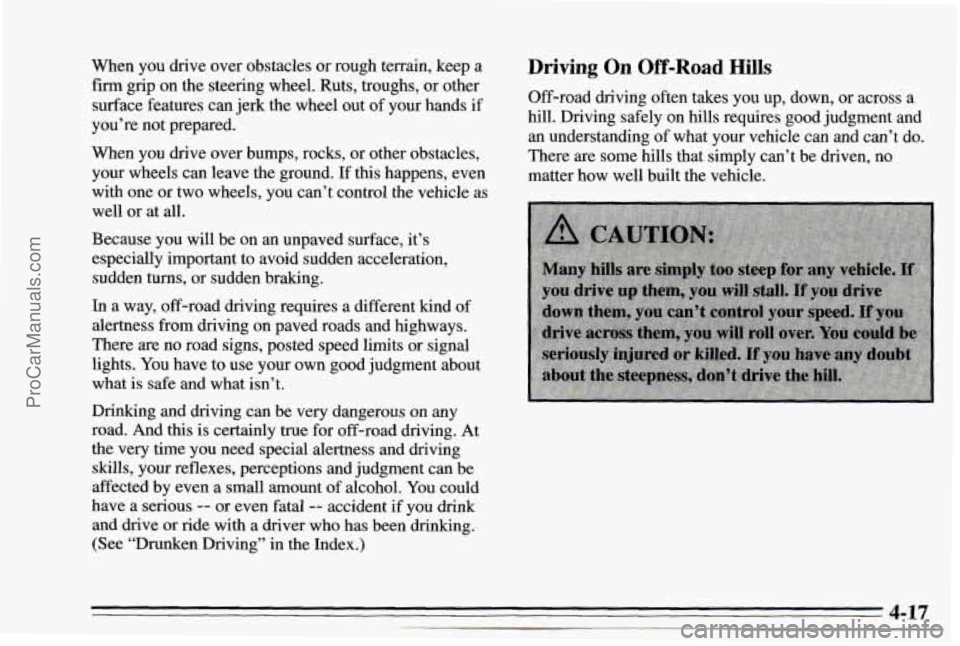
Driving On Off-Road Hills
Off-road driving often takes you up, down, or across a
hill. Driving safely on hills requires good judgment and
an understanding
of what your vehicle can and can’t do.
There are some hills that simply can’t be driven, no
matter how well built the vehicle.
4-17
ProCarManuals.com
Page 152 of 354
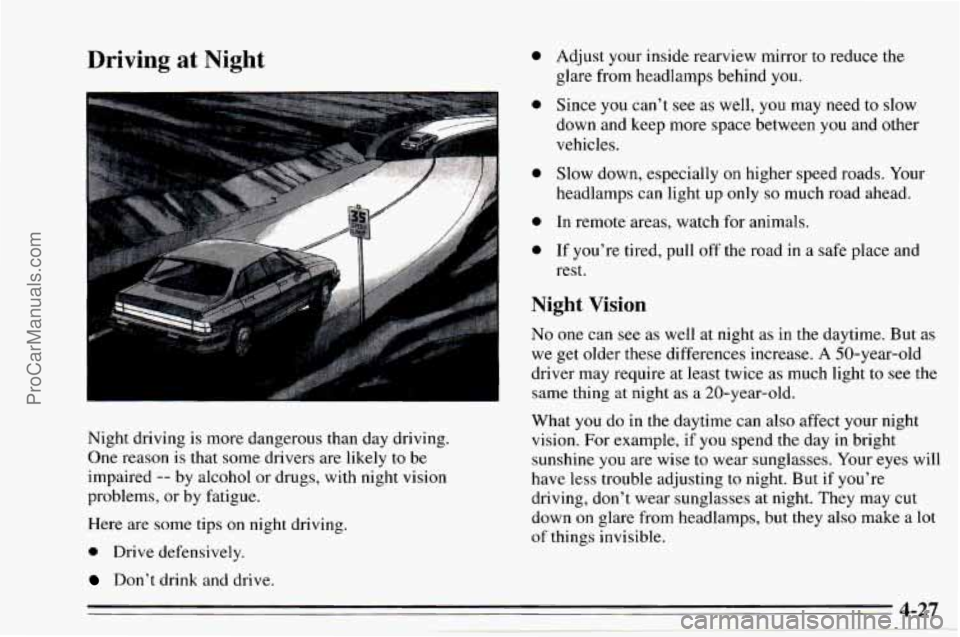
Driving at Night
Night driving is more dangerous than day driving.
One reason is that some drivers are likely to be
impaired
-- by alcohol or drugs, with night vision
problems, or by fatigue.
Here
are some tips on night driving.
0 Drive defensively.
Don’t drink and drive.
0
a
a
0
Adjust your inside rearview mirror to reduce the
glare from headlamps behind
you.
Since you can’t see as well, you may need to slow
down and keep more space between you and other
vehicles.
Slow down, especially
on higher speed roads. Your
headlamps can light up
only so much road ahead.
In remote areas, watch for animals.
If you’re tired, pull off the road in a safe place and
rest.
Night Vision
No one can see as well at night as in the daytime. But as
we get older these differences increase. A 50-year-old
driver may require at least twice as much light to see the
same thing at night as a 20-year-old.
What you do
in the daytime can also affect your night
vision. For example, if
you spend the day in bright
sunshine you are wise to wear sunglasses. Your eyes will
have less trouble adjusting
to night. But if you’re
driving, don’t wear sunglasses at night. They may cut
down on glare from headlamps, but they also make a lot
of things invisible.
ProCarManuals.com
Page 155 of 354

Hydroplaning
Hydroplaning is dangerous. So much water can build up
under your tires that
they can actually ride on the water.
This can happen if the road
is wet enough and you’re
going fast enough. When your vehicle is hydroplaning,
it has little or no contact with the road.
Hydroplaning doesn’t happen often.
But it can if your
tires haven’t much tread or if the pressure
in one or
more is low. It can happen if a lot of water is standing
on
the road. If you can see reflections from trees, telephone
poles, or other vehicles, and raindrops “dimple” the
water’s surface, there could be hydroplaning.
Hydroplaning usually happens at higher speeds. There
just isn’t a hard and fast rule about hydroplaning. The
best advice is to slow down when it is raining.
Some Other Rainy Weather Tips
0
0
0
Turn on your low-beam headlamps -- not just your
parking lamps
-- to help make you more visible to
others.
Besides slowing down, allow some extra following
distance. And be especially careful when
you pass
another vehicle. Allow yourself more clear room
ahead, and be prepared to have your view restricted
by road spray.
Have good tires with proper tread depth. (See
“Tires” in the Index.)
ProCarManuals.com
Page 173 of 354
nailer Brakes
If your trailer weighs more than 1,000 pounds (450 kg)
loaded, then it needs its own brakes -- and they must be
adequate. Be sure to read and follow the instructions for
the trailer brakes
so you’ll be able to install, adjust and
maintain them properly.
Driving with a Trailer
0
0
0
Don’t tap into your vehicle’s brake system if the
trailer’s brake system will use more than
0.02 cubic
inch
(0.3 cc) of fluid from your vehicle’s master
cylinder.
If it does, both systems won’t work well.
You could even lose your brakes.
Will the trailer brake parts take
3,000 psi
(20 650 kPa) of pressure? If not, the trailer brake
system must not be used with your vehicle.
If everything checks out this far, then make the brake
fluid tap at the port on the master cylinder that sends
fluid to the rear brakes. But don’t use copper tubing
for this.
If you do, it will bend and finally break off.
Use steel brake tubing. Towing
a trailer requires a certain amount of experience.
Before setting out for the open road, you’ll
want to get
to know your rig. Acquaint yourself with the feel of
handling and braking with the added weight
of the
trailer. And always keep in mind that the vehicle you
are
driving is now a good deal longer and not nearly as
responsive as your vehicle
is by itself.
Before you start, check the trailer hitch and platform
(and attachments), safety chains, electrical connector,
lamps, tires and mirror adjustment.
If the trailer has
electric brakes, start your vehicle and trailer moving and
then apply the trailer brake controller by hand to be sure
the brakes are working. This lets
you check your
electrical connection at the same time.
During your trip, check occasionally to be sure that the
load is secure, and that the lamps and any trailer brakes
are still working.
ProCarManuals.com
Page 176 of 354

When You Are Ready to Leave After
Parking on a Hill
1. Apply your regular brakes and hold the pedal down
while you:
Start your engine;
Shift into a gear; and
0 Release the parking brake.
2. Let up on the brake pedal.
3. Drive slowly until the trailer is clear of the chocks.
4. Stop and have someone pick up and store the chocks.
Maintenance When Trailer Towing
Your vehicle will need service more often when you’re
pulling a trailer. See the Maintenance Schedule for more
on this. Things that
are especially important in trailer
operation are automatic transmission fluid (don’t
overfill), engine oil, axle lubricant, belts, cooling
system, and brake adjustment. Each of these is covered
in this manual, and the Index will help you find them
quickly. If you’re trailering, it’s a good idea to review
these sections before you start your trip.
Check periodically to see that all hitch nuts and bolts are
tight.
4-51
ProCarManuals.com
Page 198 of 354
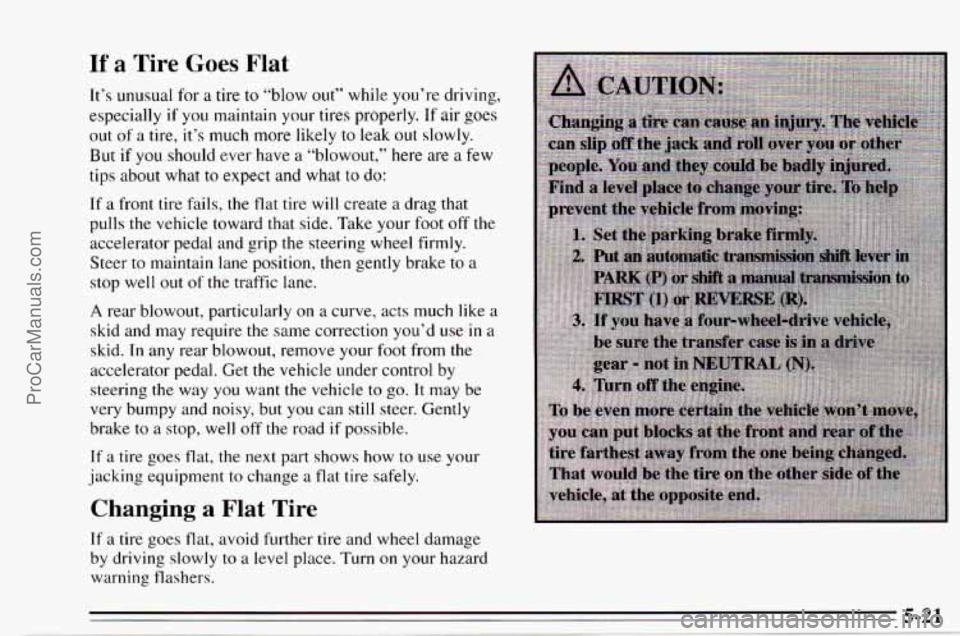
If a Tire Goes Flat
It’s unusual for a tire to “blow out’‘ while you’re driving,
especially if you maintain your
tires properly. If air goes
out of
a tire, it’s much more likely to leak out slowly.
But if you should ever have a “blowout,” here are a few
tips about what to expect and what
to do:
If a front tire fails, the flat tire will create a drag that
pulls
the vehicle toward that side. Take your foot off the
accelerator pedal and grip
the steering wheel firmly.
Steer
to maintain lane position, then gently brake to a
stop well out of the traffic lane.
A rear blowout, particularly on a curve, acts much like a
skid and may require the same correction you’d use in a
skid. In any rear blowout, remove your foot from the
accelerator pedal. Get the vehicle under control by
steering the way you want the vehicle to
go. It may be
very bumpy and noisy, but you can still steer. Gently
brake
to a stop, well off the road if possible.
If a tire goes flat, the next part shows how to use your
jacking equipment to change a flat tire safely.
Changing a Flat Tire
If a tire goes flat, avoid further tire and wheel damage
by driving slowly
to a level place. Turn on your hazard
warning flashers.
5-21
ProCarManuals.com