Page 95 of 486
3. If you have four-wheel drive, be sure the transfer case is in a drive gear
4. Move the ignition key to LOCK.
-not in NEUTRAL (N)
5. Remove the key and take it with you. If you can walk away from your
vehicle with the ignition key
in your hand, your vehicle is in PARK (P).
Shifting Out of PARK (P)
Your vehicle has a brake-transmission shift interlock system. You have to
fully apply your regular brakes before you can shift from PARK (P). See
“Automatic Transmission”
in the Index.
If
you cannot shift out of PARK (P), ease pressure on the shift lever and
push the shift lever all the way up into PARK
(P) as you maintain brake
application. Then, move the shift lever into the gear you want.
If
you ever hold the brake pedal down but still can’t shift out of PARK (P),
try this:
1. Turn the key to OFF.
2. Apply and hold the brake until the end of Step 4.
3. Shift to NEUTRAL (N).
4. Start the vehicle and then shift to the drive gear you want.
5. Have the brake-transmission shift interlock system fixed as soon as
you can.
Leaving Your Vehicle With the Engine Running
(Automatic Transmission
Models Only)
It can be dangerous to leave your vehicle with the engine
running. Your vehicle could move suddenly if the shift lever
is
not fully in PARK (P) with the parking brake firmly set. If you
have four-wheel drive with
a manual transfer case shift lever
and your transfer case
is in NEUTRAL (N), your vehicle will be
free to roll, even if your shift lever
is in PARK (P). So be sure the
transfer case is in
a drive gear - not in NEUTRAL (N). And, if
you leave the vehicle with the engine running, it could overheat
and even catch
fire. You or others could be injured. Don’t leave
your vehicle with the engine running unless you have to.
2-28
ProCarManuals.com
Page 97 of 486
Parking Your Vehicle (Manual Transmission
Models Only)
Before you get out of your vehicle, put your manual transmission in
REVERSE (R), turn off the engine, and firmly apply the parking brake.
If you have four-wheel drive, be sure your transfer case is in a drive gear.
Your vehicle could roll if it isn’t.
If you are parking on a hill, or if your pulling a trailer, see “Parking on
Hills” or “Towing a Trailer” in the Index.
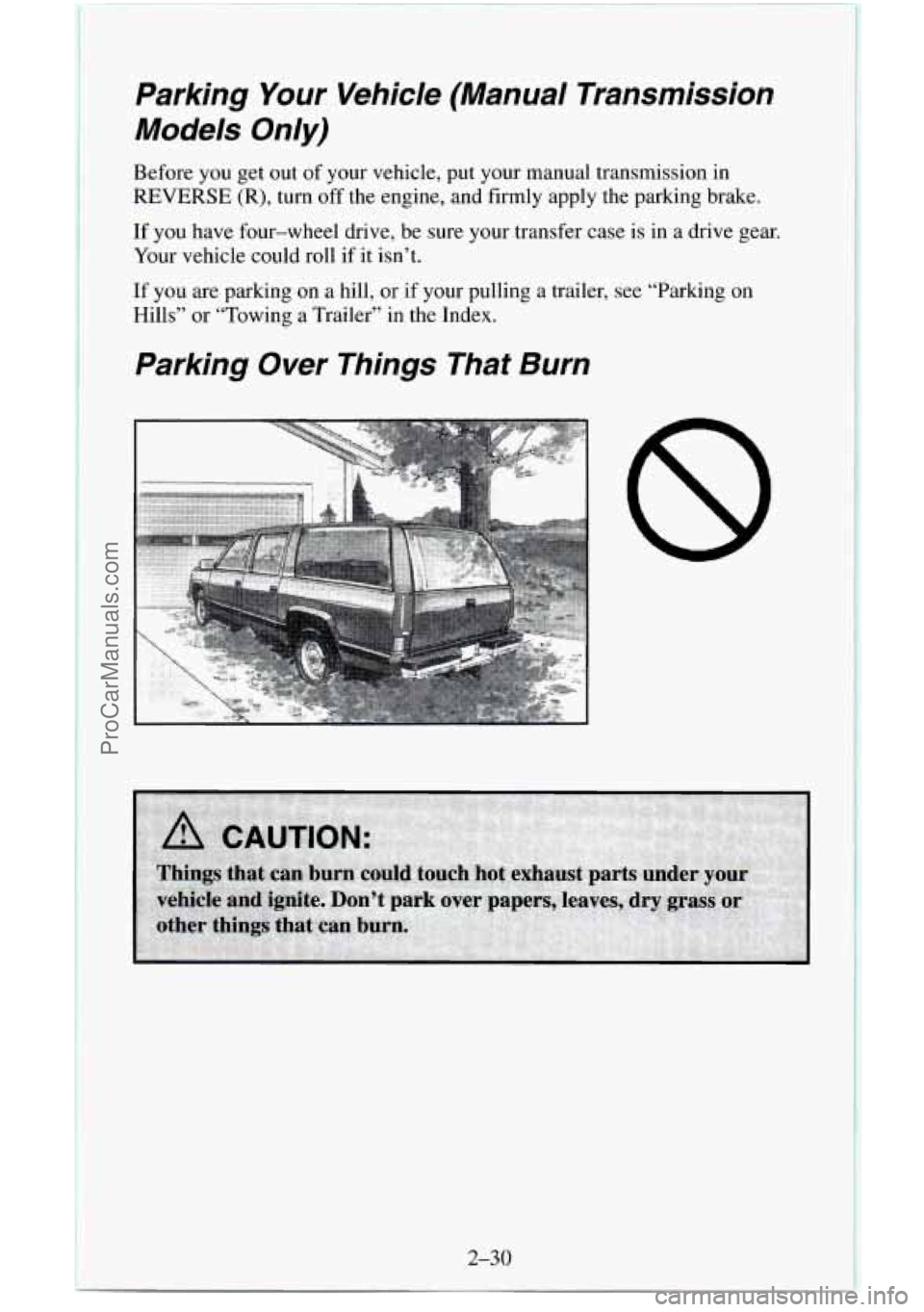
Parking Over Things That Burn
8
2-30
ProCarManuals.com
Page 98 of 486
Engine Exhaust
2-3 1
ProCarManuals.com
Page 99 of 486
Running Your Engine While You’re Parked
(Automatic Transmission)
It’s better not to park with the engine running. But if you ever have to, here
are some things to know.
If you have four-wheel drive and your transfer case is
in NEUTRAL (N),
your vehicle will be free
to roll, even if your shift lever is in PARK (P). So,
be sure the transfer case is in a drive gear - not in NEUTRAL (N). Always
set your parking brake. Follow the proper steps
to be sure your vehicle
won’t move. See “Shifting Into
PARK (P)” in the Index.
If you’re pulling a trailer, see “Towing a Trailer” in the Index.
2-32 I
ProCarManuals.com
Page 100 of 486
Four- Wheel Drive
If your vehicle has four-wheel drive, you can send your engine’s driving
power to all four wheels for extra traction.
To get the most satisfaction out
of four-wheel drive, you must be familiar with its operation. Read the part
that follows before using four-wheel drive. You should use 2-WHEEL
HIGH (2H) for most normal driving conditions.
NOTICE:
Driving in the 4-WHEEL HIGH (4H) or &WHEEL LOW (4L)
positions for a long time on dry or wet pavement could shorten
the life of your vehicle’s drivetrain.
I NOTICE:
Changing your vehicle’s body height can damage your vehicle’s
suspension, drivetrain, or other vehicle components.
It may also
affect the way your vehicle handles, and the function of your
vehicle’s safety features. Do not change your vehicle’s height
from the original design specifications.
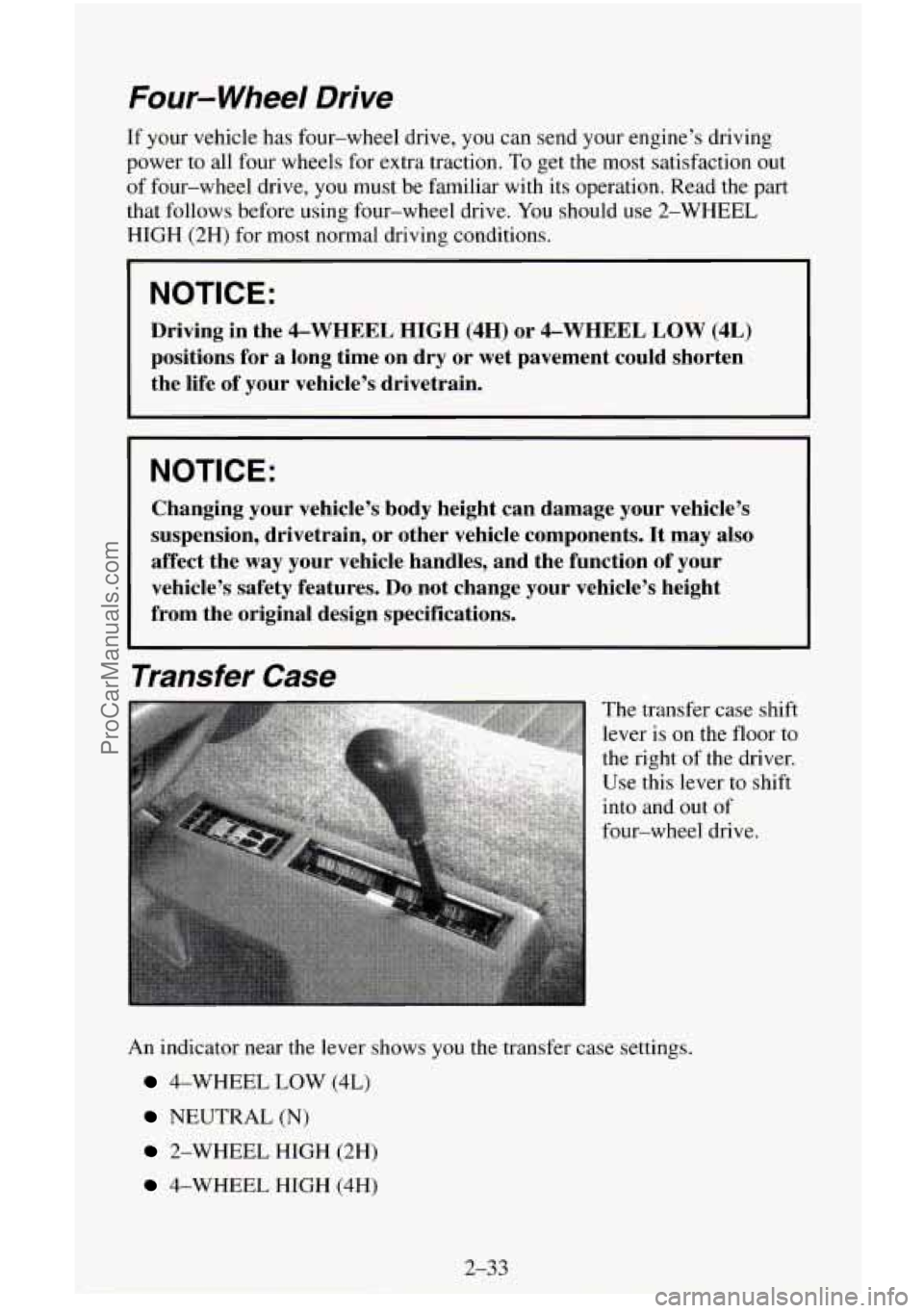
Transfer Case
The transfer case shift
lever is on the floor to
the right of the driver.
Use this lever to shift
into and out
of
four-wheel drive.
An indicator near the lever shows you the transfer case settings.
4-WHEEL LOW (4L)
NEUTRAL (N)
2-WHEEL HIGH (2H)
4-WHEEL HIGH (4H)
2-33
ProCarManuals.com
Page 118 of 486
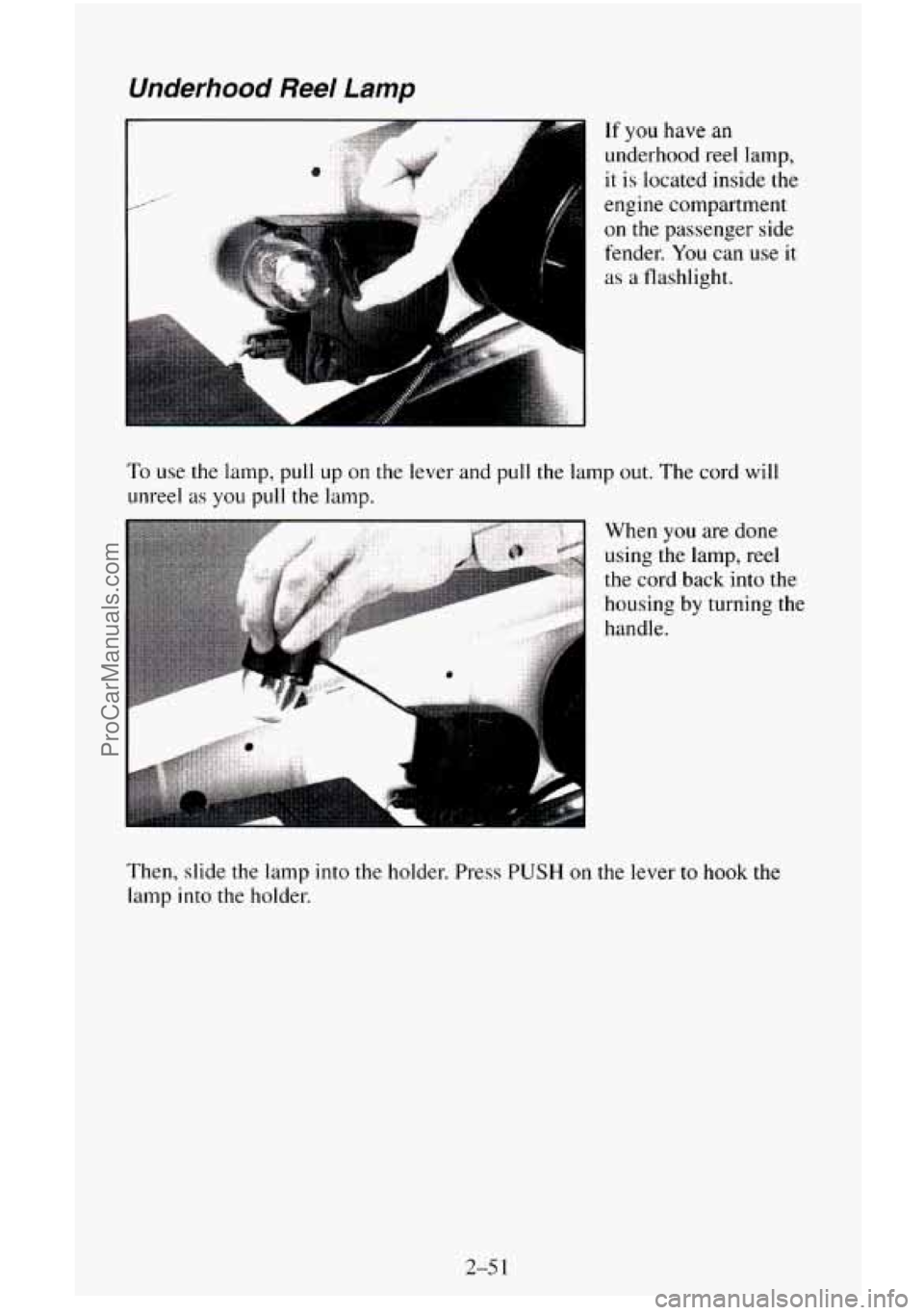
Underhood Reel Lamp
If you have an
underhood reel lamp,
it is located inside
the
engine compartment
on the passenger side
fender.
You can use it
as
a flashlight.
To use the lamp, pull up on the lever and pull the lamp out. The cord will
unreel
as you pull the lamp.
When
you are done
using the lamp, reel
the cord back into the
housing by turning the
handle.
Then, slide the lamp into the holder. Press
PUSH on the lever to hook the
lamp into the holder.
2-5 1
ProCarManuals.com
Page 136 of 486
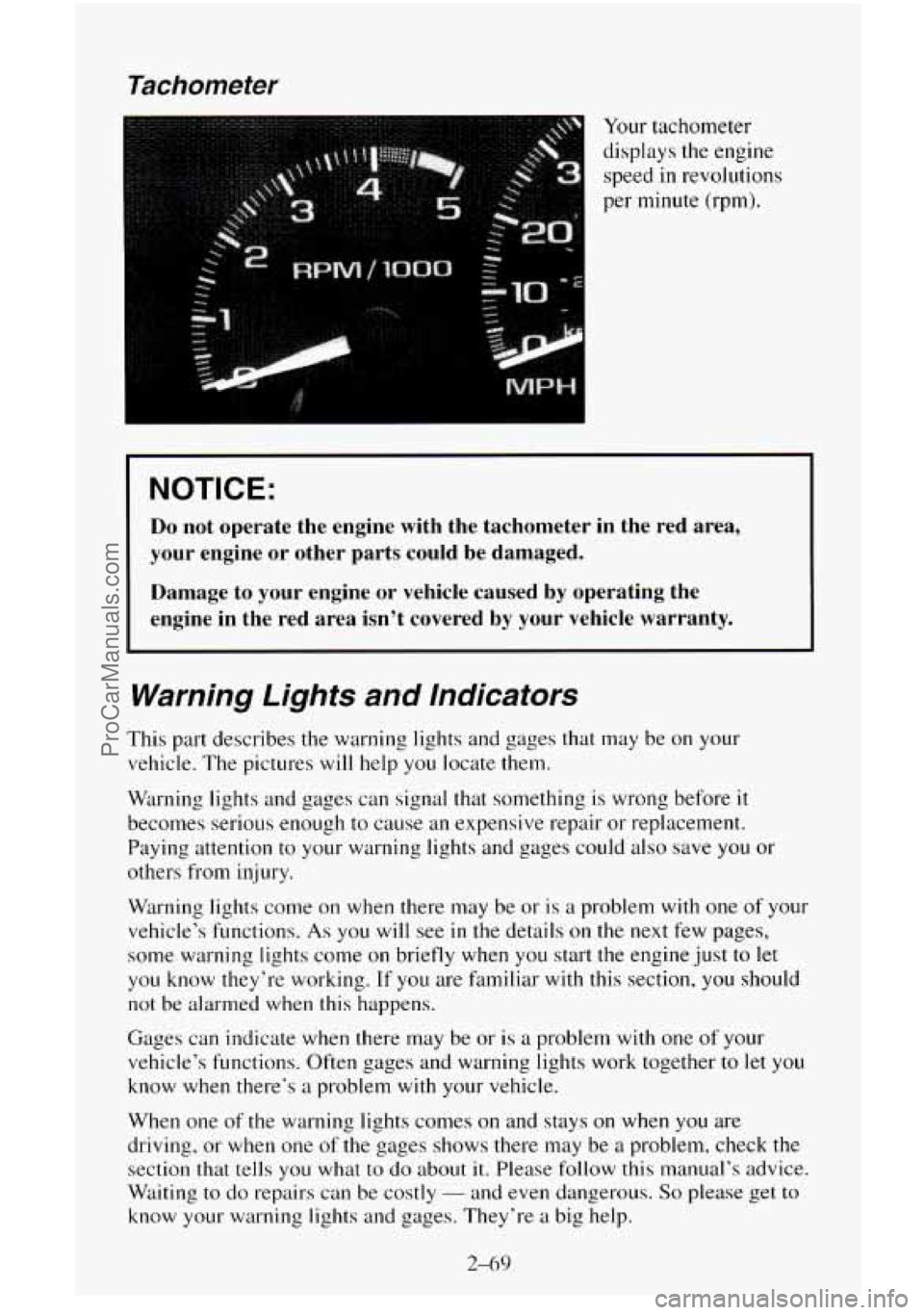
Tachometer
Your tachometer
displays the engine
speed in revolutions
per minute (rpm).
I NOTICE:
Do not operate the engine with the tachometer in the red area,
your engine or other parts could be damaged.
Damage to your engine
or vehicle caused by operating the
engine in the red area isn’t covered
by your vehicle warranty.
Warning Lights and Indicators
This part describes the warning lights and gages that may be on your
vehicle. The pictures will help
you locate them.
Warning lights and gages
can signal that something is wrong before it
becomes serious enough to cause an expensive repair or replacement.
Paying attention
to your warning lights and gages could also save you or
others from injury.
Warning lights come on when there may be or is a problem with
one of your
vehicle’s functions.
As you will see in the details on the next few pages,
some warning lights come
on briefly when you start the engine just to let
you know they’re working. If you are familiar with this section, you should
not be alarmed when
this happens.
Gages can indicate when there may be
or is a problem with one of your
vehicle’s functions. Often gages and warning lights work together
to let you
know when there’s a problem with your vehicle.
When one
of the warning lights comes on and stays on when you are
driving, or when one of the gages shows there may be a problem, check the
section that tells
you what to do about it. Please follow this manual’s advice.
Waiting
to do repairs can be costly - and even dangerous. So please get to
know your warning lights and gages. They‘re a big help.
2-69
ProCarManuals.com
Page 139 of 486
The brake system warning light will also come on when you set your
parking brake, and it will stay on if your parking brake doesn’t release fully.
If it stays on after your parking brake is fully released, it means you have a
brake problem.
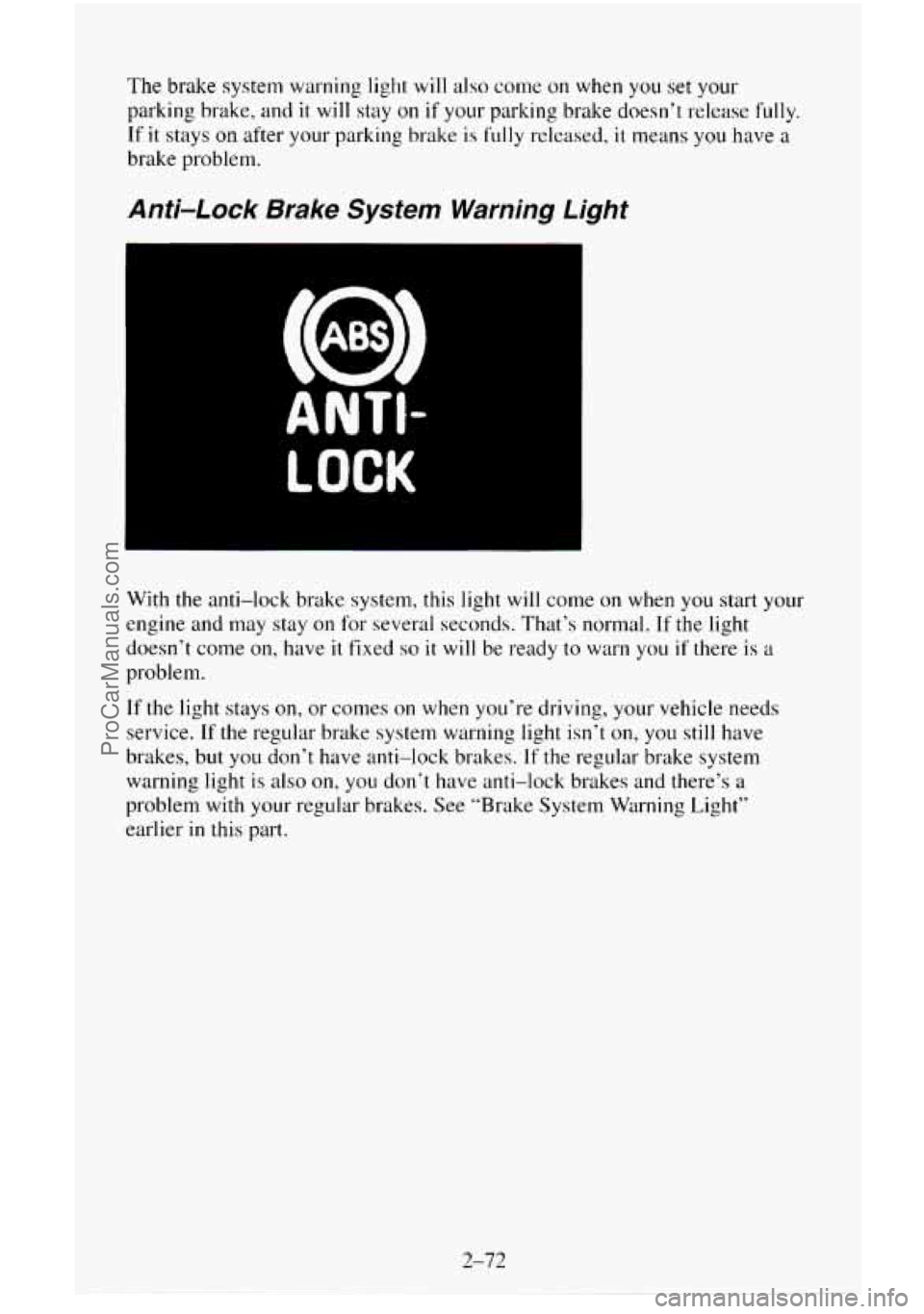
Anti4 ock Brake System Warning Light
ANTI-
LOCK
With the anti-lock brake system, this light will come on when you start your
engine and may stay on for several seconds. That’s normal.
If the light
doesn’t come on, have
it fixed so it will be ready to warn you if there is a
problem.
If the light stays on, or comes on when you’re driving, your vehicle needs
service.
If the regular brake system warning light isn’t on, you still have
brakes, but
you don’t have anti-lock brakes. If the regular brake system
warning light
is also on, you don’t have anti-lock brakes and there’s a
problem with your regular brakes. See “Brake System Warning Light”
earlier
in this part.
2-72
.~
ProCarManuals.com