Page 22 of 386
Downloaded from www.Manualslib.com manuals search engine Driver Position
This part describes the driver’s restraint system.
Lap-Shoulder Belt
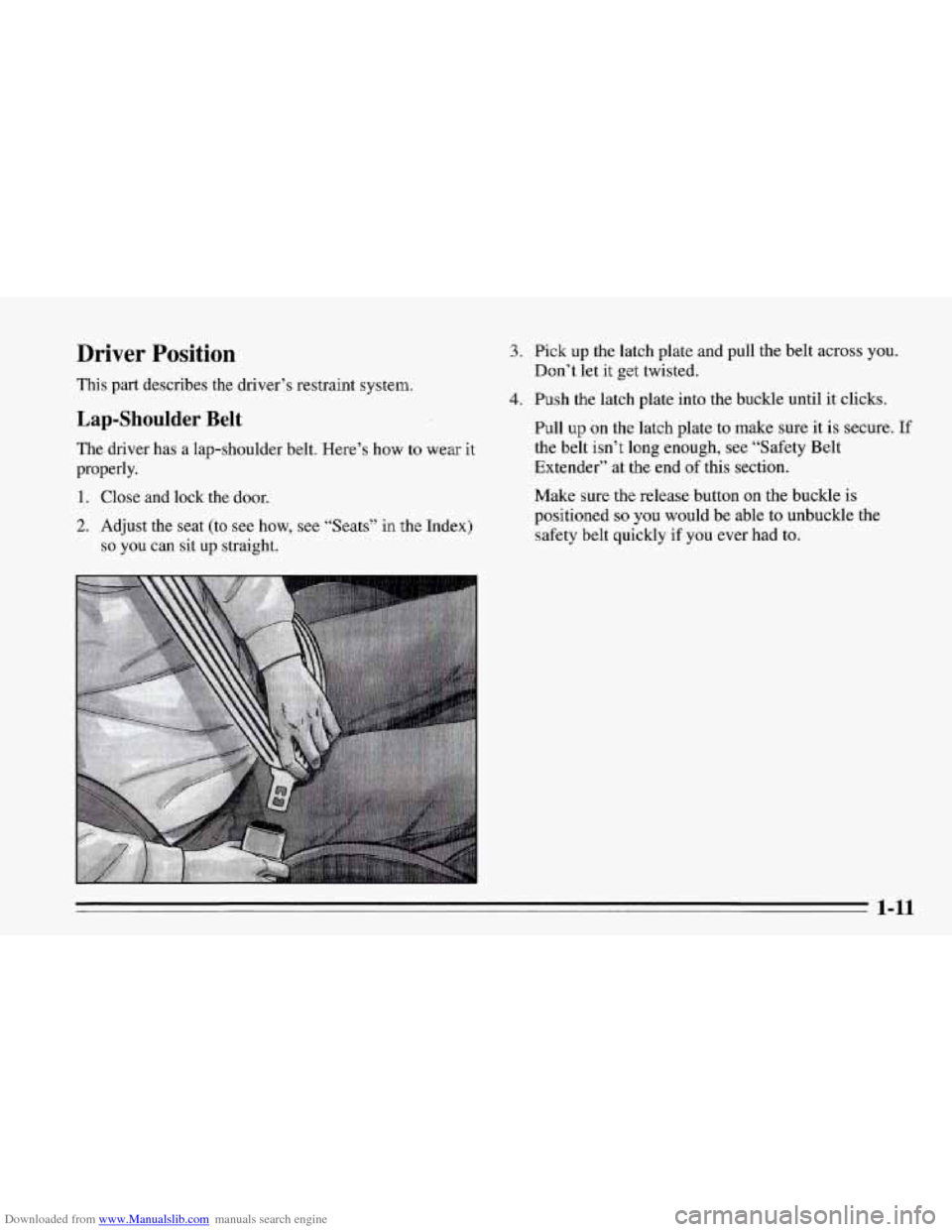
The driver has a lap-shoulder belt. Here’s how to wear it
properly.
1. Close and lock the door.
2. Adjust the seat (to see how, see “Seats” in the Index)
so you can sit up straight.
..
. . ..
3. Pick up the latch plate and pull the belt across you.
Don’t let it get twisted.
4. Push the latch plate into the buckle until it clicks.
Pull
up on the latch plate to make sure it is secure. If
the belt isn’t long enough, see “Safety Belt
Extender” at the end
of this section.
Make sure the release button on the buckle
is
positioned so you would be able to unbuckle the
safety belt quickly if you ever had to.
1-11
Page 23 of 386
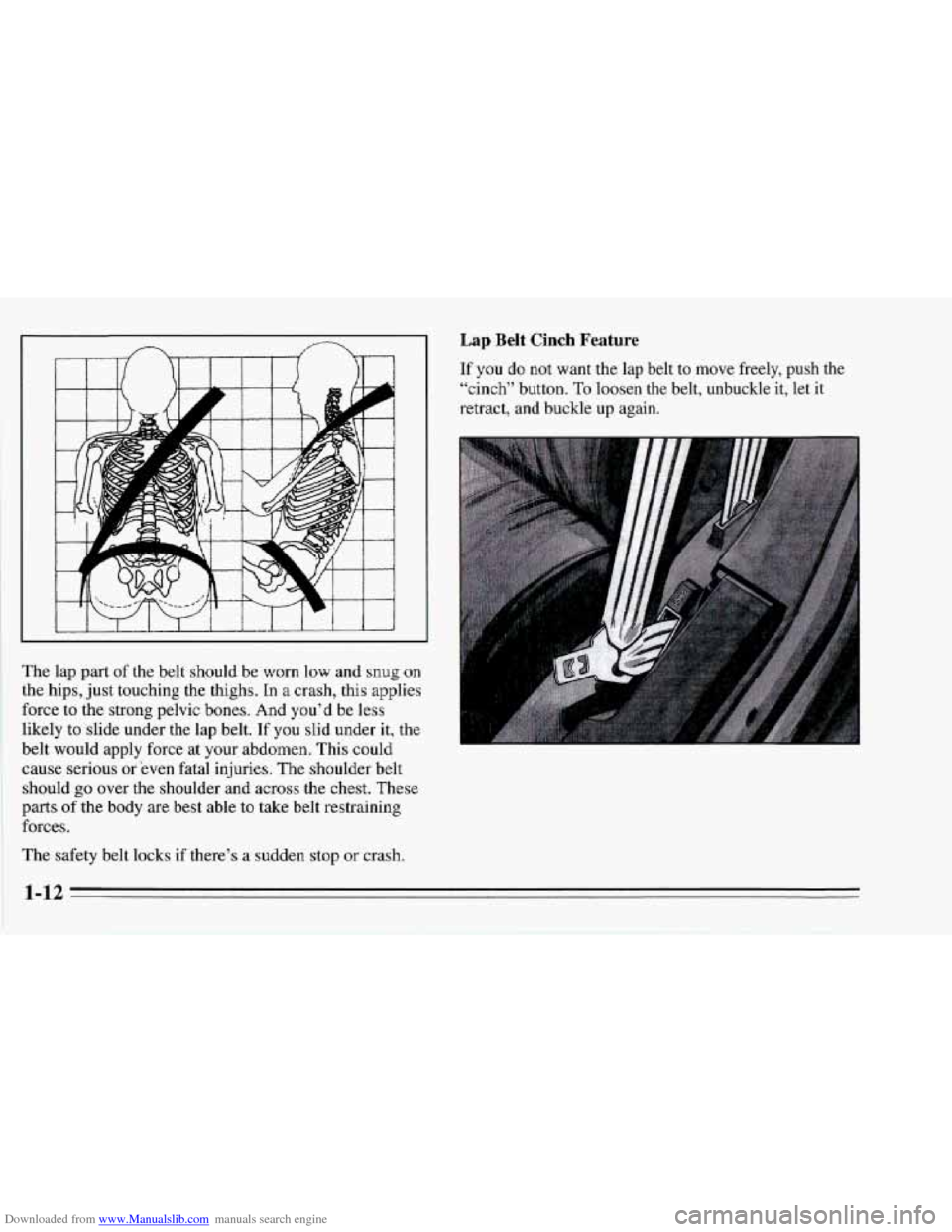
Downloaded from www.Manualslib.com manuals search engine The lap part of the belt should be worn low and snug on
the hips, just touching the thighs. In a crash, this applies
force to the strong pelvic
bones. And you’d be less
likely to slide under the lap belt.
If you slid under it, the
belt would apply force at your abdom’en. This could
cause serious or even fatal injuries. The shoulder belt
should
go over the shoulder and across the chest. These
parts of the body are best able to take belt restraining
forces.
The safety belt locks if there’s
a sudden stop or crash.
Lap Belt Cinch Feature
If you do not want the lap belt to move freely, push the
“cinch” button.
To loosen the belt, unbuckle it, let it
retract, and buckle
up again.
1-12
Page 24 of 386
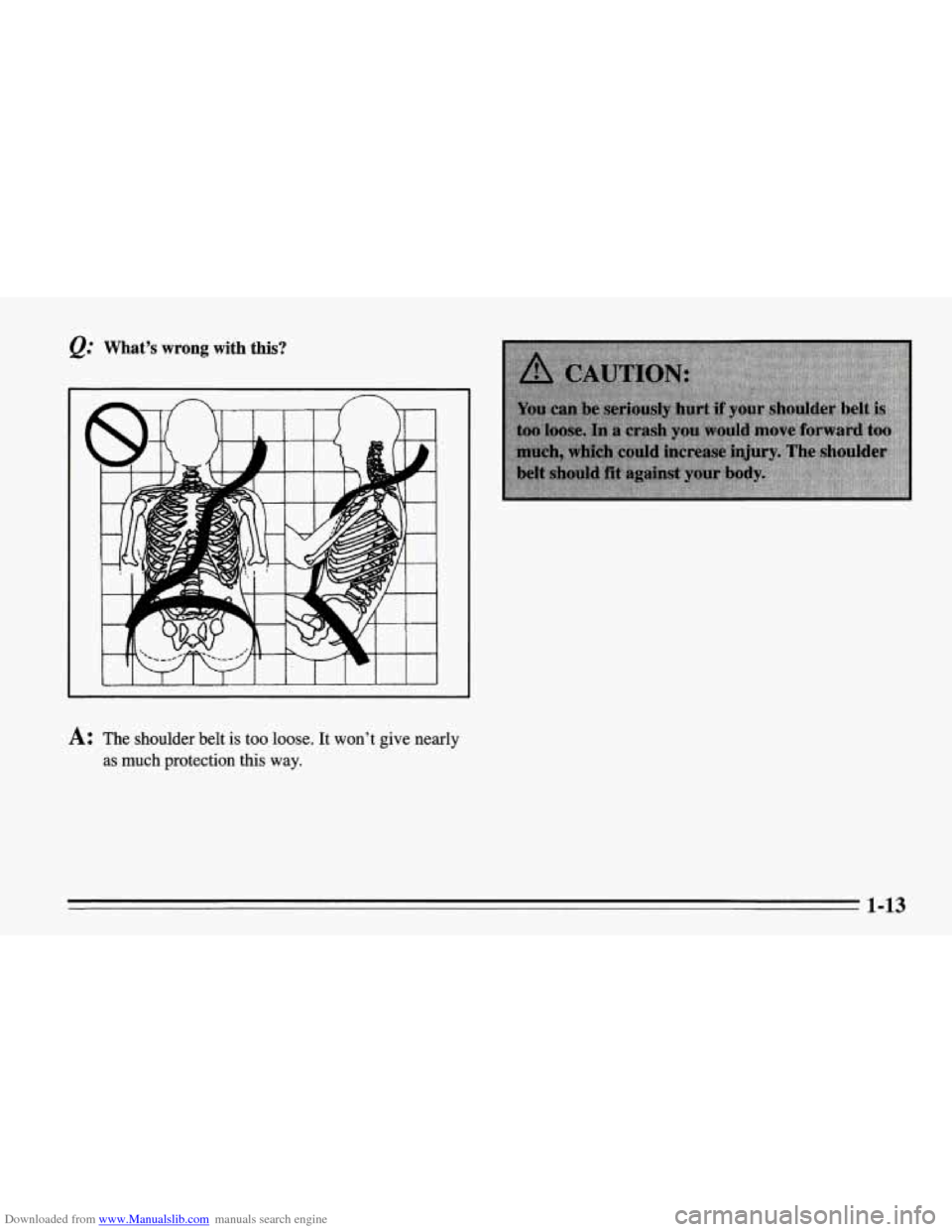
Downloaded from www.Manualslib.com manuals search engine What’s wrong with this?
A: The shoulder belt is too loose. It won’t give nearly
as much protection this way.
1-13
Page 25 of 386
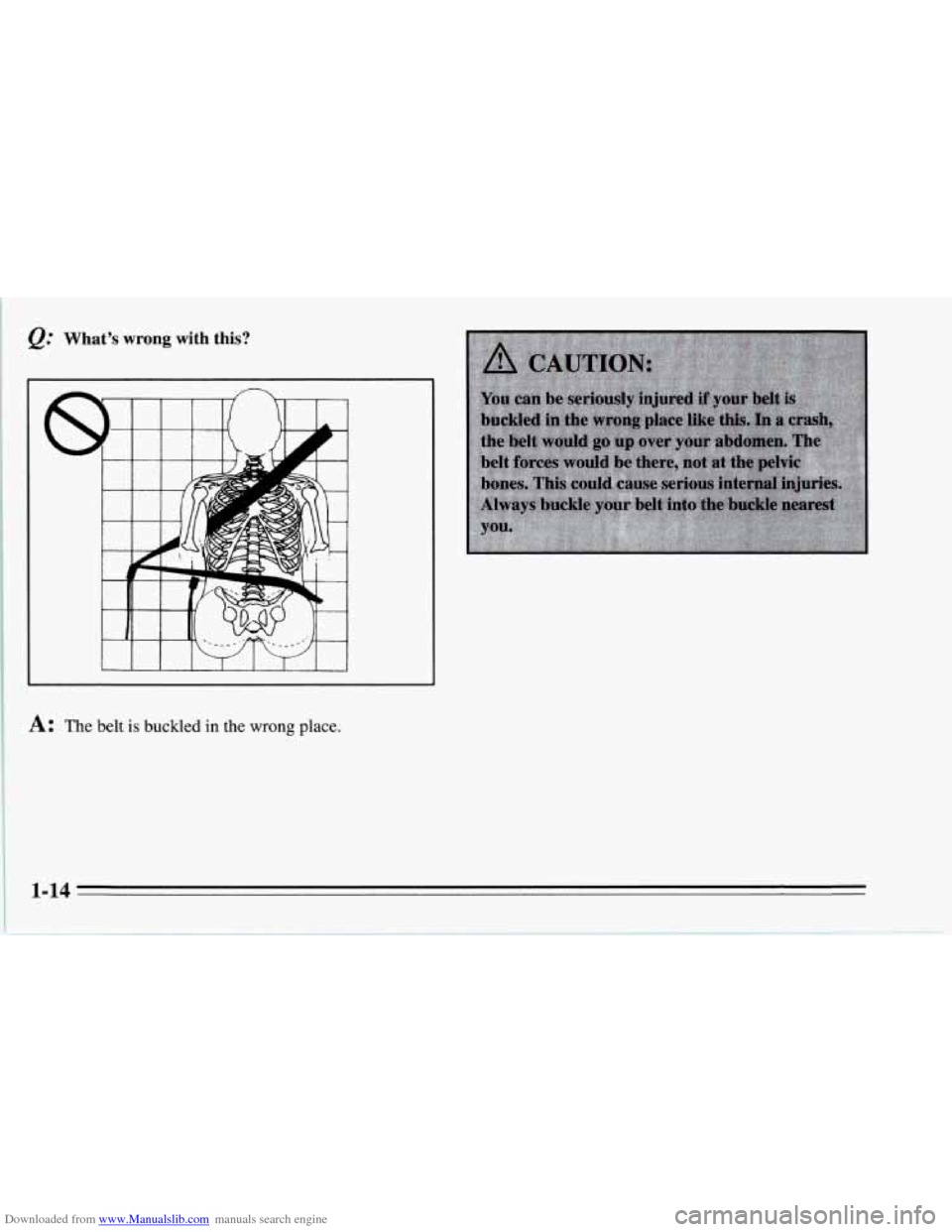
Downloaded from www.Manualslib.com manuals search engine @ What’s wrong with this?
n
A: The belt is buckled in the wrong place.
1-14
Page 26 of 386
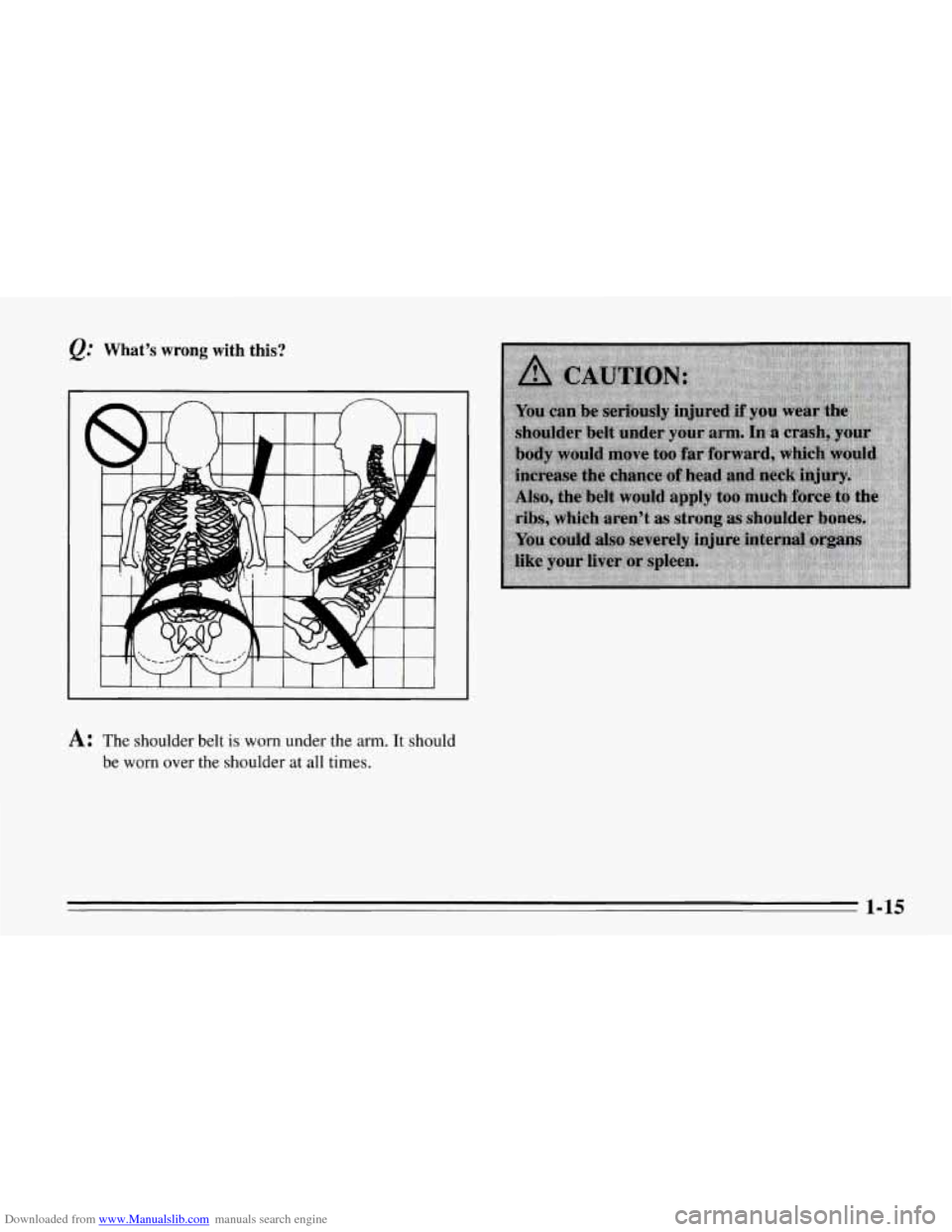
Downloaded from www.Manualslib.com manuals search engine What’s wrong with this?
A: The shoulder belt is worn under the arm. It should
be
worn over the shoulder at all times.
1-15
Page 27 of 386
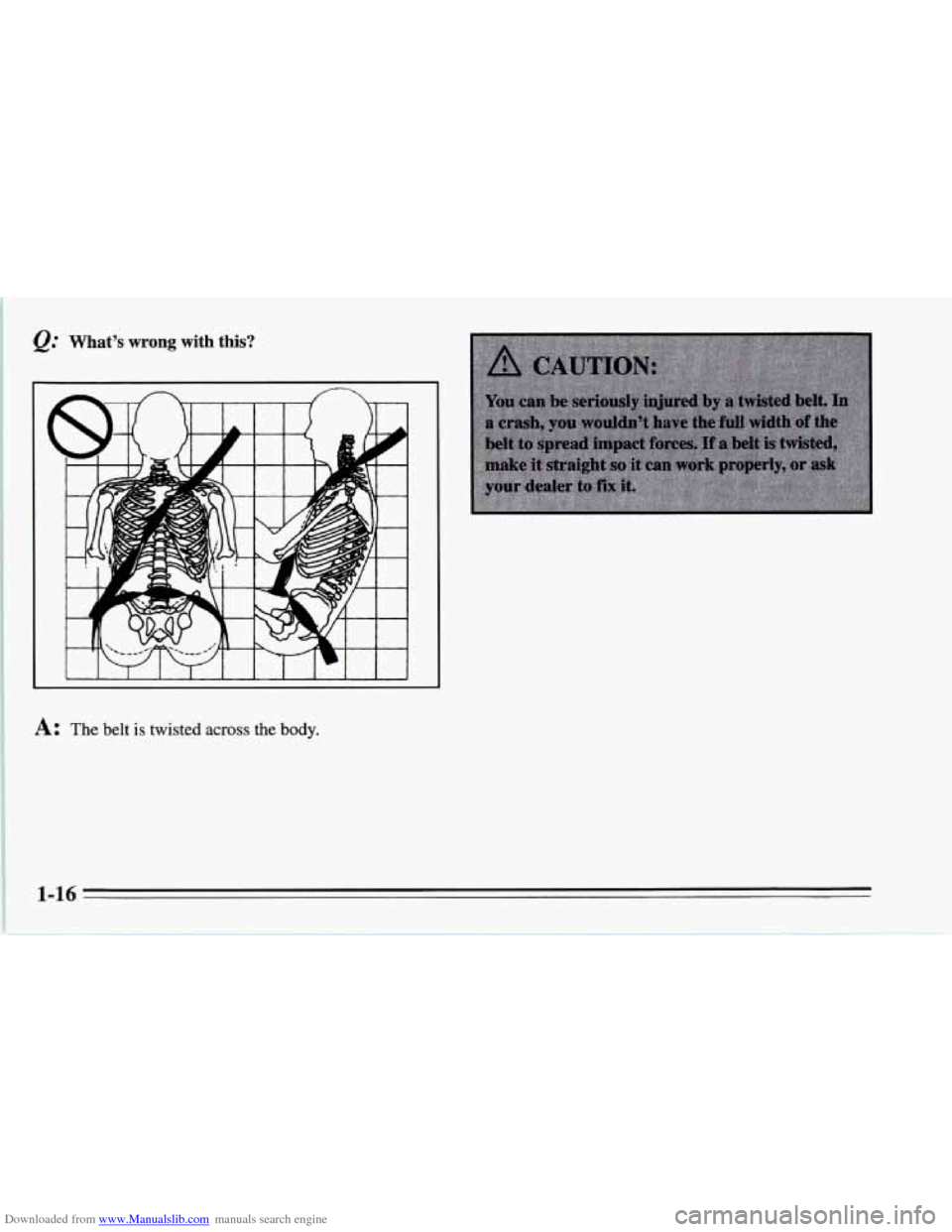
Downloaded from www.Manualslib.com manuals search engine @ What's wrong with this?
A: The belt is twisted across the body.
1-16
Page 28 of 386
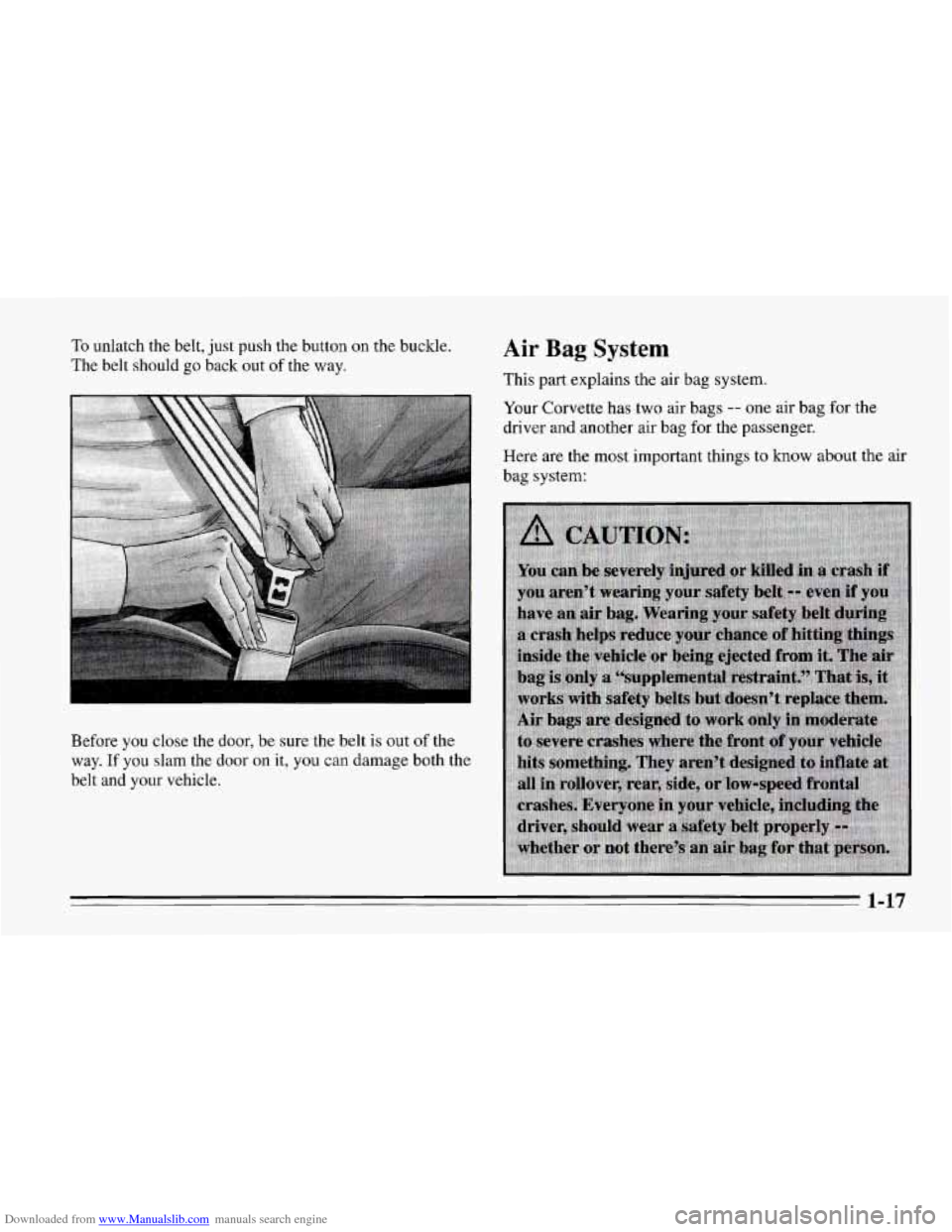
Downloaded from www.Manualslib.com manuals search engine To unlatch the belt, just push the button on the buckle.
The belt should go back out
of the way.
Before you close the door, be sure the belt
is out of the
way.
If you slam the door on it, you can damage both the
belt and your vehicle.
Air Bag System
This part explains the air bag system.
Your Corvette has two air bags
-- one air bag for the
driver and another air bag for the passenger.
Here are the most important things
to know about the air
bag system:
1-17
Page 31 of 386
Downloaded from www.Manualslib.com manuals search engine When should an air bag inflate?
The air bag is designed to inflate in moderate to severe
frontal or near-frontal crashes. The air bag will inflate
only
if the impact speed is above the system’s designed
“threshold level.” If your vehicle goes straight into a
wall that doesn’t move or deform, the threshold level is
about
9 to 15 mph (14 to 24 km/h). The threshold level
can vary, however, with specific vehicle design,
so that
it can be somewhat above or below
this range. If your
vehicle strikes something that will move or deform, such
as a parked car, the threshold level will be higher. The
air bag is not designed to inflate in rollovers, side
impacts, or rear impacts, because inflation would not
help the occupant.
It is possible that in a crash only one of the two air bags
in your Corvette will deploy.
This is rare, but can
happen in a crash just severe enough to make an air bag
inflate.
In any particular crash, no one can say whether an air
bag should have inflated simply because of the damage
to a vehicle or because of what the repair costs were.
Inflation is determined by the angle of the impact and
the vehicle’s deceleration. Vehicle damage is only one
indication of this.
What makes an air bag inflate?
In a frontal or near-frontal impact of sufficient severity,
the air bag sensing system detects that the vehicle is
suddenly stopping as a result
of a crash. The sensing
system triggers a chemical reaction of the sodium azide
sealed in the inflator. The reaction produces nitrogen
gas, which inflates the air bag. The inflator, air bag, and
related hardware are all part of the air bag modules
packed inside the steering wheel and in the instrument
panel in front of the passenger.
How does an air bag restrain?
In moderate to severe frontal or near-frontal collisions,
even belted occupants can contact the steering wheel or
the instrument panel. The air bag supplements the
protection provided by safety belts. Air bags distribute
the force of the impact more evenly over the occupant’s
upper body, stopping the occupant more gradually. But
air bags would not help you in many types of collisions,
including rollovers and rear and side impacts, primarily
because an occupant’s motion
is not toward the air bag.
Air bags should never be regarded
as anything more
than a supplement to safety belts, and then only in
moderate to severe frontal or near-frontal collisions.
1-20