Page 197 of 340
Downloaded from www.Manualslib.com manuals search engine The following steps will tell you how to use the jack and
change a tire.
The equipment you'll need is in the trunk.
1.
2.
3.
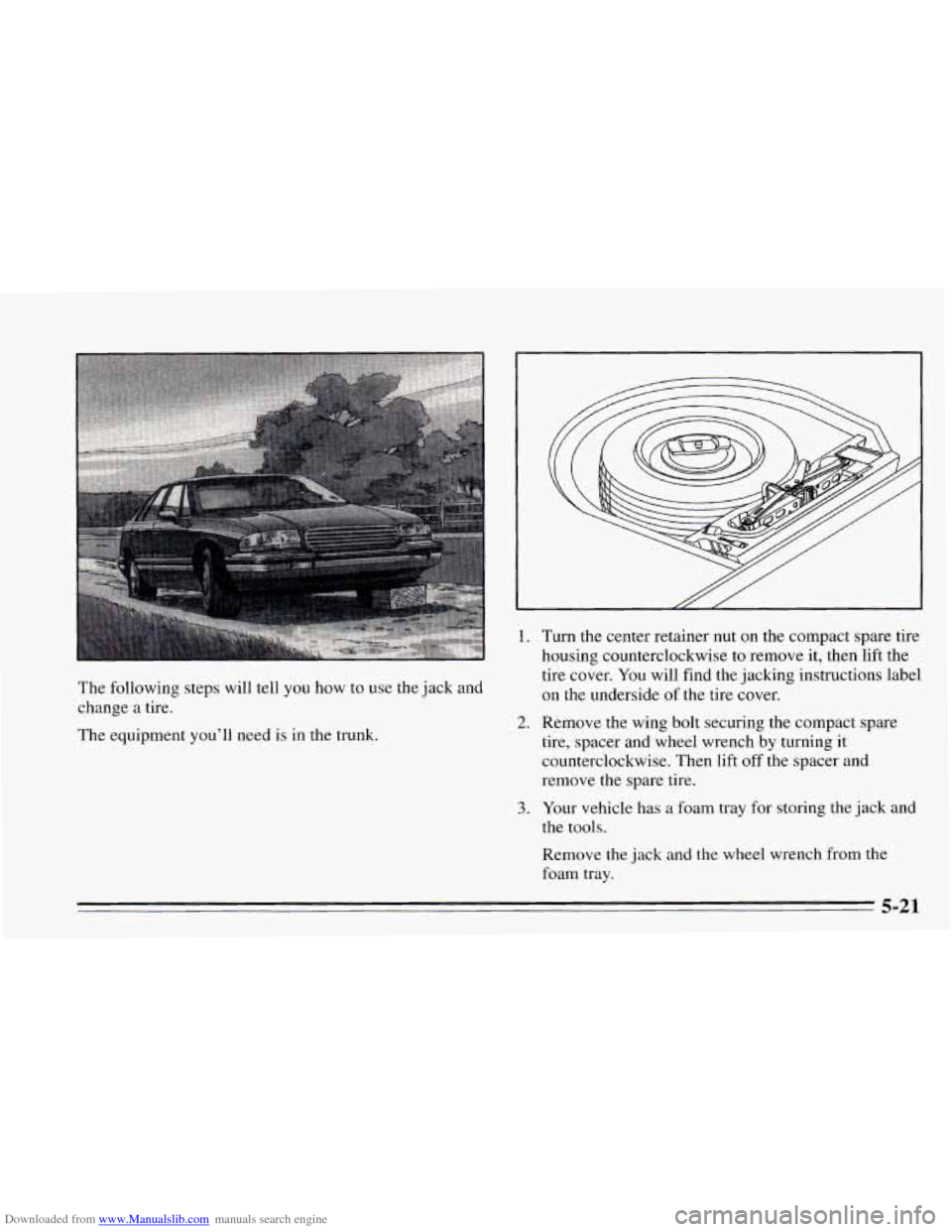
Turn the center retainer nut on the compact spare tire
housing counterclockwise to remove it, then lift the
tire cover. You will find the jacking instructions label
on the underside of the tire cover.
Remove the wing bolt securing the compact spare
tire, spacer and wheel wrench by turning it
counterclockwise. Then lift
off the spacer and
remove the spare tire.
Your vehicle has a foam tray for storing the jack and
the tools.
Remove the jack and the wheel wrench from the
foam tray.
5-21
Page 198 of 340
Downloaded from www.Manualslib.com manuals search engine 4. Remove the band around the jack. Turn the jack
handle clockwise
to raise the jack head a few inches.
5. Using the wheel wrench, remove the plastic cap nuts.
If your vehicle has aluminum wheels,
you may have
to remove a cover plate to access the wheel nuts. Use
the flat end
of the wheel wrench to remove the cover
plate.
Loosen all the wheel nuts. Don’t remove the
wheel nuts yet.
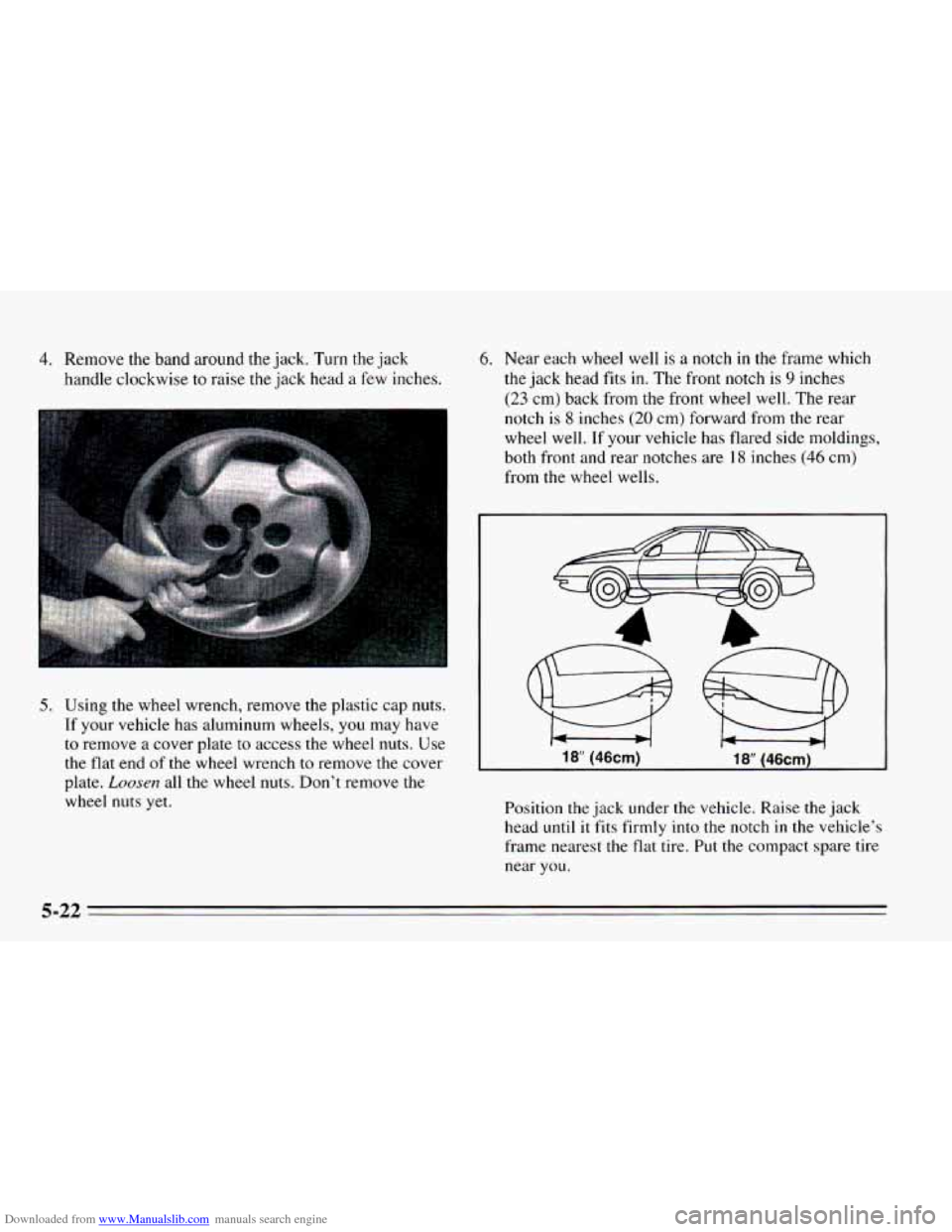
6. Near each wheel well is a notch in the frame which
the jack head fits in. The front notch
is 9 inches
(23 cm) back from the front wheel well. The rear
notch
is 8 inches (20 cm) forward from the rear
wheel well. If your vehicle has flared side moldings,
both front and rear notches are 18 inches
(46 cm)
from the wheel wells.
Position the jack under the vehicle. Raise the jack
head
until it fits firmly into the notch in the vehicle’s
frame nearest the flat tire. Put the compact spare tire
near
you.
5-22
Page 199 of 340
Downloaded from www.Manualslib.com manuals search engine NOTICE:
Raising your vehicle with the jack improperly
positioned will damage the vehicle or may allow
the vehicle
to fall off the jack. Be sure to fit the
jack lift head into the proper location before
raising your vehicle.
I
NOTICE:
Do not jack or lift the vehicle using the oil pan.
Pans could crack and begin to leak fluid.
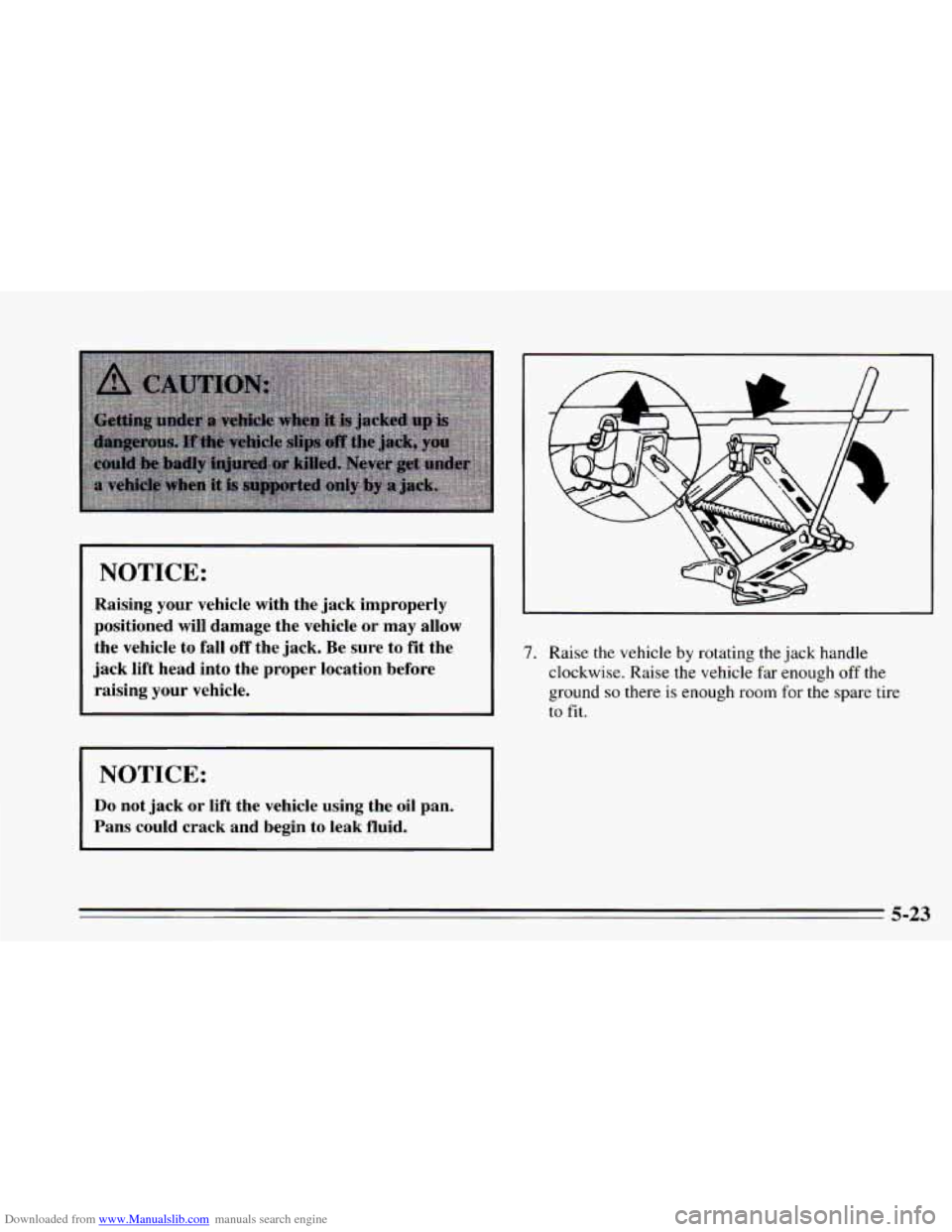
7. Raise the vehicle by rotating the jack handle
clockwise. Raise the vehicle
far enough off the
ground
so there is enough room for the spare tire
to fit.
5-23
Page 201 of 340
Downloaded from www.Manualslib.com manuals search engine c
11. Lower the vehicle by rotating the jack handle
counterclockwise. Lower the jack completely.
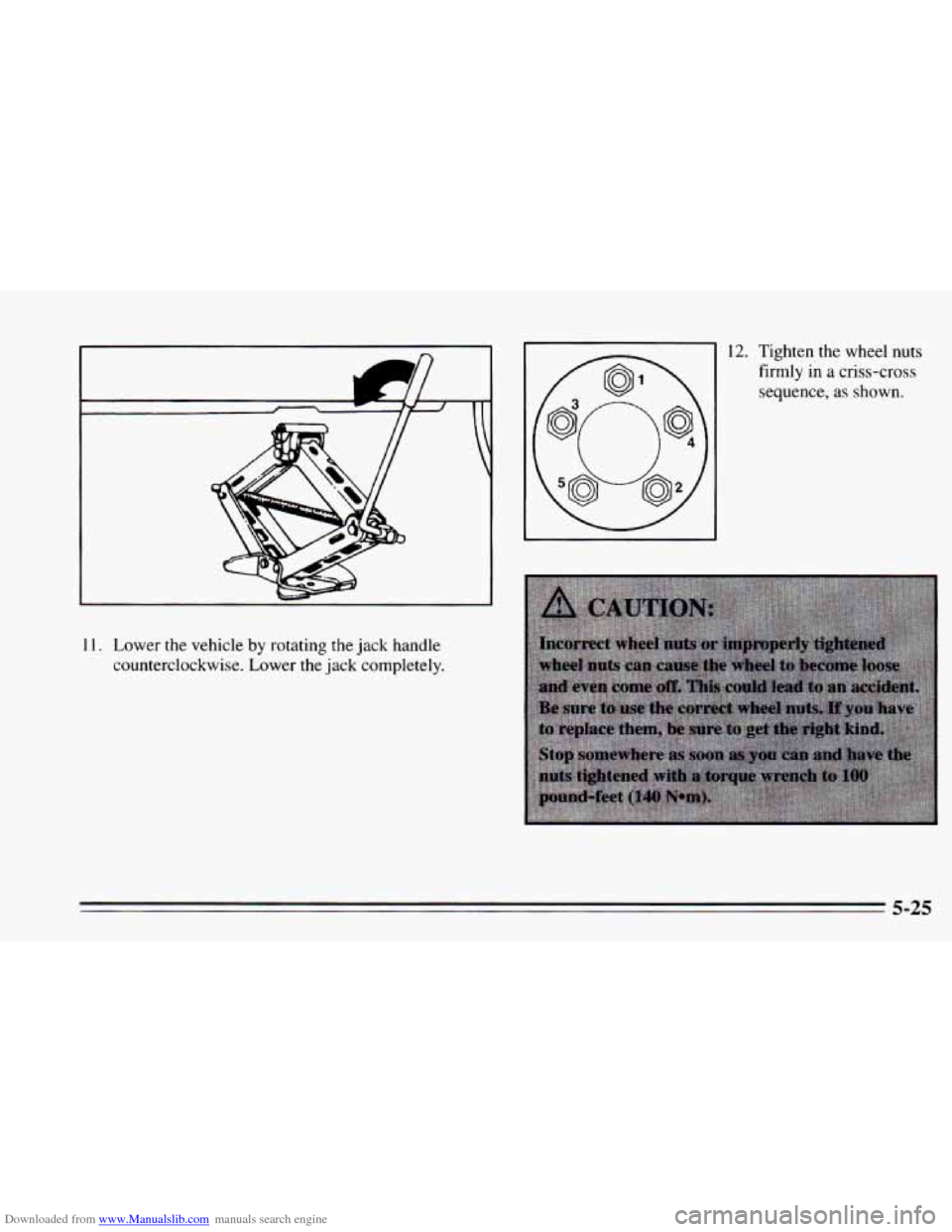
12. Tighten the wheel nuts
firmly in
a criss-cross
sequence, as shown.
5-25
Page 209 of 340
Downloaded from www.Manualslib.com manuals search engine P
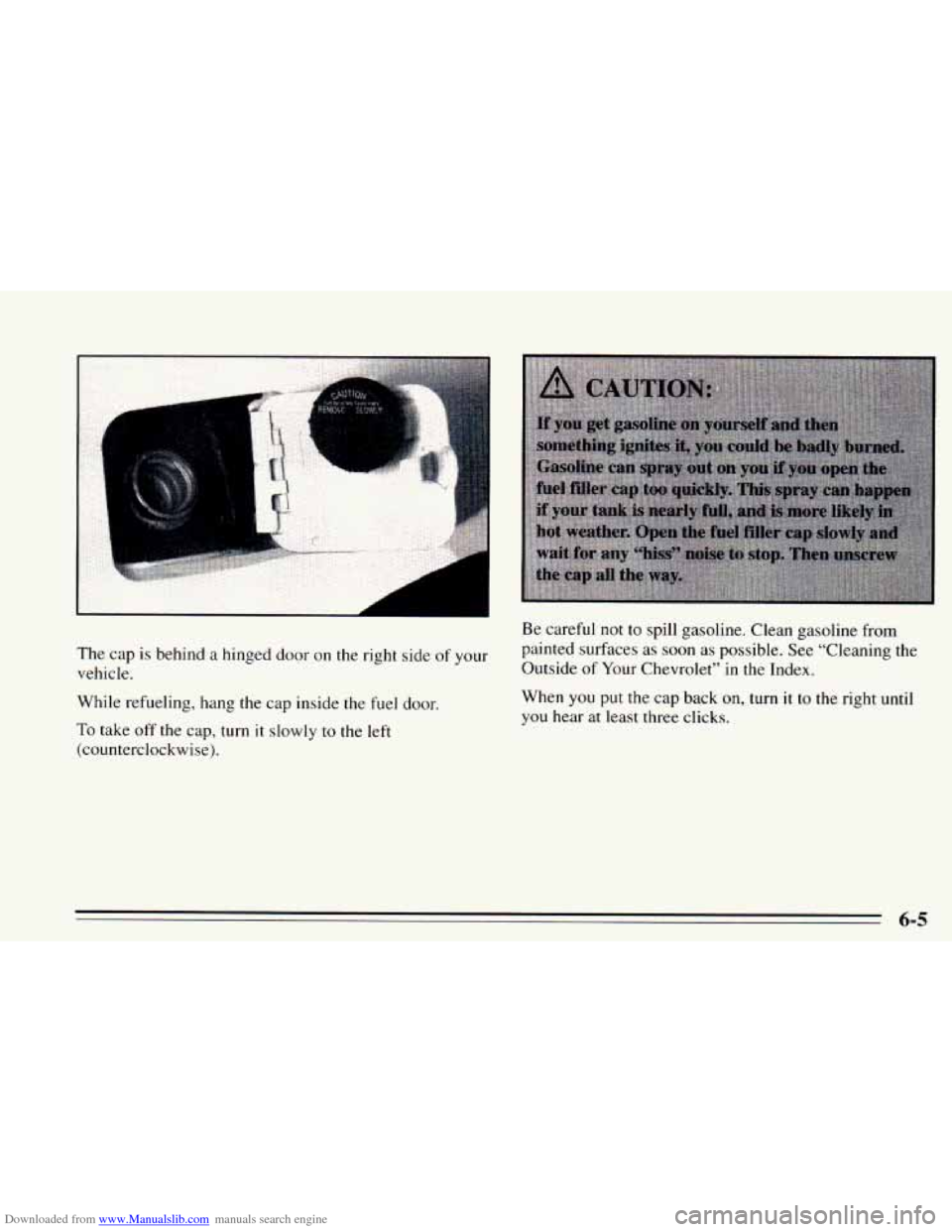
The cap is behind a hinged door on the right side of your
vehicle.
While refueling, hang the cap inside the
fuel door.
To take off the cap, turn it slowly to the left
(counterclockwise).
Be careful not to spill gasoline. Clean gasoline from
painted surfaces as soon
as possible. See “Cleaning the
Outside of
Your Chevrolet” in the Index.
When
you put the cap back on, turn it to the right until
you hear at least three clicks.
6-5
Page 224 of 340
Downloaded from www.Manualslib.com manuals search engine Then, follow these steps: How to Add Fluid
Here’s how to add fluid. Refer to the Maintenance
Schedule
to determine what kind of fluid to use. See
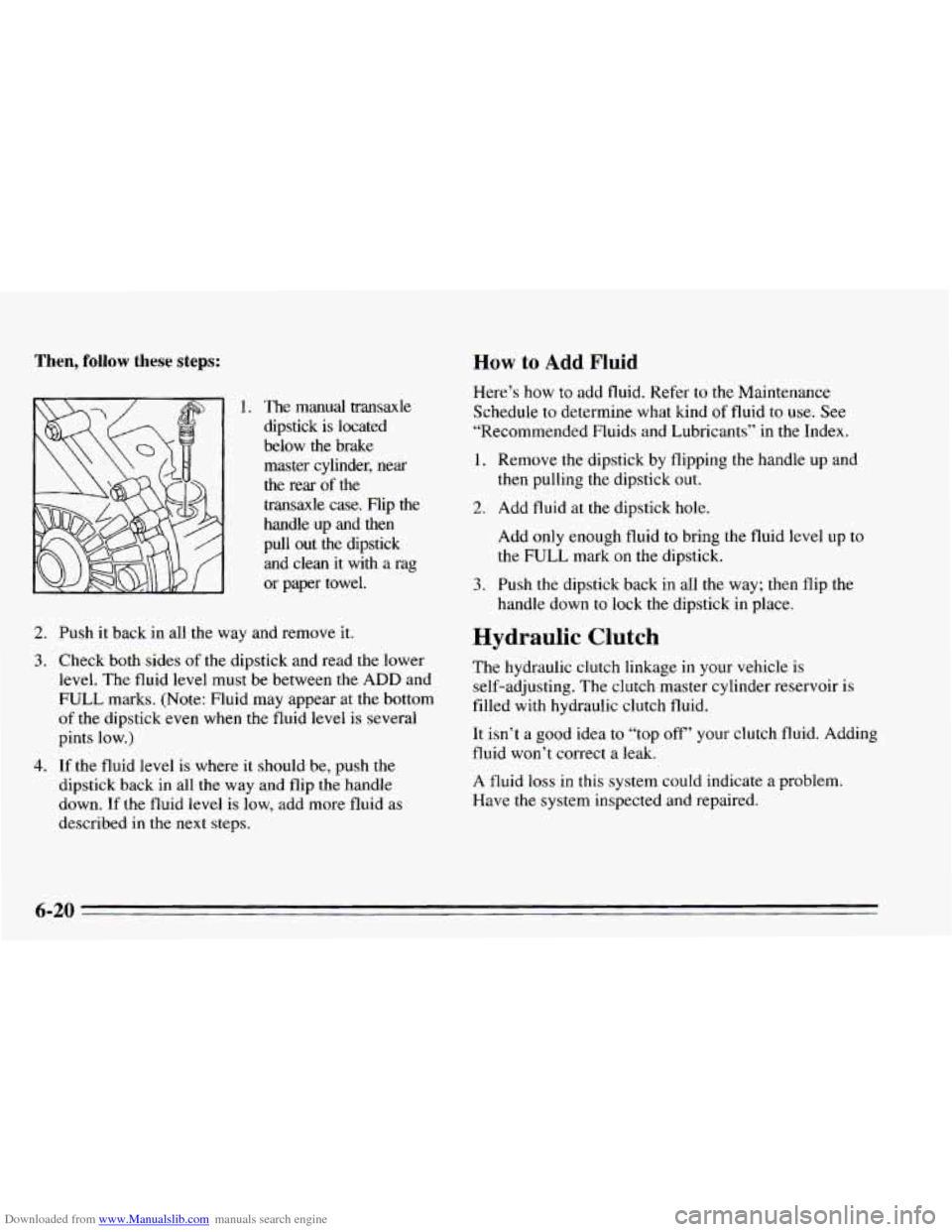
“Recommended Fluids and Lubricants” in the Index. ~ , 1. The manual transaxle
dipstick is located
below the brake
master cylinder, near the rear
of the
transaxle case. Flip the
handle up and then pull out the dipstick
and clean it with a rag
or paper towel.
2. Push it back in all the way and remove it.
3. Check both sides of the dipstick and read the lower
level. The fluid level must be between the
ADD and
FULL
marks. (Note: Fluid may appear at the bottom
of the dipstick even when the fluid level is several
pints
low.)
4. If the fluid level is where it should be, push the
dipstick back in all the way and flip the handle
down.
If the fluid level is low, add more fluid as
described
in the next steps.
1. Remove the dipstick by flipping the handle up and
then pulling the dipstick out.
2. Add fluid at the dipstick hole.
Add only enough fluid to bring the fluid level up to
the FULL mark on the dipstick.
3. Push the dipstick back in all the way; then flip the
handle down to lock the dipstick in place.
Hydraulic Clutch
The hydraulic clutch linkage in your vehicle is
self-adjusting. The clutch master cylinder reservoir
is
filled with hydraulic clutch fluid.
It isn’t
a good idea to “top off’ your clutch fluid. Adding
fluid won’t correct a leak.
A fluid loss in this system could indicate a problem.
Have the system inspected and repaired.
6-20
Page 235 of 340
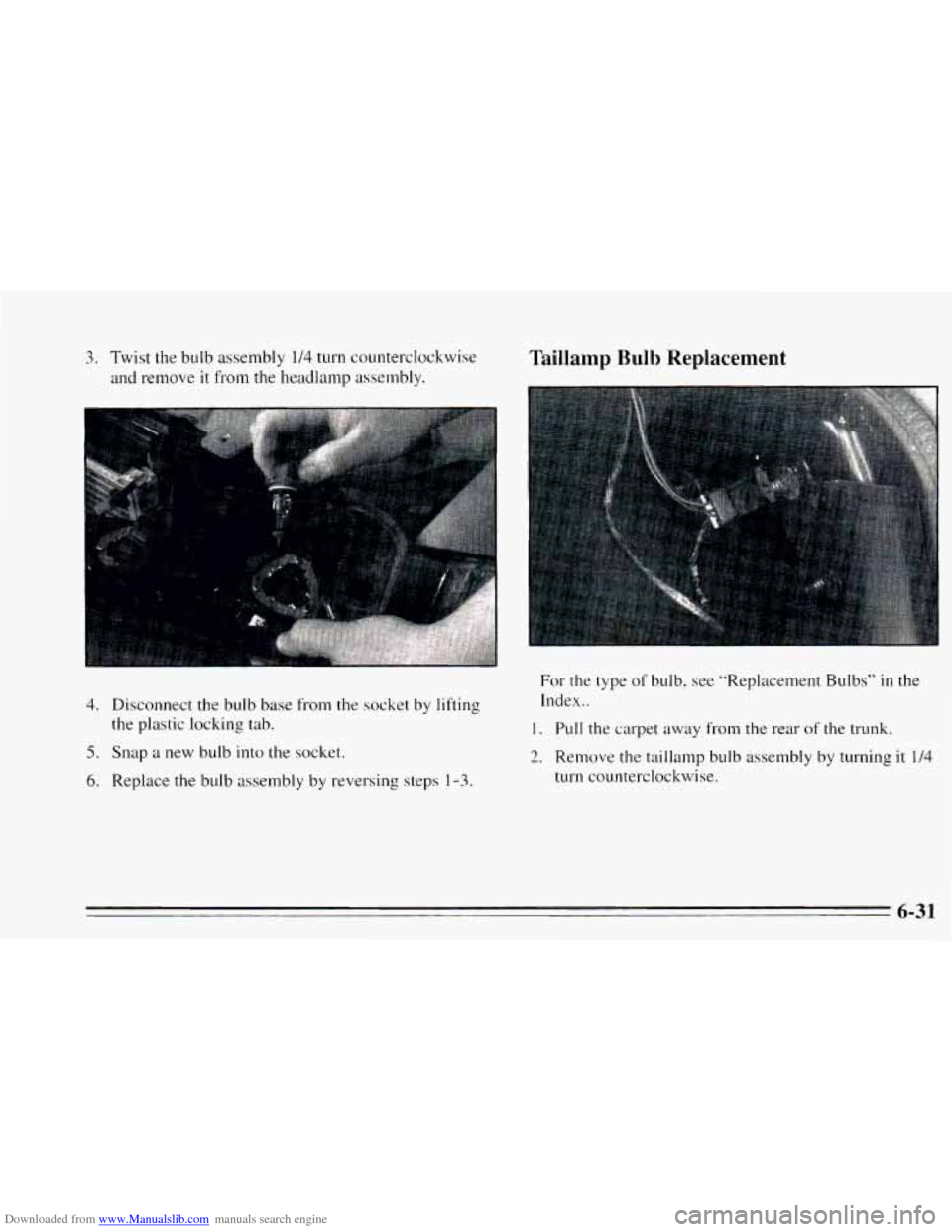
Downloaded from www.Manualslib.com manuals search engine 4. Disconnect the bulb base from the socket by lifting
the plastic locking tab.
5. Snap a new bulb into the socket.
6. Replace the bulb assembly by reversing steps 1-3.
For the type of bulb, see “Replacement Bulbs” in the
Index..
1. Pull the carpet away from the rear of the trunk.
2. Remove the taillamp bulb assembly by turning it 1/4
turn counterclockwise.
6-31
Page 256 of 340
Downloaded from www.Manualslib.com manuals search engine Fuses and Circuit Breakers There is also a fuse block at the driver’s side in the
engine compartment. Lift off the cover to check the
fuses.
To identify and check fuses, refer to the Fuse Usage
chart.
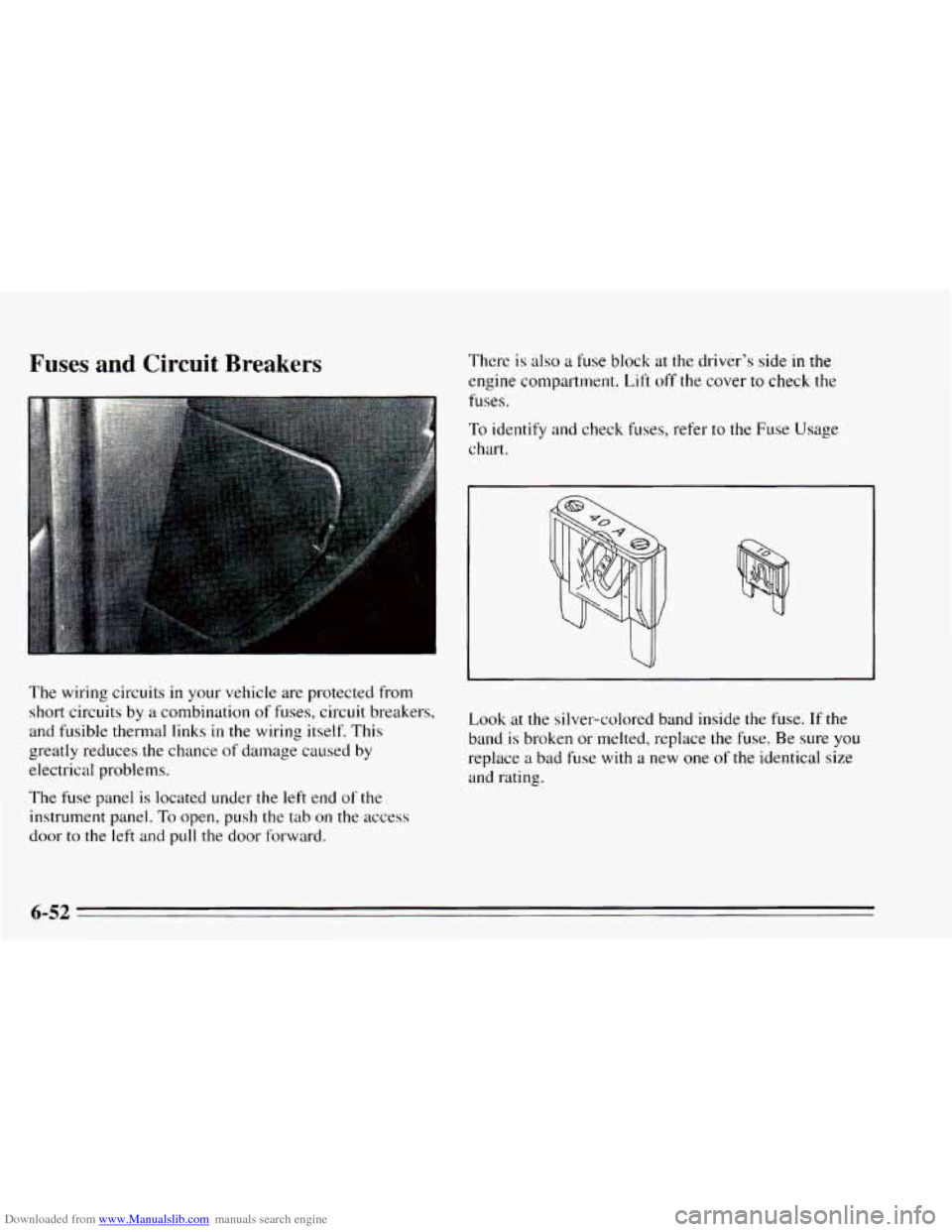
The wiring circuits
in your vehicle are protected from
short circuits by
a combination of fuses, circuit breakers, Look at the silver-colored band inside the fuse. If the
and fusible thermal links in the wiring itself. This
band is broken or melted, replace the fuse. Be sure you greatly reduces the chance of damage caused by
replace a bad fuse with a new one of the identical size
electrical problems. and rating.
The fuse panel is located under the left end of the
instrument panel.
To open, push the tab on the access
door
to the left and pull the door forward.
6-52