Page 174 of 340
Downloaded from www.Manualslib.com manuals search engine Driving with a Trailer
Towing a trailer requires a certain amount of experience.
Before setting
out for the open road, you’ll want to get
to know your rig. Acquaint yourself with the feel of
handling and braking with the added weight
of the
trailer. And always keep in mind that
the vehicle you are
driving is now a good deal longer and not nearly as
responsive
as your vehicle is by itself.
Before
you start, check the trailer hitch and platform
(and attachments), safety chains, electrical connector,
lamps, tires and mirror adjustment. If the trailer has
electric brakes, start your vehicle and trailer moving and
then apply the trailer brake controller by hand
to be sure
the brakes are working. This lets you check your
electrical connection at the same time.
During your trip, check occasionally to be sure that the
load is secure, and that the lamps and any trailer brakes
are still working.
Passing
You’ll need more passing distance up ahead when
you’re towing
a trailer. And, because you’re a good deal
longer, you’ll need to
go much farther beyond the
passed vehicle before you can return to your lane.
Backing Up
Hold the bottom of the steering wheel with one hand.
Then, to move
the trailer to the left, just move that hand
to the left. To move the trailer to the right, move your
hand to the right. Always back up slowly and,
if
possible, have someone guide you.
Making Turns
Following Distance
Stay at least twice as far behind the vehicle ahead as you
would when driving your vehicle without a trailer. This
can help you avoid situations that require heavy braking
and sudden turns.
I NOTICE:
Making very sharp turns while trailering could
cause the trailer to come in contact with the
vehicle. Your vehicle could
be damaged. Avoid
making very sharp turns while trailering.
When you’re turning with a trailer, make wider turns than
normal.
Do this so your trailer won’t strike soft shoulders,
curbs. road signs, trees, or other objects. Avoid jerky or
sudden maneuvers. Signal well
in advance.
4-34
Page 184 of 340
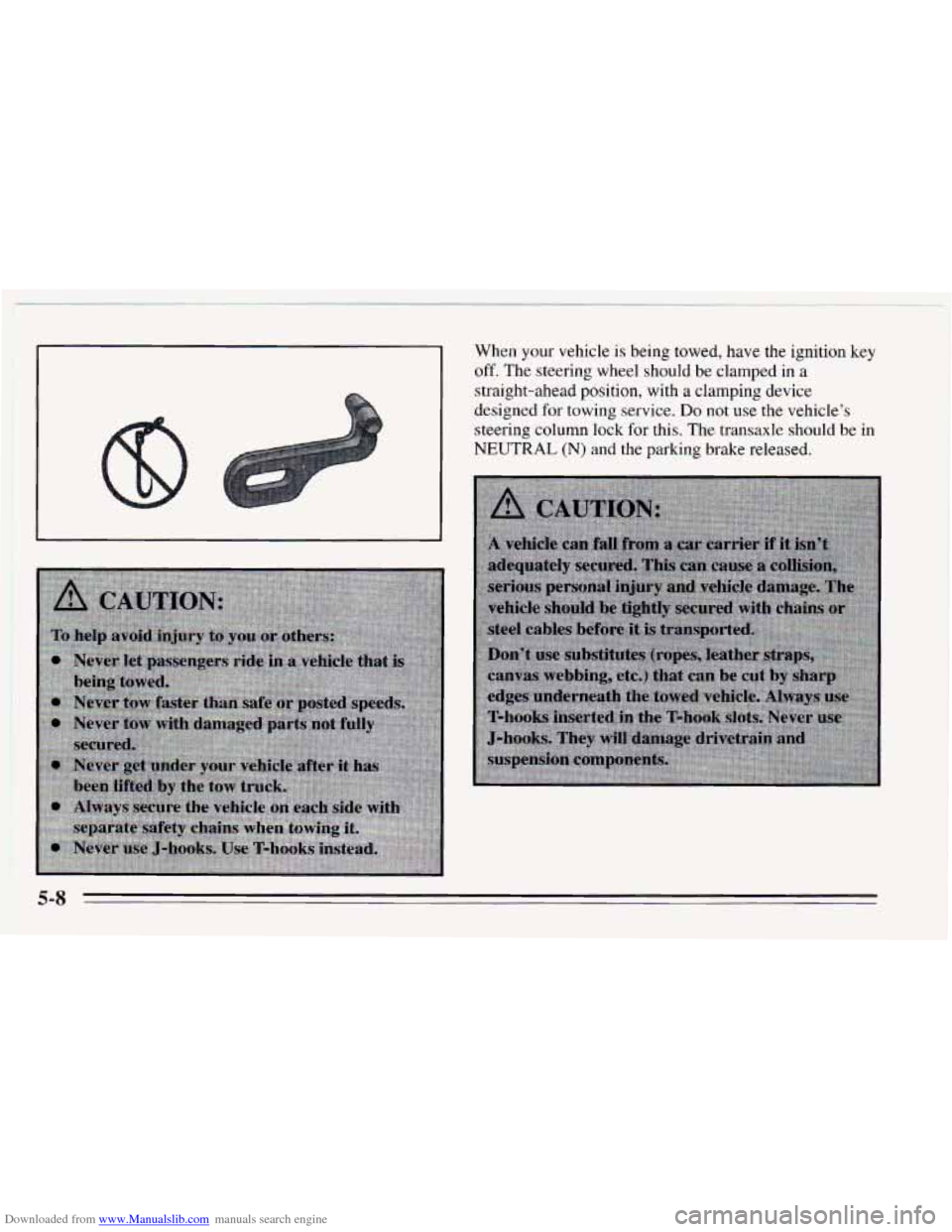
Downloaded from www.Manualslib.com manuals search engine When your vehicle is being towed, have the ignition key
off, The steering wheel should be clamped in a
straight-ahead position, with a clamping device
designed for towing service.
Do not use the vehicle’s
steering column lock
for this. The transaxle should be in
NEUTRAL (N) and the
parking brake released.
5-8
Page 196 of 340
Downloaded from www.Manualslib.com manuals search engine If a Tire Goes Flat
It’s unusual for a tire to “blow out” while you’re driving,
especially if
you maintain your tires properly. If air goes
out of a tire, it’s much more likely
to leak out slowly.
But if you should ever have a “blowout,” here are a few
tips about what to expect and what to do:
If a front tire fails, the flat tire will create a drag that
pulls the vehicle toward that side. Take your foot off the
accelerator pedal and grip the steering wheel firmly.
Steer to maintain lane position, then gently brake to a
stop well out
of the traffic lane.
A rear blowout, particularly on a curve, acts much like a
skid and
may require the same correction you’d use in a
skid. In any rear blowout, remove your foot from the
accelerator pedal. Get the vehicle under control by
steering the way you want the vehicle to
go. It may be
very bumpy and noisy, but you can still steer. Gently
brake to
a stop, well off the road if possible.
If a tire goes flat, the next part shows how to use your
jacking equipment
to change a flat tire safely.
Changing a Flat Tire
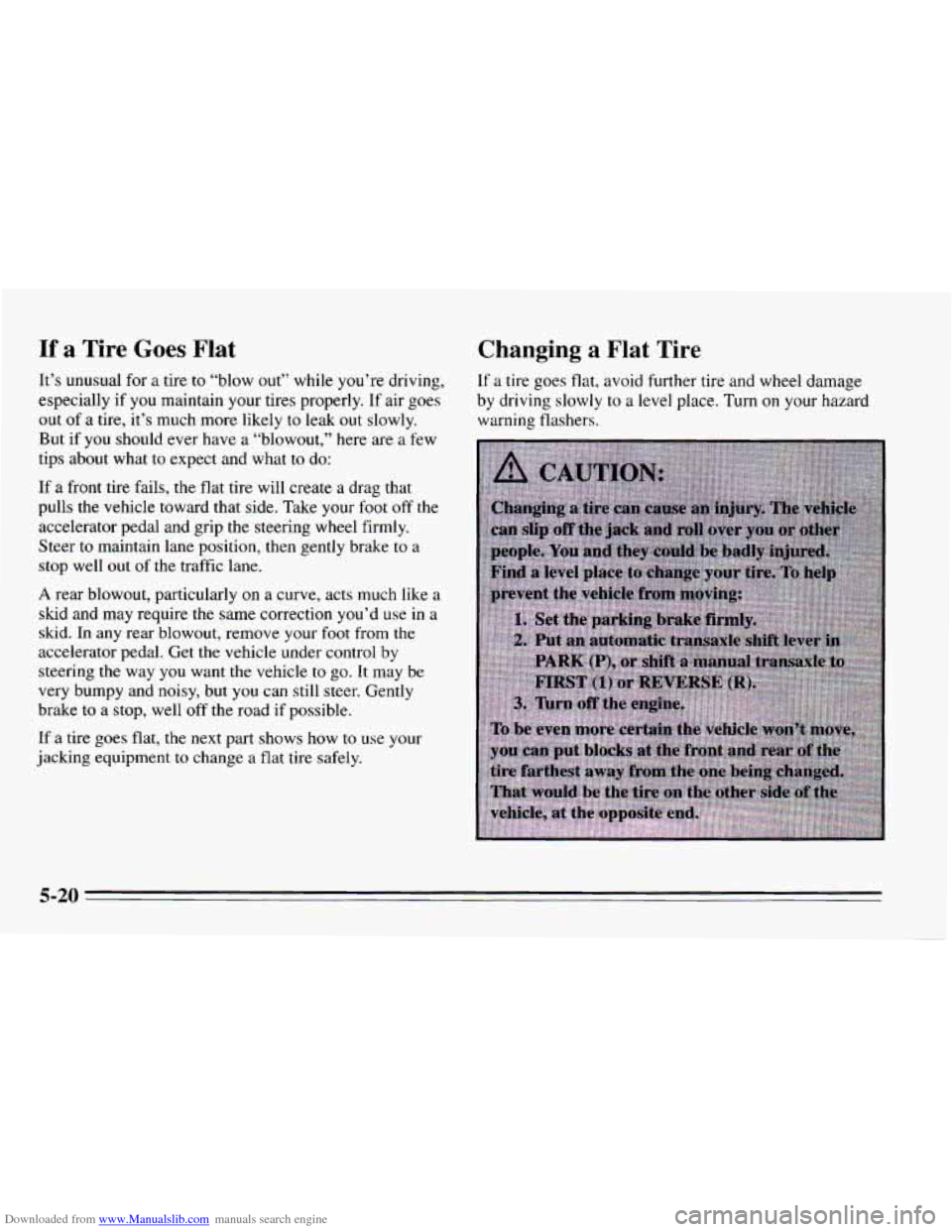
If a tire goes flat, avoid further tire and wheel damage
by driving slowly
to a level place. Turn on your hazard
warning flashers.
5-20
Page 204 of 340
Downloaded from www.Manualslib.com manuals search engine If You’re Stuck: In Sand, Mud, Ice or
Snow
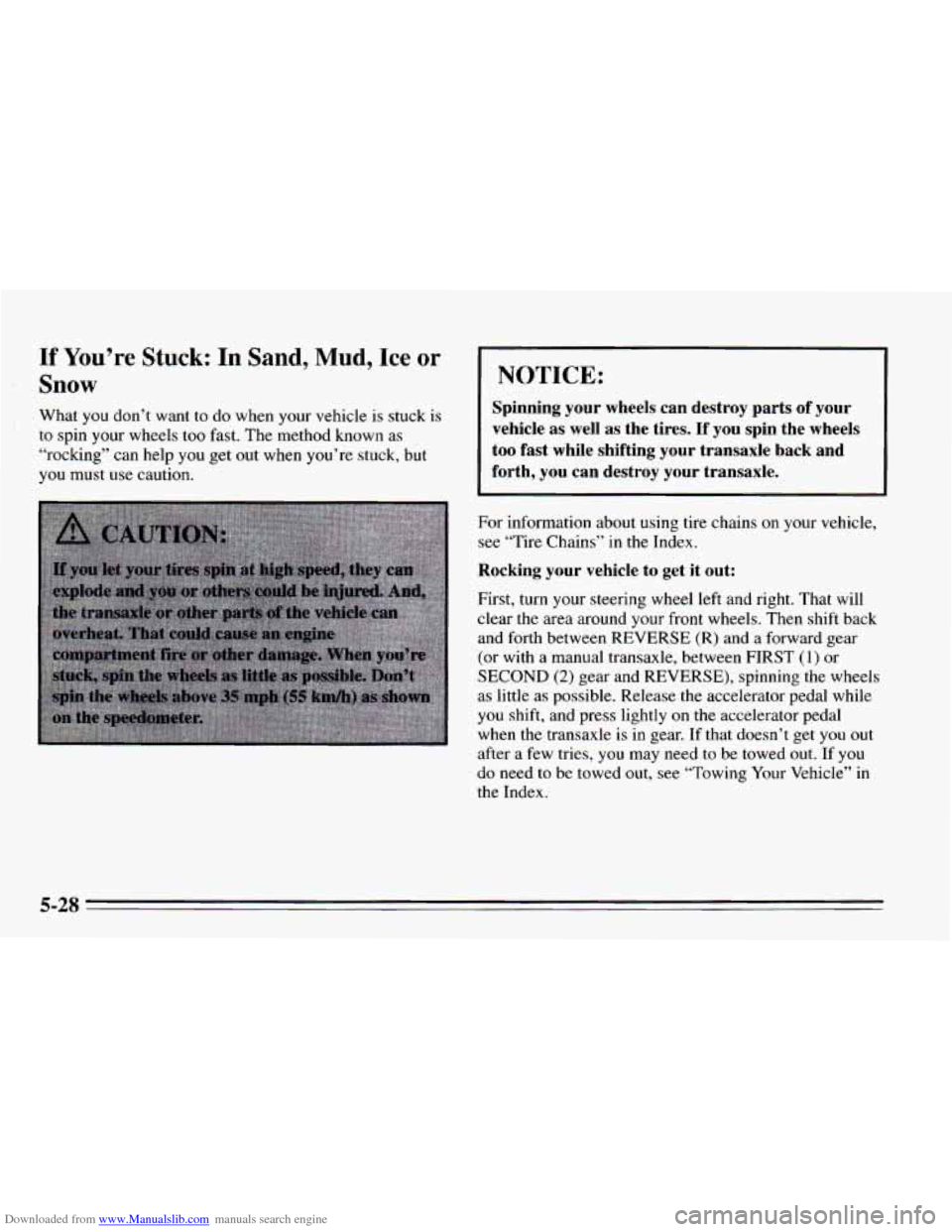
What you don’t want to do when your vehicle is stuck is
to spin your wheels too fast. The method known as
“rocking” can help you get out when you’re stuck, but
you must use caution.
I NOTICE:
Spinning your wheels can destroy parts of your
vehicle as well as the tires.
If you spin the wheels
too fast while shifting your transaxle back and
forth, you can destroy your transaxle.
For information about using tire chains on your vehicle,
see “Tire Chains”
in the Index.
Rocking your vehicle to get it out:
First, turn your steering wheel left and right. That will
clear the area around your front wheels. Then shift back
and forth between REVERSE (R) and a forward gear
(or with a manual transaxle, between FIRST
(1) or
SECOND (2) gear and REVERSE), spinning the wheels
as little as possible. Release the accelerator pedal while
you shift, and press lightly on the accelerator pedal
when the transaxle is in gear. If that doesn’t get
you out
after a few tries, you may need to be towed out. If you
do need to be towed out, see “Towing Your Vehicle” in
the Index.
5-28
Page 212 of 340
Downloaded from www.Manualslib.com manuals search engine Before closing the hood, be sure all the filler caps are on
properly. Then lift the hood to relieve pressure
on the
hood prop. Remove the hood prop from the slot in the
hood and return
the prop to its retainer. Then just let the
hood down and close it firmly.
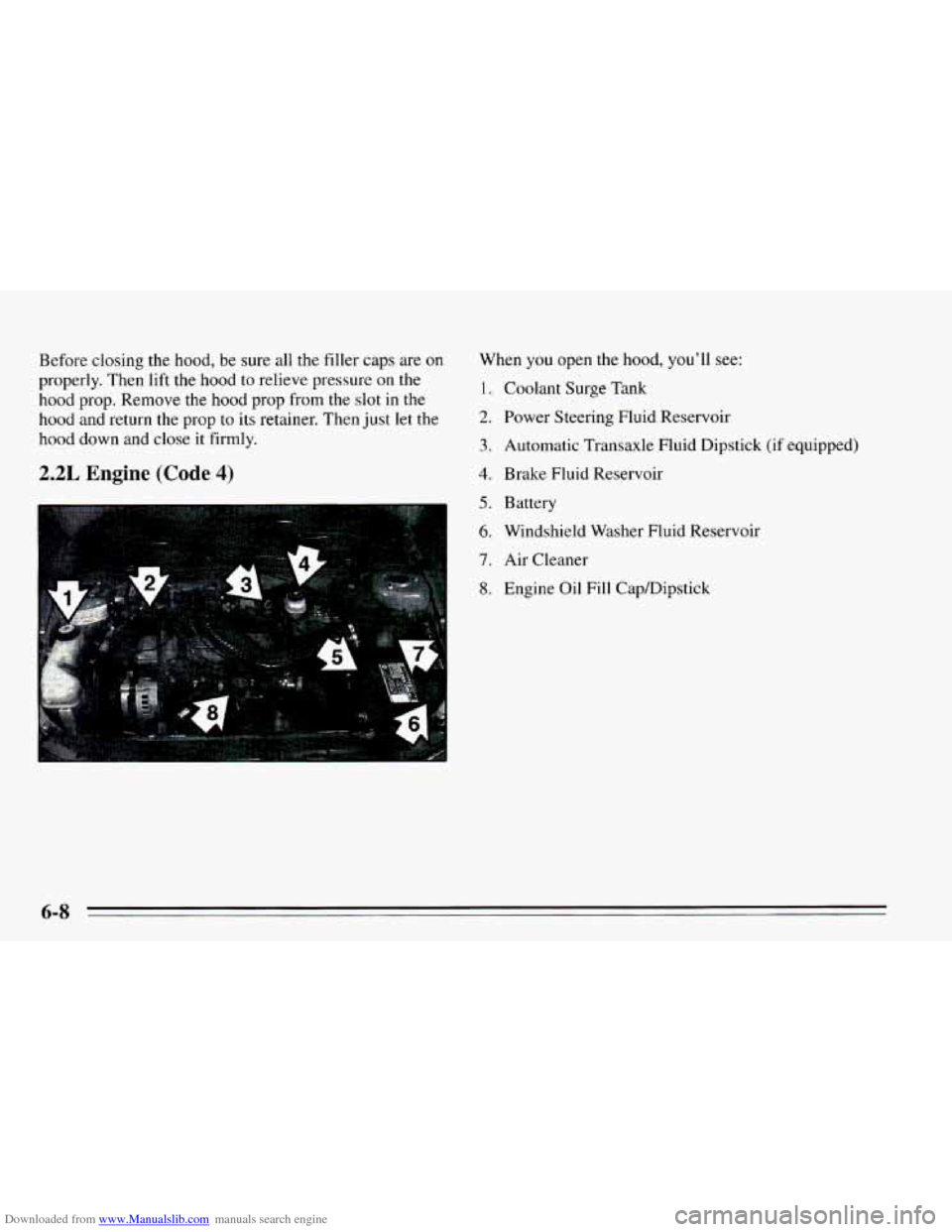
2.2L Engine (Code 4)
When you open the hood, you’ll see:
1. Coolant Surge Tank
2. Power Steering Fluid Reservoir
3. Automatic Transaxle Fluid Dipstick (if equipped)
4. Brake Fluid Reservoir
5. Battery
6. Windshield Washer Fluid Reservoir
7. Air Cleaner
8. Engine Oil Fill Capmipstick
Page 213 of 340
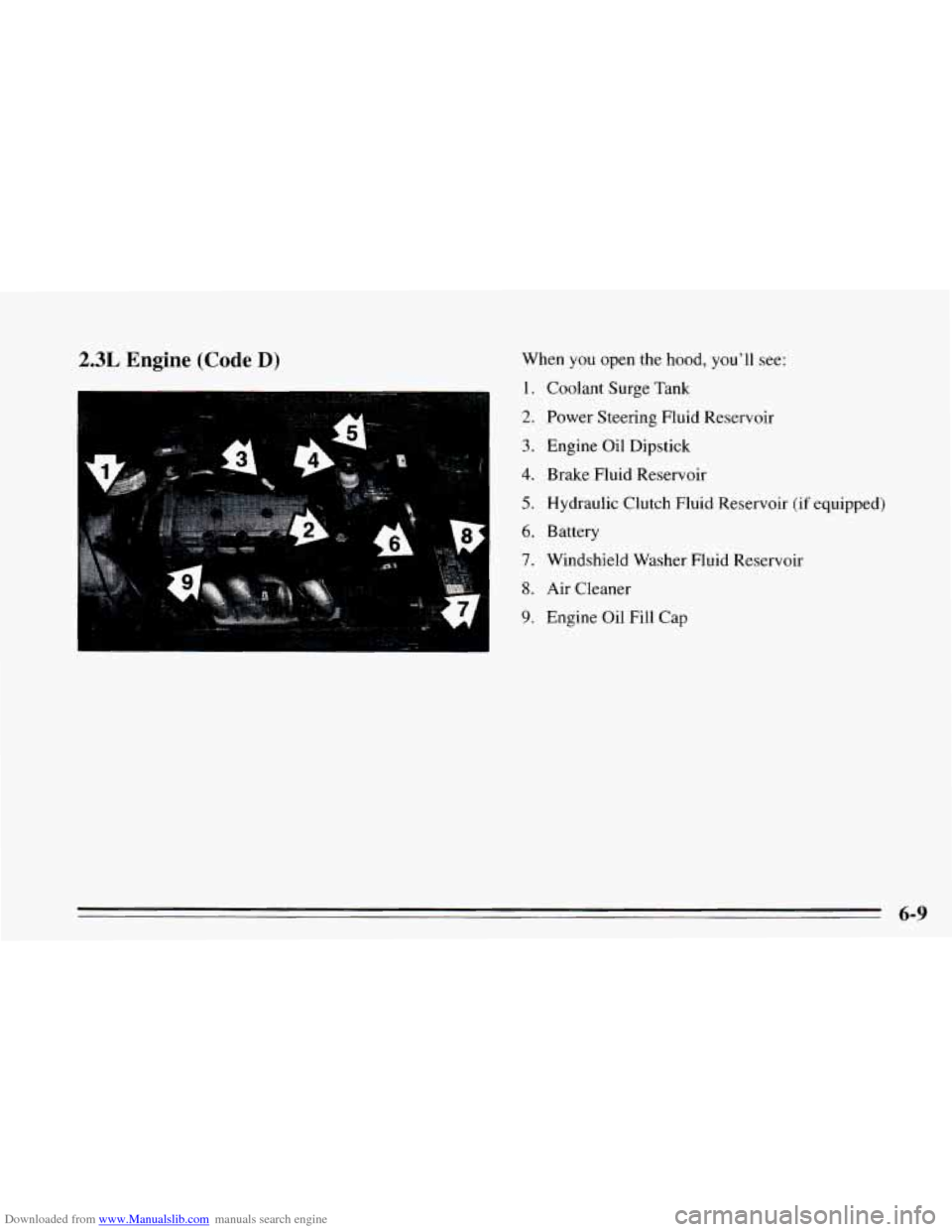
Downloaded from www.Manualslib.com manuals search engine 2.3L Engine (Code D) When you open the hood, you’ll see:
1.
2.
3.
4.
5.
6.
7.
8.
9.
Coolant Surge Tank
Power Steering Fluid Reservoir
Engine
Oil Dipstick
Brake Fluid Reservoir
Hydraulic Clutch Fluid Reservoir
(if equipped)
Battery
Windshield Washer Fluid Reservoir
Air Cleaner
Engine Oil Fill Cap
6-9
Page 228 of 340
Downloaded from www.Manualslib.com manuals search engine Thermostat
Engine coolant temperature is controlled by a thermostat
in the engine coolant system. The thermostat stops the
flow of coolant through the radiator until the coolant
reaches
a preset temperature.
When
you replace your thermostat, an AC’ thermostat
is recommended.
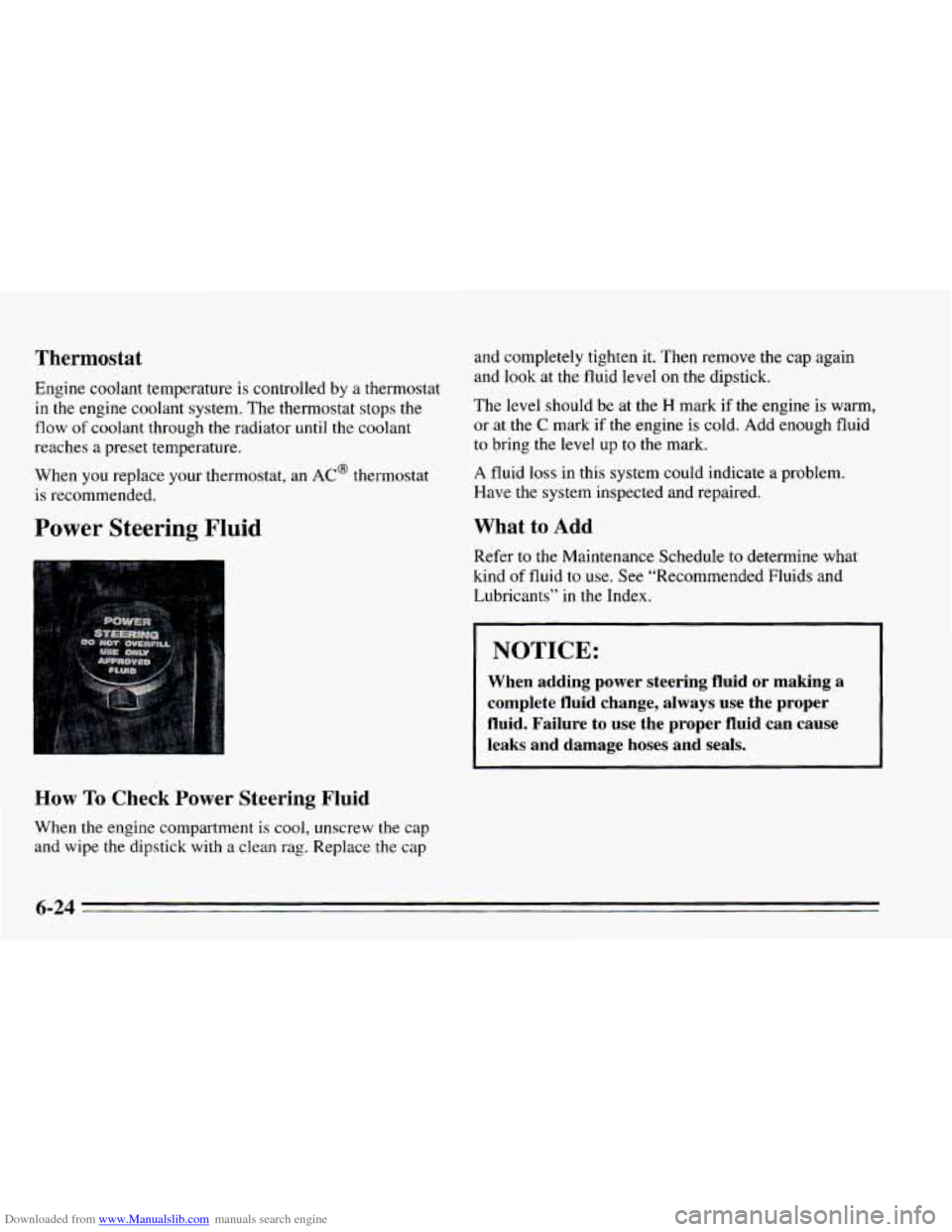
Power Steering Fluid
How To Check Power Steering Fluid
When the engine compartment is cool, unscrew the cap
and wipe the dipstick with a clean rag. Replace the cap and
completely tighten
it. Then remove the cap again
and look at the fluid level
on the dipstick.
The level should be at the
H mark if the engine is warm,
or at the
C mark if the engine is cold. Add enough fluid
to bring the level up
to the mark.
A fluid loss in this system could indicate a problem.
Have the system inspected and repaired.
What to Add
Refer to the Maintenance Schedule to determine what
kind
of fluid to use. See “Recommended Fluids and
Lubr’
nts” in the Index.
I NOTICE:
~~
When adding power steering fluid or making a
complete fluid change, always use the proper
fluid. Failure to use the proper fluid
can cause
leaks and damage hoses and seals.
6-24
Page 258 of 340
Downloaded from www.Manualslib.com manuals search engine I 1
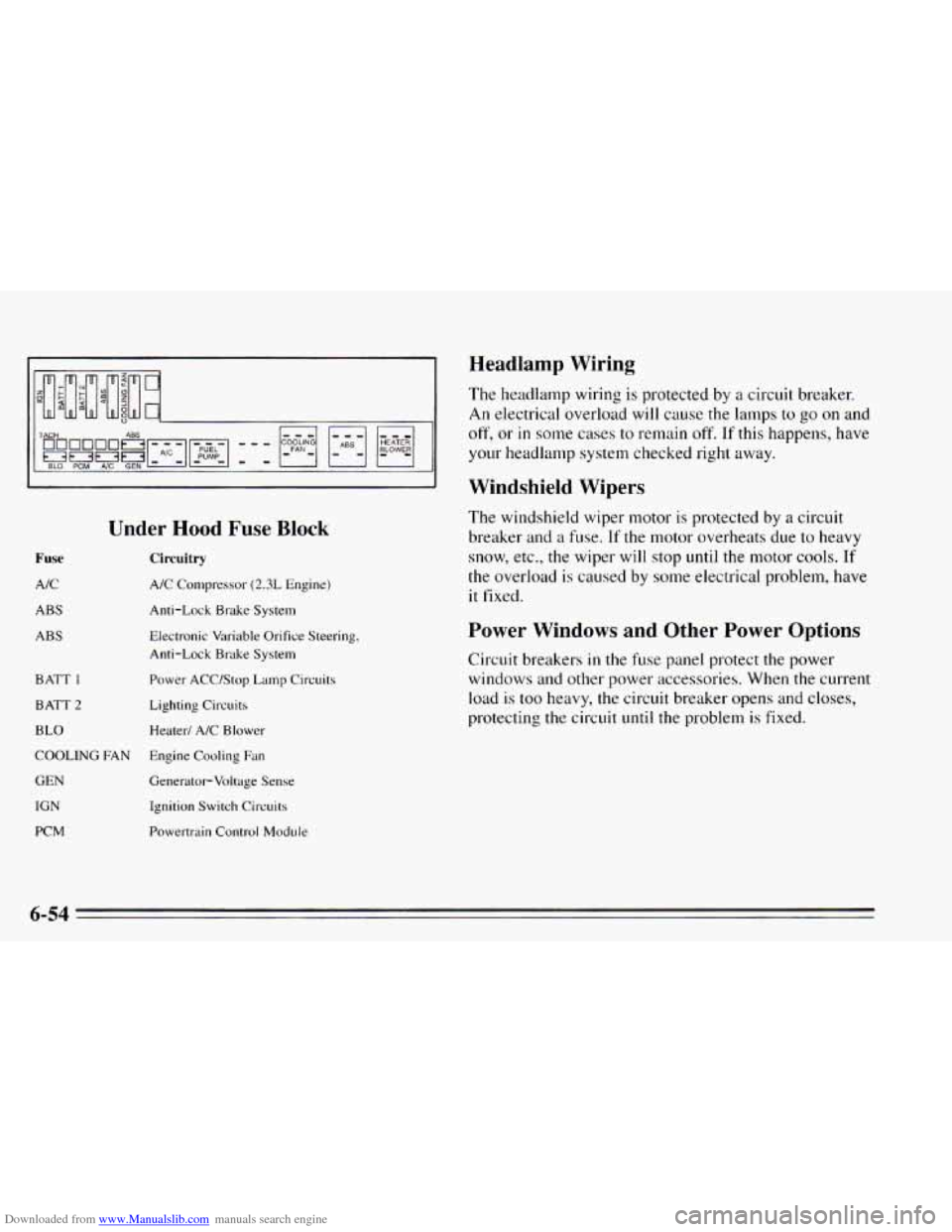
Under Hood Fuse Block
Fuse
AIC
ABS
ABS
BATT 1
BATT 2
BLO
COOLING FAN
GEN
IGN
PCM
Circuitry
A/C Compressor (2.3L Engine)
Anti-Lock Brake System
Electronic Variable Orifice Steering,
Anti-Lock Brake System
Power ACC/Stop
Lamp Circuits
Lighting Circuits
Heater/ A/C Blower
Engine Cooling Fan
Generator-Voltage Sense
Ignition Switch Circuits
Powertrain Control Module
Headlamp Wiring
The headlamp wiring is protected by a circuit breaker.
An electrical overload will cause the lamps to go on and
off, or
in some cases to remain off. If this happens, have
your headlamp system checked right away.
Windshield Wipers
The windshield wiper motor is protected by a circuit
breaker and a fuse.
If the motor overheats due to heavy
snow, etc., the wiper will stop until the motor cools. If
the overload is caused by some electrical problem, have
it fixed.
Power Windows and Other Power Options
Circuit breakers in the fuse panel protect the power
windows and other power accessories. When the current
load is too heavy, the circuit breaker
opens and closes,
protecting the circuit
until the problem is fixed.