1995 CHEVROLET CAVALIER flat tire
[x] Cancel search: flat tirePage 202 of 340
Downloaded from www.Manualslib.com manuals search engine ~ Don’t try
to put a wheel cover on your compact spare
~ tire, It won’t fit. Store the wheel cover and plastic cap ! nuts in the trunk or rear area until you have the flat tire
repaired or replaced.
NOTICE:
Wheel covers won’t fit on your compact spare. If
you try to put a wheel cover on your compact
spare, you could damage the cover or the spare.
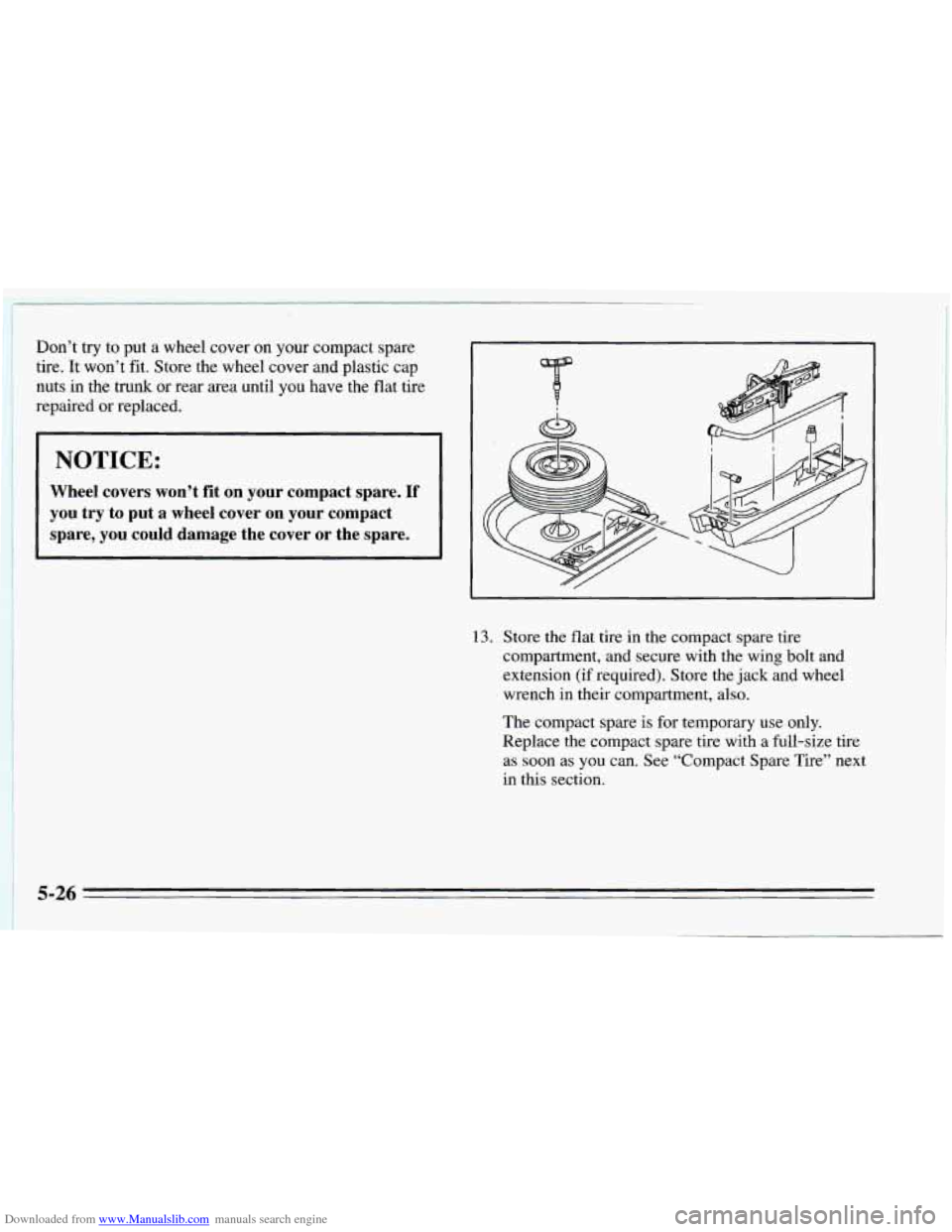
13. Store the flat tire in the compact spare tire
compartment, and secure with the wing bolt and
extension (if required). Store the jack and wheel
wrench in their compartment, also.
The compact spare is for temporary use only.
Replace the compact spare tire with a full-size tire
as soon as you can. See “Compact Spare Tire” next
in this section.
5-26
Page 203 of 340
Downloaded from www.Manualslib.com manuals search engine I NOTICE:
Compact Spare Tire
Although the compact spare was fully inflated when
your vehicle was new, it can lose air after a time. Check
the inflation pressure regularly. It should be
60 psi
(420 Pa). After installing the compact spare on your
vehicle, you should stop
as soon as possible and make
sure your spare tire is correctly inflated. The compact
spare
is made to perform well at posted speed limits for
distances up
to 3,000 miles (5 000 km), so you can
finish your trip and have your full-size tire repaired or
replaced where you want. Of course,
it’s best to replace
your spare with a full-size tire as soon as you can. Your
spare will last longer and be in good shape in case you
need
it again.
Don’t take your compact spare through an
automatic car wash with guide rails. The
compact spare can get caught on the rails. That
can damage the tire and wheel, and maybe other
parts
of your vehicle.
Don’t use your compact spare on some other vehicle.
And don’t mix your compact spare or wheel with other
wheels or tires. They won’t fit. Keep your spare and its
wheel together.
NOTICE:
Tire chains won’t fit your compact spare. Using
them will damage your vehicle and destroy the
chains too. Don’t use tire chains on your compact
spare.
5-27
Page 238 of 340
Downloaded from www.Manualslib.com manuals search engine Inflation - Tire Pressure
The Tire-Loading Information label which is on the rear
edge
of the driver’s door shows the correct inflation
pressures for your tires, when they’re cold. “Cold”
means your vehicle has been sitting for at least three
hours or driven
no more than a mile.
NOTICE:
Don’t let anyone tell you that underinflation or
overinflation is all right. It’s not. If your tires
don’t have enough air (underinflation) you can
get:
Too much flexing
Too much heat
Tire overloading
Bad wear
Bad handling
Bad fuel economy.
NOTICE: (Continued) NOTICE:
(Continued)
If your tires have too much air (overinflation),
you can get:
Unusual wear
Bad handling
0 Rough ride
Needless damage from road hazards.
When to Check
Check your tires once a month or more.
Don’t forget your compact spare tire.
It should be at
60 psi (420 kPa).
How to Check
Use a good quality pocket-type gage to check tire
pressure. Simply looking at the tires will not tell
you the
pressure, especially if you have radial tires
-- which
may look properly inflated even if they’re underinflated.
If your tires have valve caps, be sure to put them back
on. They help prevent leaks by keeping
out dirt and
moisture.
6-34
Page 239 of 340
Downloaded from www.Manualslib.com manuals search engine Tire Inspection and Rotation
Tires should be inspected every 6,000 to 8,000 miles
(10 000 to 13 000 km) for any signs of unusual wear. If
unusual wear is present, rotate your tires as soon
as
possible and check wheel alignment. Also check for
damaged tires or wheels. See “When It’s Time for New
Tires” and “Wheel Replacement” later in this section for
more information.
The purpose of regular rotation is to achieve more
uniform wear for all tires on the vehicle. The first
rotation is the most important. See “Scheduled
Maintenance Services” in the Index for scheduled
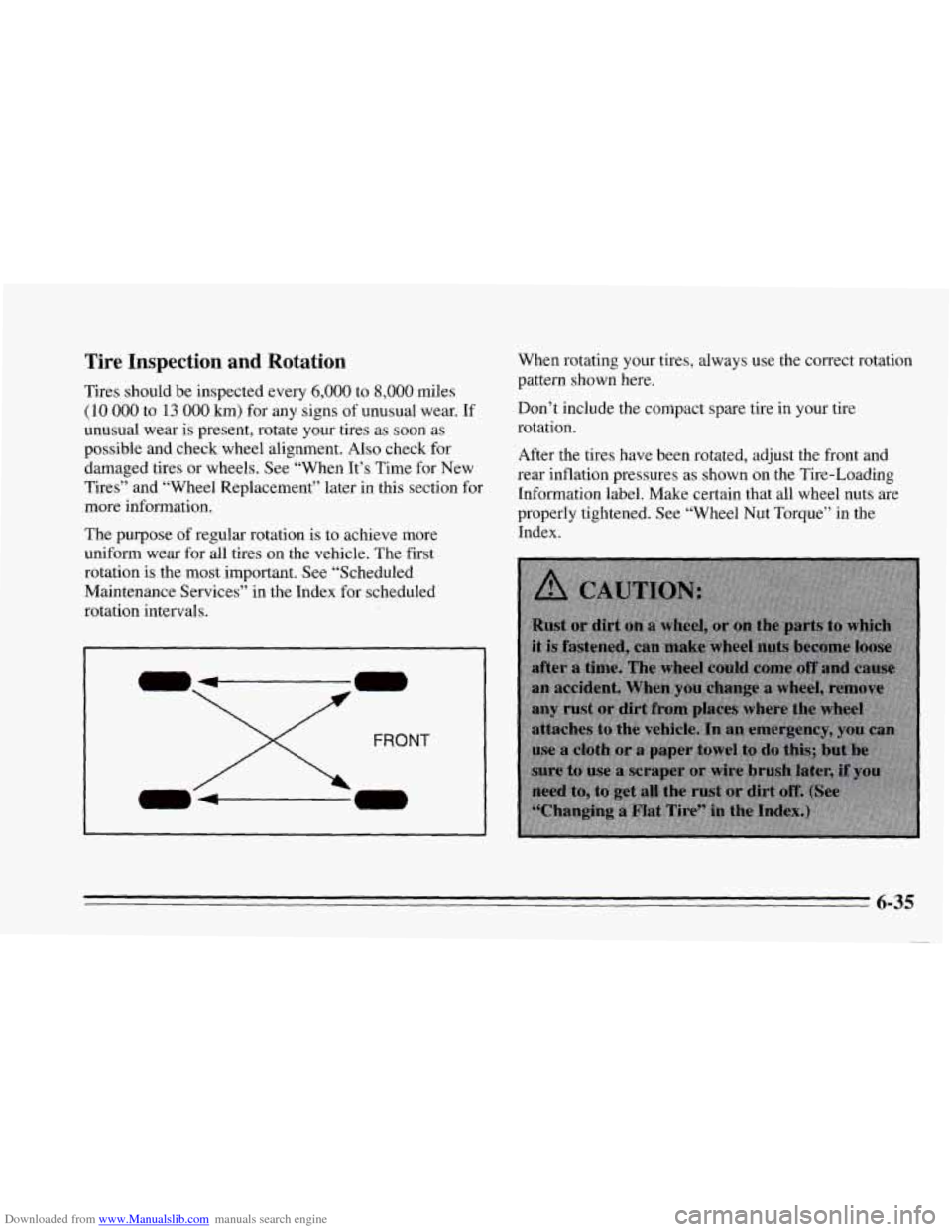
rotation intervals. When
rotating your tires, always use the correct rotation
pattern shown here.
Don’t include the compact spare tire in your tire
rotation.
After the tires have been rotated, adjust the front and
rear inflation pressures as shown on the Tire-Loading
Information label. Make certain that all wheel nuts are
properly tightened. See “Wheel Nut Torque” in the
Index.
FRONT
6-35
Page 243 of 340
Downloaded from www.Manualslib.com manuals search engine Temperature - A, B, C
The temperature grades are A (the highest), B, and C,
representing the tire’s resistance to the generation of
heat and its ability to dissipate heat when tested under
controlled conditions
on a specified indoor laboratory
test wheel. Sustained high temperature can cause the
material
of the tire to degenerate and reduce tire life, and
excessive temperature can lead
to sudden tire hilure.
The grade
C corresponds to a level of performance
which all passenger car tires must meet under the
Federal Motor Vehicle Safety Standard
No. 109. Grades
B and A represent higher levels of performance on the
laboratory test wheel than the minimum required by law.
Wdrning: The temperature grade for this tire
is
established for a tire that is properly inflated and not
overloaded. Excessive speed, underinflation, or
excessive loading, either separately or
in combination,
can cause heat buildup and possible tire failure.
These grades are molded on the sidewalls of passenger
car tires. While the tires
available as standard
or optional
equipment
on General Motors vehicles may vary with
respect to these grades, all such tires meet General
Motors performance standards and
have been approved
for use
on General Motors vehicles. All passenger type
(P Metric) tires must conform to Federal safety
requirements
in addition to these grades.
Wheel Alignment and Tire Balance
The wheels on your vehicle were aligned and balanced
carefully at the hctory to give
you the longest tire life
and best overall performance.
In most cases, you will not need to have your wheels
aligned again. However, if
you notice unusual tire wear
or your vehicle pulling one way or the other, the
alignment may need to be reset.
If you notice your
vehicle vibrating when driving
on a smooth road, your
wheels may need to be rebalanced.
6-39
Page 263 of 340
Downloaded from www.Manualslib.com manuals search engine a Section 7 Maintenance Schedule
I
LE
IMPORTANT:
KEEP ENGINE OIL
AT THE PROPER
!VEL AND CHANGE
RECOMMENDED AS
This section covers the maintenance required for your
Chevrolet. Your vehicle needs these services
to retain its
safety, dependability and emission control performance.
Introduction
Your Vehicle and the Environment
Proper vehicle maintenance not only helps to keep your
vehicle
in good working condition, but also helps the
environment.
All recommended maintenance procedures
are important. Improper vehicle maintenance or the
removal
of important components can significantly
affect the quality of the air we breathe. Improper fluid
levels or even the wrong tire inflation can increase the
level of emissions from your vehicle.
To help protect our
environment, and to help keep your vehicle in good
condition, please maintain your vehicle properly.
7-1
Page 300 of 340
Downloaded from www.Manualslib.com manuals search engine Part B: Owner Chews and Services
Listed below are owner checks and services which
should be performed at the intervals specified to help
ensure the safety, dependability and emission control
performance of your vehicle.
Be sure any necessary repairs are completed at once.
Whenever any fluids or lubricants are added
to your
vehicle, make sure
they are the proper ones, as shown in
Part D.
At Each Fuel Fill
It is important for you or a service station attendant to
pe$orm these underhood checks at each fuel fill.
Engine Oil Level Windshield Washer Fluid Level
Check the windshield washer fluid level
in the
windshield washer tank and add the proper fluid
if
necessary. See “Windshield Washer Fluid” in the Index
for further details.
At Least Once a Month
Tire Inflation
Check tire inflation. Make sure tires are inflated to the
pressures specified on the Tire-Loading Information
label located
on the rear edge of the driver’s door. See
“Tires”
in the Index for further details.
Cassette Deck
Clean cassette deck. Cleaning should be done every
50 hours of tape play. See “Audio Systems’’ in the Index
for further details.
Check the engine oil level
and add the proper oil if
necessary. See “Engine Oil” in the Index for further
details.
At Least Twice a Year
Engine Coolant Level
Check the engine coolant level and add the proper
coolant mix if necessary. See “Coolant”
in the Index for
further details.
Hydraulic Clutch System Inspection
Check the fluid level in the clutch reservoir. See
“Hydraulic Clutch Fluid“ in the Index.
A fluid loss in
this system could indicate
a problem. Have the system
inspected and repaired at once.
7-38
Page 314 of 340
Downloaded from www.Manualslib.com manuals search engine Roadside offers two levels of service to the customer,
Basic Care and Cuurtesy '" Care:
ROADSIDE Basic Care PROVIDES:
Toll-free number, 1 -800-CHEV-USA
Free towing for warranty repairs
Basic over-the-phone technical advice
Available dealer services at reasonable costs
(i.e., wrecker services, locksmith/key service, glass
repair, etc.)
Note: Roadside
Basic Care applies to all Chevrolet/Geo
vehicles regardless
of age or miles.
ROADSIDE
Courtesy Care PROVIDES:
Roadside Basic Care services (as outlined above)
Plus:
FREE Non-Warranty Towing (to the closest dealer
from a legal roadway)
on the road or locked inside)
FREE Locksmith/Key Service (when keys are lost
FREE Flat Tire Service (spare installed on the road)
FREE Jump Start (at home or on the road)
0 FREE Fuel Delivery ($5 of fuel delivered on the road)
Note:
Courtesy Cure is available to Retail and Retail
Lease Customers operating
1994 and newer
Chevrolet/Geo vehicles for
a period of 36
months/36,000 miles. All
Courtesy Care services must
be pre-arranged by Chevrolet Roadside or Dealer
Service Management.
Basic Cure and Courtes!: Cm-e are not part of or included in the coverage
provided by the New Vehicle Limited Warranty. Chevrolet reserves the
right
to modify or discontinue Basic Care and Courtesy at any time.
For complete program details, see your Chevrolet/Geo
dealer to obtain a Roadside Assistance Center brochure.
The Roadside Assistance Center uses companies that will provide you with quality and priority service. When roadside
services are required,
our advisors will explain any payment
obligations that may
be incurred for utilizing outside services.
For prompt assistance when calling, please have
the
following information available to give to the advisor:
0 Vehicle Identification Number
0 License plate number
8-6