1995 CHEVROLET BLAZER turn signal
[x] Cancel search: turn signalPage 9 of 380
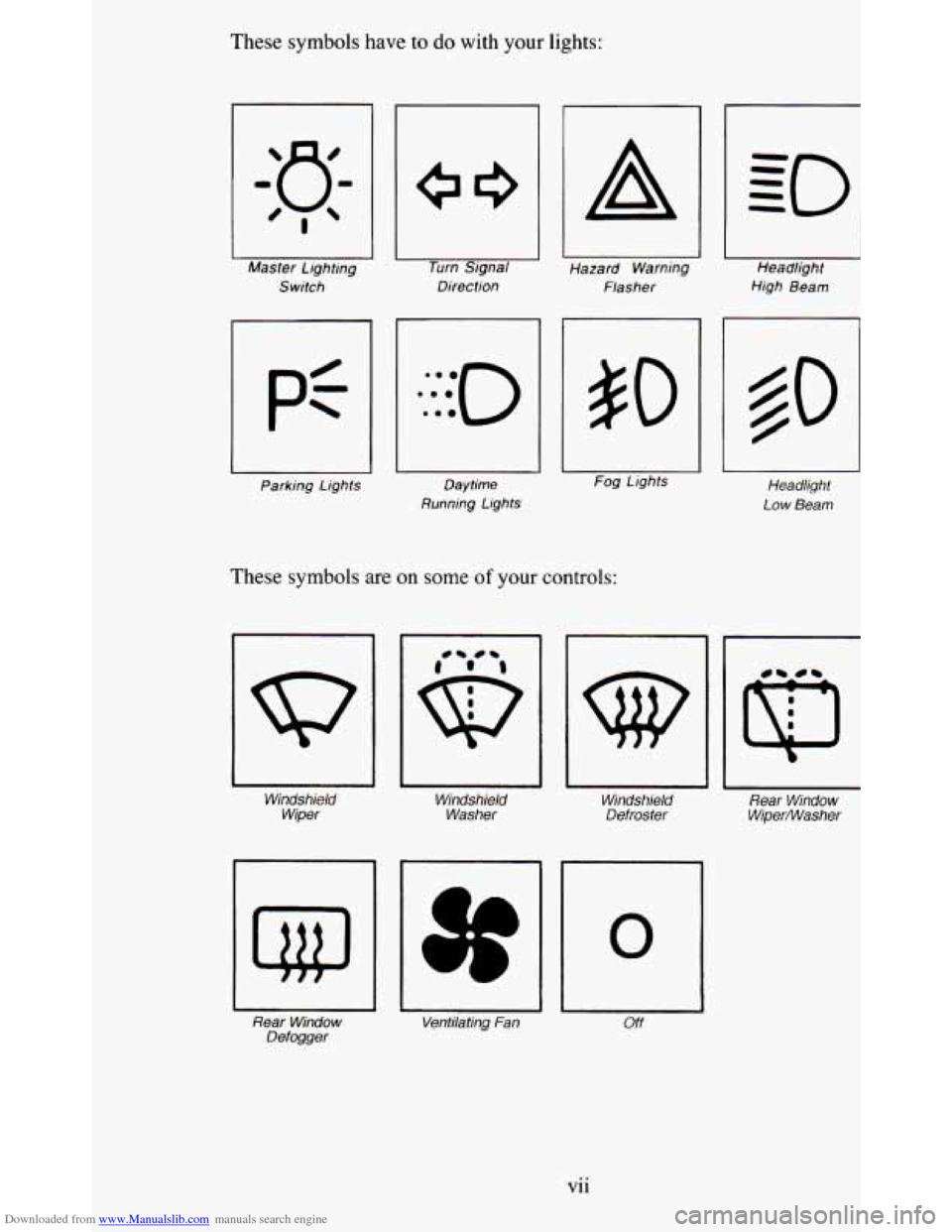
Downloaded from www.Manualslib.com manuals search engine These symbols have to do with your lights:
Master Lighting
Switch
I
Parking Lights
- Turn Signal Direction
Daytime
Running Lights
A
Hazard Warning
Rasher
I Fog Lights
These symbols are on some of your controls:
Windshield
Wiper
Rear Window Defogger
Q
0* ew
Windshield Washer
Ventilating Fan
I
Windshield Defroster
0
c Off
Heaulight
High
Beam
Headlight
Low Beam
0% 0%
Rear Window
WiperMasher
vii
Page 89 of 380
Downloaded from www.Manualslib.com manuals search engine Multifunction Lever
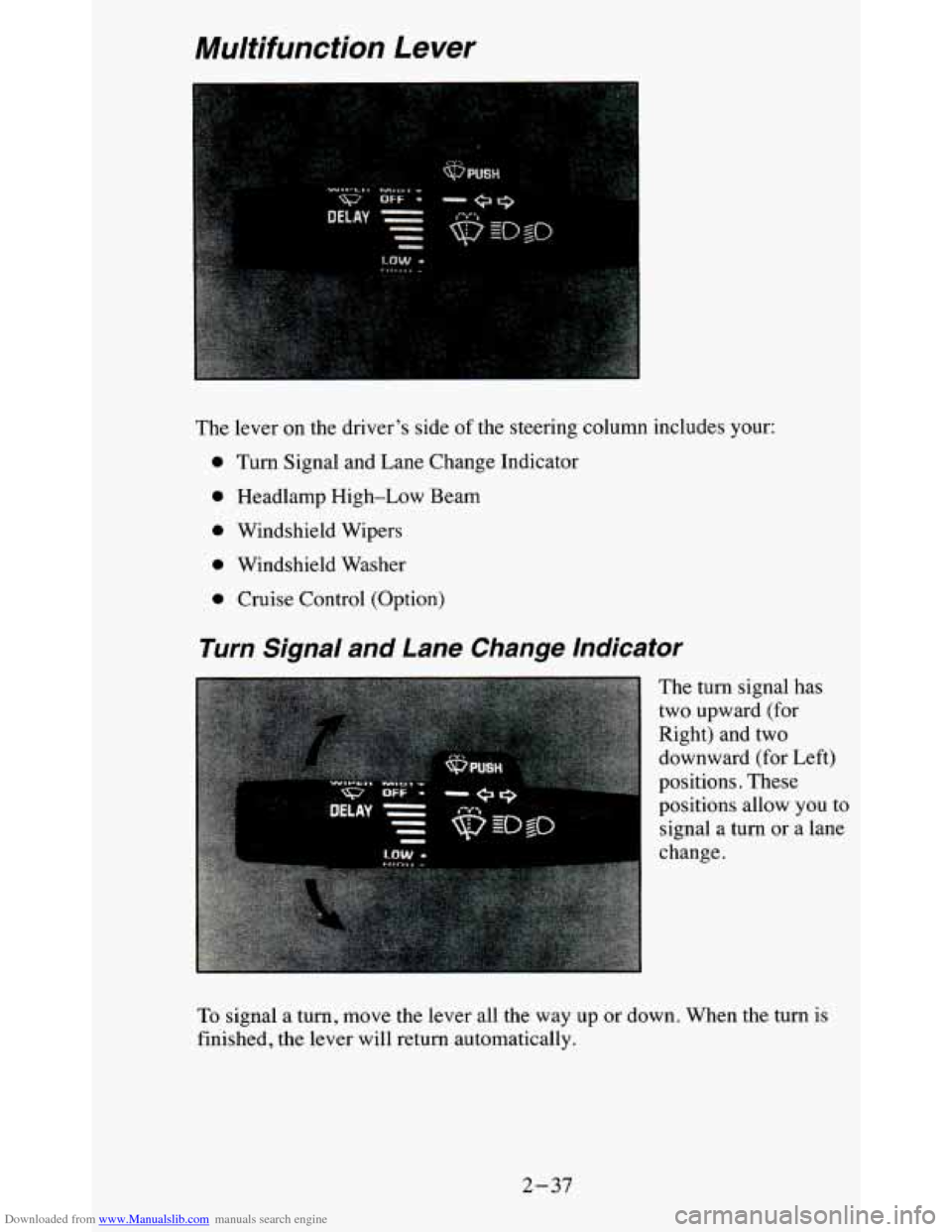
The lever on the driver’s side of the steering column includes your:
0 Turn Signal and Lane Change Indicator
0 Headlamp High-Low Beam
0 Windshield Wipers
0 Windshield Washer
0 Cruise Control (Option)
Turn Signal and Lane Change Indicator
The turn signal has
two upward (for
Right) and two
downward (for Left)
positions. These
positions allow you to
signal a turn or a lane
change
.
To signal a turn, move the lever all the way up or down. When the turn is
finished, the lever will return automatically.
2-37
Page 90 of 380
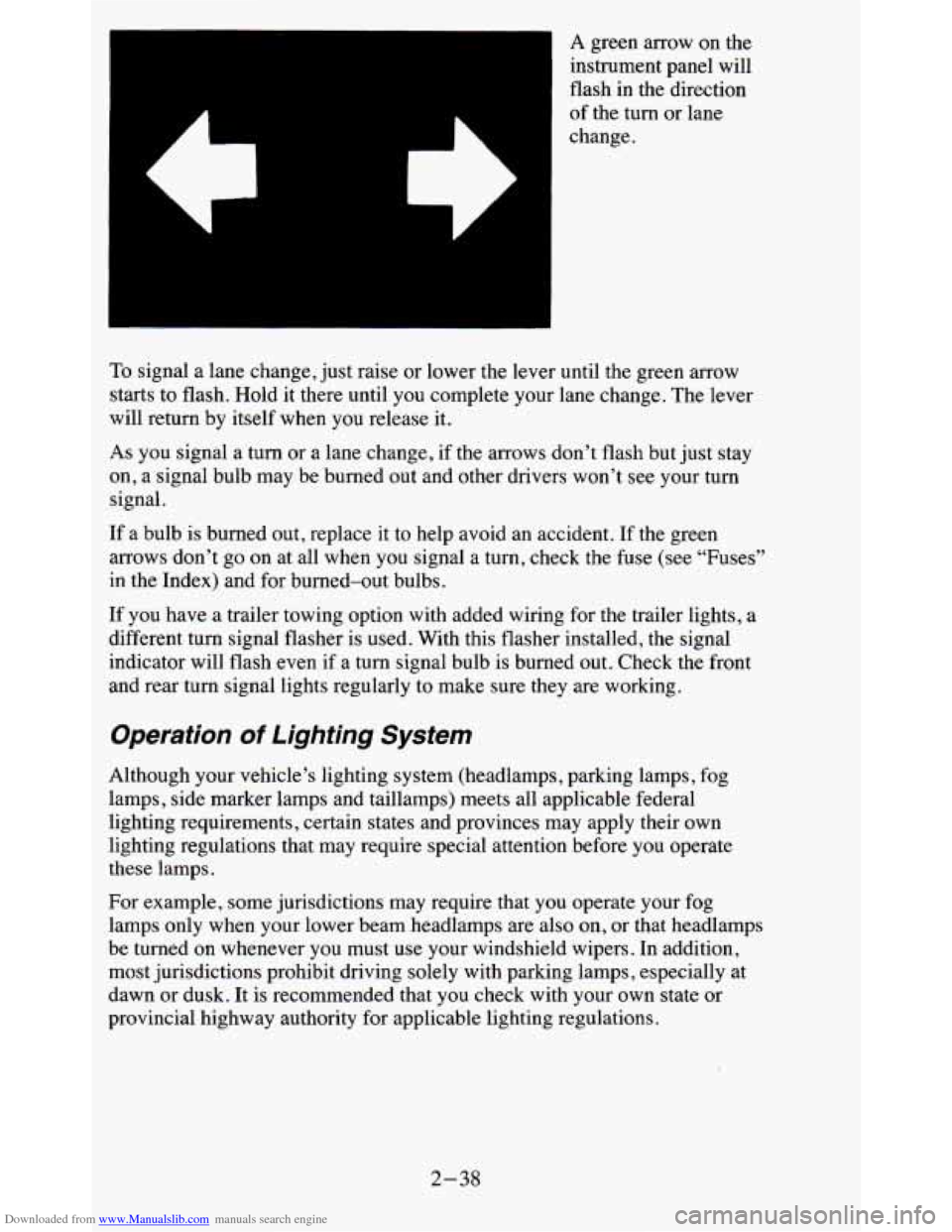
Downloaded from www.Manualslib.com manuals search engine A green arrow on the
instrument panel will
flash
in the direction
of the turn or lane
change.
To signal a lane change, just raise or lower the lever until the green arrow
starts to flash. Hold it there until you complete your lane change. The lever
will return by itself when you release it.
As you signal a turn or a lane change, if the arrows don’t flash but just stay
on, a signal bulb may be burned out and other drivers won’t see your turn
signal.
If a bulb is burned out, replace it to help avoid an accident. If the green
arrows don’t go on at all when
you signal a turn, check the fuse (see “Fuses”
in the Index) and for burned-out bulbs.
If you have a trailer towing option with added wiring for the trailer lights, a
different turn signal flasher is used. With this flasher instal\
led, the signal
indicator will flash even if
a turn signal bulb is burned out. Check the front
and rear turn signal lights regularly to make sure they are w\
orking.
Operation of Lighting System
Although your vehicle’s lighting system (headlamps, parking lamps, fog
lamps, side marker lamps and taillamps) meets all applicable federal
lighting requirements, certain states and provinces may apply their own
lighting regulations that may require special attention before you operate
these lamps.
For example, some jurisdictions may require that you operate your fog
lamps only when your lower beam headlamps are also on,
or that headlamps
be turned on whenever you must use your windshield wipers. In \
addition,
most jurisdictions prohibit driving solely with parking lamps, especially at
dawn or dusk. It is recommended that you check with your own state or
provincial highway authority for applicable lighting regulations.
2-38
Page 123 of 380
Downloaded from www.Manualslib.com manuals search engine The brake system warning light will also come on when you set your
parking brake, and it will stay on
if your parking brake doesn’t release fully.
If it stays
on after your parking brake is fully released, it means you have a
brake problem.
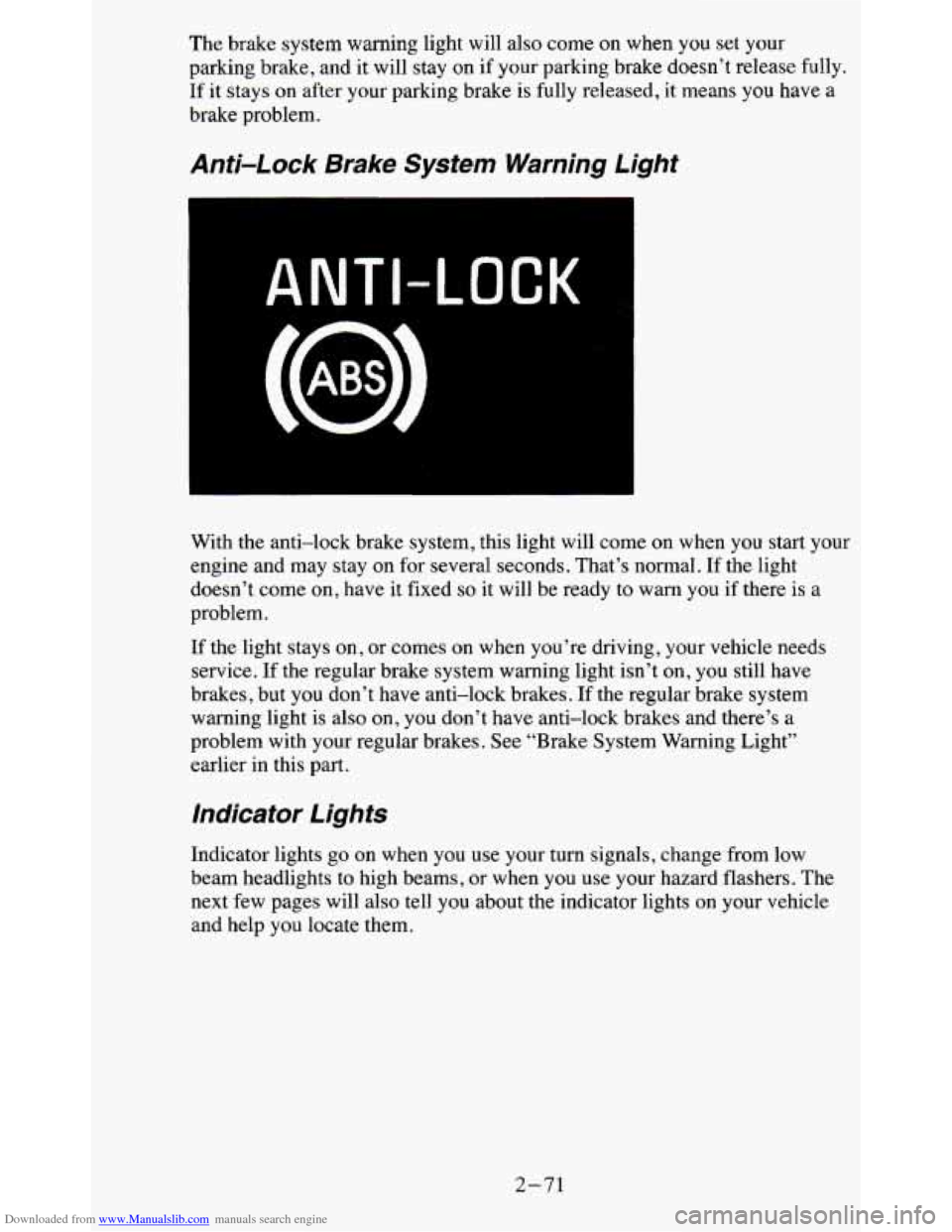
Anti-Lock Brake System Warning Light
ANTI-LOCK
With the anti-lock brake system, this light will come on when you start your
engine and may stay on for several seconds. That’s normal. If the light
doesn’t come on, have it fixed
so it will be ready to warn you if there is a
problem.
If the light stays on, or comes on when you’re driving, your vehicle needs
service. If the regular brake system warning light isn’t on, you still have
brakes, but you don’t have anti-lock brakes.
If the regular brake system
warning light is also on, you don’t have anti-lock brakes and there’s a
problem with your regular brakes. See “Brake System Warning Light”
earlier in this part.
Indicator Lights
Indicator lights go on when you use your turn signals, change from low
beam headlights to high beams,
or when you use your hazard flashers. The
next few pages will also tell you about the indicator lights \
on your vehicle
and help you locate them.
2-71
Page 128 of 380
Downloaded from www.Manualslib.com manuals search engine Headlamp High Beam Indicator Light
A
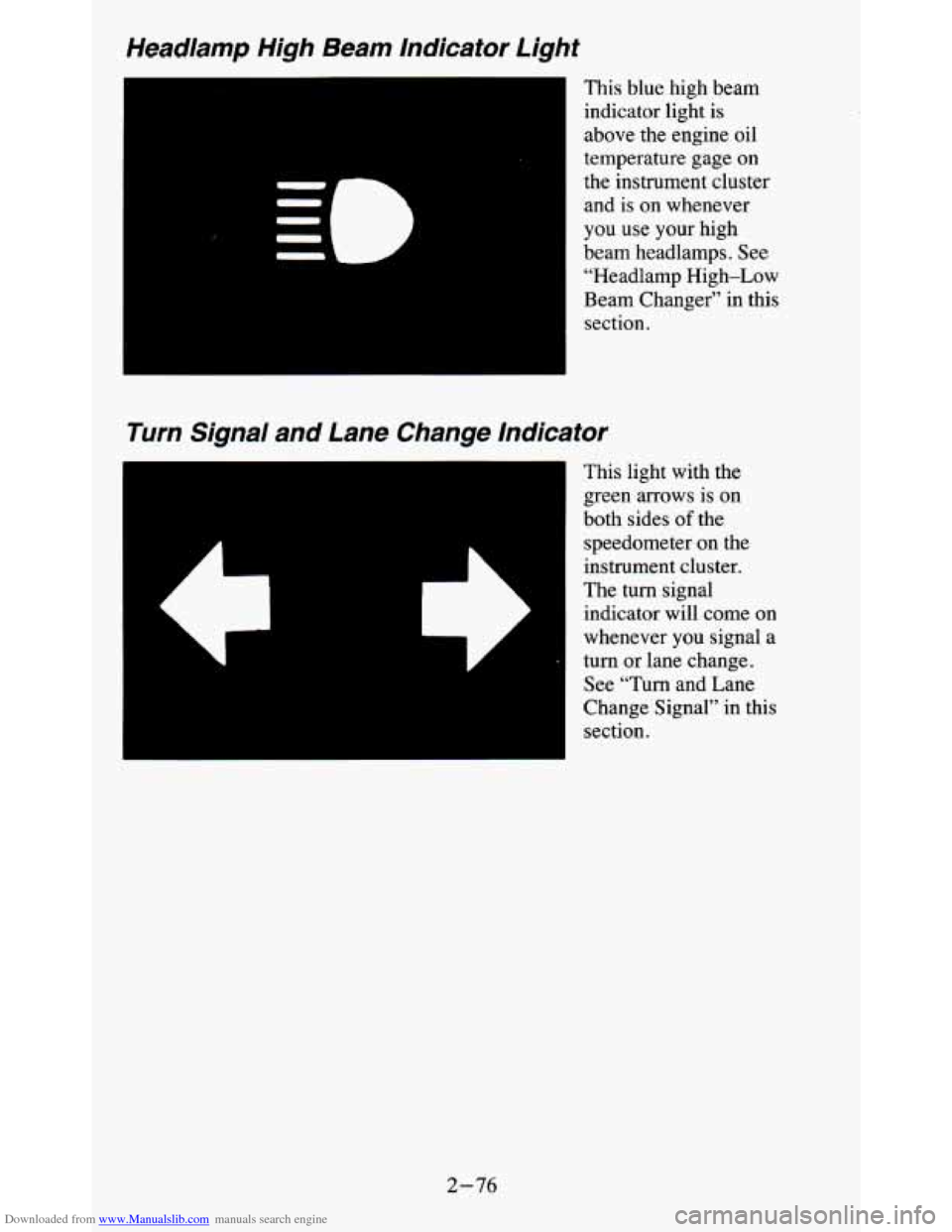
This blue high beam
indicator light is
above the engine oil
temperature gage on
the instrument cluster and is on whenever
you use your high
beam headlamps. See
“Headlamp High-Low
Beam Changer” in this
section.
Turn Signal and Lane Change lndicator
This light with the
green arrows is on
both sides
of the
speedometer
on the
instrument cluster.
The turn signal
indicator will come on
whenever you signal a
turn or lane change.
See “Turn and Lane
Change Signal” in this section.
2-76
Page 164 of 380
Downloaded from www.Manualslib.com manuals search engine So here are some tips for passing:
e
e
e
e
a
a
a
0
0
“Drive ahead.” Look down the road, to the sides, and to crossroads for
situations that might affect your passing patterns.
If you have any doubt
whatsoever about making a successful pass, wait for
a better time.
Watch for traffic signs, pavement markings, and lines. If you can see a
sign up ahead that might indicate a
turn or an intersection, delay your
pass.
A broken center line usually indicates it’s all right to pass \
(providing the road ahead is clear). Never cross a solid line
on your
side of the lane or a double solid line, even if the road seems empty of
approaching traffic.
Do not get too close to
the vehicle you want to pass while you’re
awaiting
an opportunity. For one thing, following too closely reduces
your area of vision, especially if you’re following a larger vehicle.
Also, you won’t have adequate space if the vehicle ahead suddenly
slows or stops. Keep back a reasonable distance.
When it looks like a chance to pass is coming up,
start to accelerate but
stay in the right lane and don’t get too close. Time your \
move
so you,
will be increasing speed as the time comes to move into the \
other lane.
If the way
is clear to pass, you will have a “running start” that more\
than makes up for the distance you would lose by dropping back. And
if something happens to cause you to cancel your pass, you need only
slow down and drop back again and wait for another opportunity.
If other cars are lined up to pass a slow vehicle, wait your tu\
rn. But
take care that someone isn’t trying to pass you as you pull out to pass
the slow vehicle. Remember to glance over your shoulder and check
the blind spot.
Check your mirrors, glance over your shoulder, and start your left lane
change signal before moving out
of the right lane to pass. When you
are far enough ahead
of the passed vehicle to see its front in your inside
mirror, activate your right lane change signal and move back i\
nto the
right lane. (Remember that your right outside mirror is convex. The
vehicle you just passed may seem
to be farther away from you than it
really is.)
Try not to pass more than one vehicle at a time on two-lane roads.
Reconsider before passing the next vehicle.
Don’t overtake a slowly moving vehicle too rapidly. Even tho\
ugh the
brake lamps are not flashing, it may be slowing down or start\
ing to
turn.
If you’re being passed, make it easy for the following driver to get
ahead of you. Perhaps you can ease a little to the right.
4-10
Page 169 of 380
Downloaded from www.Manualslib.com manuals search engine Surface Obstacles. Unseen or hidden obstacles can be hazardous. A rock,
log, hole, rut, or bump can startle you
if you’re not prepared for them. Often
these obstacles are hidden by grass, bushes,
snow or even the rise and fall of
the terrain itself. Here are some things to consider:
Is the path ahead clear?
Will the surface texture change abruptly up ahead?
@ Does the travel take you uphill or downhill? (There’s more discussion
of these subjects later.)
0 Will you have to stop suddenly or change direction quickly?
When you drive over obstacles or rough terrain, keep a firm grip
on the
steering wheel. Ruts, troughs, or other surface features can jerk
the wheel
out
of your hands if you’re not prepared.
When you drive over bumps, rocks, or other obstacles, your wheels can
leave the ground. If this happens, even with one or two wheels, you can’t
control the vehicle as well or
at all.
Because you will be on an unpaved surface, it’s especially important to
avoid sudden acceleration, sudden turns, or sudden braking.
In a way, off-road driving requires a different kind of alertness from driving
on paved roads and highways. There are no road signs, posted speed limits
or signal lights. You have to use your own good judgment about what is safe
and what isn’t.
Drinking and driving can be very dangerous on any road. And this
is
certainly true for off-road driving. At the very time you need special
alertness and driving skills, your reflexes, perceptions and judgment can be
affected by even a small amount of alcohol.
You could have a serious - or
even fatal - accident if you drink and drive or ride with a driver who has
been drinking. (See “Drunken Driving” in the Index.)
Driving On Off-Road Hills
Off-road driving often takes you up, down, or across a hill. Driving safely
on hills requires good judgment and an understanding of what your vehicle
can and can’t do. There are some hills that simply can’t be driven, no matter
how well built the vehicle.
4- 15
Page 179 of 380

Downloaded from www.Manualslib.com manuals search engine you are faced with severe glare (as from a driver who doesn’t lower the high
beams, or a vehicle
with misaimed headlights), slow down a little. Avoid
staring directly into the approaching lights.
Keep your windshield and all the glass on your vehicle clean
- inside and
out. Glare at night is made much worse by dirt on the glass. Even the inside
of the glass can build up
a film caused by dust. Dirty glass makes lights
dazzle and flash more than clean glass would, making the pupils
of your
eyes contract repeatedly.
Remember that your headlights light up far less
of a roadway when you are
in a turn or curve. Keep your eyes moving; that way, it’s easier to pick out
dimly lighted objects. Just as your headlights should be checked regularly
for proper aim,
so should your eyes be examined regularly. Some drivers
suffer from night blindness
- the inability to see in dim light - and aren’t
even aware of it.
Driving in the Rain
Rain and wet roads can mean driving trouble. On a wet road y\
ou can’t stop,
accelerate or turn as well because your tire-to-road traction isn’t as good as
on dry roads. And, if your tires don’t have much tread left, you’ll get even
less traction. It’s always wise to go slower and be cautious
if rain starts to
fall while you are driving. The surface may get wet suddenly when your
reflexes are tuned for driving on dry pavement.
The heavier the rain, the harder it is to see. Even
if your windshield wiper
blades are in good shape,
a heavy rain can make it harder to see road signs
and traffic signals, pavement markings, the edge
of the road, and even
people walking.
It’s wise to keep your wiping equipment in good shape and keep your
windshield washer tank filled. Replace your windshield wiper inserts when
they show
signs of streaking or missing areas on the windshield, or when
strips of rubber start
to separate from the inserts.
4-25