1995 CHEVROLET BLAZER check engine
[x] Cancel search: check enginePage 301 of 380
Downloaded from www.Manualslib.com manuals search engine Headlamps
The headlamp wiring is protected by a circuit breaker in the light switch. An
electrical overload will cause the lights to go on and off, or in some cases to
remain
off. If this happens, have your headlamp wiring checked right away.
Windshield Wipers
The windshield wiper motor is protected by a circuit breaker and a fuse. If
the motor overheats due to heavy snow, etc., the wiper will stop until the
motor cools. If the overload is caused by some electrical problem and not
snow, etc., be sure to get it fixed.
Power Windows and Other Power Options
Circuit breakers in the fuse panel protect the power windows and other
power accessories. When the current load is too heavy, the cir\
cuit breaker
opens and closes, protecting the circuit until the problem is fixed.
Trailer Wiring Harness
The optional seven-wire trailer wiring harness is protected by an in-line
fuse in the battery feed wire. This fuse is near the junction block in the
front, driver’s side fender. See “Trailer Wiring Harness” in the
Features &
Controls section.
Fuse B/ock
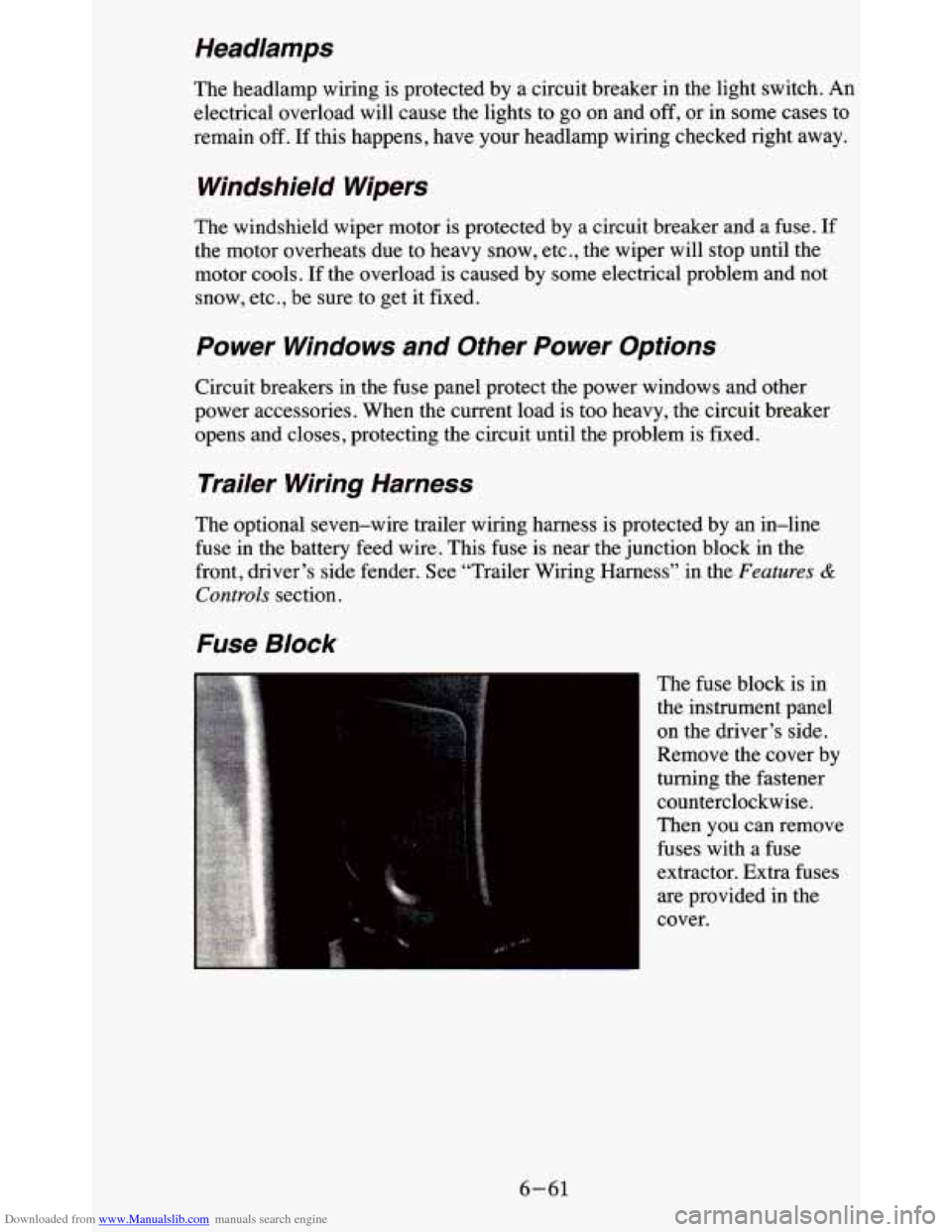
The fuse block is in
the instrument panel
on the driver’s side.
Remove the cover by
turning the fastener
counterclockwise.
Then you can remove
fuses with a fuse
extractor. Extra fuses
are provided in the
cover.
6-61
Page 303 of 380
Downloaded from www.Manualslib.com manuals search engine Wheel Nut Torque
DESCRIPTION
Base or Optional Wheel
Cooling System Capacity
ENGINE VIN CODE
4.3L
W
TORQUE
95 ft.
lbs. ( 130 Nom)
QUANTITY*
12.1 Quarts
(1 1.5 Liters)
*All quantities are approximate. After refill, the level MUST be checked.
Crankcase Capacity
ENGINE
4.3L
VIN CODE
W
QUANTITY WITH
FILTER*
4.5 Quarts (4.3 Liters)
*All quantities are approximate. After refill, the level MUST be checked.
Do not overfill.
Fuel Tank Capacity
TYPE
2-Door Models
4-Door Models
QUANTITY*
20 Gallons (76 Liters)
19 Gallons (72 Liters)
*All quantities are approximate.
6-63
Page 305 of 380
Downloaded from www.Manualslib.com manuals search engine Instrument Cluster Lamps
NOTE: A PC part number indicates that the bulb and base are one
assembly and must be replaced as such.
Anti-lock Brake
Warning Indicator
Brake System Warning
Indicator
Check Gages Indicator
Daytime Running
Lamps Indicator
Charging System
Indicator
High Beam Indicator
Instrument Cluster
Illumination
Malfunction Indicator
Lamp (SERVICE
ENGINE
SOON)
Seat Belt Indicator
Turn Signal Indicator
Upshift Indicator
AIR BAG Indicator
1
1
1
1
1
1
6
1
1
2
1
1
PC74
PC74
PC74 PC74
PC74
PC74
PC168
PC74
PC 194
PC74 PC74
See
GM Dealer
6-65
Page 314 of 380
Downloaded from www.Manualslib.com manuals search engine How This Section is Organized
The remainder of this section is divided into five parts:
“Part A: Scheduled Maintenance Services” shows what to have done and
how often. Some
of these services can be complex, so unless you are
technically qualified and have the necessary equipment, you should let your
dealer’s service department
or another qualified service center do these jobs.
If you are skilled enough to do some work on your vehicle, you will
probably want to get the service information
GM publishes. You will find a
list of publications and how to get them in this manual. See “Service
Publications” in the Index.
“Part B: Owner Checks and Services” tells you what should be checked
whenever
you stop for fuel. It also explains what you can easily do to help
keep your vehicle in good condition.
“Part C: Periodic Maintenance Inspections” explains important
inspections that your
GM dealer’s service department or another qualified
service center should perform.
“Part D: Recommended Fluids and Lubricants” lists some products GM
recommends to help keep your vehicle properly maintained. These \
products,
or their equivalents, should be used whether you do the work yourself or
have it done.
“Part E: Maintenance Record’ provides a place for you to record the
maintenance performed on your vehicle. Whenever any maintenance is
performed, be sure to write it down
in this part. This will help you
determine when your next maintenance should be done. In addition, it is a
good idea to keep your maintenance receipts. They may be needed to
qualify your vehicle
for warranty repairs.
7-2
Page 315 of 380
Downloaded from www.Manualslib.com manuals search engine Part A: Scheduled Maintenance Services
Using Your Maintenance Schedule
We at General Motors want to help you keep your vehicle in good working
condition. But we don’t know exactly how you’ll drive it. You may drive
very short distances only a few times a week. Or you may drive long
distances all the time in very hot, dusty weather.
You may use your vehicle
in making deliveries. Or you may drive it
to work, to do errands or in many
other ways.
Because of all the different ways people use their GM vehicles, maintenance
needs
vary. You may even need more frequent checks and replacements than
you’ll find in the schedules in this section.
So please read this section and
note how you drive. If you have any questions on how to keep your vehicle
in good condition, see you GM dealer.
This part tells you the maintenance services
you should have done and when
you should schedule them. If you
go to your dealer for your service needs,
you’ll know that GM-trained and supported service people will\
perform the
work using genuine GM parts.
The proper fluids and lubricants to use are listed in Part
D. Make sure
whoever services your vehicle uses these. All parts should be \
replaced and
all necessary repairs done before you or anyone else drives the vehicle.
These schedules are for vehicles that:
carry passengers and cargo within recommended limits. You will find
these limits on your vehicle’s CertificationEire label. See “Loading
Your Vehicle’’
in the Index.
are driven on reasonable road surfaces within legal driving limits.
are driven off-road in the recommended manner. See “Off Road
Driving With Your Four-wheel Drive Vehicle” in the Index.
use the recommended unleaded fuel. See “Fuel” in the Index.
Selecting the Right Schedule
First you’ll need to decide which of the two schedules is right for your
vehicle. Here’s how to decide which schedule to follow:
7-3
Page 317 of 380
Downloaded from www.Manualslib.com manuals search engine Every 60,000 Miles (100 000 km)
Engine Accessory Drive Belt Inspection
Spark Plug Wire Inspection
Engine Timing Check
Fuel Tank, Cap and Lines Inspection
Follow Schedule I1
only if none of the conditions from Schedule I is true.
I Schedule // /nterva/s
Every 7,500 Miles (12 500 km)
Engine Oil and Filter Change (or every 12 months)
Chassis Lubrication (or every 12 months)
Drive Axle Service
At 7,500 Miles ( 12 500 km) - Then Every 15,000 Miles (25 000 km)
Tire Rotation
Every 30,000 Miles (50 000 km)
Cooling System Service (or every 24 months)
Spark Plug Replacement
Fuel Filter Replacement
Air Cleaner Filter Replacement
Front Wheel Bearing Repack (2-Wheel Drive Only)
Every 50,000 Miles (83 000 km)
Automatic Transmission Service (severe conditions)
Every 60,000 Miles (100 000 km)
Spark Plug Wire Inspection
Engine Accessory Drive Belt Inspection
Fuel Tank, Cap and Lines Inspection
Engine Timing Check
7-5
Page 318 of 380
Downloaded from www.Manualslib.com manuals search engine I Maintenance Schedule I
The services shown in this schedule up to 100,000 miles (166 000 km)
should be performed after 100,000 miles (166 000 km) at the same intervals.
Footnotes
? The California Air Resources Board has determined that the failure to
perform this maintenance item will not nullify the emission warranty or
limit recall liability prior to the completion of vehicle useful life. We,
however, urge that all recommended maintenance services be performed at
the indicated intervals and the maintenance be recorded in “\
Section
E:
Maintenance Record.”
** Drive axle service:
0
0
0
Locking Differential - Drain fluid and refill at first engine oil change.
At subsequent oil changes, check fluid level and add fluid as needed.
If
driving in dusty areas or towing a trailer, drain fluid and refill every
15,000 miles (25
000 km).
Standard Differential
- Check fluid level and add fluid as needed at
every oil change. If driving in dusty areas or towing
a trailer, drain
fluid and refill
every 15,000 miles (25 000 km) .
More frequent lubrication may be required for heavy-duty or off-road
use.
3,000 Miles (5 000 km)
0
0
Change engine oil and filter (or every 3 months, whichever occurs
first).
An Emission Control Service.
Lubricate the front suspension, ball joints (ball joints should not be
lubricated unless their temperature is 10°F (-1 2°C) or higher. When
the weather is cold, let them warm up before lubricating them
or they
could be damaged.), steering linkage and transfer case shift linkage,
parking brake cable guides, propshaft splines, universal joints, brake
pedal springs, and clutch pedal springs at every
oil change (or every 6
months
, whichever occurs first).
Check readfront axle fluid level and add fluid as needed. Check
constant velocity joints and axle seals for leaking.
**
I DATE I ACTUALMILEAGE I SERVICED BY:
7-6
Page 319 of 380
Downloaded from www.Manualslib.com manuals search engine I Maintenance Schedule I
6,000 Miles (70 000 km)
0 Change engine oil and filter (or every 3 months, whichever occurs
0 Lubricate the front suspension, ball joints (ball joints should not be
first).
An Emission Control Service.
lubricated unless their
temperature is 10°F (-12°C) or higher. When
the weather is cold, let them warm up before lubricating them
or they
could be damaged.), steering linkage and transfer case shift linkage,
parking brake cable guides, propshaft splines, universal joints, brake
pedal springs, and clutch pedal springs at every oil change (or every
6
months, whichever occurs first).
0 Check readfront axle fluid level and add fluid as needed. Check
constant velocity joints and axle seals for leaking.
**
rotation pattern and additional information.
0 Rotate tires. See “Tire Inspection and Rotation” in the Index for proper
DATE ACTUAL MILEAGE SERVICED BY ~~ -
,.
9,000 Miles (75 000 km)
0 Change engine oil and filter (or every 3 months, whichever occurs
0 Lubricate the front suspension, ball joints (ball joints should not be
first).
An Emission Control
Service.
lubricated unless their temperature is 10°F (-12°C) or higher. When
the weather is cold, let them warm up before lubricating them or they
could be damaged.), steering linkage and transfer case shift linkage,
parking brake cable guides
, propshaft splines , universal joints, brake
pedal springs, and clutch pedal springs at every oil change (or every
6
months, whichever occurs first).
0 Check readfront axle fluid level and add fluid as needed. Check
constant velocity joints and axle seals for leaking.
**
DATE
SERVICED BY: ACTUAL MILEAGE
7-7